An Unexpected Obstacle on a Snowy Harbor Road
The winter morning began peacefully along a small fishing harbor. Snow covered the surrounding wooden buildings, aluminum fishing boats rested near the waterfront, and distant seagulls called above the cold water.
Ellis, a 45-year-old man with a short salt-and-pepper beard, was driving his faded teal pickup truck along the snowy harbor road.
Wearing a mustard-colored canvas parka and a navy beanie, he appeared to be enjoying an ordinary morning near the waterfront.
However, something unusual was happening just ahead of his vehicle.
A small cream-white polar bear cub stood beside a large orange wheeled trash bin near the roadside.
Without warning, the cub placed both front paws against the bin and pushed it directly into the road.
The large container tipped forward, its plastic body rattling against the snowy surface.
Ellis immediately applied the brakes.
Slush splashed beneath the pickup’s tires as the vehicle came to a sudden stop.
The startled driver leaned toward his open window, looking directly at the little animal.
“Whoa! What are you doing?”
The polar bear cub turned its head toward him and released a soft, urgent sound.
Ellis appeared confused.
The little bear did not immediately run away. Instead, it remained nearby, looking toward the man who had just stopped his vehicle.
The orange trash bin had created an unexpected interruption to his journey, but the cub’s unusual behavior suggested that something else was happening.
Within this fictional winter adventure, the encounter would become the beginning of a remarkable rescue involving an animal that desperately needed assistance.
Ellis had no idea what was waiting for him near the waterfront.
The Little Cub Seemed to Want Him to Follow
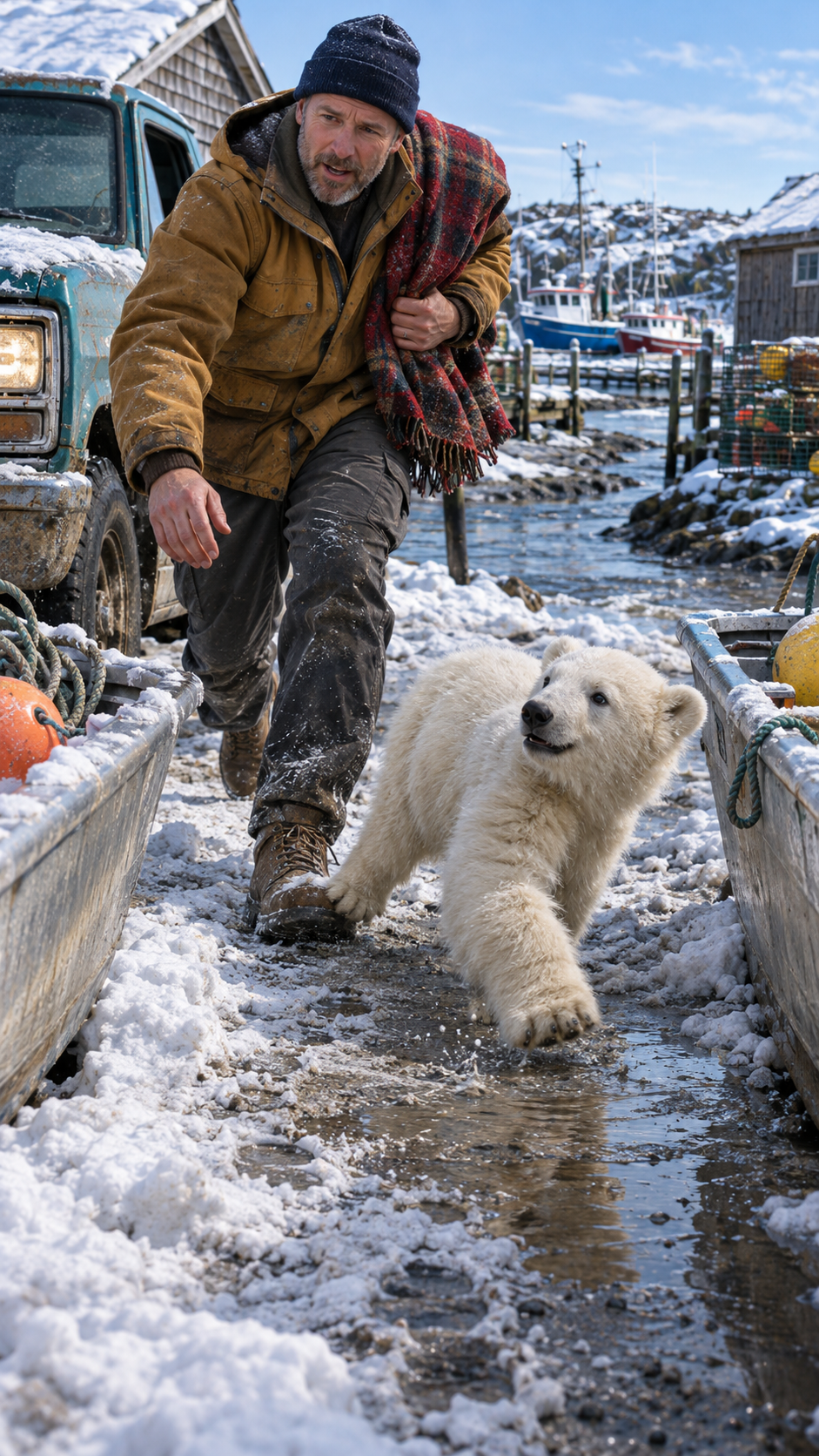
Ellis stepped outside his faded teal pickup truck.
A red plaid blanket rested over his left shoulder as he stood beside the vehicle, looking toward the small polar bear cub.
The little animal approached his brown boots and gently placed one front paw against his footwear.
Then it turned and began walking between two aluminum fishing boats positioned near the snowy harbor path.
Ellis watched its movements carefully.
The cub briefly stopped and looked backward.
Its small rounded ears, cream-white fur, and dark nose stood out against the snowy surroundings.
“Okay, little buddy. Show me.”
Ellis began following the animal.
His boots crunched against the snow as they moved between the fishing boats and toward the waterfront.
The cub released a short whimper before continuing forward.
Every few moments, its movements brought Ellis closer to the wooden harbor landing.
The surrounding environment remained peaceful despite the unusual encounter. Cold wind moved through the harbor, water flowed beneath the wooden structures, and distant activity could be heard around the fishing boats.
Ellis still carried the red plaid blanket over his shoulder.
He did not yet know why the little animal had approached him or why it had pushed the orange trash bin into the road.
The fictional narrative presents the cub’s behavior as an urgent attempt to attract his attention.
Something near the freezing water appeared to require immediate assistance.
As Ellis followed the cub toward the waterfront, the reason behind the unusual interruption gradually became apparent.
The little bear had led him toward a snowy wooden landing beside the harbor water.
There, another small animal was struggling.
A Frightened Puppy in the Freezing Water
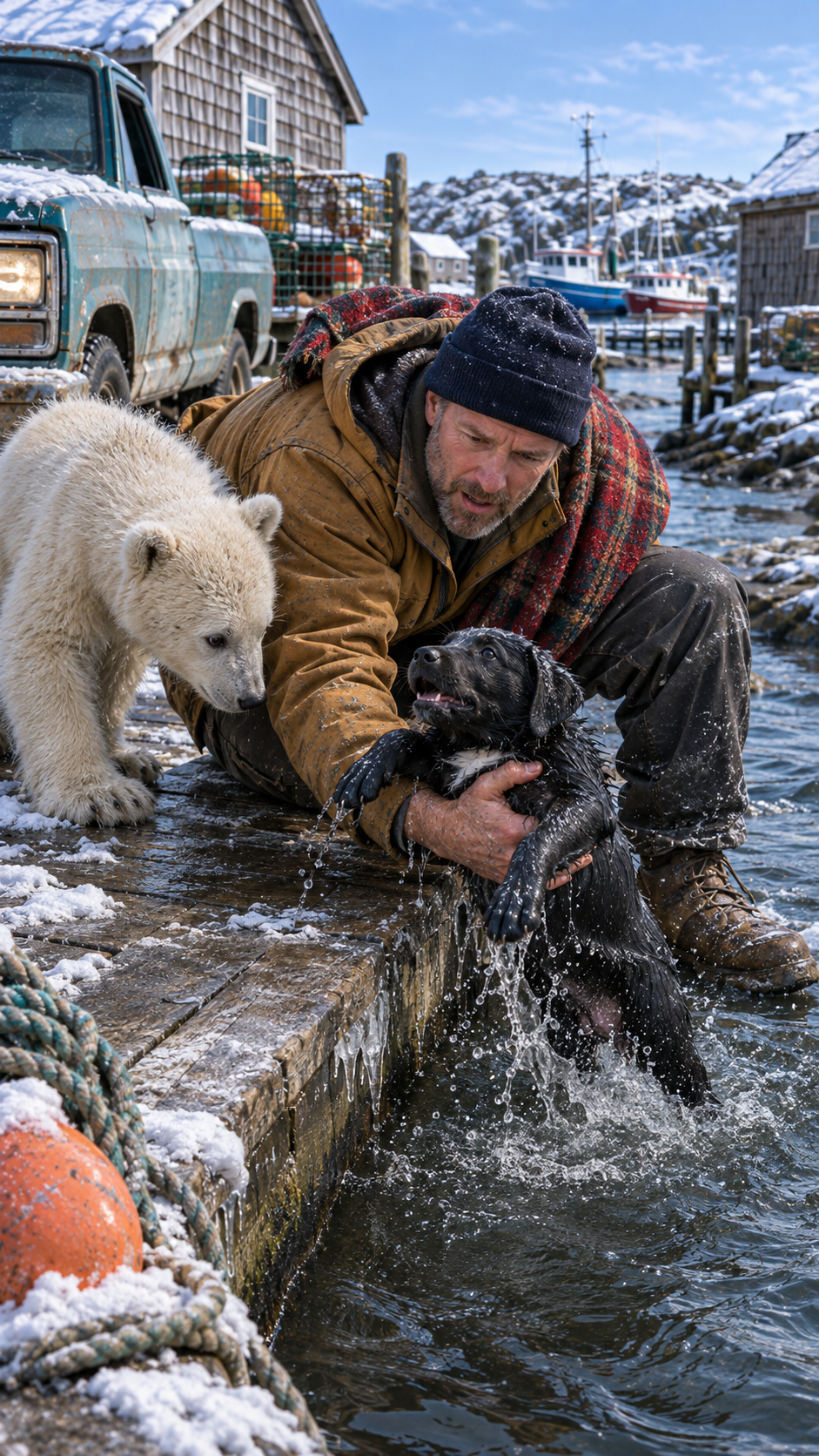
Near the edge of the wooden harbor landing, a small black Labrador puppy was soaked with freezing water.
Its dark fur clung to its body, and water splashed around its tiny paws.
Ellis immediately knelt beside the landing.
The polar bear cub stood close to him, watching anxiously as he reached toward the frightened puppy.
Using both hands, Ellis carefully supported the little dog’s body.
He lifted it completely out of the water and brought it securely against his chest.
Cold water dripped from the puppy’s black fur and paws.
The frightened animal released a soft whimper.
“I’ve got you, buddy. You’re safe now.”
Ellis continued holding the puppy carefully, keeping its small body supported.
The polar bear cub moved its head closer, observing the rescued animal.
The contrast between the two youngsters was remarkable.
One had thick cream-white fur suited to cold environments, while the other was a small domestic puppy that had become completely soaked in freezing harbor water.
The story does not establish how the Labrador puppy entered the water or how long it had been struggling there.
What mattered at that moment was that Ellis had reached the animal and removed it from the immediate danger depicted in the fictional sequence.
The wooden boards creaked beneath him as he remained beside the landing.
The puppy continued making quiet sounds, while the cub stood nearby.
Ellis now understood why the encounter had brought him toward the waterfront.
The little polar bear’s unexpected appearance on the road had led him to a vulnerable animal in need of assistance.
However, removing the puppy from the freezing water was only the beginning.
The soaked youngster still needed warmth, protection, and appropriate care.
A Red Plaid Blanket Offered Comfort
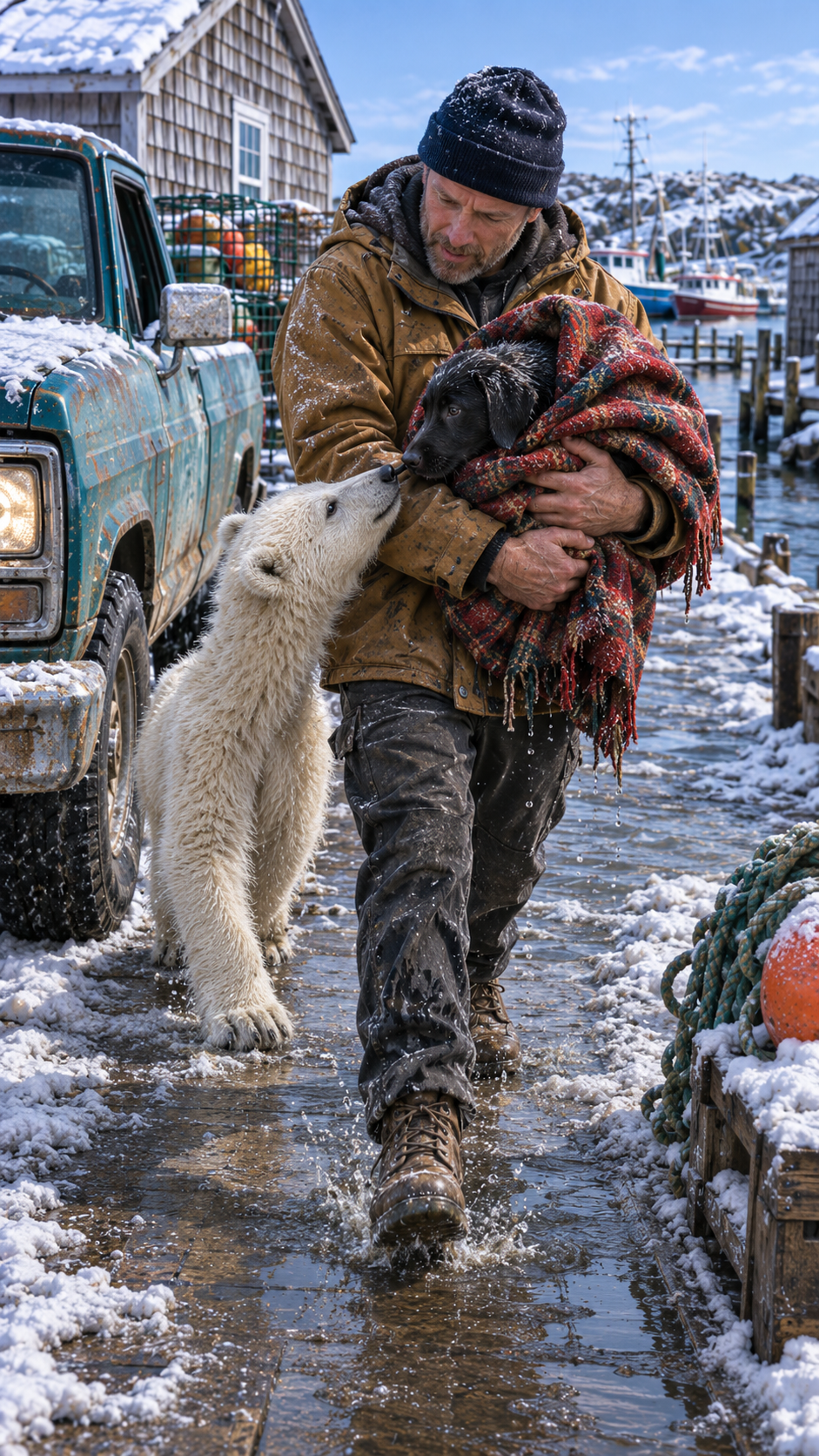
Ellis wrapped the rescued black Labrador puppy securely inside the red plaid blanket he had been carrying.
The soft material surrounded the little dog’s soaked body, providing protection from the cold winter wind.
Holding the puppy against his chest, Ellis began walking along the snowy harbor path.
His faded teal pickup truck remained nearby.
The polar bear cub walked closely beside his left leg, occasionally raising its nose toward the wrapped puppy.
The little Labrador gently moved its head and sniffed toward the cub.
Their brief interaction created a particularly touching moment within the fictional story.
Only a short time earlier, the puppy had been struggling in the freezing water. Now it was being carried securely while the little polar bear remained close.
Ellis looked down at the two youngsters and smiled.
“Come on, both of you. Let’s get warm.”
His footsteps created small splashes as he crossed shallow puddles along the snowy path.
The red plaid blanket moved gently with each step, while the puppy remained protected inside it.
The polar bear cub continued walking beside him.
Distant seagulls called above the harbor, and the winter wind moved through the surrounding fishing boats.
The immediate atmosphere had changed considerably.
The urgency of the rescue was gradually giving way to a quieter moment of relief.
The puppy was no longer in the freezing water, and Ellis was carrying it toward a sheltered environment.
Within the imaginative narrative, the cub continued accompanying them, creating an unusual connection between the three characters.
Their next destination was a rustic wooden cottage near the harbor.
Inside, a glowing wood stove offered a welcome contrast to the cold winter landscape.
Two Little Animals Beside a Warm Fire
Inside the wooden harbor cottage, the atmosphere was considerably warmer.
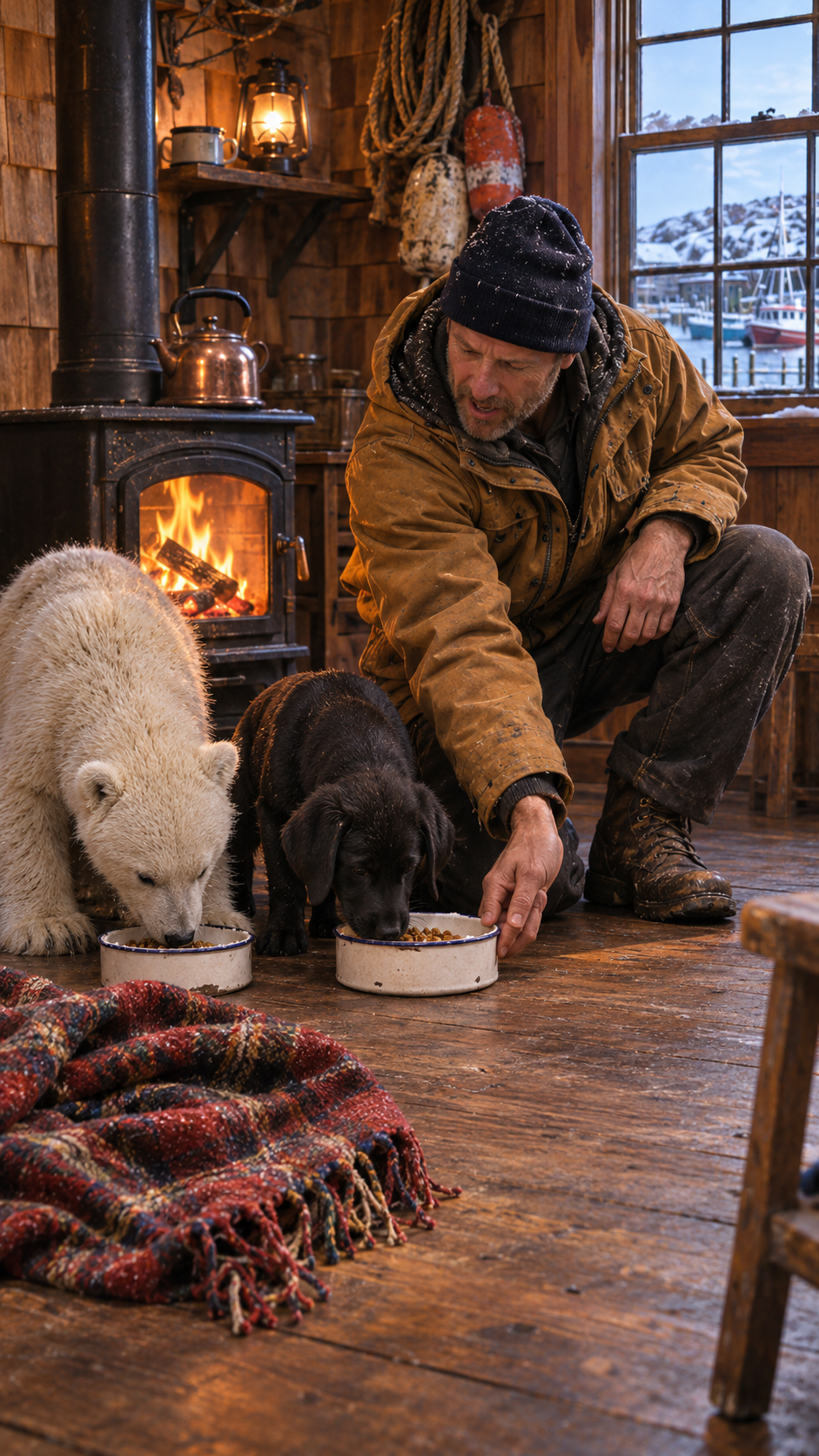
A cast-iron wood stove glowed gently, filling the rustic interior with soft firelight.
Bright winter daylight entered through the window, illuminating the wooden floor and the familiar red plaid blanket.
Beside the stove were two separate white enamel bowls.
The polar bear cub and the rescued black Labrador puppy were eating quietly from their respective bowls.
Ellis knelt beside them.
He gently moved the puppy’s bowl closer, allowing the little dog to continue eating comfortably.
“There you go. Plenty for both of you.”
The Labrador puppy appeared calmer than it had been beside the harbor landing.
Its attention was now directed toward its bowl rather than the frightening circumstances from which it had been rescued.
The polar bear cub remained nearby, occasionally moving its head and ears as it ate.
The gentle sound of the enamel bowl against the wooden floor mixed with the crackling fire.
Ellis watched the two animals with a warm smile.
The scene offered a peaceful contrast to the earlier moments of the story.
The sudden braking of the pickup truck, the rattling orange trash bin, and the splashing harbor water had been replaced by warmth and quiet companionship.
The red plaid blanket rested on the floor, serving as a familiar reminder of the rescue.
The fictional sequence does not establish what food was provided or whether veterinary and wildlife specialists had assessed either animal.
Instead, the cottage scene focuses on the emotional transition from danger to comfort.
The puppy had been removed from the freezing water, and the two youngsters were now depicted resting in a sheltered environment.
For Ellis, what had begun as an unexpected interruption to his morning had become an extraordinary encounter.
But the most heartwarming moment was still to come.
An Unusual Friendship in the Winter Sunlight
Bright winter morning sunlight illuminated the wooden harbor cottage.
Outside, snow covered the surrounding landscape, while the distant waterfront remained visible beyond the porch.
Ellis sat on the wooden porch step wearing his familiar winter clothing and brown boots.
Beside him rested the black Labrador puppy, now dry, and the little cream-white polar bear cub.
The puppy wagged its tail excitedly.
It released a playful bark before gently nudging the cub.
The polar bear turned its head toward the little dog and responded with a soft animal sound.
Ellis watched their interaction and laughed.
“Look at you two. Best friends already.”
He gently stroked the cub’s back within the fictional scene as both animals remained beside his boots.
The contrast with their earlier encounter was remarkable.
The Labrador puppy had been soaked and frightened near the freezing harbor water.
The polar bear cub had stood beside the orange trash bin, creating an unexpected obstacle that brought Ellis’s pickup truck to a stop.
Now the two youngsters appeared relaxed beside one another in the bright winter sunlight.
The surrounding harbor provided a beautiful backdrop for their final moment together.
The story presents their apparent friendship as an imaginative cinematic ending rather than a realistic example of how domestic dogs and wild polar bears should interact.
Nevertheless, the emotional message is clear.
The little puppy’s journey from danger to comfort creates a heartwarming conclusion, while the cub’s unusual role gives the story its memorable twist.
Why the Cub’s Unexpected Behavior Makes the Story So Compelling
The opening moments of the narrative immediately introduce an unusual question.
Why would a polar bear cub push a large orange trash bin into the path of a moving pickup truck?
The unexpected action captures Ellis’s attention and creates the central mystery of the story.
The little bear does not simply disappear after the vehicle stops.
Instead, it approaches the driver, touches his boot, and moves toward the waterfront.
These actions gradually connect the mysterious encounter with the discovery of the black Labrador puppy.
Within the fictional narrative, the cub appears to be guiding Ellis toward an animal in need.
However, such behavior should not be interpreted as documented evidence that wild polar bears deliberately seek human assistance for domestic animals.
The story uses imaginative animal behavior to create an emotional rescue sequence.
Its appeal comes from the unexpected connection between two very different animals and the human character who becomes involved in their adventure.
The audience discovers the purpose of the journey at the same time as Ellis.
That gradual revelation makes the rescue particularly memorable.
What initially appears to be an inconvenient interruption becomes an opportunity to help a vulnerable animal.
The Serious Risks of Freezing Water
Although the events depicted in the story are fictional, cold-water emergencies involving domestic animals are a genuine concern.
Puppies can be especially vulnerable to cold conditions because of their small size and developing ability to regulate body temperature.
Exposure to freezing water can cause dangerous heat loss, exhaustion, breathing difficulties, and other serious medical complications.
Removing an animal from the water does not necessarily mean that all immediate health risks have passed.
A rescued puppy may require urgent veterinary assessment, even if it appears calmer after being brought into a sheltered environment.
The red plaid blanket in the story represents Ellis’s effort to protect the little Labrador from further exposure to the cold.
However, real cold-water rescues require careful assessment of both the animal’s condition and the surrounding hazards.
Snow-covered docks, slippery wooden landings, and freezing water can also place rescuers in serious danger.
People should avoid entering hazardous water and contact emergency responders or qualified animal rescue professionals when necessary.
The fictional adventure provides a dramatic reminder of why pets should be closely supervised around waterfronts, particularly during winter.
Prevention and timely professional assistance remain essential to protecting vulnerable animals.
Understanding the Difference Between Wild and Domestic Animals
The polar bear cub and Labrador puppy create an adorable visual contrast throughout the story.
Their different coats, sizes, and movements make their fictional companionship especially memorable.
However, their natural needs and behaviors are fundamentally different.
Labradors are domesticated dogs that can live alongside people when provided with appropriate care, training, and companionship.
Polar bears are powerful wild predators with highly specialized environmental and dietary requirements.
Even young polar bears can present serious risks, and a cub’s mother may be nearby.
A polar bear cub should never be approached, touched, fed, followed, or brought into a private residence by an untrained person.
Likewise, domestic dogs should never be deliberately introduced to wild polar bears.
The peaceful interactions shown in this narrative are entirely dramatized.
Real encounters between wild animals, domestic pets, and humans can have unpredictable and dangerous consequences.
Wildlife authorities and qualified specialists are responsible for assessing situations involving potentially distressed or displaced polar bears.
The fictional cottage scene and porch reunion are intended to communicate warmth and companionship, not to provide instructions for keeping or handling wildlife.
Respecting wild animals means allowing them to remain wild and protecting their natural habitats.
The Quiet Power of Compassion
Ellis’s role in the story begins with a moment of surprise.
His ordinary journey is interrupted when an orange trash bin suddenly appears in front of his pickup truck.
Instead of continuing along the road, the fictional character becomes involved in an unexpected rescue.
His attention gradually shifts from the inconvenience of the interruption to the vulnerable puppy waiting near the waterfront.
Once the puppy is removed from the water, the story focuses on his reassuring words and careful handling.
“I’ve got you, buddy. You’re safe now.”
That simple statement captures the emotional center of the rescue.
The puppy cannot explain what happened or ask for assistance through words.
Its vulnerability is communicated through its soaked fur, quiet whimpers, and small movements.
Ellis responds with compassion.
The later scenes continue emphasizing that theme through the red plaid blanket, the warm cottage, and the peaceful morning on the porch.
Each element contributes to the contrast between the puppy’s earlier distress and its eventual comfort.
The story reminds viewers that noticing a vulnerable animal and seeking appropriate assistance can make a meaningful difference.
Compassion becomes most valuable when it is accompanied by responsible decisions that protect everyone involved.
From a Frightening Morning to a Beautiful Ending
The snowy harbor had become the setting for an extraordinary fictional adventure.
A small polar bear cub had pushed an orange trash bin into the road, bringing a faded teal pickup truck to a sudden stop.
Ellis had followed the little animal between fishing boats and toward the waterfront, where he discovered a soaked black Labrador puppy.
The rescue continued with a red plaid blanket, a walk through the snowy harbor, and a quiet moment beside a glowing wood stove.
By the final morning, the frightened puppy appeared comfortable and playful.
The little polar bear cub remained nearby, creating an imaginative picture of friendship between two very different animals.
The story’s emotional progression is built around simple contrasts.
Cold gives way to warmth.
Fear gives way to comfort.
Confusion gives way to understanding.
And an unexpected interruption becomes the beginning of a memorable rescue.
The final scene returns to the peaceful atmosphere of the winter harbor, allowing the audience to appreciate the happiness of the moment after the earlier uncertainty.
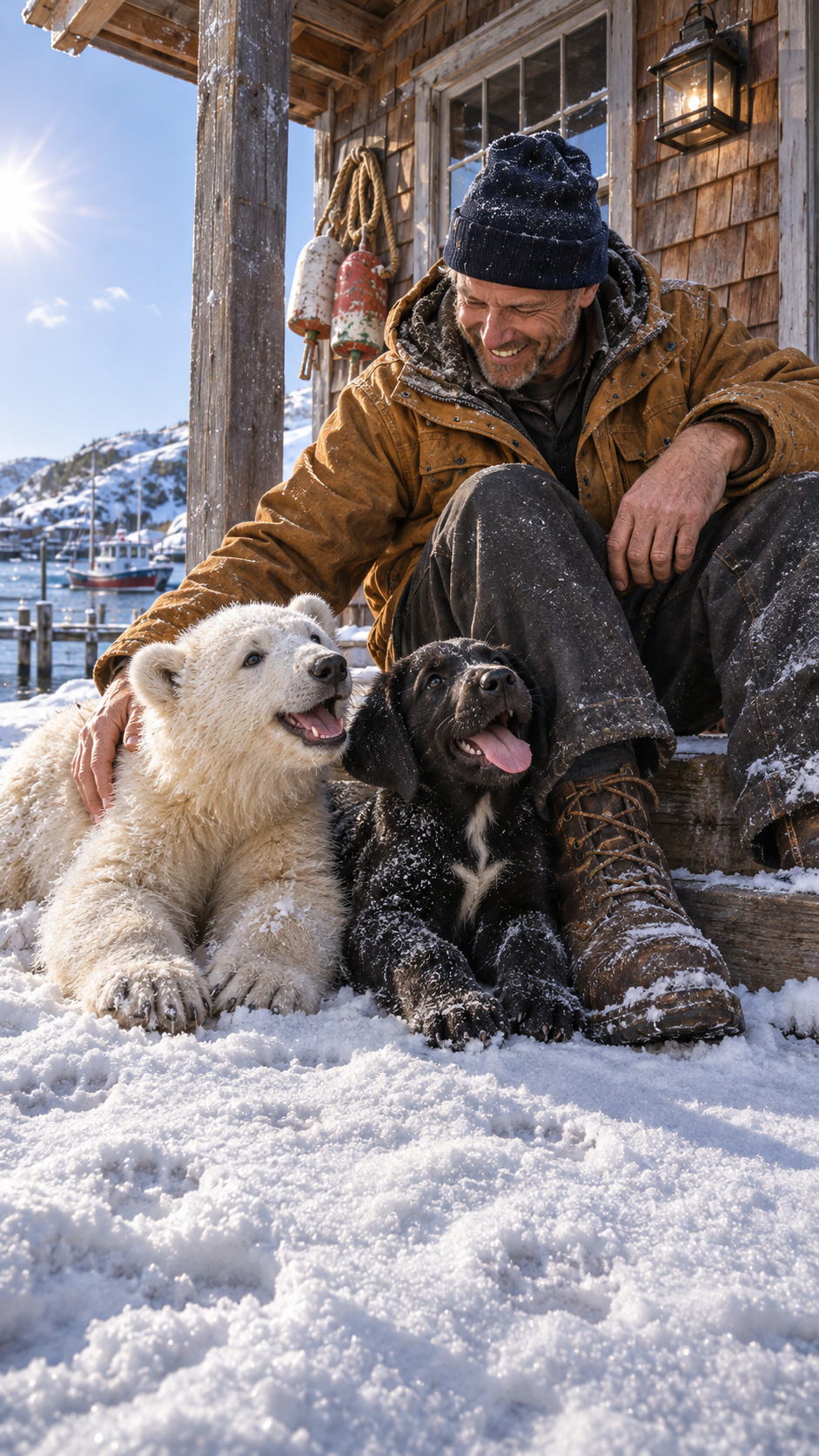
Sitting on the wooden porch beneath the bright winter sunlight, Ellis laughed as the little Labrador puppy playfully nudged the cream-white polar bear cub beside his boots. The snowy harbor stretched into the distance, and the frightening moments near the freezing water had given way to a peaceful fictional ending. Their extraordinary adventure offered a heartwarming reminder of compassion, the importance of protecting vulnerable animals, and the unexpected beauty that imaginative stories can bring to life.Disclaimer: This article and its accompanying video are fictional, AI-generated content created for entertainment and inspirational storytelling. The characters, polar bear cub, Labrador puppy, and rescue events do not represent a verified real-life incident. The depicted friendship and rescue behavior are entirely dramatized. Polar bears are dangerous wild animals and must never be approached, touched, fed, housed, or introduced to domestic pets. Contact qualified wildlife authorities and veterinary professionals during real animal emergencies. No real people or animals were endangered or harmed during the creation of this fictional content.