Something Was Moving Beneath the Highway Guardrail
Vehicles traveled along a busy highway surrounded by tall pine trees and patches of green roadside vegetation. Trucks passed in the distance, their engines breaking the otherwise peaceful atmosphere of the bright afternoon.
Along the gravel shoulder, however, something unusual was happening beneath a steel guardrail.
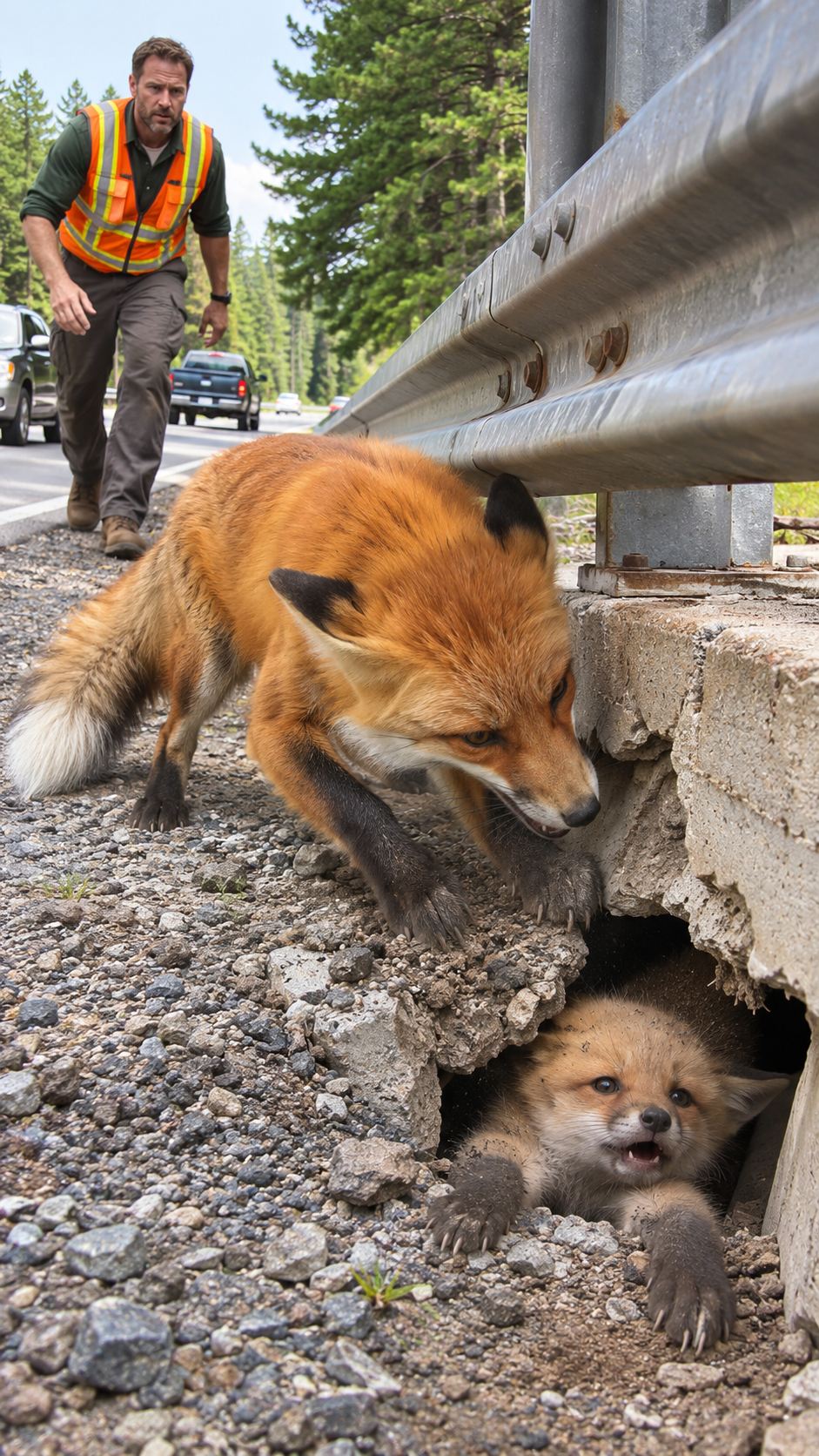
An adult red fox was desperately scratching at the broken concrete surrounding a drainage opening.
Her reddish-orange fur stood out against the gray concrete and loose gravel. She repeatedly moved her front paws against the damaged edge, attempting to reach something inside.
Just beneath her was a frightened little fox cub.
Its head and front paws were visible outside the opening, but the rest of its body remained partially trapped.
The youngster attempted to move forward, scraping its tiny paws against the gravel. Despite its efforts, it could not completely escape the damaged drainage structure.
The mother remained immediately beside it.
She scratched at the concrete, lowered her head toward her baby, and continued searching for a way to free it.
Meanwhile, a highway worker named Jack was approaching along the roadside shoulder.
As he walked closer, he noticed the unusual movement beneath the guardrail.
“Hey! What happened here?”
Jack slowed his footsteps as he looked toward the two animals.
The mother fox continued struggling beside the opening, while her frightened cub released quiet whimpers.
What had initially appeared to be an ordinary stretch of roadside was now the setting of a desperate situation.
The little animal needed assistance, and its mother appeared unwilling to leave without it.
The Mother Refused to Give Up
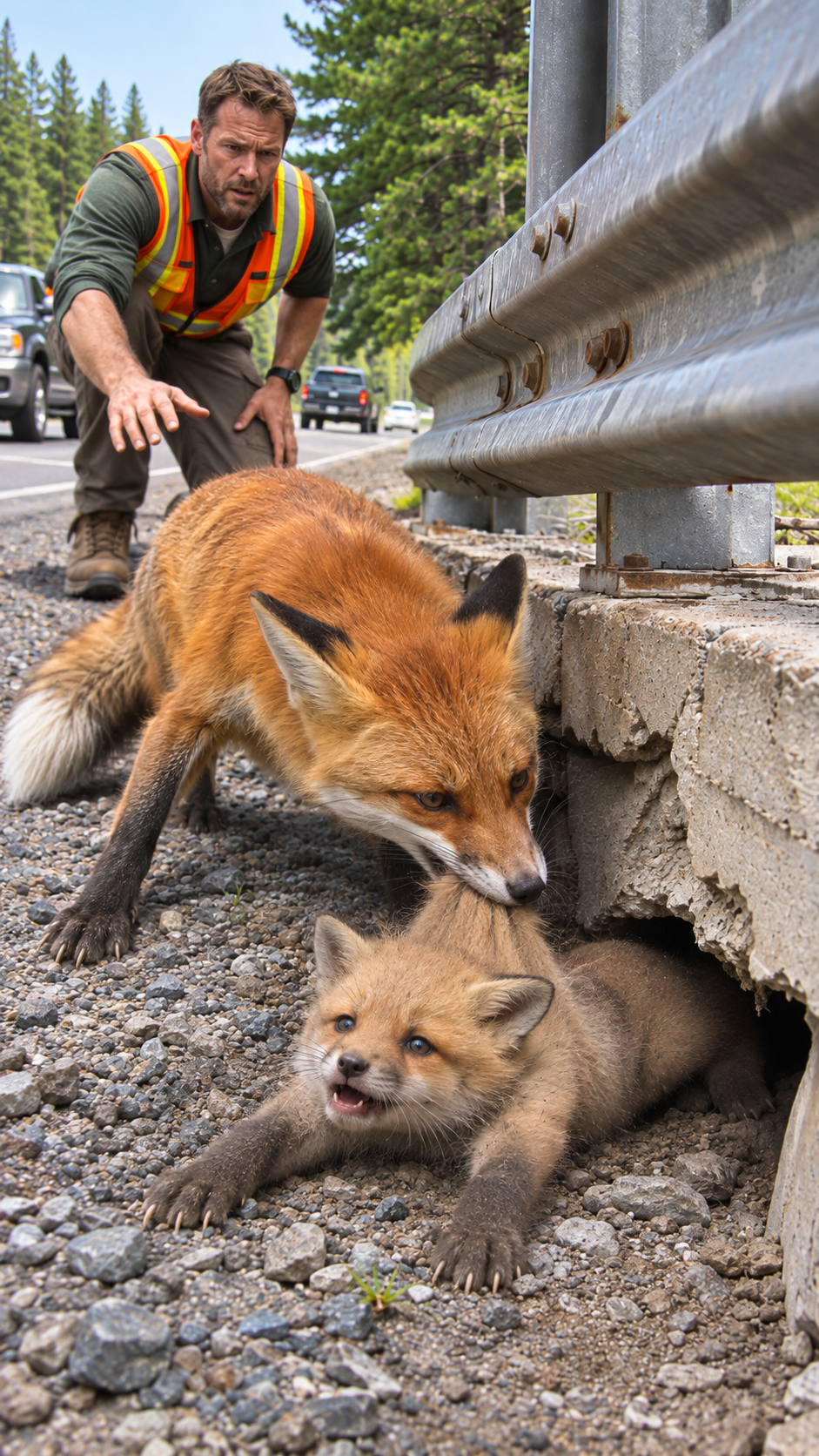
The adult fox lowered her head toward the drainage opening.
She gently gripped the loose fur behind her cub’s neck and attempted to pull it forward.
The youngster moved slightly.
Its front paws shifted across the gravel, but its hindquarters remained trapped inside the damaged concrete opening.
The mother adjusted her position and continued trying.
Small stones moved beneath her paws as she struggled to find enough traction.
Her anxious expression and repeated movements created a heartbreaking scene.
Despite her efforts, the little fox remained unable to escape.
The passing vehicles continued moving along the nearby highway. Their distant engines contrasted with the quiet cries coming from beneath the guardrail.
Jack approached slowly, watching the mother’s movements.
As he got closer, he could finally see why the adult fox was behaving so unusually.
The cub was not simply resting inside the drainage opening.
Its body was physically trapped.
“Oh, buddy… you’re stuck.”
Jack stopped momentarily to observe the situation.
The broken concrete surrounding the opening appeared to be preventing the cub from moving its hindquarters freely.
The mother fox remained focused on her baby, occasionally adjusting her position as she attempted to pull it toward her.
Within the fictional narrative, her determination illustrated the powerful protective behavior that makes the relationship between a mother animal and her offspring so compelling.
She had not abandoned the little cub despite the nearby traffic, unfamiliar surroundings, and approaching human.
Jack recognized that the situation required patience.
Moving too quickly could frighten the adult fox or increase the distress of the trapped youngster.
The mother had already demonstrated how closely she was guarding her baby.
Before anything else could happen, Jack needed to approach without creating additional fear.
A Highway Worker Decided to Stop
Jack continued walking toward the drainage opening with slow, measured footsteps.
His heavy work boots pressed against the loose gravel as he moved closer to the steel guardrail.
The mother fox immediately noticed him.
She positioned herself protectively beside her cub, watching the approaching worker with cautious eyes.
Her body remained close to the opening.
The little fox continued whimpering, its front paws resting against the gravel.
Jack stopped several feet away.
He lowered his hands and spoke calmly.
“Easy, mama. I’m just trying to help.”
The adult fox remained alert.
Her attention shifted between Jack and the frightened youngster.
The worker did not immediately reach toward either animal. Instead, he paused, allowing the tension of the encounter to settle within the dramatized rescue sequence.
Wind moved gently through the nearby pine trees, while vehicles continued passing along the highway.
The scene emphasized the uncertainty of the situation.
Jack wanted to assist the trapped cub, but the mother fox was naturally protective of her offspring.
Her cautious reaction was understandable.
Wild animals can become defensive when their young are threatened, particularly when they are frightened or unable to escape a stressful situation.
The fictional story portrays Jack as someone attempting to remain calm rather than adding to the animals’ distress.
His reassuring voice provided an emotional contrast to the cub’s frightened cries.
For several moments, the mother fox remained beside the drainage opening.
Jack watched her carefully.
Then something unexpected happened.
The adult fox began moving away from the immediate area surrounding her trapped baby.
The Mother Fox Slowly Stepped Aside
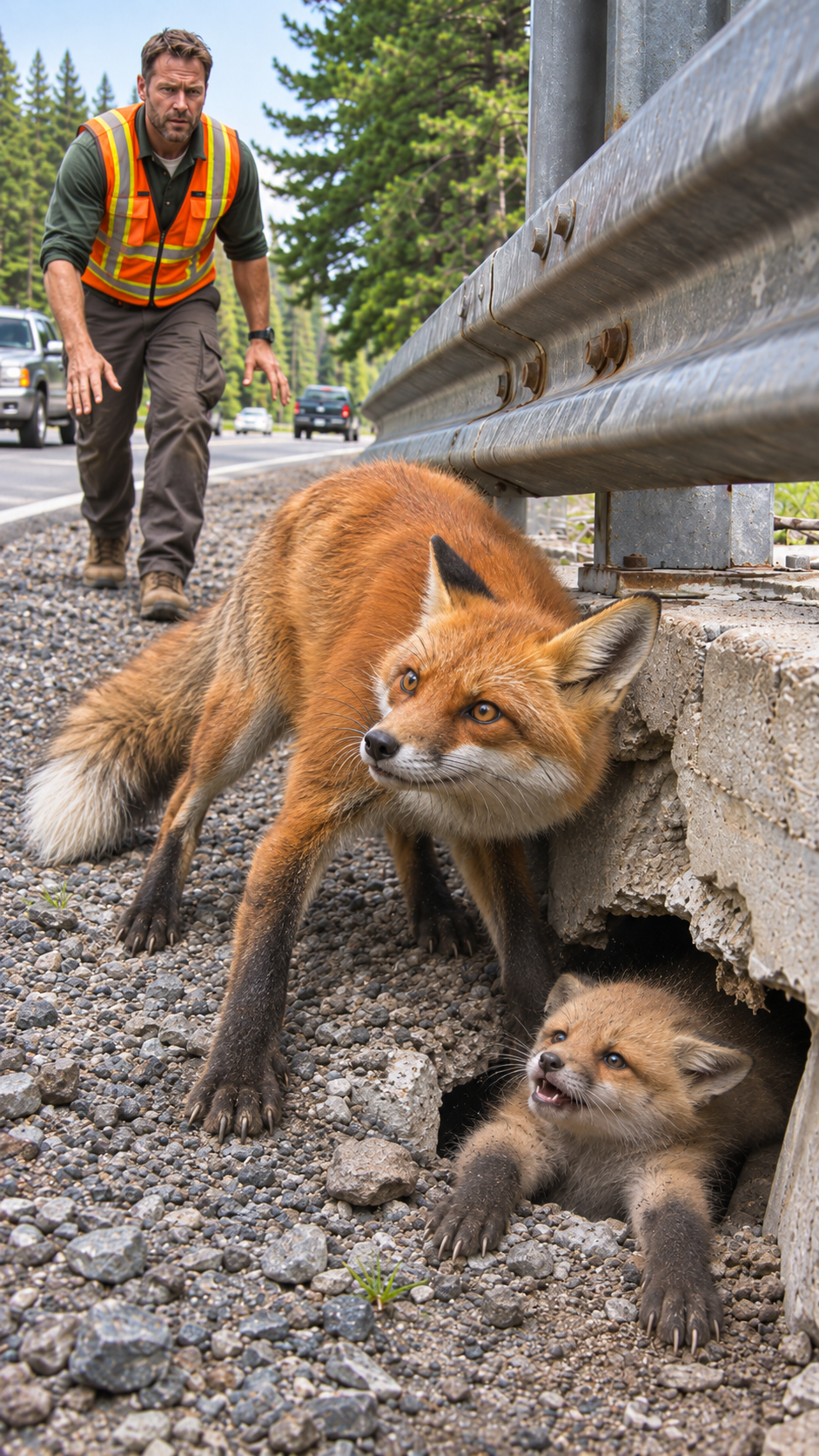
The red fox took several cautious steps along the steel guardrail.
She moved only a short distance before stopping and turning her head toward the drainage opening.
Her cub remained partially trapped inside.
Although the mother had moved away, she continued watching closely.
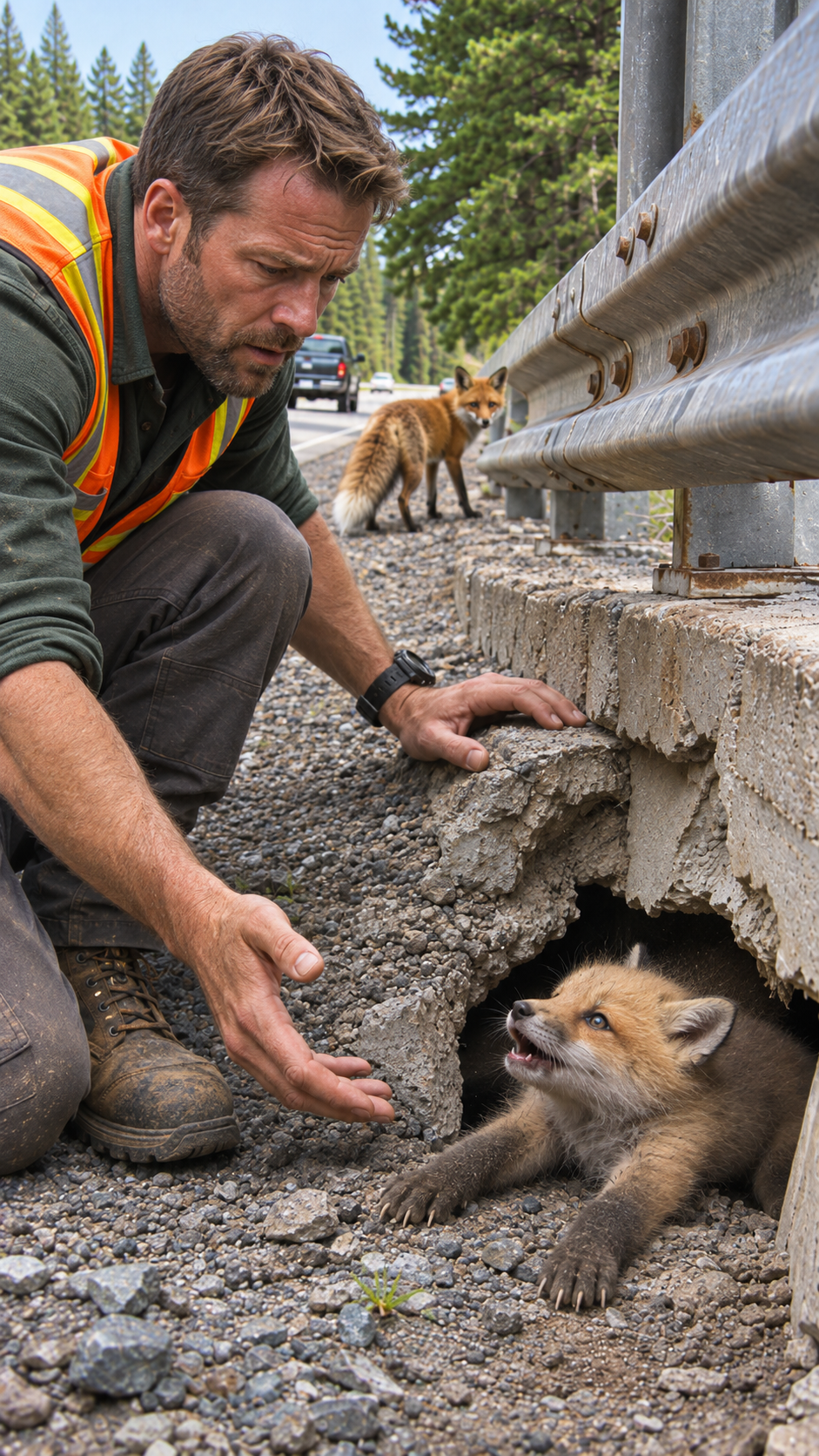
Jack carefully lowered himself onto the gravel shoulder beside the damaged concrete.
From his new position, he could see the frightened youngster more clearly.
The cub looked upward, its small face visible beneath the broken edge of the drainage opening.
Jack extended one hand toward it.
“It’s okay, little one. I’ve got you.”
His voice remained quiet.
The mother fox watched from several feet away, her attention fixed on the unfolding encounter.
The surrounding vegetation rustled gently in the breeze.
Small pieces of gravel shifted beneath Jack’s knees as he examined the damaged opening.
The fictional sequence presents the mother’s decision to move aside as a dramatic turning point.
However, her behavior should not be interpreted as proof that wild foxes understand human intentions or deliberately authorize people to handle their offspring.
Wild animals respond to unfamiliar situations in complex and sometimes unpredictable ways.
Within this story, the mother’s movement creates an opportunity for Jack to reach the trapped cub while she remains nearby.
The youngster’s frightened expression emphasized its vulnerability.
Its front paws were already outside the opening, but its hindquarters could not move freely past the damaged concrete.
Jack could now see that simply pulling the animal forward would not necessarily resolve the problem.
The surrounding obstruction was the central issue.
The next few moments would determine whether the cub could finally escape.
The Moment Everyone Had Been Waiting For
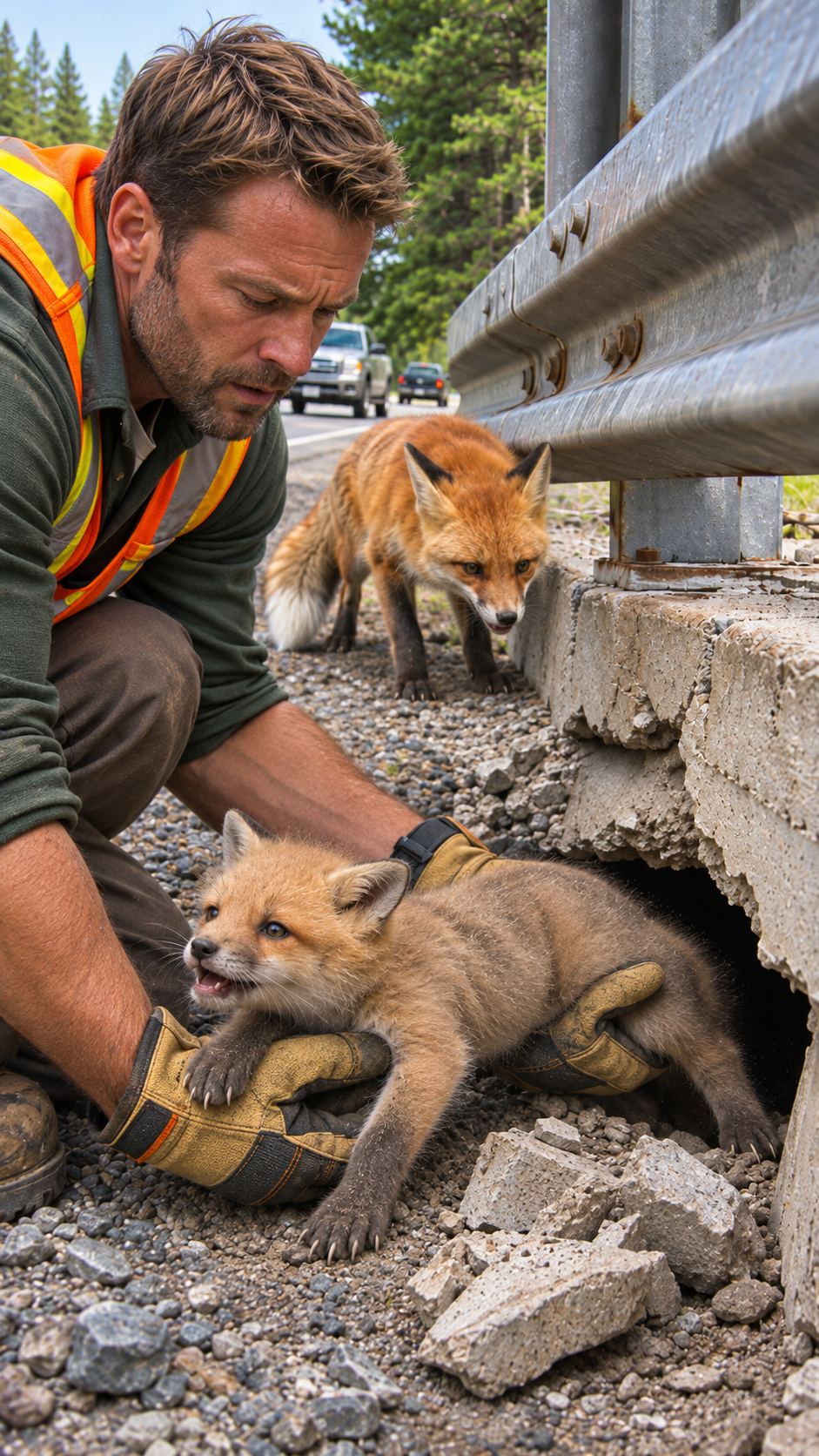
Wearing protective work gloves, Jack examined the loose concrete fragments surrounding the drainage opening.
Within the fictional rescue sequence, he carefully moved several pieces away from the trapped youngster.
Small fragments shifted across the gravel.
The cub remained frightened, releasing gentle whimpers as the worker continued assisting it.
Jack supported the little animal beneath its chest and hindquarters.
Gradually, the cub began moving forward.
Its front paws extended farther onto the gravel shoulder.
Then its hind legs finally emerged from the damaged opening.
The little fox was completely free.
“There we go! You’re free now.”
Jack’s expression changed immediately.
The tension of the earlier moments gave way to visible relief.
The cub showed no visible injury as he supported its small body.
From beside the steel guardrail, the mother fox continued watching attentively.
The opening that had prevented the youngster from escaping was now behind it.
Its tiny paws were no longer scraping helplessly against the broken concrete.
The scene captured the central emotional moment of the story.
An animal that had been unable to escape despite its mother’s repeated efforts had finally been freed.
The mother’s earlier struggle made the moment particularly meaningful.
She had remained close throughout the encounter, watching as the worker approached and eventually released her baby.
Jack continued holding the cub carefully.
The distant sound of passing vehicles remained present, but the atmosphere surrounding the rescue had changed.
What had begun with frightened cries and desperate scratching was gradually becoming a moment of relief.
The little fox was no longer trapped.
One final moment remained before the story could reach its heartwarming conclusion.
The Little Fox Finally Stood on Its Own
Jack remained kneeling beside the drainage opening.
He gently lowered the rescued cub toward the gravel, allowing its four paws to touch the ground.
The youngster stood independently.
Its small body was now completely outside the damaged concrete structure.
Jack slowly withdrew his hands, watching the little animal with a relieved smile.
“You’re okay now, little guy.”
The mother fox remained a short distance away beside the steel guardrail.
Her baby was finally free from the opening that had restricted its movement.
The bright roadside environment appeared peaceful again.
Birds could be heard singing, pine trees moved gently in the wind, and traffic continued passing in the distance.
The little fox stood on the gravel beside Jack.
For the first time since the beginning of the story, it was no longer struggling against the concrete.
The fictional narrative ends with the cub standing independently and its mother watching nearby.
It does not show the animals returning to their den or establish what happened to them afterward.
Nevertheless, the final image communicates the immediate relief of seeing the youngster outside the dangerous opening.
The mother’s persistence and Jack’s compassionate response provide the emotional foundation of the story.
The Remarkable Protective Instincts of Mother Foxes
Red foxes are intelligent and adaptable wild animals that can survive in a wide range of environments.
They are often found near forests, agricultural areas, open fields, and even suburban communities.
Mother foxes devote considerable attention to raising their young.
During the early stages of development, fox cubs depend heavily on adult family members for food, protection, and shelter.
Young cubs gradually become more independent as they grow and learn to explore their surroundings.
However, unfamiliar structures and human-made environments can introduce hazards that young animals may not recognize.
The mother fox in this fictional story demonstrates a dramatized version of protective parental behavior.
She remains beside her trapped offspring, repeatedly attempts to free it, and continues watching throughout the encounter.
Her actions create a powerful emotional connection because the audience can immediately understand the vulnerability of the little cub.
The youngster is unable to escape independently, while its mother continues attempting to assist it.
Although animal behavior should not automatically be interpreted through human emotions, the importance of parental care in many wildlife species is well established.
The fictional rescue uses that natural theme to create a moving story about persistence, vulnerability, and protection.
Hidden Dangers Along Busy Roads
Highways and roadside infrastructure can create significant challenges for wildlife.
Drainage openings, culverts, damaged concrete structures, fences, and other human-made features may become obstacles for animals moving through unfamiliar environments.
Small animals can sometimes enter narrow spaces without being able to escape easily.
Roadside locations introduce additional risks because of nearby traffic.
An animal that becomes frightened or disoriented may move toward passing vehicles, creating danger for both wildlife and motorists.
The broken drainage opening in this story illustrates how an ordinary piece of infrastructure can become a hazard under certain circumstances.
The cub’s small size allows part of its body to emerge, but the damaged opening prevents it from escaping completely.
Its mother’s repeated attempts are unsuccessful because the physical obstruction remains in place.
Maintaining roadside infrastructure and considering wildlife movement when designing drainage systems can help reduce some of these risks.
Reporting damaged structures and potentially dangerous animal encounters to appropriate authorities can also contribute to safer environments.
The fictional story highlights a situation that might otherwise go unnoticed by people traveling along a busy highway.
While motorists continue toward their destinations, vulnerable wildlife may be struggling just beyond the edge of the road.
Why Compassion Must Be Accompanied by Caution
Jack’s decision to stop and acknowledge the animals’ distress is an important part of the narrative.
He notices something unusual instead of simply continuing past the drainage opening.
His concern becomes the starting point of the fictional rescue.
However, real wildlife emergencies require careful judgment.
An adult fox protecting its offspring can react defensively, particularly when approached by an unfamiliar person.
Wild foxes may bite or scratch when frightened, and they can carry diseases that present health risks to humans and domestic animals.
Protective work gloves alone do not make handling a wild animal safe.
A trapped animal may also have injuries that are not immediately visible.
Improper handling could worsen its condition or create additional stress.
The roadside environment introduces another serious concern: moving traffic.
People should never place themselves in danger by stopping in an unsafe location, entering traffic lanes, or attempting a rescue without appropriate assistance.
Anyone who discovers trapped wildlife near a highway should contact qualified wildlife rescue professionals, animal control services, or the relevant road authorities from a safe location.
Providing accurate information about the animal and its surroundings can help trained responders assess the situation.
The fictional rescue emphasizes compassion, but responsible assistance in real life also requires respecting the risks involved.
The Importance of Noticing What Others Might Miss
The story begins with an ordinary roadside environment.
Vehicles pass, trees move in the wind, and a highway worker approaches along the gravel shoulder.
The emergency itself is relatively small compared with the surrounding landscape.
A frightened fox cub is partially visible beneath a steel guardrail.
Without closer attention, the movement could easily be overlooked.
Jack notices the mother fox’s repeated scratching and recognizes that something is unusual.
That moment of awareness changes the direction of the entire narrative.
Many meaningful acts of assistance begin with noticing a problem.
Someone recognizes an unusual situation, takes it seriously, and seeks an appropriate way to respond.
The fictional story illustrates this idea through a simple encounter involving a vulnerable animal.
Jack does not know how the cub became trapped or how long its mother has been attempting to free it.
He only recognizes that the youngster cannot escape independently.
The story reminds viewers that compassion can begin with paying attention to the world around them.
Even when people cannot safely intervene themselves, reporting a problem to qualified professionals can make a meaningful difference.
Why the Mother’s Persistence Makes the Story So Moving
Throughout the six scenes, the mother fox remains an essential part of the narrative.
She is present when the cub first attempts to escape.
She tries to pull it from the opening.
She watches cautiously as Jack approaches.
Even after moving several feet away, she continues looking toward her baby.
Her presence connects every stage of the rescue.
The audience does not simply witness a trapped animal being freed. It also sees the persistent presence of an adult fox that has remained close to its offspring throughout the difficult situation.
That relationship gives the rescue its emotional depth.
The cub’s eventual freedom provides a contrast to the mother’s earlier unsuccessful efforts.
What initially appeared to be a hopeless struggle ends with the youngster standing independently on all four paws.
The mother remains nearby, watching the scene unfold.
Although the story is fictional, its themes of protection and persistence are familiar throughout the natural world.
They remind viewers that wildlife deserves consideration, particularly when human-made environments introduce unexpected dangers.
From Desperate Struggle to Quiet Relief
The encounter began with a mother fox scratching desperately against broken concrete.
Her little cub was trapped beneath a highway guardrail, unable to move its hindquarters beyond the damaged opening.
Despite repeated attempts, the mother could not free it.
Then Jack noticed the animals.
His approach introduced a moment of uncertainty before the fictional rescue gradually unfolded.
The mother stepped aside while remaining nearby.
The damaged opening was cleared, and the cub was finally released.
The final moments were remarkably different from the beginning.
There was no longer a desperate struggle against the concrete.
The little fox stood independently, while Jack smiled and its mother watched from beside the guardrail.
The highway continued carrying vehicles past the scene, and the surrounding pine trees moved gently in the afternoon breeze.
For the little cub, the immediate fictional danger had passed.
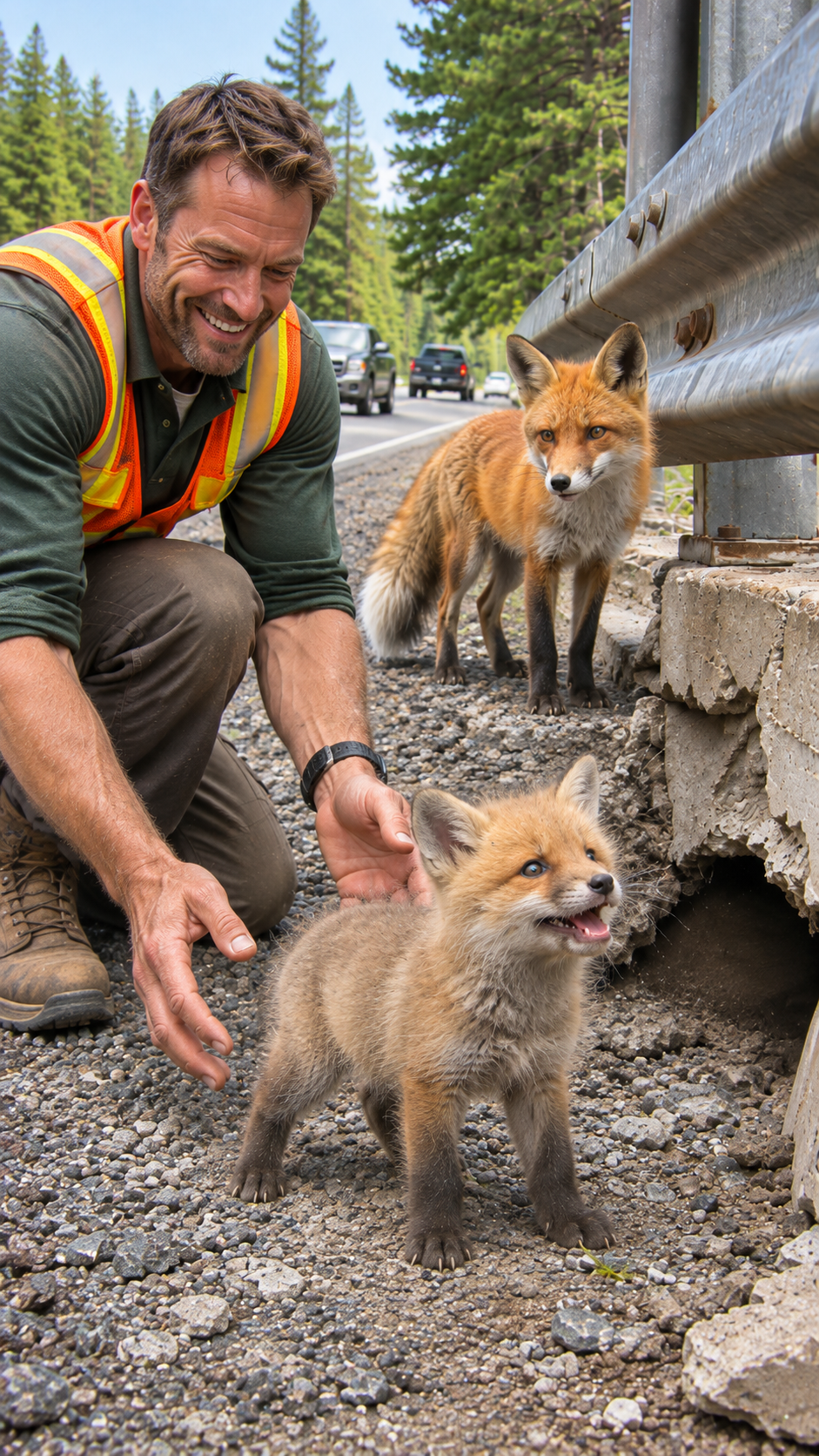
As the rescued fox cub stood on its tiny paws beside the drainage opening, Jack slowly withdrew his hands and smiled with relief. The mother fox watched from nearby, her baby finally free from the broken concrete. Their extraordinary fictional encounter offered a heartwarming reminder that vulnerable wildlife deserves protection, that compassion begins with awareness, and that even an ordinary moment beside a busy highway can become an unforgettable story of hope.