A Peaceful Walk Interrupted by a Mysterious Sound
The sun was shining brightly over a peaceful lake. Gentle waves moved toward the shoreline, birds sang from nearby trees, and the distant sounds of recreational boats created a relaxing atmosphere.
A 26-year-old brunette woman wearing a red crop top, short blue denim shorts, and white sneakers was walking along the lakeside pathway with her smartphone in her hand.
She appeared to be enjoying an ordinary moment outdoors.
Along the pathway stood a turquoise wooden storage cabin used to keep recreational equipment.
Its white door was closed, and nothing about the small building initially appeared unusual.
Then, without warning, a metallic rattling sound interrupted the peaceful surroundings.
Almost immediately, a distressed meow followed.
The woman stopped walking.
Her expression changed from relaxed to startled as she turned toward the turquoise cabin.
“Wait! What was that?”
She looked carefully at the closed wooden door.
The sound had been brief, but it was distinctive enough to capture her attention.
Rather than continuing along the pathway, she began approaching the cabin.
She held her smartphone in her right hand while listening for another sound.
The surrounding lake remained peaceful, but something inside the small storage building appeared to be in distress.
The woman moved closer.
She had no idea what she was about to discover or how important her decision to stop would become.
What began as an ordinary lakeside walk was quickly turning into an unexpected rescue.

Something Was Crying Behind the Locked Door
The young woman approached the turquoise storage cabin cautiously.
She examined the closed white door before noticing a metal ventilation grille.
Another desperate meow came from inside.
This time, the sound was unmistakable.
The woman crouched beside the door and carefully moved her ear closer to the ventilation grille.
She could hear quiet scratching followed by another frightened cry.
“Hey, little buddy. Are you stuck in there?”
Her voice was gentle, but her expression revealed growing concern.
Whatever was making the sound appeared unable to leave the building.
The woman looked toward the door, searching for a way to understand what was happening inside.
However, the cabin remained locked.
The ventilation grille provided only a limited view, preventing her from determining exactly where the animal was located.
She remained beside the door, listening carefully.
The distressed meowing continued.
Outside, the gentle wind moved through nearby trees, and the distant sounds of boat engines could still be heard.
The contrast between the peaceful surroundings and the frightened sounds coming from inside the cabin made the situation increasingly concerning.
The woman realized that she needed someone who could unlock the building.
She did not attempt to force the door open or damage the ventilation grille.
Instead, she looked around the nearby recreational area for someone who might have access to the storage cabin.
Her attention soon turned toward a lakeside employee.
He appeared to be the person who could help her discover what was happening behind the locked door.
She Immediately Called Someone for Help
The young woman stood beside the turquoise cabin and urgently waved toward the nearby employee.
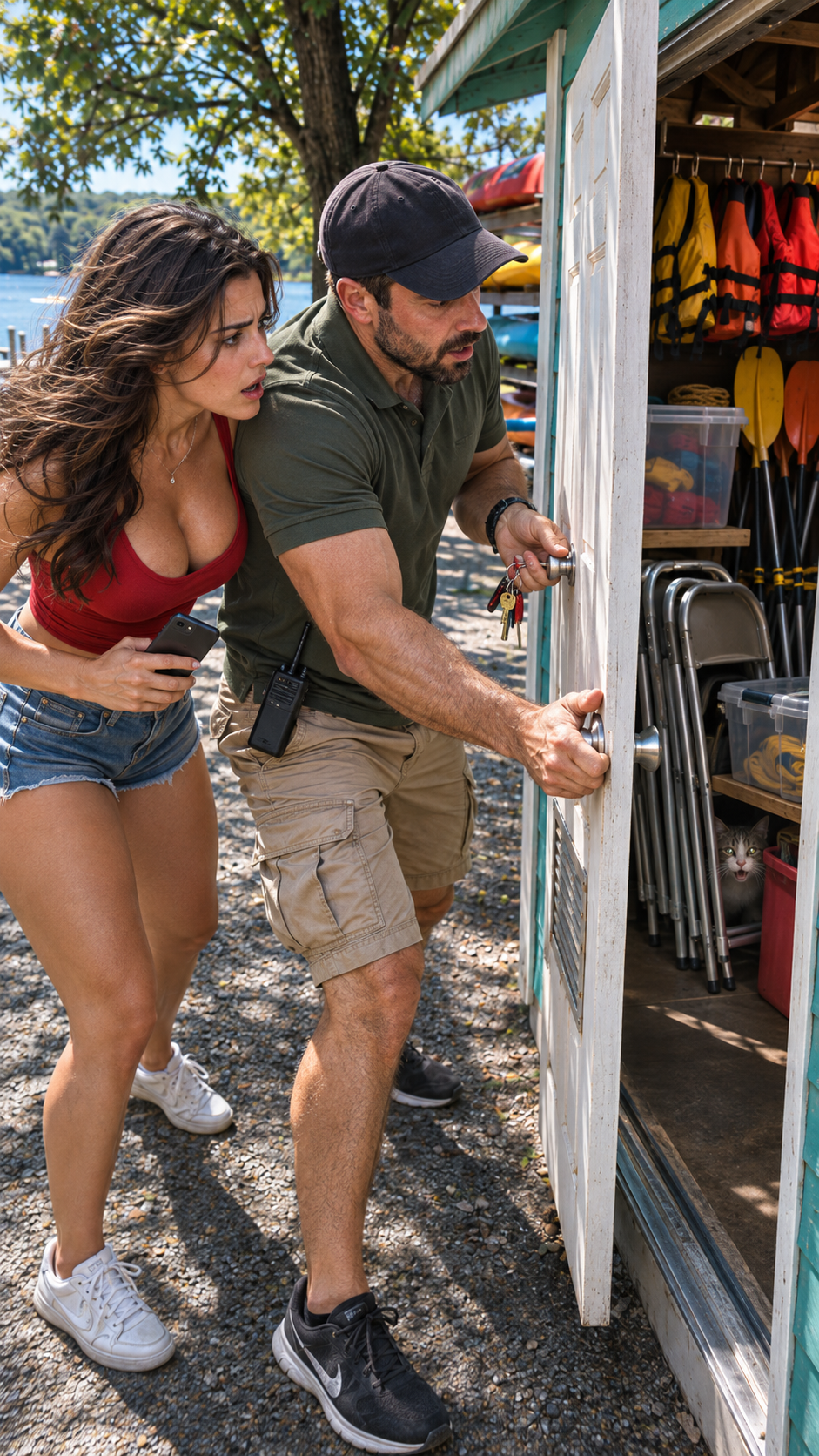
He was wearing an olive-green polo shirt, beige cargo shorts, and a dark baseball cap.
Noticing her gestures, he began walking toward the storage building.
The woman pointed toward the metal ventilation grille.
“There’s something trapped inside!”
The employee looked toward the closed door.
“Let me check.”
He crouched beside the ventilation grille and listened carefully.
Another distressed meow came from inside the cabin.
The employee now understood why the woman had called him over.
Something was clearly making noise behind the locked door.
The woman remained beside him, watching anxiously as he assessed the situation.
Within the fictional narrative, the employee had access to the storage building and was able to investigate without damaging the property.
His involvement provided a practical solution to the obstacle that had prevented the woman from helping the animal immediately.
The quiet scratching continued from somewhere inside.
The employee reached toward his pocket, where he carried a set of keys.
The woman looked toward the white wooden door.
Although she now had someone helping her, she still did not know exactly where the frightened animal was hiding.
The cabin contained equipment, and the sounds appeared to be coming from somewhere beyond the entrance.
The employee prepared to unlock the door.
Both of them remained focused on the mysterious cries.
The answer was finally within reach, but opening the cabin would reveal another unexpected challenge.

The Employee Finally Opened the Storage Cabin
The employee removed a set of keys from his pocket.
He selected the appropriate key and inserted it into the lock on the white cabin door.
The unlocking mechanism produced a familiar metallic sound.
The young woman stood beside him, watching anxiously.
As the employee slowly opened the door, the interior of the turquoise storage cabin became visible.
Colorful life jackets were stored alongside kayak paddles, plastic storage containers, and stacked folding chairs.
The equipment filled much of the small building.
At first, neither the woman nor the employee could see the animal responsible for the distressed sounds.
Then another frightened meow came from behind the equipment.
The woman immediately pointed toward the back of the cabin.
“It’s coming from back there!”
The employee listened.
“I hear it.”
He carefully examined the arrangement of the stored equipment.
The stacked folding chairs and plastic containers created several narrow spaces where a small animal could potentially become trapped.
The fictional story does not establish how the animal originally entered the cabin or when the door was locked.
It also does not suggest that anyone deliberately placed the animal inside.
What was clear, however, was that the frightened creature needed assistance.
The employee moved toward the area from which the sounds appeared to be coming.
The woman remained close to the doorway.
She watched as he carefully began examining the equipment.
The cries became easier to hear now that the cabin door was open.
Somewhere behind the stacked folding chairs was a vulnerable animal that had been unable to escape.
The employee knelt down and prepared to move the obstruction.

They Discovered a Frightened Little Cat
Inside the storage cabin, the employee carefully moved a lightweight plastic storage panel positioned beside the stacked folding chairs.
The movement revealed a narrow space behind the equipment.
There, looking toward them with frightened green eyes, was a gray tabby cat with a distinctive white chest.
The young woman’s expression immediately softened.
“Oh, sweetheart! Come here.”
She crouched beside the doorway and gently extended both hands toward the frightened animal.
The employee remained close to the equipment.
“Easy, little guy. You’re safe.”
The cat released another quiet meow.
Its gray fur and white chest became more visible as the employee carefully moved the remaining obstruction.
Within the fictional sequence, the cat was no longer prevented from leaving the narrow space.
However, it appeared hesitant to move immediately.
The unfamiliar voices, shifting equipment, and sudden opening of the cabin door may have contributed to its nervousness within the dramatized scene.
The woman remained crouched, speaking gently and allowing the animal to approach.
The employee finished moving the obstacle.
The cat finally began walking toward the woman.
Its movements were cautious, but it was now able to leave the area behind the folding chairs.
The young woman watched with visible relief.
Only moments earlier, she had been standing outside the locked cabin, uncertain about the source of the mysterious cries.
Now the frightened animal was directly in front of her.
The immediate obstruction had been removed.
The employee and the woman had worked together to provide the cat with an opportunity to escape.
After everything that had happened, the most emotional moment of their unexpected encounter was still to come.
Why Cats Sometimes Become Trapped in Unexpected Places
Although the events in this story are fictional, cats can genuinely find themselves trapped inside sheds, garages, storage buildings, and other enclosed spaces.
Their natural curiosity often encourages them to investigate unfamiliar environments.
Small openings, sheltered corners, and quiet spaces may attract their attention.
A cat may enter an open building without being noticed by the people using it.
If a door is subsequently closed, the animal may become unable to leave.
Storage buildings can present additional challenges because equipment and containers may restrict movement.
Folding chairs, stacked boxes, and other materials can create narrow spaces where animals become frightened or physically obstructed.
The fictional gray tabby in this story is discovered behind recreational equipment inside a lakeside cabin.
Its exact reason for entering the building remains unknown.
The narrative also does not establish how long the cat had been trapped.
Nevertheless, the situation illustrates why checking enclosed spaces before locking them can be a valuable precaution.
People responsible for storage facilities can help reduce potential risks by inspecting accessible areas and ensuring that animals have not entered unnoticed.
Maintaining organized storage arrangements may also make it easier to identify unexpected problems.
The fictional rescue encourages awareness of the ordinary environments in which vulnerable animals may encounter difficulties.
Sometimes an apparently harmless storage building can become a dangerous place for an animal that cannot find its way outside.
Recognizing the Sounds of an Animal in Distress
Cats communicate through a combination of vocalizations, body language, and physical behavior.
Meowing can serve numerous purposes, including attracting attention, expressing discomfort, or communicating with people.
The meaning of a particular sound depends on the animal and its surrounding circumstances.
In this fictional story, the gray tabby’s repeated cries are the first indication that something unusual is happening inside the storage cabin.
The young woman initially hears metallic rattling followed by distressed meowing.
Instead of ignoring the sound, she approaches the building and listens more carefully.
Her decision to investigate allows her to recognize that an animal may be unable to escape.
The employee subsequently confirms that the sounds are coming from inside.
This progression demonstrates the importance of considering the context surrounding an animal’s behavior.
Not every meow indicates an emergency.
However, repeated distressed vocalizations coming from a locked or inaccessible location may justify further investigation by someone authorized to access the area.
People should avoid placing themselves in danger or damaging property while attempting to determine the source of unfamiliar sounds.
Contacting the responsible property owner, employee, animal welfare organization, or emergency service may be the appropriate response.
The fictional woman’s decision to seek help provides a meaningful example of responsible concern.
She recognizes a possible problem and involves someone capable of accessing the building safely.
The Importance of Asking for the Right Kind of Help
One of the most significant details in the fictional rescue is the woman’s decision not to attempt opening the locked cabin herself.
After hearing the distressed meowing, she examines the ventilation grille and realizes that she cannot reach the animal.
Rather than forcing the door or attempting to enter through an unsuitable opening, she calls a nearby employee.
The employee has the keys needed to unlock the building.
His involvement allows the situation to progress without unnecessary damage.
He also helps identify and move the equipment that is obstructing the frightened cat.
The cooperation between the two characters becomes central to the rescue.
The woman notices the animal’s distress and attracts attention to the problem.
The employee provides access and assists with removing the obstruction.
Both contribute to the positive fictional outcome.
In real animal welfare emergencies, knowing whom to contact can be just as important as recognizing that an animal needs assistance.
Some situations require veterinary professionals, trained rescuers, property managers, or emergency responders.
The appropriate response depends on the circumstances and the potential risks involved.
The story demonstrates that compassion does not always require someone to solve a problem independently.
Sometimes the most responsible action is to involve a person with the appropriate access, knowledge, or equipment.
Understanding the Behavior of a Frightened Cat
Cats may respond to unfamiliar or stressful situations in different ways.
Some attempt to hide, while others vocalize, remain motionless, or try to escape.
An animal that feels trapped may become particularly cautious when approached.
Even when someone intends to help, unfamiliar movements or loud noises can increase its fear.
The gray tabby in this fictional story is initially discovered behind stacked recreational equipment.
Its green eyes and hesitant movements communicate its frightened condition within the narrative.
The woman speaks gently while extending her hands toward the animal.
The employee carefully moves the remaining obstruction, allowing the cat to approach voluntarily.
The sequence is dramatized to emphasize patience and compassion.
However, frightened cats can react unpredictably in real situations.
They may scratch or bite if they feel threatened, especially when injured or unable to escape.
People should avoid cornering unfamiliar animals or attempting to handle them without considering their behavior and condition.
Qualified animal rescue personnel can provide appropriate guidance when necessary.
The fictional story highlights the importance of giving a vulnerable animal an opportunity to move away from danger.
Its emotional message comes from the contrast between the cat’s initial fear and the possibility of reaching a safer environment.
Small Acts of Kindness Can Have Meaningful Consequences
The young woman was not searching for an animal when she began her lakeside walk.
She was simply enjoying the surroundings while carrying her smartphone.
Her involvement in the rescue began with a sound that she could easily have ignored.
The metallic rattling and distressed meowing captured her attention.
She stopped, approached the cabin, and listened carefully.
Those seemingly small decisions changed the direction of the fictional story.
Without her decision to investigate, the employee might not have become aware of the sounds coming from inside the building at that moment.
The narrative illustrates how ordinary acts of awareness can create opportunities to help.
Compassion does not always begin with a dramatic event.
Sometimes it begins with noticing something unusual and taking it seriously.
The woman does not possess specialized rescue equipment or claim to have professional animal handling experience.
Her contribution is recognizing that something may be wrong and seeking appropriate assistance.
The employee then becomes involved, providing the access and practical support needed within the story.
Together, they demonstrate the value of cooperation.
The fictional rescue celebrates the idea that meaningful kindness can emerge from everyday circumstances.
It encourages viewers to remain attentive to their surroundings and respond responsibly when they encounter credible signs of distress.
Keeping Storage Areas Safer for Animals
Recreational facilities often use storage buildings to protect equipment from weather and unauthorized access.
Life jackets, paddles, folding chairs, and plastic containers are commonly stored in these spaces.
While such buildings serve useful purposes, their doors and interior arrangements may create potential hazards for animals that enter unnoticed.
Regular inspections can help identify problems before they become more serious.
Checking accessible corners and spaces before closing a building may reduce the possibility of accidentally trapping an animal.
Maintaining clear pathways and stable equipment arrangements can also improve general safety.
The turquoise storage cabin in the fictional story provides a recognizable example of an ordinary facility where an unexpected problem develops.
Nothing about its exterior initially suggests that an animal is inside.
The distressed sounds are the only indication that something requires attention.
This detail reinforces the importance of routine awareness.
Preventing animal welfare emergencies often involves simple precautions rather than extraordinary rescue efforts.
Responsible facility management can contribute to safer environments for both people and animals.
The fictional encounter encourages viewers to consider how everyday practices may help prevent similar situations.
What Happens After a Trapped Cat Is Rescued?
Removing a cat from an enclosed space may resolve the immediate danger, but further care can still be necessary.
An animal that has been trapped may experience dehydration, stress, exhaustion, or injuries that are not immediately visible.
Its condition depends on factors such as the length of confinement, environmental temperature, access to water, and any physical obstructions it encountered.
A veterinarian can assess whether medical attention is required.
Animal welfare professionals may also help determine whether the cat has an identifiable owner.
Checking for a microchip, reviewing local lost-pet reports, and contacting appropriate rescue organizations can help reunite missing animals with their families.
The fictional story does not establish whether the gray tabby belongs to someone or whether it is a stray.
It also does not show a veterinary examination or confirm its long-term living arrangements.
Those details remain outside the scope of the video.
The immediate narrative focuses on the discovery of the frightened animal and the removal of the obstruction preventing it from leaving.
Its emotional conclusion celebrates the relief associated with reaching a safer environment.
In real circumstances, however, responsible assistance includes considering the animal’s needs after the initial rescue.
Why Their Unexpected Teamwork Was So Meaningful
The young woman and the lakeside employee perform different but equally important roles throughout the fictional encounter.
She is the first person shown noticing the distressed sounds.
Her curiosity becomes concern when she realizes that an animal may be trapped behind the locked door.
The employee responds when she calls for assistance.
He listens to the sounds, unlocks the storage cabin, and carefully examines the equipment.
When the gray tabby becomes visible, both characters speak gently toward it.
The employee removes the remaining obstruction while the woman waits near the doorway.
Their combined efforts create the opportunity for the cat to leave its hiding place.
The story does not depend on a single person accomplishing everything alone.
Instead, it highlights how awareness and practical assistance can complement each other.
The employee could access the cabin, while the woman had recognized the need to investigate.
Their cooperation transforms a mysterious sound into a positive fictional rescue.
The encounter reminds viewers that helping vulnerable animals can involve several different contributions.
Noticing a problem, contacting the appropriate person, and providing responsible assistance are all meaningful actions.
One Final Moment Outside the Turquoise Cabin
Bright sunlight continued illuminating the lakeside pathway.
The white door of the turquoise storage cabin remained open.
Inside, the colorful life jackets, kayak paddles, plastic containers, and folding chairs were still visible.
The frightened sounds that had initially attracted the woman’s attention had become quieter.
The gray tabby was no longer obstructed by the equipment.
The employee remained nearby, watching with a relieved expression.
The young woman looked toward the little animal.
Her ordinary walk had brought her into an unexpected situation involving a vulnerable creature that needed assistance.
The mysterious metallic rattling, repeated cries, and locked wooden door had finally led to an explanation.
What remained was a peaceful moment that would capture the emotional meaning of the entire encounter.
The woman gently reached toward the gray tabby.
Outside, birds continued singing while small waves moved toward the shoreline.
The final seconds of the fictional rescue would reveal the beautiful contrast between the animal’s earlier distress and its newfound comfort.

The young woman gently lifted the rescued gray tabby into her arms and stepped outside the turquoise cabin into the bright sunlight. Stroking its head as it relaxed against her chest, she softly said, “You’re safe now, little buddy.” The employee smiled and replied, “Good thing you heard him.” As the cat began purring peacefully, their unexpected encounter ended with a touching reminder that sometimes a simple decision to stop and listen can make an extraordinary difference in the life of a vulnerable animal.