An Ordinary Outing Took an Unexpected Turn
It seemed like another peaceful day in a quiet suburban neighborhood. Birds were singing, leaves moved gently in the breeze, and construction workers were busy renovating a nearby residential property.
An elderly man was making his way through the neighborhood in his wheelchair, accompanied by his faithful dog.
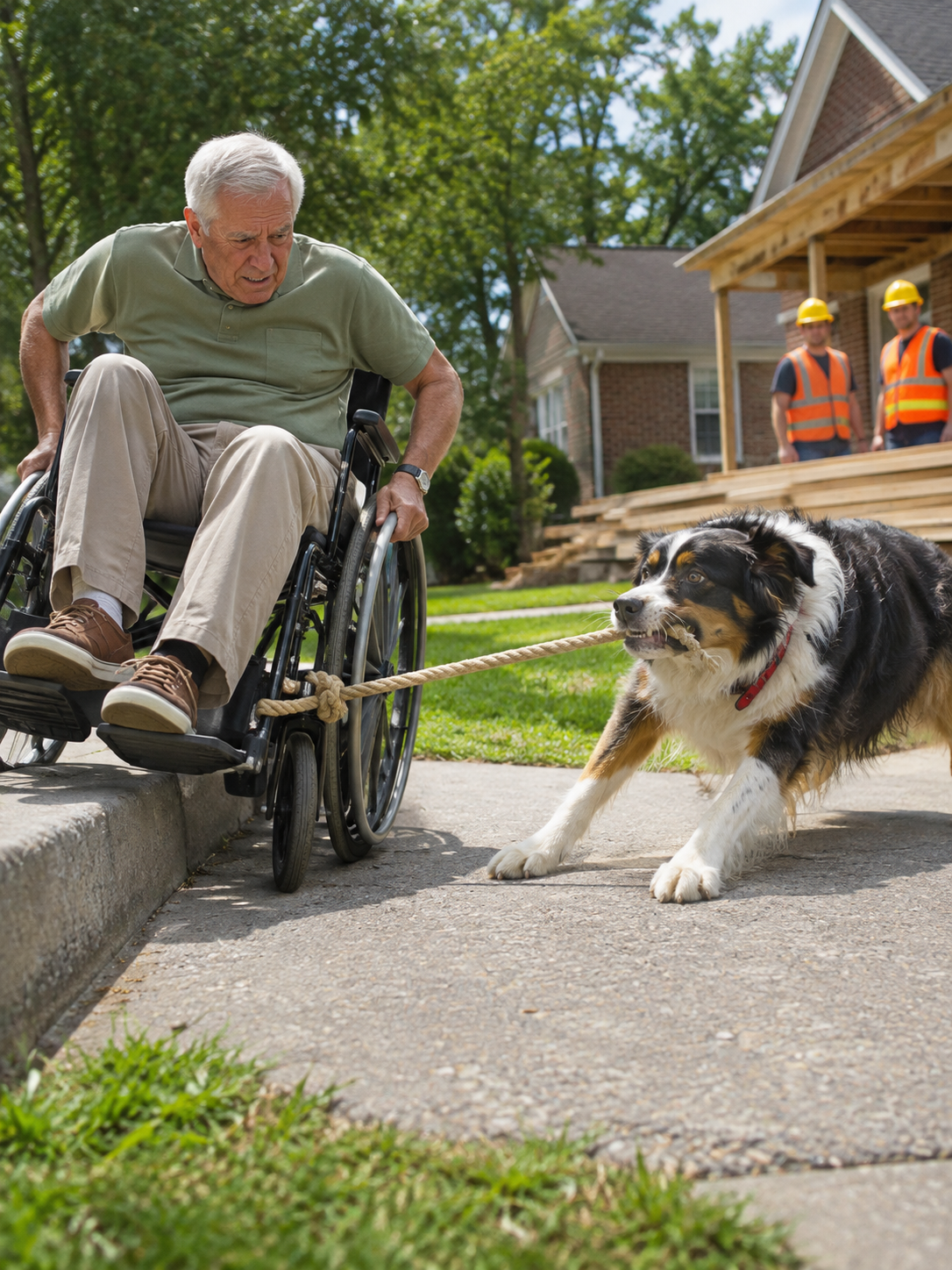
The intelligent and affectionate dog remained close to him, holding a beige rope attached to the wheelchair.
Everything appeared normal until they encountered a raised concrete curb.
The wheelchair’s front wheel suddenly struck the concrete edge, producing a loud rattling sound.
The elderly man nearly lost his balance but managed to steady himself.
His loyal dog immediately attempted to pull the wheelchair forward.
The beige rope tightened, but the wheelchair refused to move beyond the concrete obstacle.
The dog tried again, putting more effort into helping its companion.
Unfortunately, the raised curb was simply too high.
“Come on, buddy! It’s too high!”
The elderly man’s voice revealed his growing frustration.
What might have appeared to be an insignificant obstacle to someone walking along the neighborhood had become a considerable challenge for him.
Despite their combined efforts, neither the man nor his loyal companion could overcome the concrete edge.
The dog looked toward the wheelchair before turning its attention back to the elderly man.
Neither of them could continue their journey.
However, something nearby was about to capture the dog’s attention and completely change the situation.
His Best Friend Could Sense His Frustration
After several unsuccessful attempts, the elderly man stopped pushing his wheelchair.
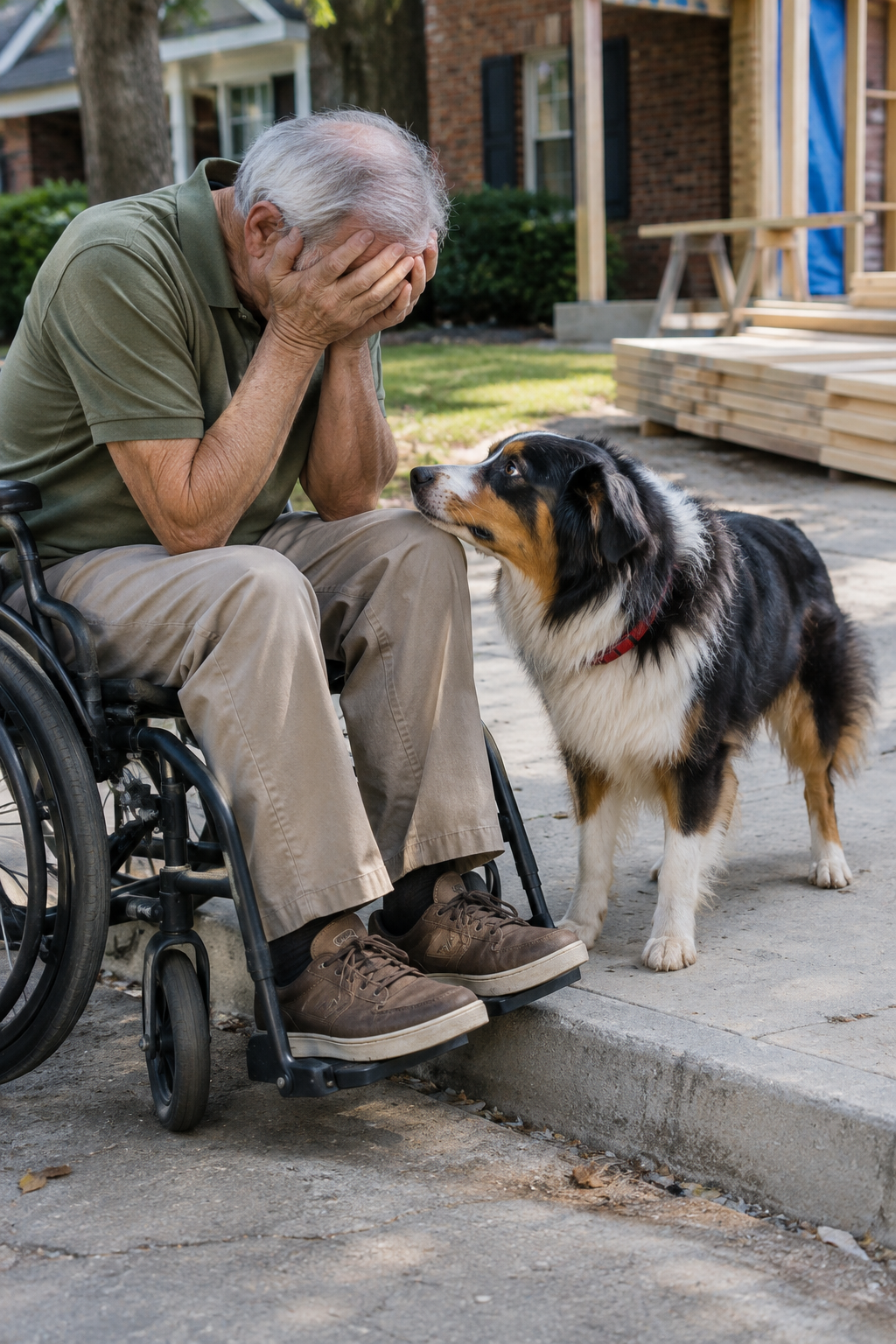
He slowly raised both hands and covered his face.
The frustration of being unable to continue along the sidewalk had become overwhelming.
“I don’t know what to do, buddy.”
His loyal dog immediately released the beige rope.
Instead of continuing to pull the wheelchair, the animal approached the elderly man and gently placed its nose against his knee.
The man remained seated, visibly discouraged.
His companion looked toward him with attentive eyes.
The moment was quiet but deeply emotional.
The dog remained beside him, offering the kind of companionship that did not require words.
Within this fictional story, the animal’s behavior reflected the close relationship between the two companions.
The elderly man was facing a difficult situation, and his faithful dog appeared unwilling to ignore his frustration.
Then something in the distance caught the animal’s attention.
At a nearby residential renovation site, several wooden planks were stacked beside construction materials.
Two workers were standing near the lumber.
The dog looked toward the wooden boards before briefly turning its attention back to the elderly man.
Suddenly, it began running toward the construction site.
The elderly man watched in confusion.
He had no idea why his companion had left his side or what had attracted its attention.
His wheelchair remained beside the raised concrete curb.
All he could do was wait and see what the dog intended to accomplish.
Two Construction Workers Noticed Something Unusual
The nearby renovation site was filled with construction materials, stacked lumber, and the familiar sounds of ongoing work.
Two construction workers stood beside several wooden boards when an unexpected visitor suddenly appeared.
The elderly man’s dog rushed into the open area.
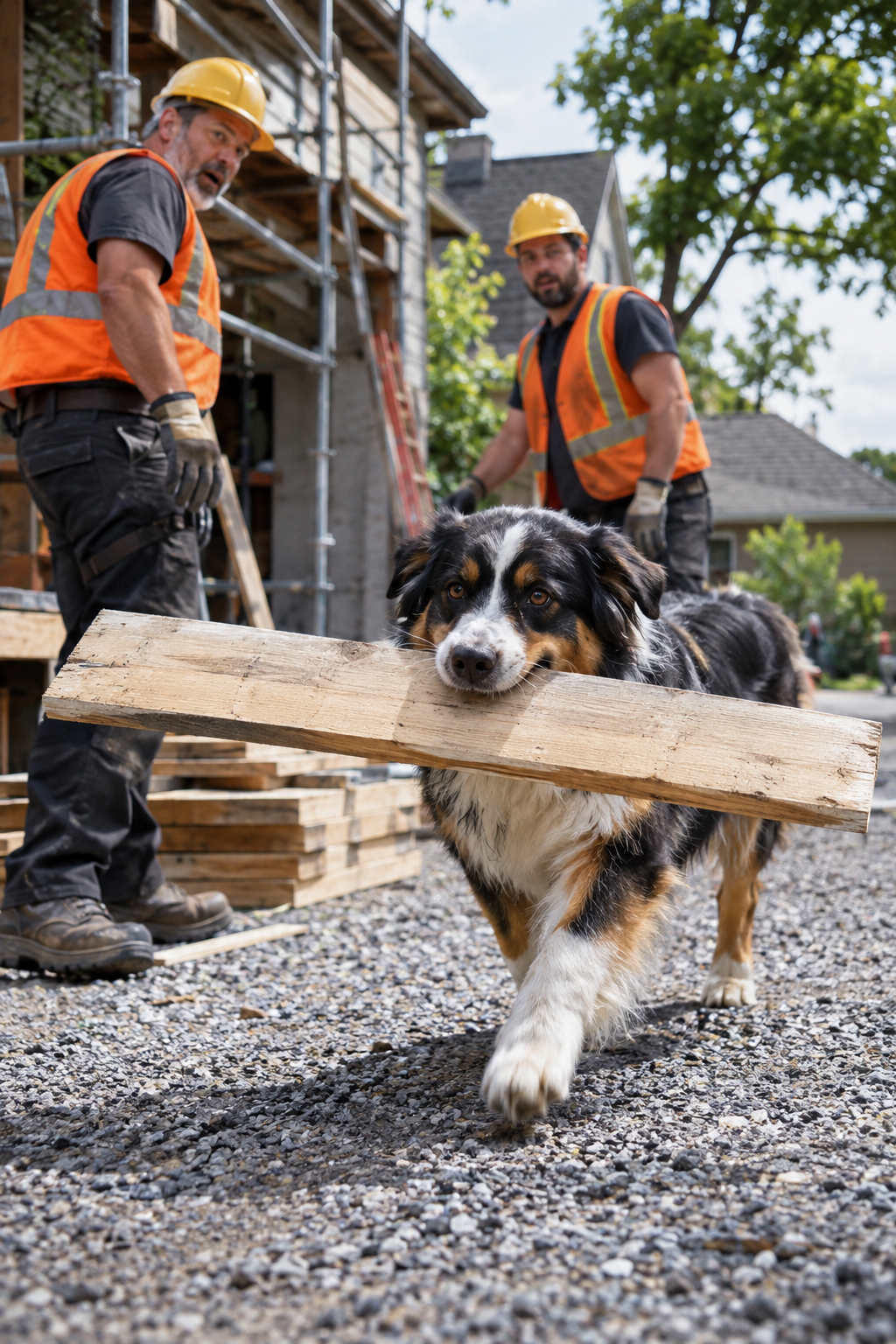
It approached the stacked lumber and began examining several pieces of wood.
The workers immediately noticed the animal’s unusual behavior.
One of them turned toward the dog with a surprised expression.
“Hey! What’s that dog doing?”
The dog continued examining the boards before selecting a wide wooden plank.
It lowered its head and firmly grasped the wood with its mouth.
The plank scraped against the gravel as the animal lifted it.
Both construction workers watched in disbelief.
They had not expected a dog to enter their worksite and begin carrying away a piece of lumber.
However, the animal appeared focused on its unusual task.
It adjusted its grip before turning away from the construction materials.
The wooden plank was held horizontally in its mouth as it began moving toward the sidewalk.
The workers exchanged surprised expressions.
Curious about where the dog was going, they decided to follow.
The animal continued moving quickly, carrying the wooden plank away from the renovation site.
Within the fictional narrative, the dog appeared to have recognized a possible solution to the problem preventing its companion from continuing his journey.
The construction workers had no idea what they were about to discover.
The Elderly Man Couldn’t Believe What His Dog Had Brought Back
The elderly man remained beside the concrete curb, waiting for his companion to return.
His wheelchair was still unable to move onto the raised sidewalk.
Then he noticed the familiar dog approaching from a distance.
But something was different.
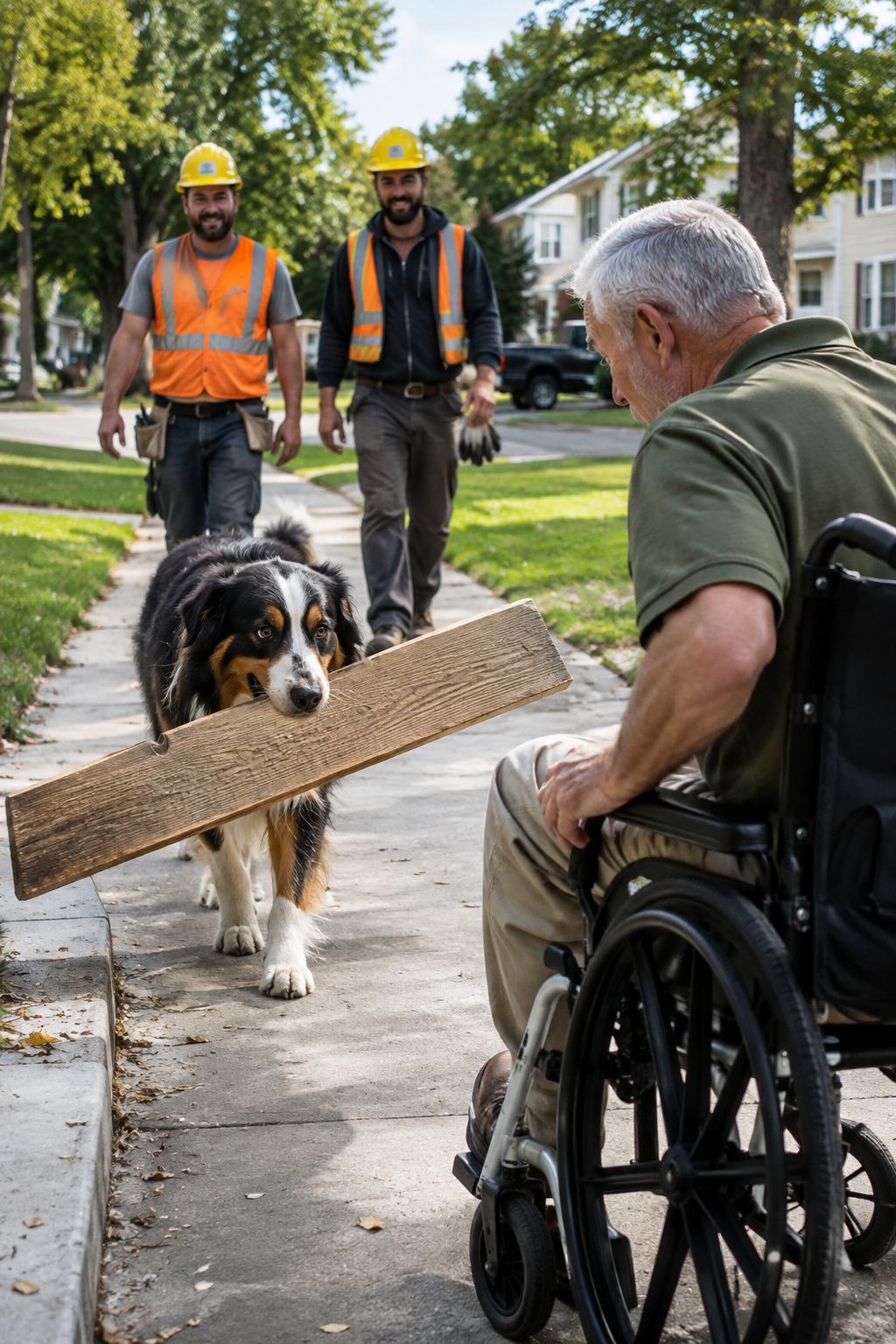
The animal was carrying a wide wooden plank horizontally in its mouth.
The elderly man lifted his head and stared in disbelief.
“Buddy? What did you bring me?”
The dog continued approaching.
Behind it, the two construction workers followed along the suburban sidewalk.
The wooden plank remained securely between the animal’s jaws until it reached the concrete curb.
The dog gently lowered the board onto the pavement.
The elderly man looked at the plank before turning toward his loyal companion.
His earlier frustration was gradually being replaced by curiosity.
The two construction workers approached and noticed the wheelchair positioned beside the raised concrete edge.
They could now see the obstacle that had interrupted the elderly man’s journey.
The dog’s unusual behavior at the renovation site was beginning to make sense within the fictional story.
It had brought the wooden plank directly to the location where its companion needed assistance.
The elderly man continued watching the animal.
The dog moved closer to the board, directing its attention toward the concrete curb.
What had initially appeared to be an ordinary piece of construction material was about to become the central element of an extraordinary moment.
The workers remained nearby, ready to observe what happened next.
An Unexpected Solution Brought Everyone Together
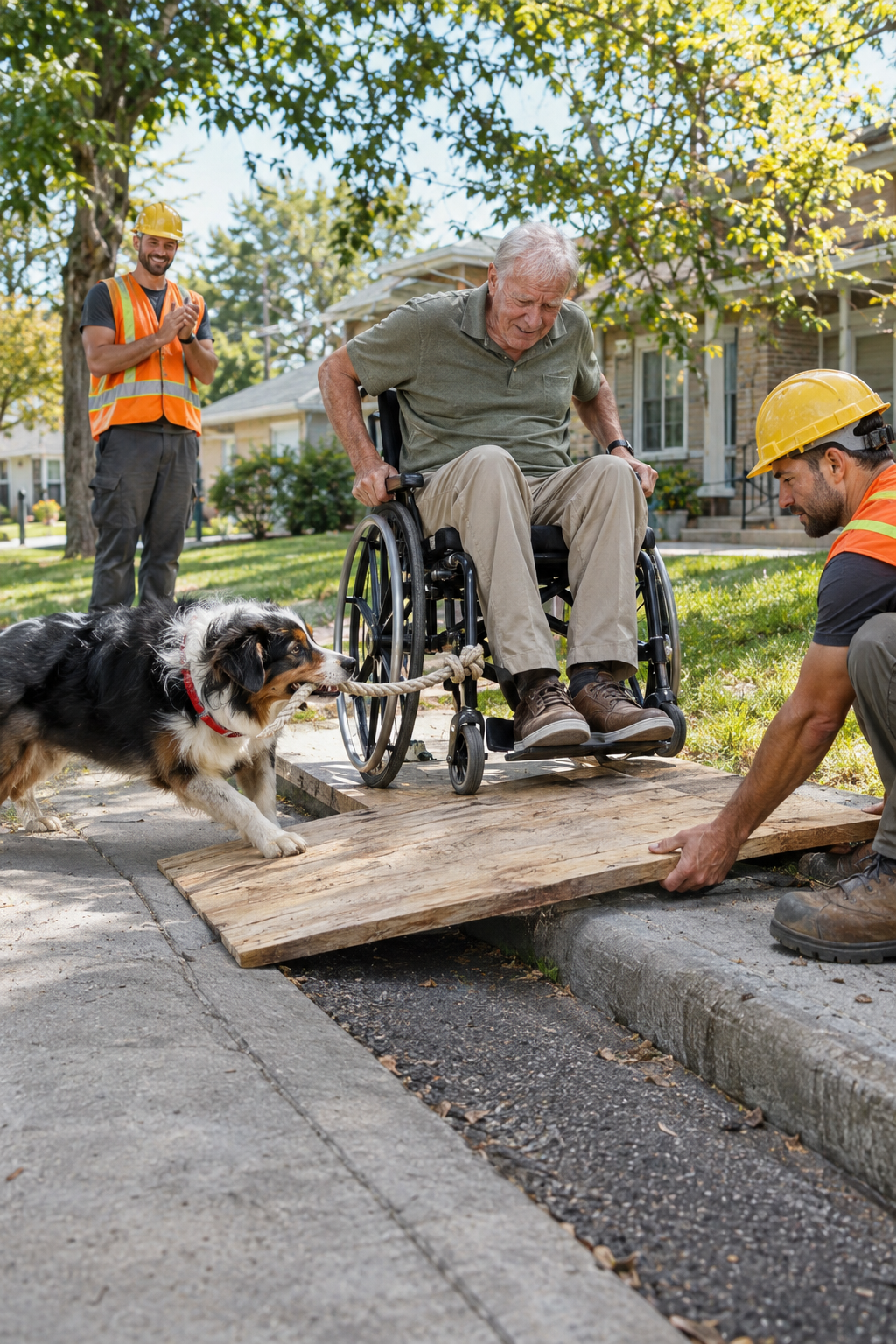
The loyal dog began repositioning the wide wooden plank using its mouth and front paws.
Within the dramatized sequence, the board was moved across the raised concrete curb, creating a temporary inclined surface.
One of the construction workers stepped forward to steady the plank.
The elderly man carefully positioned his wheelchair in front of the wooden surface.
His loyal companion returned to the beige rope.
The dog gently grasped it while the man began propelling his wheelchair forward.
The front wheels slowly rolled onto the wooden plank.
The construction worker maintained his position beside the board.
Unlike the earlier attempts against the concrete curb, the wheelchair was now making visible progress.
The elderly man continued moving forward.
His faithful dog remained in front of him, assisting within the fictional sequence.
The sound of wheels rolling across wood replaced the frustrating rattling that had interrupted their journey earlier.
Gradually, the wheelchair approached the top of the raised curb.
The elderly man’s expression changed as he realized they were finally overcoming the obstacle.
“That’s it, buddy! We made it!”
The wheelchair successfully reached the sidewalk.
The construction workers watched with smiles.
The dog remained beside its companion, appearing pleased with the outcome.
What had begun as a frustrating accessibility problem had transformed into a remarkable fictional moment of cooperation.
However, the most emotional part of the encounter was still to come.
The elderly man was about to show his faithful companion exactly how much their friendship meant to him.
Why Accessibility Matters in Everyday Life
Although this story is fictional, the difficulties associated with inaccessible sidewalks are genuine concerns for many wheelchair users.
Raised curbs, uneven pavement, damaged pathways, and missing accessibility ramps can create significant obstacles.
For someone walking through a neighborhood, a concrete curb might seem like an ordinary part of the environment.
For someone using a wheelchair, that same curb may prevent them from continuing their journey independently.
The elderly man’s experience illustrates this difference.
He was simply attempting to move along a familiar neighborhood when the raised concrete edge interrupted his progress.
He was not attempting an extraordinary physical challenge.
He wanted to continue an ordinary activity without unnecessary barriers.
Accessible sidewalks and properly designed curb ramps help people with different mobility needs navigate their communities more safely.
They support independence, participation, and personal freedom.
Everyone should have the opportunity to visit shops, enjoy outdoor spaces, and travel through their neighborhood without encountering avoidable obstacles.
The fictional story uses an unexpected act of animal companionship to highlight this important issue.
Its broader message is that accessibility should be considered an essential part of community planning and infrastructure maintenance.
People should not have to depend on extraordinary circumstances simply to continue an everyday journey.
The Remarkable Intelligence of Loyal Dogs
Dogs are widely admired for their ability to learn, respond to familiar situations, and develop meaningful relationships with their human companions.
Many working and herding dogs are particularly attentive to movement, routines, and changes in human behavior.
Their intelligence allows them to learn a variety of tasks when provided with appropriate training.
The dog in this fictional story demonstrates an extraordinary level of resourcefulness.
When its initial efforts to help the elderly man fail, it appears to recognize that another approach is necessary.
It notices the wooden boards at the nearby renovation site and retrieves one.
The sequence is deliberately dramatized to create an inspirational story.
It does not establish that real dogs naturally understand the engineering requirements of wheelchair ramps.
Nevertheless, the narrative draws attention to qualities that make dogs such meaningful companions.
Their attentiveness, responsiveness, and willingness to interact with people can contribute to powerful emotional connections.
The elderly man’s dog represents these qualities through an imaginative act of assistance.
Its determination becomes the driving force behind the entire fictional encounter.
The Emotional Importance of Animal Companionship
For many people, a dog is much more than a household pet.
Dogs can become familiar companions during everyday activities, quiet evenings, and challenging moments.
Their presence may provide comfort and encourage meaningful interaction.
The relationship between the elderly man and his loyal dog is central to this fictional story.
When the wheelchair becomes stuck, the animal initially attempts to help.
After those efforts fail, it approaches the man and gently touches his knee with its nose.
That simple gesture communicates the emotional connection between them.
The elderly man is frustrated, but his companion remains attentive.
The story later introduces the extraordinary wooden plank sequence, yet the quieter moment of companionship is equally important.
Sometimes the presence of a familiar animal can make a difficult experience feel less isolating.
The dog cannot express its feelings through human language.
Instead, its attention and affectionate behavior become the foundation of the relationship portrayed in the video.
The fictional encounter celebrates the bond that can develop between people and their animal companions.
It reminds viewers that friendship can be expressed through small gestures as well as extraordinary acts.
Kindness From Unexpected Strangers
The two construction workers play an important supporting role in the story.
Initially, they are simply carrying out their responsibilities at a nearby residential renovation site.
Their attention is captured when the dog unexpectedly enters the area and retrieves a wooden plank.
Curiosity encourages them to follow the animal.
When they reach the elderly man, they discover why the dog has brought the board.
One worker becomes directly involved by steadying the temporary surface during the fictional crossing.
Their participation highlights the importance of cooperation.
The elderly man remains actively involved in moving his wheelchair.
The dog provides assistance within the dramatized narrative.
The construction worker contributes additional support.
Together, they overcome the immediate obstacle.
In real circumstances, people who notice someone experiencing an accessibility difficulty can offer assistance respectfully.
Asking whether help is wanted allows the individual to maintain control over their own mobility and decisions.
People should never assume that a wheelchair user automatically requires assistance or begin moving their wheelchair without permission.
Meaningful kindness respects personal independence.
The fictional construction workers represent the positive impact that thoughtful cooperation can have during an unexpected situation.
Why Safe Accessibility Equipment Is Important
The wooden plank is presented as a successful solution within this fictional video.
However, an ordinary wooden board should not automatically be considered suitable for wheelchair use.
Real accessibility ramps require appropriate dimensions, stability, load capacity, surface traction, and slope.
An unsecured or unsuitable board can shift, break, or create a dangerous incline.
Similarly, pulling a wheelchair with a rope can create risks for both the wheelchair user and the animal.
The fictional scene simplifies these concerns for dramatic storytelling.
It should not be interpreted as a practical demonstration of safe wheelchair assistance.
People encountering inaccessible pathways should seek an appropriate alternative route, suitable mobility equipment, or qualified assistance.
Permanent accessibility improvements should be designed according to applicable safety requirements and professional guidance.
The central lesson is not that a wooden plank can solve every accessibility problem.
It is that people deserve environments designed to accommodate their mobility needs.
Safe infrastructure can prevent frustrating situations like the one depicted in the story.
Accessibility should support independence rather than require improvised solutions.
The Difference Between Assistance and Independence
Throughout the fictional encounter, the elderly man remains actively involved in his own movement.
He initially attempts to propel his wheelchair beyond the concrete curb.
Later, when the wooden plank is positioned, he carefully aligns the wheels and continues moving forward.
His dog and the construction worker provide assistance, but the man remains an active participant.
This distinction is important.
Receiving assistance does not mean losing independence.
People with disabilities can make their own decisions about when support is appropriate and how it should be provided.
Accessible environments and suitable equipment can help individuals maintain greater control over their everyday activities.
The elderly man’s frustration in the story is connected to a specific physical obstacle.
It does not define his entire life or determine his capabilities.
The emotional resolution occurs when that obstacle is overcome through cooperation.
The fictional narrative encourages viewers to recognize the importance of removing environmental barriers while respecting individual dignity.
Supporting someone should involve acknowledging their choices, abilities, and personal preferences.
Sometimes the Smallest Gestures Carry the Greatest Meaning
The dog retrieving the wooden plank is the most extraordinary element of the fictional story.
However, another moment deserves equal attention.
When the elderly man covers his face in frustration, the dog approaches and gently places its nose against his knee.
There is no dramatic celebration or complicated action.
The animal simply remains close to its companion.
That quiet interaction illustrates the emotional significance of companionship.
People often remember moments when someone remained beside them during a difficult experience.
The same emotional theme is reflected in many relationships between humans and their pets.
A familiar presence can become meaningful when circumstances feel frustrating or uncertain.
The elderly man’s loyal dog provides that presence throughout the fictional encounter.
Its later actions are dramatized to create an extraordinary narrative, but the underlying message is familiar.
Friendship is not measured solely by impressive achievements.
It can also be expressed through attention, patience, affection, and the willingness to remain close during challenging moments.
The Beautiful Meaning Behind Their Friendship
The elderly man’s journey begins with an ordinary outing through a quiet neighborhood.
An unexpected concrete obstacle interrupts his progress.
His loyal companion initially attempts to help but cannot overcome the raised curb.
When the man becomes frustrated, the dog remains attentive.
It then notices something nearby and retrieves a wooden plank from a renovation site.
Two construction workers follow the animal and become involved in the situation.
Their cooperation allows the elderly man to continue moving along the sidewalk.
The fictional story combines several meaningful themes.
It highlights companionship, accessibility, cooperation, and the importance of recognizing when someone may need assistance.
The extraordinary behavior of the dog creates the dramatic structure of the narrative.
However, the emotional strength comes from the relationship between the two companions.
The story does not establish how long the elderly man and his dog have been together.
It does not describe their previous experiences or the animal’s training history.
Those details remain unknown.
Nevertheless, their affectionate interaction communicates a powerful sense of friendship.
The elderly man’s gratitude becomes the emotional center of the final scene.
One Final Moment That Touched Everyone
The wheelchair had finally reached the sidewalk.
The raised concrete curb was now behind the elderly man.
The wooden plank remained near the edge, while the two construction workers stood nearby.
Birdsong and the gentle movement of leaves once again filled the peaceful neighborhood.
The elderly man’s earlier frustration had been replaced by a warm smile.
His faithful dog turned toward him.
The animal that had remained attentive throughout the encounter was now standing beside his wheelchair.
The two construction workers watched quietly.
The elderly man looked down at his companion with visible affection.
After everything that had happened, the wooden plank was no longer the most important part of the story.
Neither was the concrete curb.
The most meaningful element was the friendship between the elderly man and the dog that had remained beside him throughout the difficult moment.
Their extraordinary fictional encounter was about to end with a simple expression of gratitude.
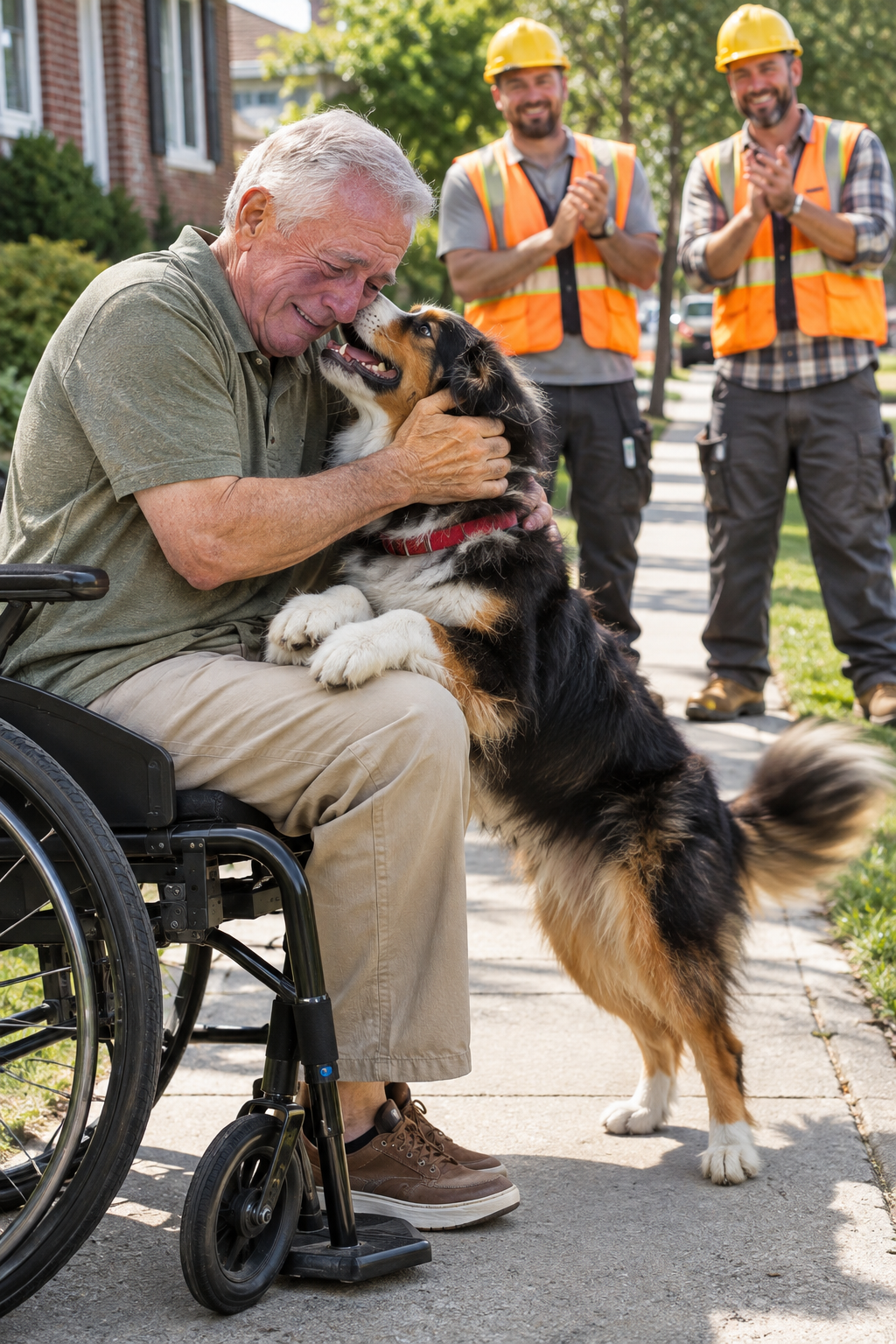
The loyal dog gently placed its front paws on the elderly man’s knees as he leaned forward and wrapped his arms around his faithful companion. The two construction workers smiled and applauded while the dog happily wagged its tail. Stroking the animal’s head, the elderly man said emotionally, “You’re more than a dog. You’re my best friend.” Their beautiful encounter ended with a touching reminder that genuine friendship, compassion, and cooperation can make even the most difficult moments feel a little easier.
Disclaimer: This article and its accompanying video are fictional, AI-generated content created for entertainment, inspirational storytelling, and accessibility awareness. The characters, animals, and events depicted do not represent a verified real-life incident. Animal behavior and wheelchair assistance techniques are dramatized. Improvised wheelchair ramps and rope-based pulling can be dangerous and should not be attempted without appropriate professional guidance, equipment, and safety assessment.