An Ordinary Bus Ride Turned Into a Painful Experience
Bright sunlight streamed through the windows of a crowded public transit bus. Passengers occupied nearly every available seat, while others stood in the aisle, holding the yellow handrails as the vehicle continued along its route.
Among them was a woman named Emily.
She carried a beige shoulder bag, wore white sneakers, and used a black carbon-fiber prosthetic leg on her right side.
As the bus moved, Emily struggled to maintain her balance.
She held the yellow handrail tightly, attempting to remain steady despite the vehicle’s movements.
Directly beside her was a priority seat occupied by a woman named Karen.
Karen sat comfortably with her legs crossed while Emily remained standing nearby.
Realizing that sitting down would make the journey considerably easier, Emily politely approached her.
“Excuse me, could I please sit down?”
Her request was calm and respectful.
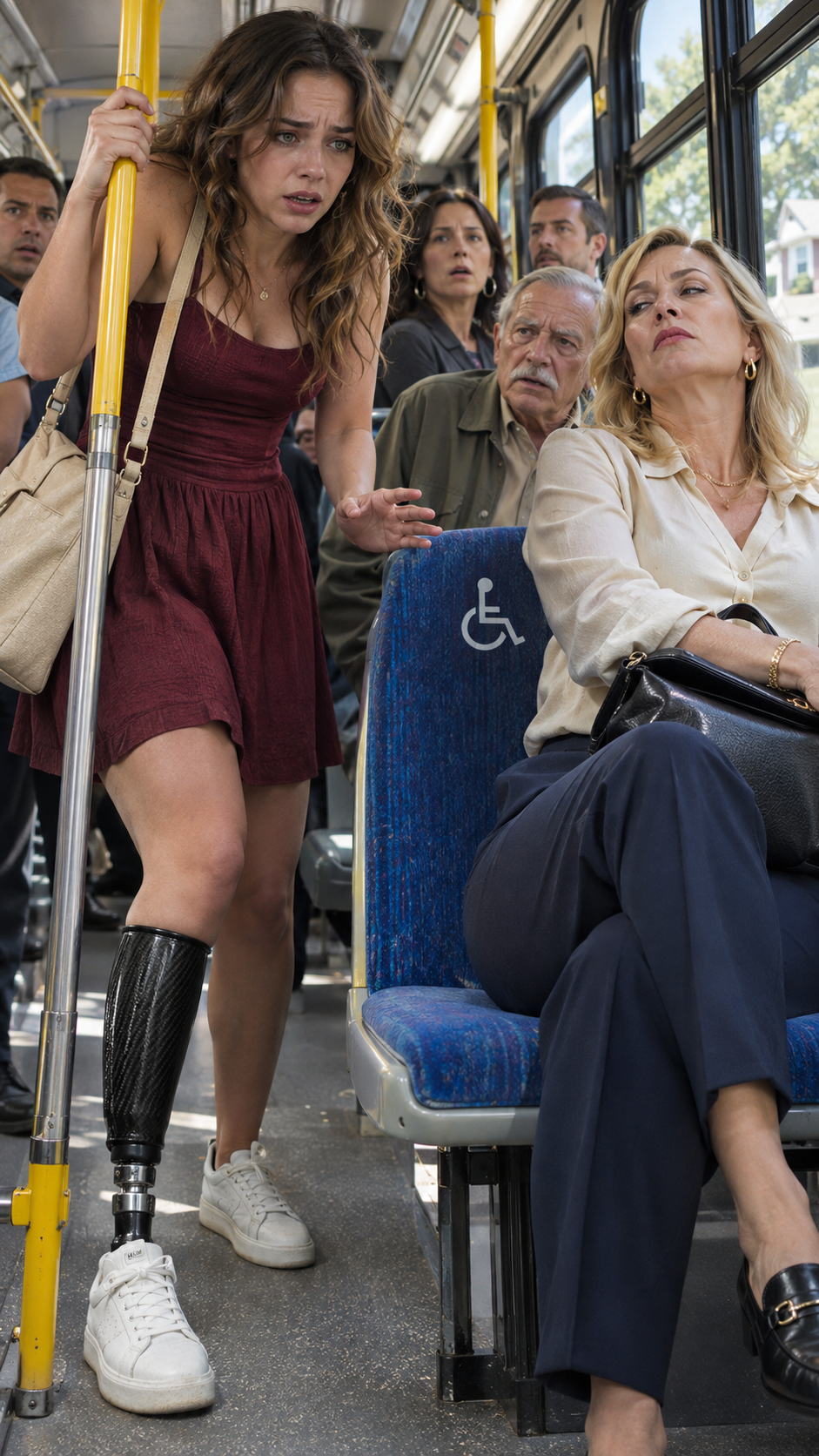
Karen looked directly toward Emily’s prosthetic leg before responding coldly.
“Find another seat.”
Several nearby passengers turned their heads in surprise.
Emily appeared uncomfortable, but she did not respond aggressively.
She continued holding the yellow handrail, attempting to maintain her balance.
The crowded bus offered few obvious alternatives.
What should have been an ordinary journey was becoming increasingly difficult for her.
Unfortunately, the uncomfortable exchange was only the beginning of an unexpected situation that would soon capture the attention of everyone nearby.
Emily Tried to Explain Why She Needed the Seat
The bus continued moving while Emily remained standing beside Karen.
Every vibration from the road made maintaining her balance more challenging.
She tightened her grip on the yellow handrail and looked toward the seated passenger again.
Rather than becoming angry, Emily attempted to explain her situation.
“It’s really difficult for me to stand.”
Her words were simple.
She was not asking for special attention or attempting to create an argument.
She was explaining a specific difficulty that affected her ability to remain standing safely while the vehicle was moving.
Karen turned her attention toward the window.
“That’s not my problem.”
The response left Emily visibly uncomfortable.
Several passengers nearby had heard the exchange.
However, nobody immediately stepped forward to address the situation.
Emily continued holding the handrail.
Her beige handbag remained over her shoulder as she attempted to steady herself.
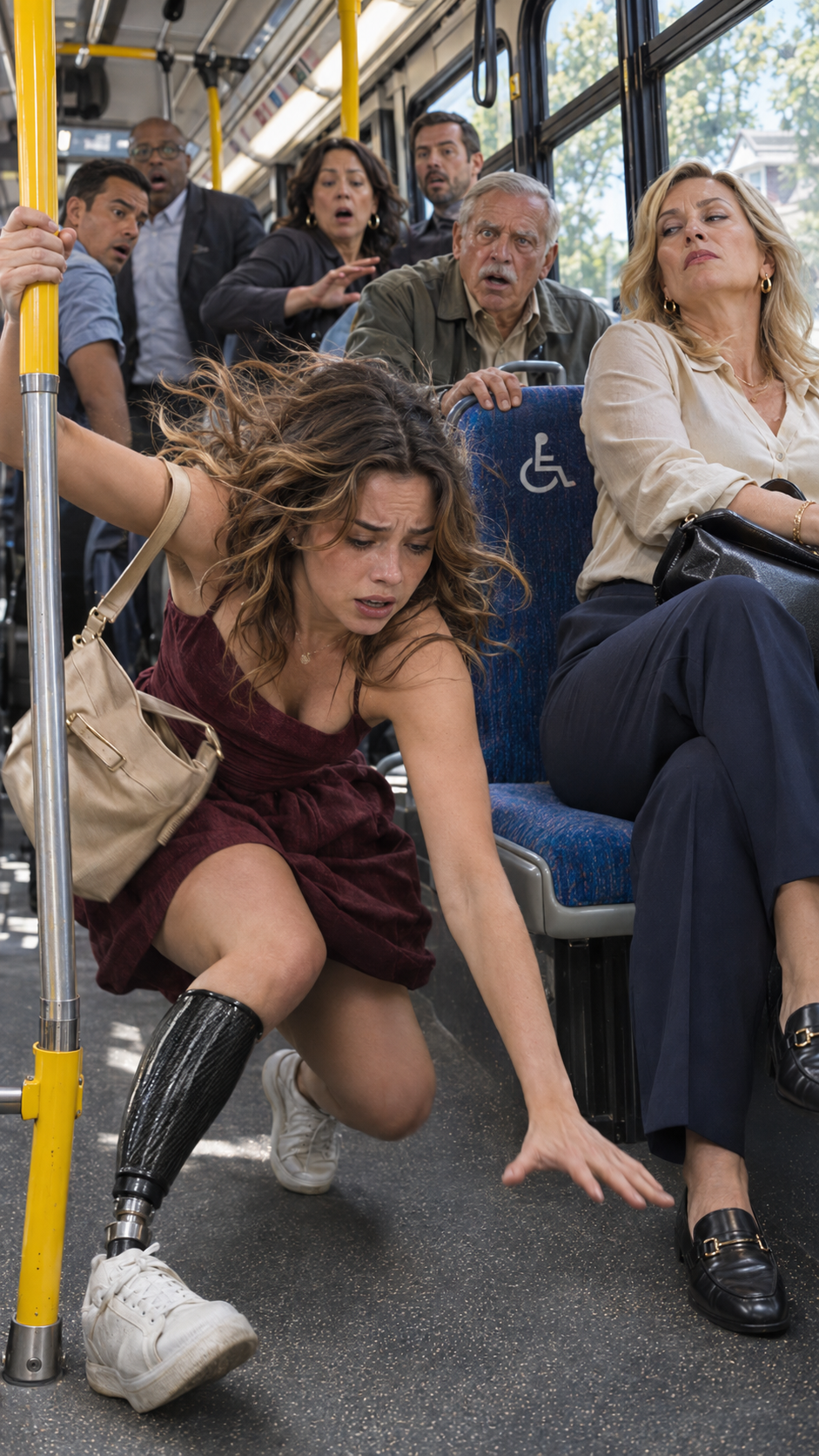
Then the bus suddenly braked.
The unexpected movement caused Emily to lose her balance.
Her handbag slipped from her shoulder, and she fell onto the rubber floor of the bus.
Several passengers gasped in shock.
The sound of the handbag striking the floor interrupted the ordinary background noise of the vehicle.
Emily remained seated on the ground, attempting to understand what had just happened.
There were no visible injuries, but the fall had left her shaken.
The situation had now become much more serious than an uncomfortable disagreement over a seat.
She Found Herself on the Floor Asking for Help
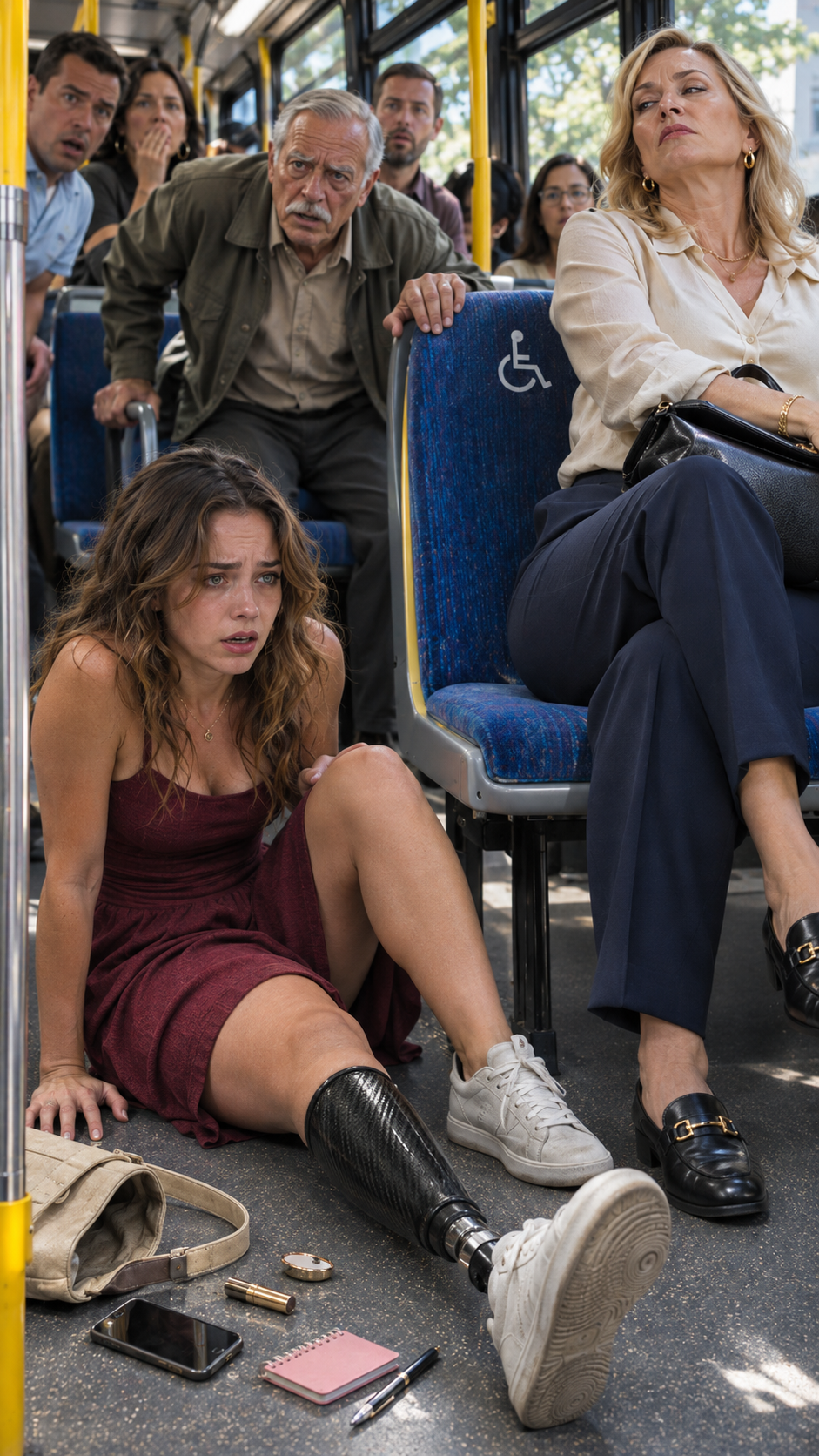
Emily sat on the rubber bus floor with her right prosthetic leg extended forward.
Her beige handbag lay beside her.
A smartphone and several small personal belongings had fallen out of the bag and were scattered across the floor.
She looked toward the surrounding passengers.
The experience was clearly uncomfortable and embarrassing.
Only moments earlier, she had politely explained that remaining standing was difficult.
Now she found herself sitting on the floor of a crowded vehicle.
“Could somebody please help me?”
Her voice reflected her nervousness.
Several passengers watched the situation unfold.
Karen remained in the priority seat.
Instead of standing, she pulled her black handbag closer to herself.
The atmosphere inside the bus became noticeably quieter.
People exchanged uncertain looks while Emily waited for someone to respond.
The fictional story does not establish why every nearby passenger initially remained in place.
Some may have been surprised or uncertain about how to react.
However, the immediate result was that Emily remained on the floor without assistance.
Then an elderly passenger named Robert noticed what had happened.
He had been sitting farther away from the initial exchange.
As soon as he recognized Emily’s situation, he rose from his seat.
Wearing an olive-green jacket over a beige shirt, Robert began making his way toward her.
While others remained uncertain, he decided that the woman should not have to face the situation alone.
His response was about to change the atmosphere inside the entire bus.
An Elderly Passenger Finally Stepped Forward
Robert carefully walked through the crowded aisle toward Emily.
Several passengers began moving aside as he approached.
He did not shout at Karen or criticize the surrounding people.
Instead, his attention remained focused on the woman sitting on the floor.
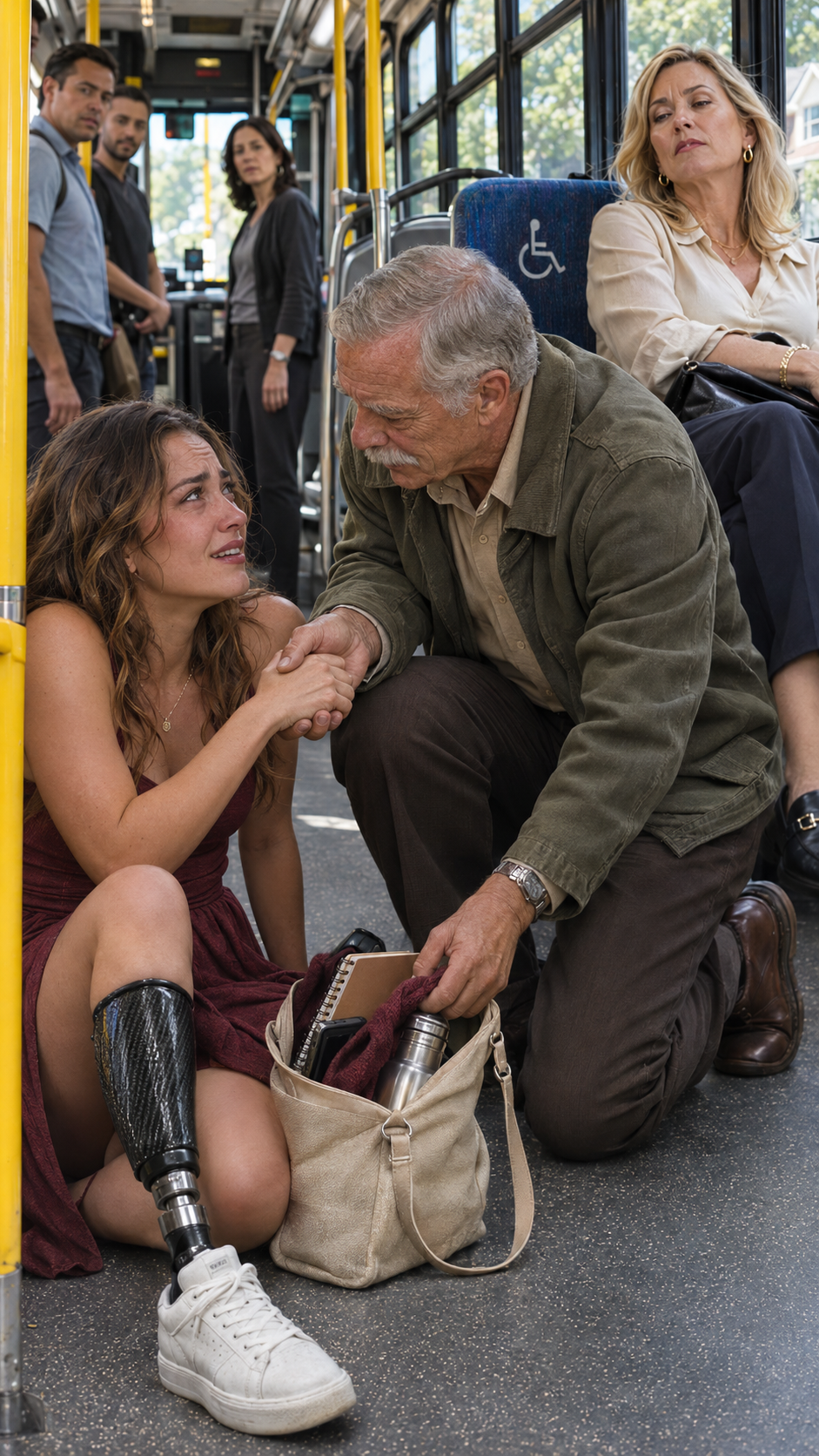
When he reached Emily, he carefully knelt beside her.
“Are you hurt, sweetheart?”
His voice was gentle and reassuring.
Emily shook her head.
“I just couldn’t keep my balance.”
Robert listened carefully.
He then noticed the personal belongings scattered across the rubber floor.
Her smartphone and other small items were lying beside the beige handbag.
Without making the situation more uncomfortable for her, Robert began collecting them.
He carefully placed the belongings back inside her bag.
Emily watched as the elderly man helped restore some order to the unexpected situation.
Karen remained seated nearby, silently observing his actions.
The other passengers continued making room around them.
Robert’s response was noticeably different from the dismissive attitude Emily had encountered earlier.
He was not interested in creating a confrontation.
His immediate concern was whether she was injured and what assistance she needed.
The fictional encounter highlights how a calm, considerate response can make a meaningful difference when someone experiences an unexpected difficulty in public.
Robert’s kindness was expressed through practical actions rather than dramatic promises.
He checked on Emily, collected her belongings, and remained beside her.
But he was not finished helping.
He was about to offer something that had been available throughout the journey but had previously been refused.
His Next Words Made Everyone Think
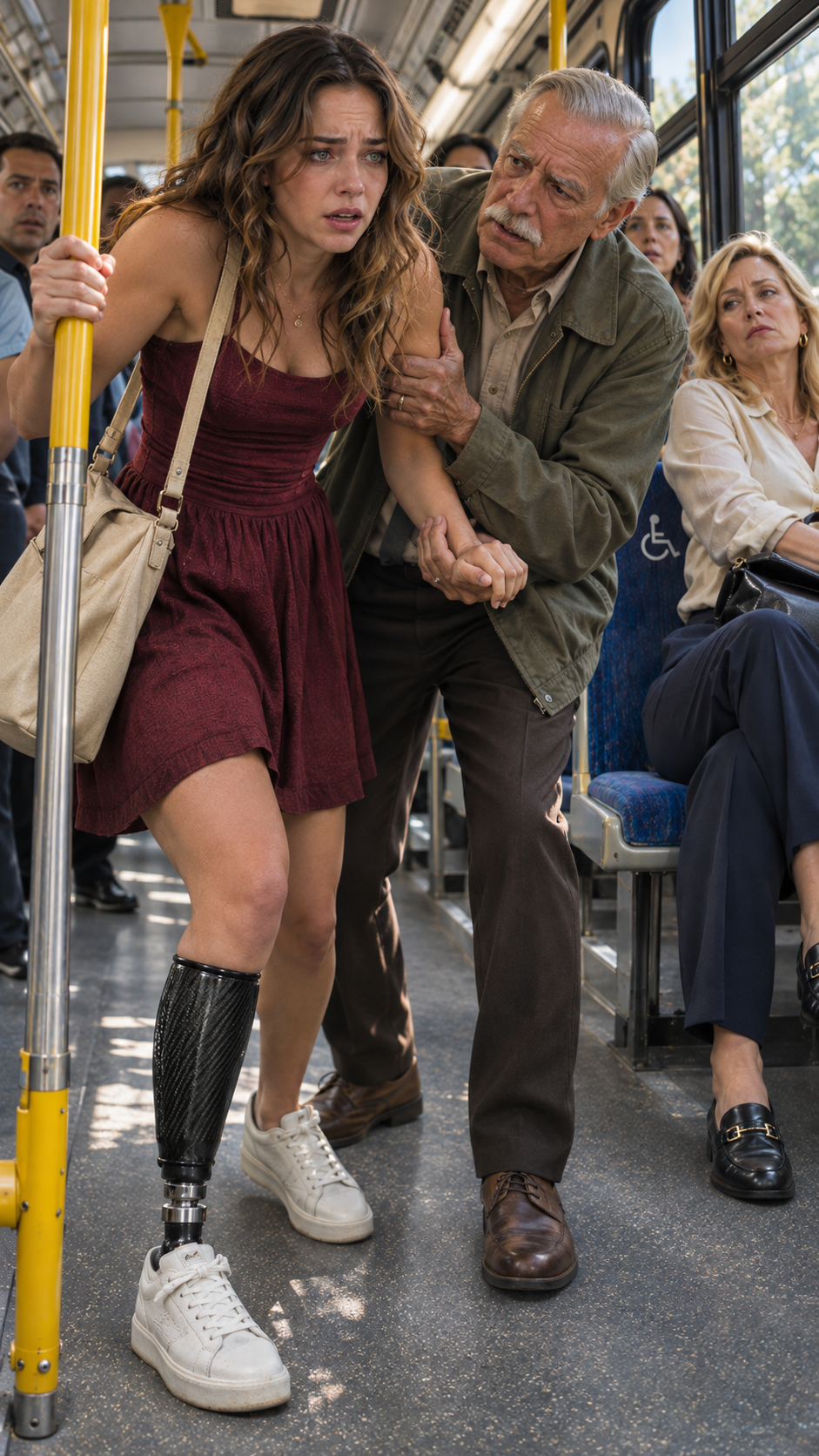
Robert gently supported Emily by her forearm and upper arm as she carefully began rising from the floor.
She positioned her white sneakers beneath her and gradually returned to an upright position.
Her right black carbon-fiber prosthetic leg remained securely in place.
Robert continued providing support while she regained her balance.
Once Emily was standing, he turned toward Karen.
His expression remained calm.
“Kindness shouldn’t be this difficult.”
There was no shouting or aggressive confrontation.
The elderly man simply expressed what the situation had demonstrated.
He then gestured toward the seat he had previously occupied.
“Come on, you can have my seat.”
Emily looked at him gratefully.
Robert carefully guided her toward the available seat, allowing her to move at a comfortable pace.
Several passengers watched the interaction.
The elderly man had willingly offered his own place to someone who had explained that standing was difficult.
He did not demand recognition or expect anything in return.
Within the fictional narrative, his actions created a powerful contrast with Karen’s earlier dismissive response.
The priority seat remained occupied, but Emily now had another opportunity to sit down.
Robert’s simple decision had resolved the immediate problem.
More importantly, he had treated Emily with the dignity and consideration that she deserved.
The atmosphere inside the bus had changed.
What began as an uncomfortable refusal had become an opportunity to demonstrate the meaning of genuine kindness.
However, the most touching exchange between Emily and Robert was still to come.
Why Priority Seating Is Important
Although this story is fictional, priority seating serves an important purpose on public transportation.
Moving vehicles can create challenges for passengers who experience difficulties with balance, mobility, fatigue, pain, or other physical conditions.
Sudden braking, acceleration, and unexpected movements may make standing particularly difficult for some individuals.
Priority seats are intended to help passengers who need accessible seating during their journeys.
These may include people with disabilities, older adults, pregnant passengers, and individuals with temporary injuries or other relevant conditions.
Emily’s experience illustrates how access to a seat can affect someone’s ability to travel comfortably and safely.
She explains that standing is difficult while holding the yellow handrail.
Her request is connected to a specific mobility challenge rather than a desire for unnecessary attention.
The subsequent fall demonstrates the potential consequences of remaining standing when maintaining balance is difficult.
However, it is also important to recognize that not every disability is visible.
Someone occupying a priority seat may have a genuine need for it, even when that need is not immediately apparent to others.
The fictional story does not establish whether Karen has an undisclosed medical condition.
Its criticism focuses on her dismissive responses and lack of consideration rather than assumptions about her physical appearance.
Respectful communication and awareness of other passengers can help create a more accessible transportation environment for everyone.
Living With a Prosthetic Leg
People who use prosthetic limbs have different experiences, abilities, and individual needs.
Some participate in demanding physical activities, while others may experience challenges involving balance, fatigue, discomfort, or movement.
The type of prosthesis, the person’s physical condition, their experience using the device, and the surrounding environment can all influence mobility.
Emily’s fictional experience represents one particular situation.
She uses a right carbon-fiber prosthetic leg and experiences difficulty maintaining her balance inside a moving bus.
The narrative does not establish why she uses a prosthesis or how long she has had it.
Those personal details are not necessary to understand her request.
She simply explains that standing is difficult.
People with prosthetic limbs should not be expected to demonstrate or justify every aspect of their medical circumstances before receiving respectful consideration.
At the same time, using a prosthetic limb does not automatically mean someone is incapable of standing, walking, working, or participating independently in everyday activities.
Individual needs vary considerably.
The most appropriate approach is to listen when someone communicates a specific difficulty and respond without making unnecessary assumptions.
The fictional story encourages viewers to recognize Emily as a person navigating an ordinary journey, rather than defining her entirely by her disability.
The Difference Between Sympathy and Respect
Robert’s behavior illustrates an important distinction between sympathy and respectful assistance.
He does not approach Emily by assuming that she is incapable of making her own decisions.
Instead, he begins by asking whether she is hurt.
He listens to her explanation before offering practical assistance.
He collects her belongings and supports her as she rises.
Finally, he offers his own seat.
These actions are presented as thoughtful responses to a specific situation.
Respectful assistance involves recognizing another person’s dignity, preferences, and independence.
People with disabilities do not necessarily want unsolicited help during every interaction.
However, when someone explicitly requests assistance, responding appropriately can make a significant difference.
In real circumstances, it is generally important to ask before physically assisting someone or touching their mobility equipment.
Different people may have specific preferences about how assistance should be provided.
The fictional scene simplifies the process of helping Emily stand for storytelling purposes.
It should not be treated as a universal demonstration of how to assist someone following a fall.
Nevertheless, Robert’s willingness to listen and respond respectfully represents the central moral of the story.
Kindness becomes more meaningful when it respects the person receiving it.
Why People Sometimes Hesitate to Help
One of the uncomfortable elements of the fictional encounter is the hesitation of the surrounding passengers.
Emily falls onto the floor and asks whether somebody can help her.
Several people watch, but Robert is the first person shown actively approaching her.
In public situations, people may hesitate for various reasons.
They may be uncertain about what happened, worried about making the situation worse, or unsure whether someone else is already preparing to intervene.
Sometimes the presence of multiple witnesses can contribute to uncertainty about who should respond.
However, hesitation does not always indicate deliberate indifference.
The fictional video does not reveal the individual motivations of every passenger.
What it demonstrates is the importance of recognizing when someone has clearly requested assistance.
Robert responds by approaching Emily and asking whether she is hurt.
His actions encourage the surrounding passengers to move aside and provide additional space.
In real emergencies, appropriate assistance may involve contacting the driver, requesting medical help, or asking the person what they need.
Not every situation requires direct physical intervention.
Sometimes simply acknowledging the person’s request and helping organize an appropriate response can be valuable.
The story encourages viewers to consider how they might respond when someone nearby experiences an unexpected difficulty.
Small Acts of Kindness Can Make a Significant Difference
Robert does not possess extraordinary abilities.
He is simply an elderly passenger traveling on the same bus.
What makes his involvement meaningful is his willingness to respond when Emily needs assistance.
He leaves his seat, walks through the crowded aisle, and kneels beside her.
He helps collect the belongings that fell from her handbag.
He then offers the seat he had been using.
Each individual action appears relatively simple.
Together, they transform Emily’s experience.
The fictional narrative demonstrates that kindness does not always require considerable financial resources or complicated decisions.
Sometimes it involves offering time, attention, patience, or something that another person needs more urgently.
Robert’s decision to stand instead of remaining seated represents a voluntary act of consideration.
He recognizes Emily’s difficulty and chooses to help address it.
The story does not establish whether he knows Emily personally or whether they have previously met.
His assistance is presented as an act of kindness between strangers.
This makes the encounter particularly meaningful.
Public spaces bring together people with different experiences, needs, and circumstances.
Thoughtful interactions can contribute to an environment in which everyone feels more respected and included.
Accessibility Is About More Than Physical Infrastructure
Accessible transportation depends partly on vehicle design and appropriate facilities.
Handrails, designated seating, accessible entrances, and suitable spaces can help accommodate passengers with different mobility needs.
However, the behavior of people using those facilities also matters.
A priority seat cannot fully serve its intended purpose when passengers dismiss the needs of others without consideration.
Similarly, accessible infrastructure may become less effective when people unnecessarily obstruct pathways or designated spaces.
Emily’s fictional experience illustrates the interaction between physical accessibility and social awareness.
The bus contains yellow handrails and priority seating.
Nevertheless, she encounters difficulty because she cannot immediately access a suitable seat.
Robert’s eventual assistance helps resolve the immediate problem.
The broader lesson is that accessibility involves both practical design and respectful human interaction.
People should not have to experience embarrassment or unnecessary conflict when communicating a legitimate accessibility need.
Transportation environments should encourage clear communication, appropriate assistance, and consideration for passengers whose needs may differ.
This does not mean making assumptions about strangers or demanding explanations about private medical conditions.
It means recognizing that people may experience the same environment differently.
A thoughtful response can help make shared spaces more comfortable for everyone.
Why Robert Chose Kindness Instead of Confrontation
Another important element of the fictional story is Robert’s calm response to Karen.
He witnesses the consequences of Emily’s difficulty and recognizes the dismissive behavior she experienced.
However, he does not insult Karen or attempt to humiliate her.
His statement is brief.
“Kindness shouldn’t be this difficult.”
He then directs his attention toward helping Emily reach an available seat.
This approach emphasizes the difference between addressing inappropriate behavior and escalating a conflict.
Robert’s actions communicate his values more effectively than an extended argument might have done.
He demonstrates the consideration that had been missing from the earlier exchange.
The fictional story does not show Karen apologizing or offering an explanation for her behavior.
Her eventual discomfort is communicated through her expression and lowered gaze.
It would therefore be inaccurate to claim that she permanently changed her attitude following the encounter.
The narrative simply presents a moment in which she witnesses another passenger responding differently.
Robert’s behavior becomes an example of how someone can challenge unkindness without responding with further hostility.
His priority remains helping the person who needs assistance.
Everyone Deserves Dignity in Public Spaces
Public transportation allows people to travel to work, appointments, social activities, and countless other destinations.
For many individuals, it is an essential part of maintaining independence.
Experiencing unnecessary embarrassment while using these services can make ordinary journeys more stressful.
Emily’s fictional experience begins with a reasonable request for somewhere to sit.
Her prosthetic leg is visible, but her dignity should not depend on whether other passengers recognize or understand her medical circumstances.
She deserves respectful communication regardless of her physical condition.
Robert’s actions reinforce this principle.
He responds to her as a fellow passenger who has experienced a difficult moment.
He does not make her situation into a spectacle or demand gratitude.
Instead, he provides practical assistance and offers reassurance.
The fictional story encourages viewers to consider the importance of treating strangers with basic consideration.
Everyone has circumstances that may not be immediately visible to others.
A person may be experiencing pain, exhaustion, uncertainty, or difficulties that are not obvious from their appearance.
Responding with patience can help prevent unnecessary conflict.
Respect is not something people should have to earn by explaining their vulnerabilities.
It should be a normal part of everyday interactions.
What to Do When Someone Falls on Public Transportation
Falls inside moving vehicles can sometimes result in injuries that are not immediately apparent.
The fictional video shows Emily remaining conscious and reporting that she is not hurt.
However, no medical examination is shown.
In real circumstances, someone who falls should be given an opportunity to explain how they feel and whether they require assistance.
If a serious injury is suspected, unnecessary movement should be avoided while appropriate medical help is arranged.
Informing the vehicle operator may also be important, particularly if the bus is still moving or the surrounding conditions are unsafe.
People should avoid attempting unfamiliar lifting techniques or handling mobility equipment without permission.
The appropriate response depends on the individual’s condition and the circumstances of the fall.
Robert’s actions are dramatized to communicate kindness and practical support.
They are not intended as professional medical or mobility assistance instructions.
The broader message is that noticing a person in difficulty and responding responsibly can help prevent additional harm.
Sometimes assistance involves offering reassurance.
In other situations, contacting qualified professionals may be necessary.
Respecting the person’s preferences and prioritizing safety should remain central to the response.
One Final Exchange That Changed the Atmosphere
Warm daylight continued streaming through the bus windows.
The yellow handrails, blue fabric seats, and crowded aisle remained part of the familiar transportation setting.
Emily’s beige handbag was once again holding the belongings that had scattered across the floor.
Robert remained close as she reached the seat he had offered.
Karen watched quietly from her original position.
The earlier tension had gradually been replaced by a calmer atmosphere.
Several passengers looked toward the elderly man and the woman he had helped.
There had been no dramatic confrontation or public argument.
Robert had simply recognized a difficult situation and chosen to respond with consideration.
For Emily, his assistance meant that she could continue her journey without the immediate difficulty of remaining standing.
For the surrounding passengers, the encounter offered a moment of reflection.
The elderly man’s actions had communicated something important without requiring a lengthy explanation.
Emily looked toward him with a grateful expression.
After everything that had happened, she finally had an opportunity to express how much his kindness meant to her.
The final moments of their fictional encounter would capture a simple message that everyone on the bus could understand.
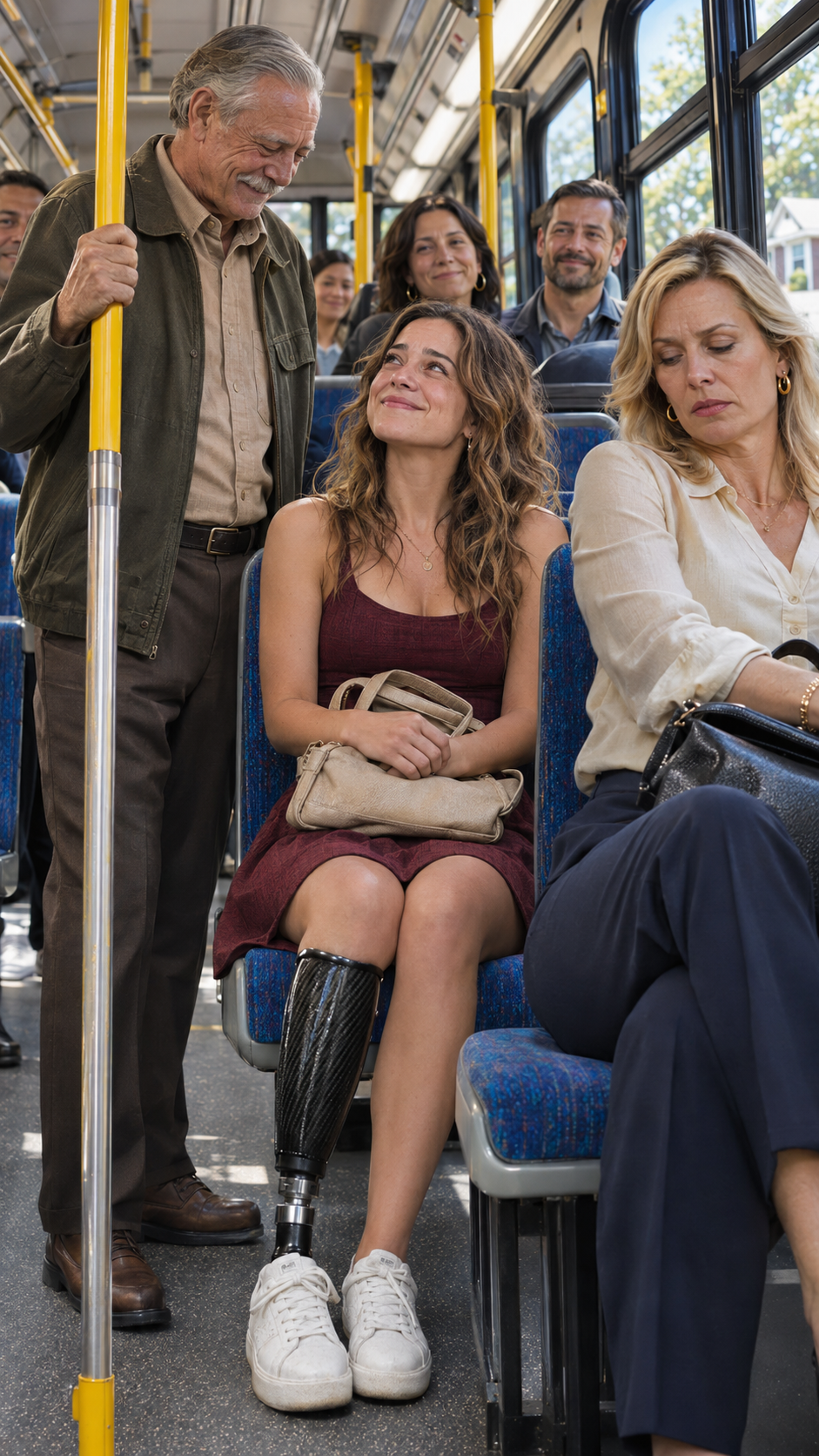
Emily sat comfortably on the blue fabric seat with her beige handbag resting on her lap while Robert stood beside her, holding the yellow handrail. Smiling emotionally, she said, “Thank you. You didn’t have to do that.” Robert smiled warmly and replied, “We should always look out for each other.” Karen lowered her gaze as several passengers smiled quietly. The bus continued its journey beneath the warm daylight, leaving behind a beautiful reminder that genuine kindness costs little but can mean everything to someone who needs it.