An Ordinary Afternoon Took an Unexpected Turn
Bright daylight illuminated a busy suburban shopping plaza. Vehicles moved through the parking area, shoppers walked along the pavement, and a gentle autumn breeze carried fallen leaves across the sidewalk.
Among the people working outside was a 62-year-old street cleaner wearing a burgundy knitted hat, a fluorescent yellow safety vest, and a dark green work uniform.
She was carefully sweeping the pavement, collecting litter and keeping the surrounding area clean.
Nearby, a dark blue SUV was parked beside the sidewalk.
A 32-year-old woman with a brown ponytail, wearing a cream trench coat, black jeans, and white sneakers, was sitting in the passenger seat.
Without much hesitation, she casually threw a paper fast-food bag and several empty cups through the passenger window.
The garbage landed directly in front of the elderly cleaner’s broom.
Paper and empty containers scattered across the pavement she was working to clean.
The elderly woman immediately stopped sweeping.
She looked down at the newly scattered garbage with a disappointed expression.
“Oh, come on…”
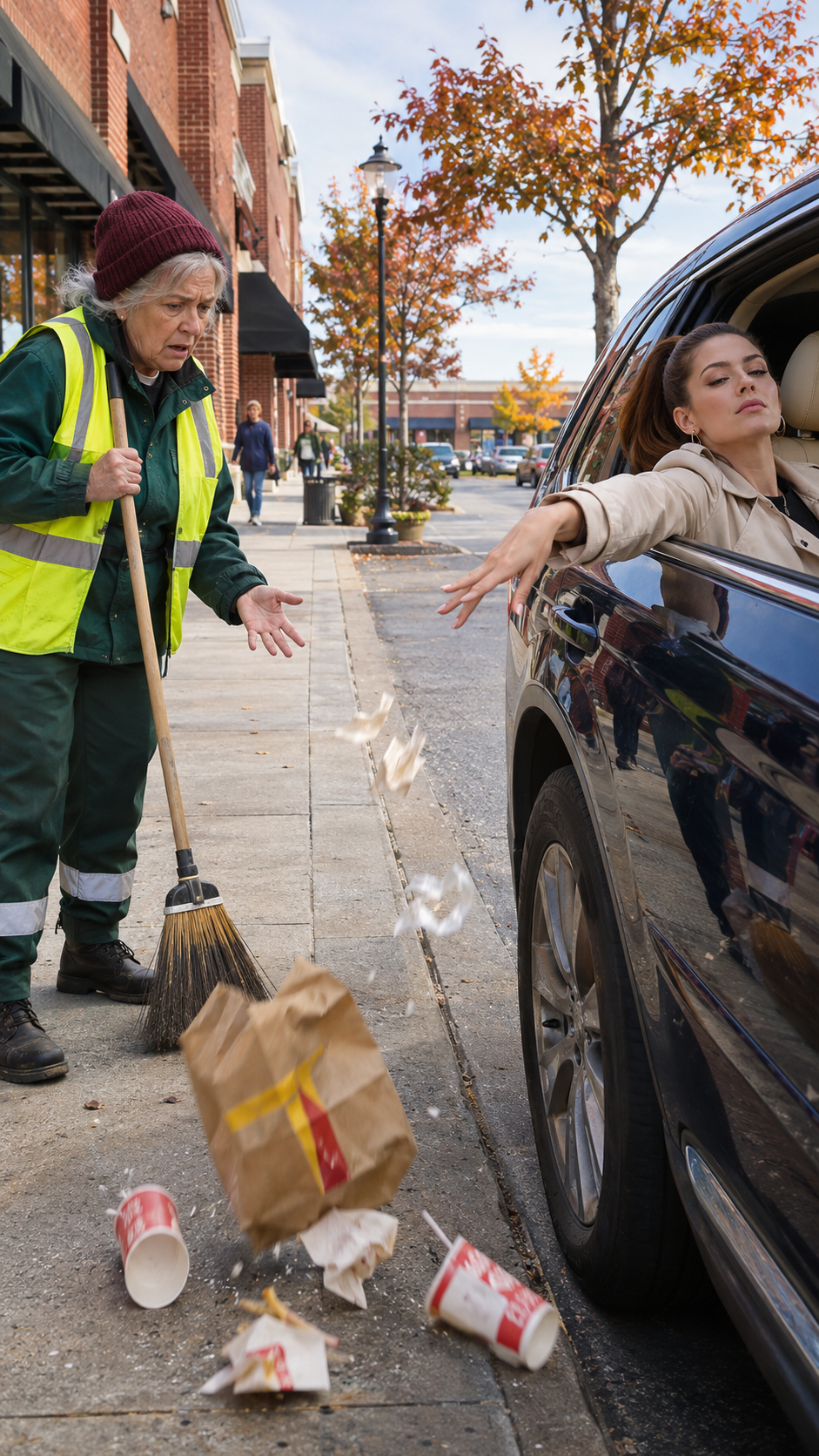
Her reaction reflected the frustration of having additional work created unnecessarily.
The woman inside the vehicle appeared unconcerned.
For her, throwing away the empty containers seemed like an insignificant action.
For the street cleaner, however, it meant bending down and collecting rubbish that could easily have been placed inside a public trash bin.
Neither woman realized that the incident had attracted someone else’s attention.
What happened next would transform an ordinary moment of inconsiderate behavior into an unexpected lesson about kindness, dignity, and personal responsibility.
Someone Had Noticed Everything
The elderly street cleaner bent down and began collecting the scattered garbage.
Her fluorescent yellow safety vest moved gently in the autumn breeze as she continued performing her responsibilities.
She did not approach the vehicle or begin an argument.
Instead, she focused on cleaning the pavement.
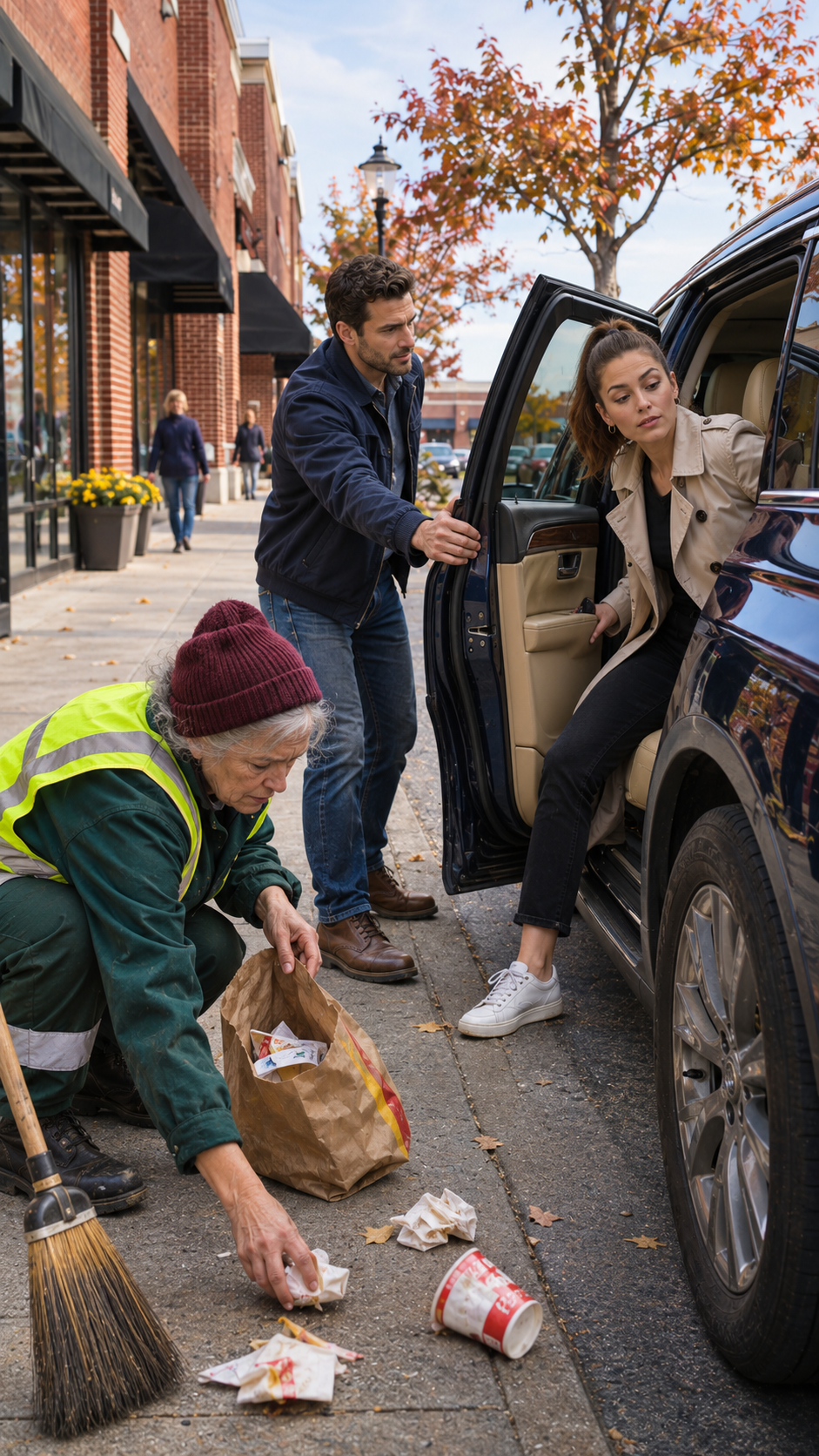
Meanwhile, a 35-year-old man with short dark brown hair approached the dark blue SUV.
He wore a navy jacket, blue jeans, and brown boots.
The man had noticed what happened.
He could see the elderly cleaner gathering the garbage that his partner had carelessly thrown from the passenger window.
Rather than immediately confronting her angrily, he approached the passenger door.
He opened it and looked toward the woman.
“Hey, step outside for a second.”
The woman smiled casually.
She appeared curious about why he wanted her to leave the vehicle.
Wearing the same cream trench coat, black jeans, and white sneakers, she stepped onto the pavement.
The elderly cleaner continued working nearby.
The man remained calm.
He did not raise his voice or create a public confrontation.
His partner had no idea that he was preparing an unusual response to what had just happened.
She looked toward him with a curious expression, apparently expecting an ordinary conversation.
However, he had something entirely different in mind.
The next few moments would reveal an unexpected contrast between appreciation and irresponsibility.
She Thought a Romantic Surprise Was Waiting for Her
Standing beside the dark blue SUV, the man revealed a soft black sleep mask.
The woman looked at it and smiled.
Her expression suggested that she believed something romantic was about to happen.
“What are you doing?”
The man responded calmly.
“I’ve got a little surprise.”
With her permission, he gently placed the sleep mask over her eyes.
The woman remained beside the vehicle, smiling with anticipation.
She could no longer see what was happening around her.
Meanwhile, the elderly street cleaner continued sweeping the pavement in the background.
The man looked toward the surrounding area before walking toward the rear of the SUV.
His partner waited patiently.
She appeared excited about the possibility of receiving a thoughtful gift.
The fictional story does not establish whether the man had originally planned a romantic gesture or whether he decided to change his plans after witnessing the littering.
What became clear was that he intended to use the moment to communicate something important.
Rather than responding with aggression, he prepared a symbolic demonstration.
The elderly cleaner continued carrying out her work, unaware that she was about to become part of the unexpected surprise.
The man reached the rear of the dark blue SUV.
His partner remained blindfolded nearby.
She smiled as she waited for whatever he was preparing.
But the beautiful gift inside the vehicle was about to take an entirely different direction.
The Beautiful Bouquet Was Meant for Someone Else
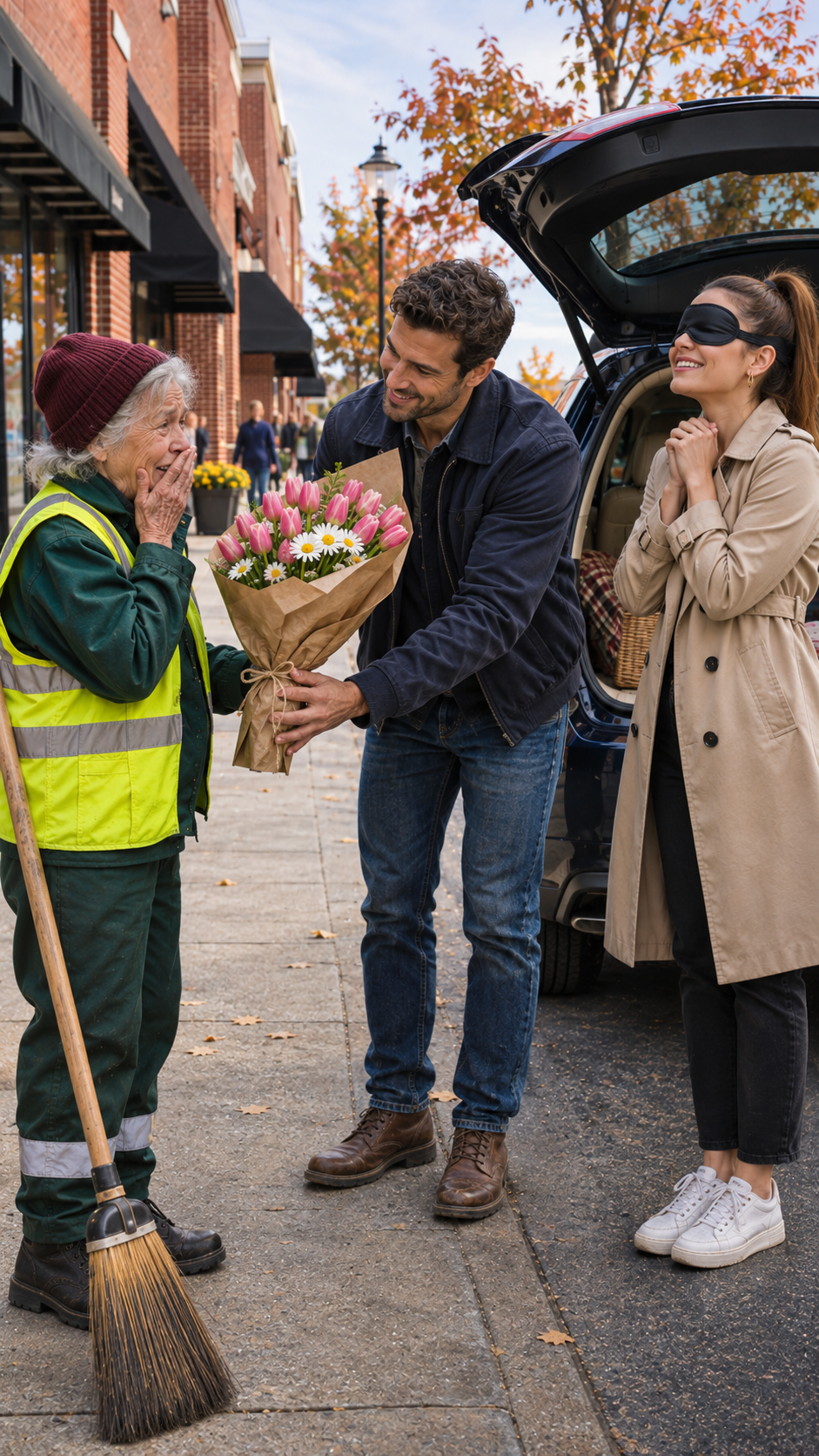
The man opened the rear hatch of the SUV.
Inside was a beautiful bouquet of pink tulips and white daisies wrapped carefully in brown kraft paper.
He lifted the flowers from the vehicle.
The colorful arrangement looked like the kind of thoughtful present his partner might have been expecting.
She remained nearby with the black sleep mask covering her eyes.
However, instead of walking toward her, the man passed her and approached the elderly street cleaner.
The cleaner looked up from her work.
The man respectfully extended the bouquet toward her.
“These are for you. Thank you for everything you do.”
The elderly woman’s expression immediately changed.
She appeared genuinely surprised by the unexpected gesture.
“Oh, that’s so sweet!”
She accepted the bouquet with a grateful smile.
Only moments earlier, she had been collecting garbage thrown directly in front of her broom.
Now someone was standing before her, expressing appreciation for the work she performed.
The contrast between those two interactions was meaningful.
The first had created unnecessary work for her.
The second recognized the value of her contribution.
The pink tulips and white daisies became a symbol of gratitude.
The man did not suggest that the flowers could erase every difficulty associated with her responsibilities.
Instead, the gesture acknowledged that her efforts deserved recognition and respect.
Meanwhile, his blindfolded partner remained beside the SUV.
She still believed that the surprise was intended for her.
She had no idea that the beautiful bouquet was already in someone else’s hands.
The man turned his attention toward the scattered fast-food containers.
There was one more part of the surprise he had prepared.

The Unexpected Gift Changed Her Expression Completely
The elderly street cleaner stood nearby holding her bouquet of pink tulips and white daisies.
Her expression remained warm and grateful.
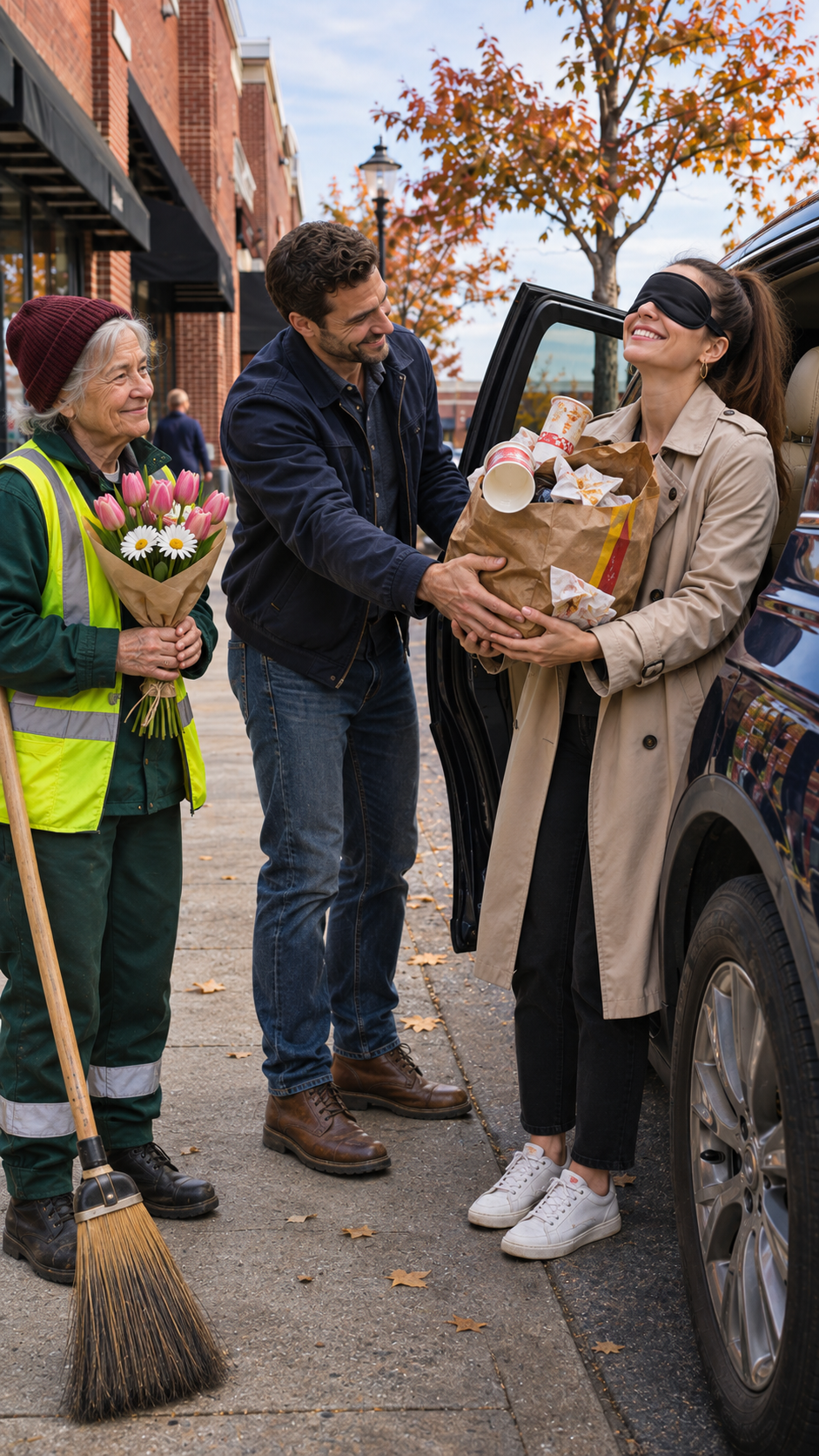
Meanwhile, the man began gathering the paper fast-food bag and empty cups that had previously been thrown onto the pavement.
He collected the discarded containers before approaching his blindfolded partner.
The woman extended her hands, apparently expecting to receive a present.
The man gently placed the collected garbage into her waiting hands.
She smiled.
Unable to see what she was holding, she remained unaware of the unusual nature of her gift.
Then the man spoke.
“Okay, you can look now.”
The woman removed the black sleep mask.
Her eyes immediately moved toward the objects in her hands.
Instead of flowers or another romantic present, she was holding the same paper bag and empty cups she had thrown from the vehicle.
Her smile slowly disappeared.
She looked toward the garbage before turning her attention toward the elderly street cleaner.
The cleaner was holding the beautiful bouquet.
The woman appeared embarrassed as she recognized the contrast between the two gifts.
The man remained calm.
There was no physical aggression or shouting.
The message was communicated through the objects themselves.
The flowers represented appreciation for someone who worked to maintain a clean environment.
The discarded containers represented a responsibility that the woman had attempted to leave behind.
Within the fictional narrative, the unexpected surprise encouraged her to reconsider her earlier behavior.
She stood beside the vehicle, holding the garbage she had carelessly thrown away.
A simple opportunity to correct her mistake was now directly in front of her.
What she chose to do next would determine the emotional meaning of the entire encounter.
The People Who Keep Our Shared Spaces Clean
Street cleaners perform responsibilities that are essential to maintaining pleasant and functional public environments.
Their work can involve collecting discarded rubbish, sweeping pathways, removing debris, and helping keep shared spaces accessible.
Shopping plazas, sidewalks, parking areas, and other public facilities benefit from regular cleaning and maintenance.
However, the people responsible for these tasks may not always receive recognition for their contributions.
Their work can become particularly demanding when others deliberately discard rubbish in inappropriate places.
The elderly cleaner in this fictional story is carrying out her ordinary responsibilities when the woman throws garbage directly in front of her broom.
The incident illustrates how an apparently small action can create unnecessary work for someone else.
A paper bag and several empty cups may seem insignificant.
Nevertheless, someone must eventually collect them.
When similar actions occur repeatedly, the cumulative burden can become considerable.
The man’s decision to give the cleaner a bouquet highlights the importance of acknowledging people whose work often happens quietly in the background.
His gesture recognizes that maintaining shared spaces requires effort.
The fictional story encourages viewers to appreciate workers regardless of their occupation, appearance, or age.
Every person performing an honest job deserves basic dignity and respectful treatment.
Why Littering Is More Than a Minor Inconvenience
Discarding garbage onto sidewalks or parking areas can have consequences beyond creating an untidy appearance.
Lightweight paper and plastic containers may be carried by the wind into nearby gardens, drainage systems, or natural environments.
Discarded materials can also create obstacles for pedestrians and increase maintenance requirements.
Animals may investigate food containers or become exposed to unsuitable materials.
While the specific garbage in this fictional story consists of a paper bag and empty cups, the broader issue applies to many types of improperly discarded waste.
The woman could have retained her garbage until she reached an appropriate disposal container.
Instead, she threw it onto an area where another person was actively working.
The presence of a street cleaner did not remove her own responsibility for disposing of the waste properly.
Public cleaning services are intended to maintain shared environments, not to encourage careless behavior.
Responsible waste disposal is generally a straightforward action.
It requires people to recognize that their personal choices can affect others.
The fictional encounter transforms this ordinary responsibility into the central lesson of the story.
The woman is eventually confronted with the same objects she attempted to discard.
Rather than allowing someone else to manage the consequences, she receives an opportunity to take responsibility herself.
The Difference Between Having a Job and Being Disrespected
One of the most important themes in the fictional narrative is the distinction between performing a service and being treated without consideration.
The elderly street cleaner is responsible for maintaining the pavement.
However, her occupation does not justify deliberately creating unnecessary work for her.
People working in cleaning, maintenance, hospitality, retail, and other service roles deserve the same basic respect as anyone else.
Their responsibilities should not be interpreted as permission for others to behave carelessly.
The woman initially appears unconcerned about the additional work created by her actions.
The cleaner responds with visible disappointment but continues performing her duties.
The man’s intervention draws attention to the human being behind the uniform.
He thanks the cleaner directly and offers her flowers.
This recognition becomes meaningful because it contrasts with the earlier disregard for her efforts.
The fictional story does not establish the cleaner’s financial circumstances, personal history, or experiences with other people.
Those details are unnecessary to understand the central message.
She is a person performing valuable work.
Her dignity does not depend on her occupation or whether someone chooses to reward her.
Respect should be present in ordinary interactions, even when no special gesture is involved.
Why Appreciation Can Mean So Much
The bouquet of pink tulips and white daisies is one of the most visually memorable elements of the fictional story.
Its significance comes from the circumstances in which it is presented.
The elderly cleaner is not expecting a gift.
She is simply continuing her responsibilities when the man approaches her.
His words are straightforward.
He thanks her for everything she does.
The flowers become an unexpected expression of recognition.
People often appreciate knowing that their efforts are noticed, particularly when their responsibilities involve repetitive or physically demanding tasks.
However, appreciation does not always require purchasing flowers or other gifts.
A sincere thank-you, considerate behavior, and avoiding unnecessary burdens can communicate respect in everyday circumstances.
The fictional narrative uses the bouquet to create a dramatic contrast between the cleaner’s contribution and the woman’s earlier behavior.
The cleaner receives something beautiful because the man chooses to recognize her work.
His partner receives the objects she discarded because those objects represent her own responsibility.
The symbolic nature of the two gifts gives the story its emotional structure.
Nevertheless, the broader message extends beyond the exchange itself.
Meaningful appreciation is reflected in how people consistently treat others.
Accountability Does Not Require Aggression
The man responds to the littering through an unusual surprise rather than an aggressive confrontation.
Within the fictional narrative, he uses the discarded garbage to demonstrate the consequences of his partner’s behavior.
The woman recognizes the objects immediately after removing her sleep mask.
Her embarrassed expression suggests that she understands the message.
However, real disagreements are generally better addressed through direct and respectful communication.
Public embarrassment, deception, or humiliation can create unnecessary conflict, even when someone has behaved inconsiderately.
The fictional surprise is a dramatized storytelling device.
It should not be interpreted as the ideal method for correcting another person’s behavior.
A straightforward conversation about why littering is disrespectful could communicate the same underlying message without creating an uncomfortable spectacle.
The important principle is accountability.
People should be encouraged to recognize the effects of their actions and correct their mistakes.
This does not require insults, threats, or physical aggression.
The fictional man remains calm throughout the encounter.
His actions are presented as an attempt to encourage reflection rather than cause physical harm.
The meaningful resolution depends not on embarrassing the woman, but on whether she recognizes her responsibility and chooses to behave differently.
Everyone Has an Opportunity to Correct a Mistake
People sometimes behave carelessly without fully considering how their actions affect others.
Recognizing a mistake is an important first step toward changing that behavior.
The woman in this fictional story initially discards her garbage without appearing concerned about the elderly cleaner.
After removing the sleep mask, she is confronted with the same waste.
She can see the cleaner holding the flowers and recognize the contrast between their experiences.
Her expression changes.
The fictional narrative creates a moment in which she has an opportunity to reconsider what she did.
However, feeling embarrassed is not the same as taking responsibility.
A meaningful response requires action.
In situations involving littering, that may mean collecting the discarded materials and placing them in an appropriate trash container.
When another person has been affected, a sincere apology can also acknowledge the inconvenience or disrespect caused.
The story does not need to establish that the woman permanently changes her behavior.
Its focus is the immediate opportunity to recognize and correct a specific mistake.
Personal responsibility involves understanding that choices have consequences.
It also involves accepting that those consequences should not automatically become someone else’s burden.
The final moments of the fictional encounter are important because they reveal whether the woman is willing to act on that understanding.
The Importance of Respecting Older Workers
The street cleaner’s age is another noticeable element of the story.
At 62 years old, she is shown carrying out her responsibilities outdoors while wearing her work uniform and safety vest.
Her age does not make her incapable of performing her job, nor does it define her entire identity.
Nevertheless, the fictional narrative encourages viewers to recognize the effort involved in her work.
Older workers, like workers of every age, deserve fair treatment and consideration.
People should avoid assuming that someone’s occupation or appearance determines their value.
The cleaner’s reaction to the littering is understandable.
She has been maintaining the pavement when another person creates an unnecessary mess directly in front of her.
The man’s gesture acknowledges her contribution without requiring her to explain her personal circumstances.
He simply thanks her.
The story illustrates that recognizing another person’s dignity does not require knowing their entire life story.
Basic courtesy should be available to everyone.
Whether someone is cleaning a sidewalk, serving customers, maintaining equipment, or performing another responsibility, their work contributes to the functioning of shared environments.
Treating workers respectfully is a simple but meaningful way to acknowledge that contribution.
Small Choices Shape the Places We Share
Public spaces are used by people with different responsibilities, routines, and needs.
Some individuals visit shopping plazas to purchase groceries or other products.
Others work in nearby businesses or maintain the surrounding facilities.
Everyone contributes, directly or indirectly, to the condition of those shared spaces.
Discarding rubbish improperly transfers a personal responsibility to someone else.
Using a public trash bin helps prevent that unnecessary burden.
The fictional encounter highlights how a seemingly minor choice can affect another person’s day.
The woman throws away several empty containers.
The cleaner must stop what she is doing and collect them.
The man notices the interaction and responds with a gesture of appreciation.
Each action influences the experience of someone else.
The broader lesson is that responsible behavior often consists of ordinary decisions.
Keeping rubbish until an appropriate disposal container is available requires little effort.
Acknowledging a worker’s contribution takes only a moment.
Offering a sincere apology after behaving inconsiderately can help repair an uncomfortable interaction.
These small choices may not attract attention, but they contribute to more pleasant and respectful shared environments.
What Makes This Story So Meaningful?
The fictional story begins with a familiar example of inconsiderate behavior.
A woman throws garbage from a vehicle while an elderly cleaner is working nearby.
The cleaner expresses disappointment and begins collecting the waste.
A man notices what happened and prepares an unexpected surprise.
The bouquet initially appears to be a romantic gift.
Instead, it becomes an expression of gratitude toward someone whose efforts deserve recognition.
The woman’s surprise then takes an entirely different form.
She receives the garbage she had discarded.
The contrast communicates the central message without requiring a lengthy argument.
Appreciation belongs to those whose contributions are often overlooked.
Responsibility belongs to the person whose actions created the problem.
However, the story’s emotional value does not depend on punishment.
Its most meaningful element is the opportunity for the woman to acknowledge her mistake and make a better choice.
The elderly cleaner deserves respect regardless of whether an apology is offered.
The man has already expressed his appreciation through the flowers.
What remains is the woman’s decision about how she will respond after recognizing the consequences of her earlier behavior.
One Final Moment That Said More Than Words
Autumn leaves continued moving gently across the pavement.
The dark blue SUV remained parked beside the shopping plaza.
The elderly street cleaner stood nearby, holding the beautiful bouquet wrapped in brown kraft paper.
The woman looked down at the paper fast-food bag and empty cups in her hands.
Her earlier excitement had disappeared.
The man remained beside the vehicle, watching calmly.
Nearby stood a black public trash bin.
The woman no longer needed anyone to explain where the discarded containers belonged.
The opportunity to correct her mistake was directly in front of her.
The elderly cleaner waited quietly, still holding the pink tulips and white daisies.
What began with a careless gesture had developed into an unexpected lesson about personal responsibility.
The final moments would reveal whether the woman had understood the importance of treating other people with consideration.
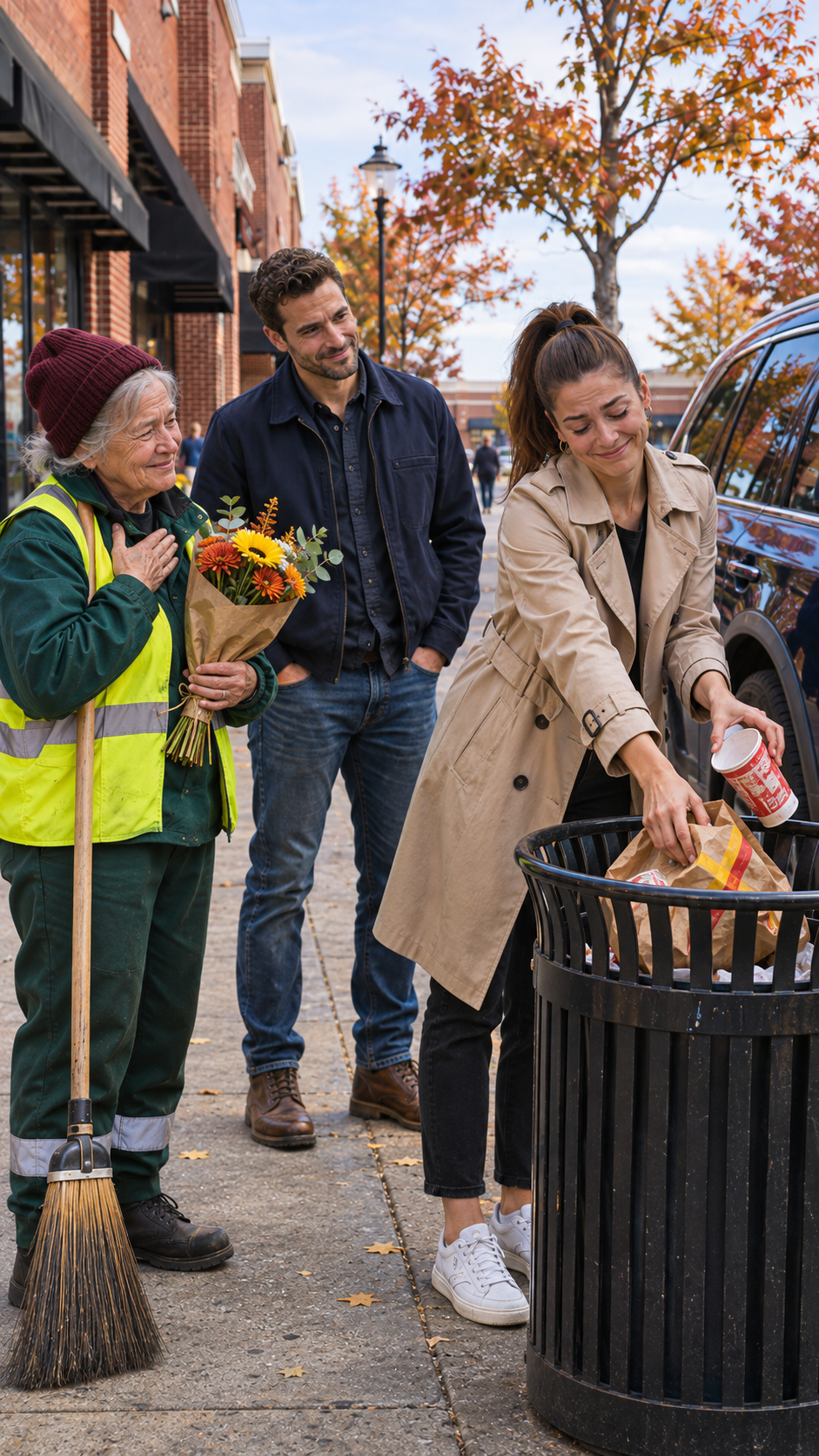
Looking embarrassed, the woman walked toward the black public trash bin and placed the paper bag and empty cups inside. She then turned toward the elderly street cleaner and sincerely said, “I’m sorry. I shouldn’t have done that.” Holding her beautiful bouquet, the cleaner warmly replied, “Thank you, sweetheart.” The man smiled gently as autumn leaves moved across the pavement. Their unexpected encounter ended with a meaningful reminder that respecting other people’s work begins with taking responsibility for our own actions.