A Peaceful Horseback Ride Turned Into a Terrifying Emergency
The countryside was peaceful, surrounded by green pastures, white wooden fences, and a winding gravel riding trail.
A blonde woman was enjoying a horseback ride on her beautiful chestnut horse. The animal carried a brown Western saddle, while the woman wore a securely fastened black riding helmet.
The gentle sounds of hoofbeats blended with birdsong and the wind moving through the surrounding grass.
Nothing appeared unusual.
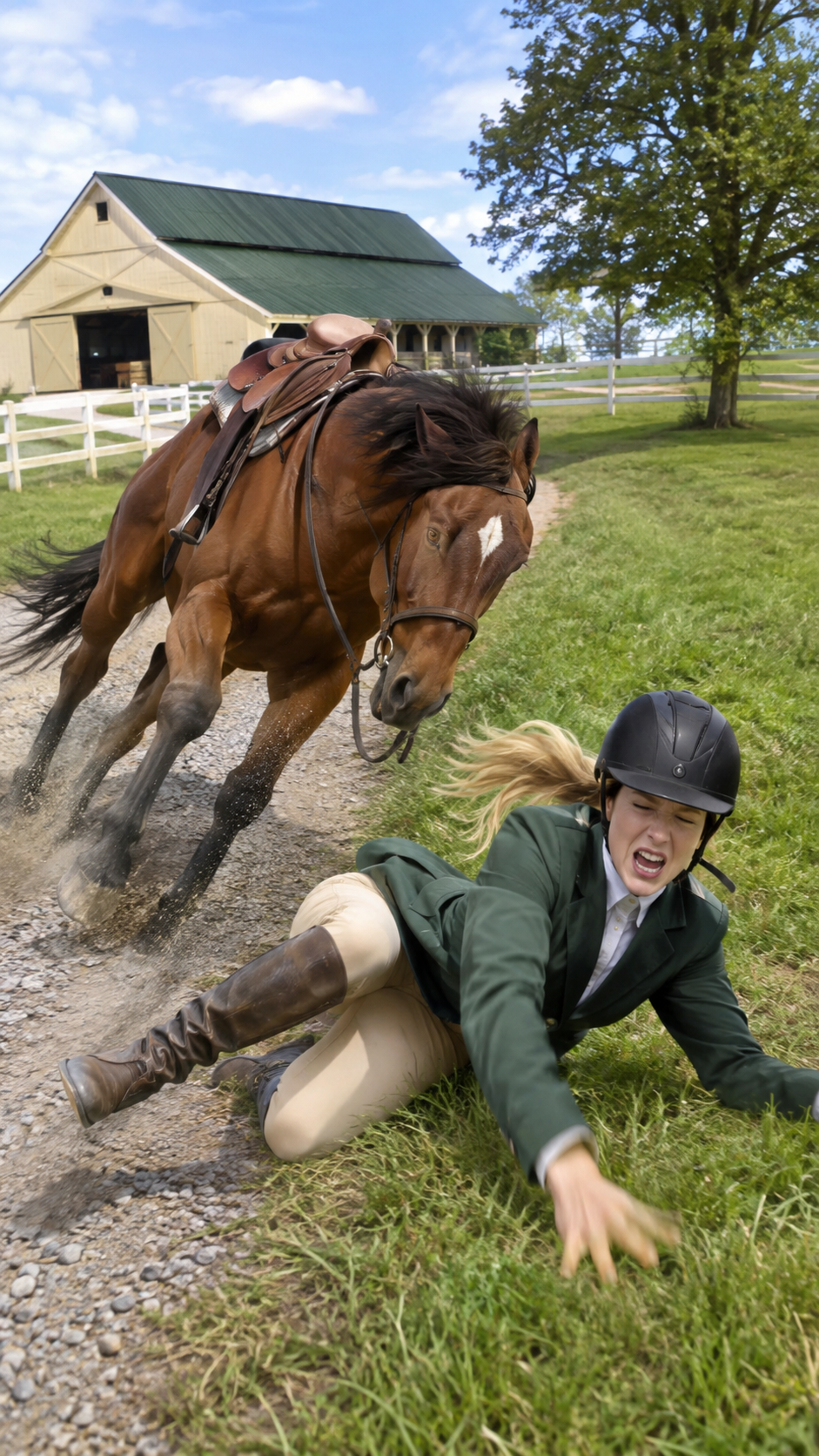
Then, without warning, the chestnut horse stumbled on the gravel trail.
The sudden movement caused the woman to lose her balance.
Before she could regain control, she fell sideways from the saddle and landed on the grassy ground beside the trail.
The frightened horse moved several steps away as the woman attempted to sit up.
A sharp pain immediately drew her attention to her leg.
“Ah! My leg!”
She struggled to move but quickly realized that something was wrong.
Her black riding helmet remained securely attached, but the fall had left her unable to stand comfortably.
The peaceful surroundings suddenly felt very different.
The woman was lying beside the trail, with no other person immediately visible nearby.
Her chestnut horse stood a short distance away, breathing heavily after the unexpected incident.
The woman looked toward her companion.
She had no idea that the animal was about to become the most important part of her unexpected rescue.
Her Loyal Horse Returned to Her Side
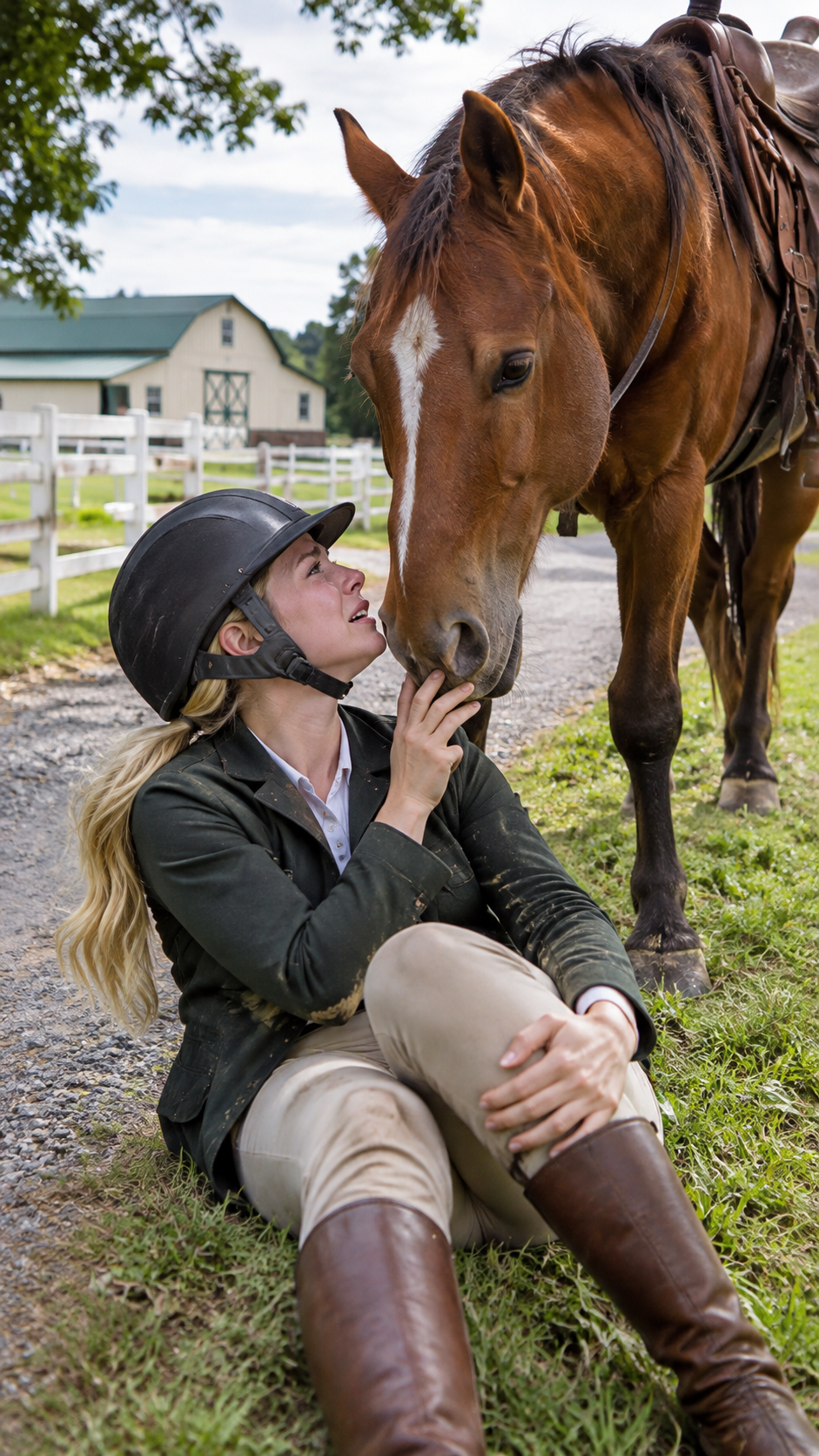
The injured woman remained on the grassy ground beside the gravel trail.
She held her painful leg while attempting to understand the seriousness of her situation.
Meanwhile, the chestnut horse slowly turned and began walking back toward her.
Its brown saddle remained empty, and the loose leather reins moved gently as it approached.
The horse lowered its head and carefully nudged the woman’s shoulder with its muzzle.
She reached toward the familiar animal.
The gentle interaction provided a moment of comfort amid the uncertainty surrounding her injury.
However, she still could not stand.
The pain in her leg prevented her from continuing the ride or returning to the nearby barn independently.
“I can’t get up. Go get help!”
Her voice reflected both discomfort and desperation.
The horse remained beside her briefly before raising its head.
In the distance stood a cream-colored barn with a dark green metal roof.
The animal turned its attention toward the building.
Within this fictional story, the horse’s behavior suggested that it recognized something unusual about its rider’s condition.
The woman watched as her companion looked toward the distant ranch buildings.
She remained on the grass, unable to continue her journey.
Then the chestnut horse suddenly began moving away.
What initially appeared to be the animal leaving its injured rider would soon develop into an extraordinary act of loyalty.
The woman could only hope that someone would notice the riderless horse and understand that something had happened.
The Horse Suddenly Raced Toward the Barn
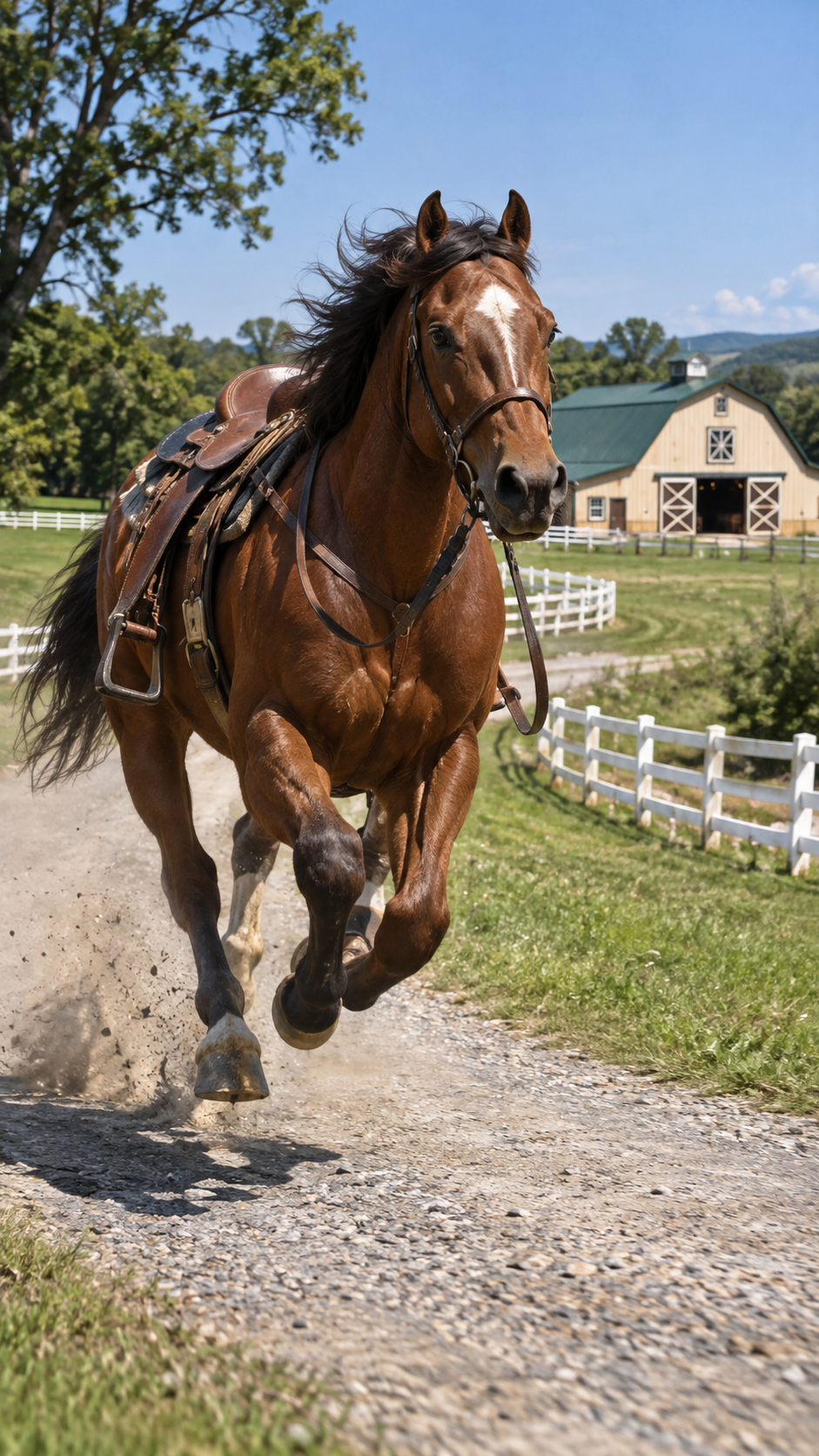
The chestnut horse began galloping along the winding gravel trail.
Its powerful hooves struck the ground, sending small clouds of dust into the air.
The empty brown Western saddle moved naturally with each stride, while the loose leather reins shifted alongside its neck.
The injured woman remained behind near the white wooden fence.
Ahead of the horse stood the cream-colored barn.
The animal continued racing toward the familiar ranch buildings.
Its rapid movements created a dramatic contrast with the peaceful countryside.
Birds continued singing in the distance, and the surrounding pastures remained quiet apart from the powerful sound of galloping hoofbeats.
Within the fictional narrative, the horse appeared determined to reach someone who could assist its injured companion.
The story does not establish whether the animal had received specialized training or had previously encountered a similar emergency.
Its behavior is presented as an imaginative example of the remarkable relationship that can develop between horses and their riders.
The chestnut horse continued along the gravel trail until the barn became increasingly visible.
Nearby, a farmer was carrying out his ordinary responsibilities.
He had no idea that an injured woman was waiting beside the distant riding trail.
However, the unexpected arrival of a horse carrying an empty saddle was about to capture his attention.
The animal approached the ranch buildings, bringing with it the first indication that something had gone seriously wrong.
The Farmer Immediately Noticed Something Was Wrong
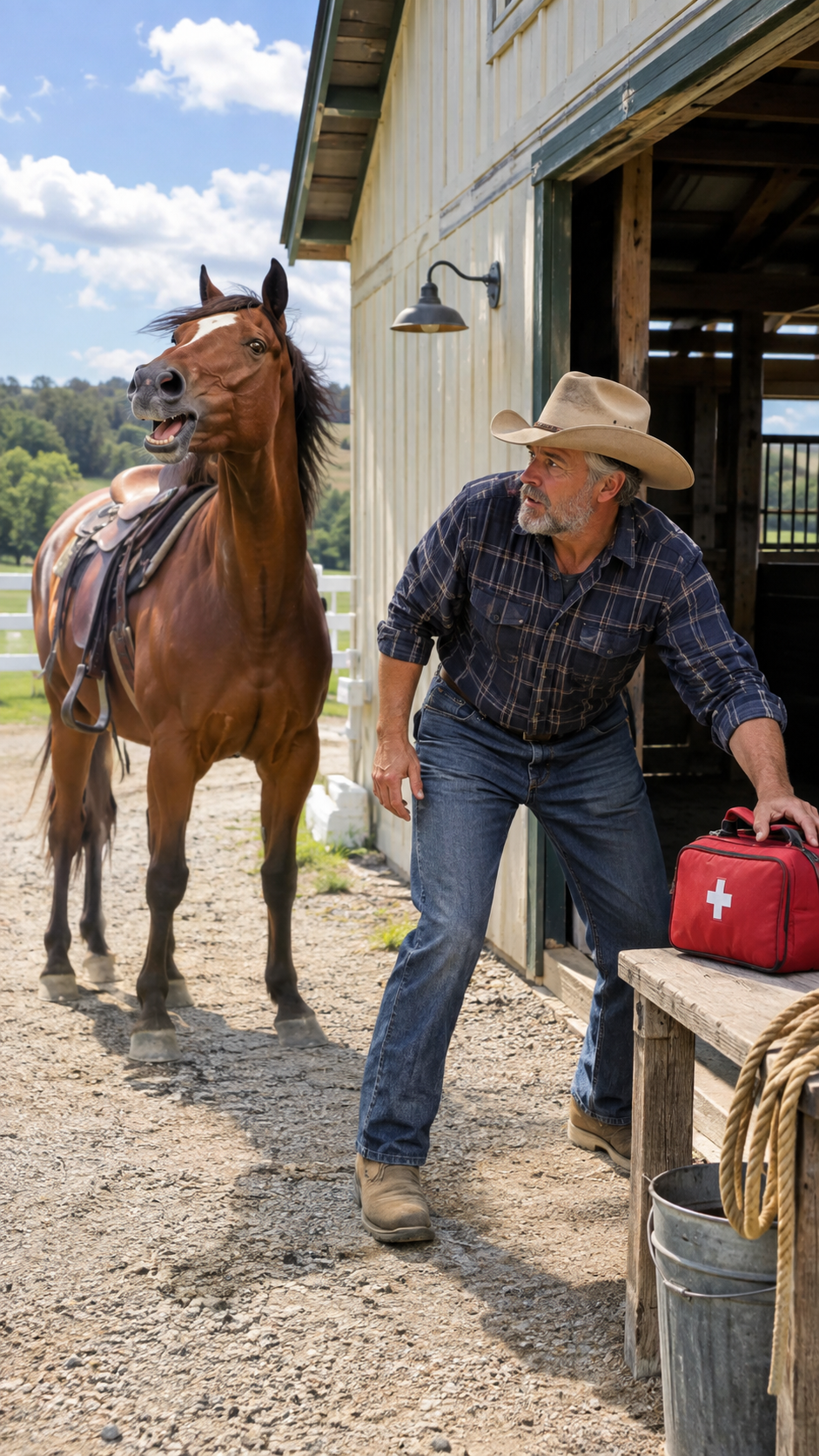
A 53-year-old farmer wearing a navy plaid shirt, blue jeans, and a tan cowboy hat was working beside the cream-colored barn.
The familiar sounds of farm activity surrounded him.
Then the chestnut horse suddenly approached.
The animal stopped nearby and released a loud neigh.
The farmer turned toward it.
His attention immediately shifted to the empty brown Western saddle.
There was no rider.
The horse repeatedly turned its head toward the distant gravel trail before looking back toward the farmer.
Something about the situation appeared unusual.
The farmer’s expression became increasingly concerned.
“Where’s your rider? Show me!”
He looked toward the direction from which the horse had arrived.
The empty saddle suggested that the rider might have become separated from the animal somewhere along the trail.
Rather than ignoring the unusual encounter, the farmer immediately prepared to investigate.
He grabbed a red first-aid kit positioned near the barn entrance.
He also had his smartphone available in case additional assistance was necessary.
The chestnut horse remained nearby, directing its attention toward the trail.
Within the fictional sequence, the farmer interpreted the animal’s behavior as an indication that its rider needed help.
He did not yet know what had happened or how seriously the woman might have been injured.
However, he understood that the situation required immediate attention.
With the red first-aid kit in his hand, he prepared to follow the horse away from the barn.
The loyal animal was about to lead him directly toward the injured woman.
The Horse Led Him Back to Its Injured Rider
The chestnut horse began moving along the gravel trail once again.
This time, the farmer followed closely beside it.
He carried the red first-aid kit in his right hand and his smartphone in his left.
Their movements interrupted the quiet atmosphere of the countryside.
The sounds of running footsteps, hoofbeats, and heavy breathing filled the air as they approached the area where the woman had fallen.
The white wooden fence gradually came into view.
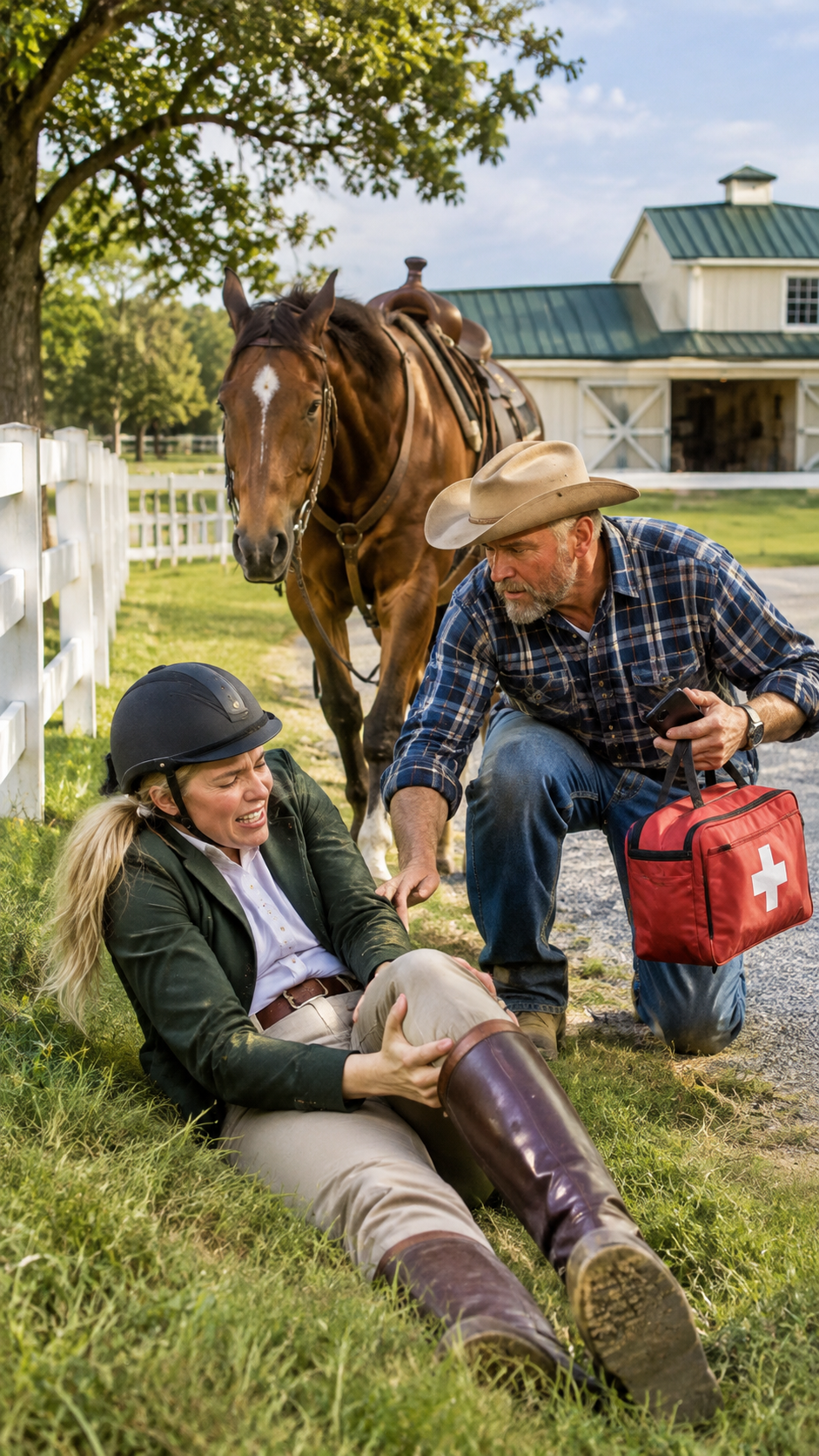
Then the farmer noticed someone lying on the grass beside the trail.
It was the missing rider.
He immediately rushed toward her and knelt beside her.
“Hey! Can you hear me?”
The woman looked toward him.
“Yes, but my leg really hurts.”
The farmer remained beside her, listening carefully.
The chestnut horse also stayed close.
Its empty saddle and familiar appearance connected the unexpected encounter at the barn with the injured woman now lying before him.
The farmer placed the red first-aid kit on the grass.
He recognized that the woman’s injury required further assistance.
Although she was conscious and able to communicate, the severity of her leg injury had not been established.
The farmer did not attempt to force her to stand or return to the saddle.
Instead, he remained beside her and prepared to contact emergency services.
For the injured woman, the arrival of another person represented an important moment of relief.
She was no longer alone beside the riding trail.
Her loyal horse had returned with someone who could help.
However, the most emotional moment of their extraordinary fictional encounter was still to come.
Why Horseback Riding Accidents Require Immediate Attention
Although the events depicted in this story are fictional, falls from horses can result in genuine and potentially serious injuries.
Horseback riding involves interaction with a large, powerful animal that may react unexpectedly to changes in terrain, unfamiliar sounds, or environmental conditions.
Even experienced riders can encounter situations that lead to a loss of balance.
A horse may stumble, become startled, or make an unexpected movement.
The consequences of a fall depend on numerous factors, including the rider’s position, the surrounding terrain, and the nature of the impact.
In this fictional story, the woman falls sideways onto the grass after her chestnut horse stumbles on a gravel trail.
She experiences significant pain in her leg and is unable to stand.
The narrative does not establish whether she has suffered a fracture, sprain, or another type of injury.
A medical diagnosis would require professional assessment.
The fact that an injured rider remains conscious and able to communicate does not necessarily mean that the injury is minor.
Some injuries may not be immediately apparent.
When a person experiences severe pain or difficulty moving after a fall, contacting emergency medical services may be necessary.
The farmer’s decision to keep the woman still and seek professional assistance reflects an important safety principle.
The immediate priority is preventing further harm while appropriate medical help is arranged.
The Importance of Wearing Appropriate Riding Equipment
One notable detail in the fictional video is that the woman’s black riding helmet remains securely attached throughout the fall.
Properly fitted riding helmets are an important part of equestrian safety equipment.
They are designed to help reduce the risk of certain head injuries during riding accidents.
However, wearing a helmet does not eliminate every possible risk.
Falls can also result in injuries involving the legs, arms, back, neck, and other parts of the body.
Appropriate footwear, suitable riding equipment, and regular inspections of saddles and other tack can contribute to safer riding practices.
Riders should also consider their experience level, the horse’s training, and the condition of the terrain.
The gravel trail in this fictional story appears peaceful, but the horse’s unexpected stumble demonstrates how quickly circumstances can change.
Even familiar riding routes may contain uneven surfaces or other hazards.
Responsible preparation can help reduce preventable risks.
Carrying a charged smartphone and informing someone about a planned riding route may also be useful precautions, particularly when traveling through isolated areas.
The fictional narrative uses an unexpected animal-assisted rescue to create an emotional story.
In real circumstances, however, appropriate preparation and reliable emergency communication remain essential.
The Extraordinary Bond Between Horses and Humans
Horses have shared close relationships with people for generations.
Through regular care, training, and interaction, they can become familiar with human voices, movements, routines, and behavioral signals.
Many riders develop meaningful relationships with their horses.
These connections often involve trust, patience, consistency, and mutual familiarity.
The chestnut horse in this fictional story represents an especially strong example of that relationship.
After the woman falls, the animal initially moves away in response to the sudden disturbance.
It then returns and gently nudges her shoulder.
That quiet interaction becomes one of the most touching moments in the narrative.
The woman reaches toward its muzzle while experiencing considerable discomfort.
Within the story, the horse’s presence provides emotional reassurance.
Its subsequent journey toward the barn is dramatized as an attempt to find assistance.
Real horses can learn complex behaviors and respond to familiar cues, but their intentions should not automatically be interpreted as equivalent to human reasoning.
The fictional narrative imagines an extraordinary situation in which the animal recognizes its rider’s distress and brings another person to help.
Its emotional appeal comes from the familiar idea of trust between humans and their animal companions.
Understanding a Horse’s Response to Unexpected Situations
Horses are naturally attentive to their surroundings.
Their behavior can be influenced by unfamiliar sounds, sudden movements, environmental changes, and previous experiences.
When startled, a horse may move away from the source of the disturbance.
Individual responses vary depending on temperament, training, health, and circumstances.
In the fictional story, the chestnut horse initially moves several steps away after stumbling and losing its rider.
It then returns to the injured woman.
Later, it gallops toward a familiar barn and approaches the farmer.
The narrative presents these actions as a deliberate rescue effort.
However, similar behavior in a real horse could have several explanations.
A riderless horse might return toward a familiar stable, seek the company of other animals, or respond to established routines.
Determining its precise intentions would require more evidence than the behavior alone.
Nevertheless, the fictional sequence uses these recognizable characteristics to create an imaginative and emotionally engaging story.
The horse’s familiarity with the ranch becomes central to the dramatic rescue.
Its journey connects the injured rider with someone capable of contacting professional medical assistance.
The broader message celebrates the meaningful relationships that can develop through responsible animal care and companionship.
Why the Farmer’s Response Was So Important
The farmer plays a crucial role in the fictional rescue.
When the chestnut horse approaches him, he notices that its saddle is empty.
Rather than treating the animal’s arrival as an ordinary occurrence, he considers the possibility that something has happened to its rider.
He takes a red first-aid kit and follows the horse toward the gravel trail.
Once he discovers the injured woman, he immediately checks whether she can hear him and communicate.
Her response confirms that she is conscious, but she reports significant pain in her leg.
The farmer remains beside her.
He does not attempt to diagnose the injury or force her to move.
Instead, he prepares to contact emergency services.
His involvement illustrates the importance of responding responsibly when someone may have suffered a serious injury.
In real emergencies, bystanders should follow instructions provided by emergency dispatchers and avoid unnecessary movement of an injured person, particularly when a serious injury is suspected.
First-aid equipment can be useful, but it does not replace professional medical assessment.
The farmer’s presence also provides emotional reassurance.
The woman now has someone beside her who can communicate with emergency responders and monitor the situation while assistance is arranged.
The fictional story highlights how timely human intervention can complement an unexpected act of animal companionship.
Why Riding Alone Requires Additional Preparation
Many people enjoy horseback riding because it provides an opportunity to experience peaceful outdoor surroundings.
Quiet trails, open pastures, and natural landscapes can make riding a rewarding activity.
However, riding in isolated areas may create additional challenges when an emergency occurs.
An injured rider might have difficulty reaching a phone, moving to a visible location, or contacting someone nearby.
The fictional woman experiences a situation in which she cannot stand after falling from her horse.
No other person is immediately visible along the trail.
Her eventual assistance arrives through the extraordinary behavior of her loyal companion.
Real riders should not depend on an animal to locate help during an emergency.
Practical preparation is much more reliable.
Informing someone about a planned route, carrying suitable communication equipment, and riding with a companion when appropriate can help reduce certain risks.
It is also important to understand the terrain and avoid conditions that exceed the abilities of either the rider or the horse.
The fictional story does not establish what precautions the woman took before beginning her ride.
Those details remain outside the scope of the video.
Its central message is that unexpected accidents can happen even during activities that initially appear peaceful.
Responsible preparation can make a meaningful difference when circumstances suddenly change.
Loyalty Is Sometimes Expressed Through Quiet Gestures
The horse’s dramatic journey toward the barn is the most extraordinary element of the fictional narrative.
However, its quieter interaction with the injured woman carries considerable emotional significance.
After the fall, the chestnut horse returns and gently touches her shoulder with its muzzle.
The woman reaches toward the animal while struggling with pain.
There are no complicated actions during this brief encounter.
The horse simply remains close to its familiar human companion.
That moment illustrates why relationships with animals can be so meaningful.
People often develop emotional connections with animals through repeated experiences, daily care, and shared routines.
A familiar presence may provide comfort during stressful circumstances.
The fictional story expands that connection into an extraordinary rescue narrative.
The horse’s return to the woman, followed by its journey toward the farmer, creates a powerful contrast between vulnerability and loyalty.
Although the animal’s intentions are dramatized, the emotional theme remains recognizable.
Trust between humans and animals develops through consistent, respectful interaction.
Responsible ownership includes understanding an animal’s needs, providing appropriate care, and avoiding unrealistic expectations about its abilities.
The story celebrates companionship while acknowledging that real animals should never be expected to replace trained emergency responders.
The Power of Cooperation During an Emergency
The fictional rescue involves more than one extraordinary action.
The horse’s unexpected arrival at the barn attracts the farmer’s attention.
The farmer recognizes the unusual circumstances and follows the animal.
The injured woman communicates her condition when he reaches her.
Emergency services are subsequently contacted to provide professional assistance.
Each part of the sequence contributes to the developing rescue.
The horse connects the injured rider with another person.
The farmer provides immediate reassurance and requests medical help.
The woman remains able to communicate important information about her pain.
This cooperation gives the story a meaningful structure.
It demonstrates that emergencies often require different forms of assistance rather than a single dramatic solution.
In real situations, recognizing an emergency, contacting appropriate professionals, and following safety guidance can be essential.
People who encounter someone injured should avoid making assumptions about the severity of the condition.
Even when an injury appears manageable, professional assessment may be necessary.
The fictional story presents the farmer as someone willing to respond immediately when he notices that something is wrong.
His actions complement the loyalty represented by the chestnut horse.
Together, they bring the narrative toward its emotional conclusion.
What Happened to the Woman’s Injury?
The fictional video establishes that the woman experiences significant leg pain after falling from her horse.
She remains conscious but cannot stand.
The farmer arrives with a red first-aid kit and contacts emergency services.
However, the story does not establish the precise medical diagnosis or the woman’s eventual recovery.
It would therefore be inaccurate to claim that she suffered a broken leg or that she recovered completely.
The narrative focuses on the immediate emergency and the arrival of assistance.
This distinction is important because the emotional impact of the story does not require invented medical details.
The woman’s vulnerability is already evident through her inability to stand and her request for help.
The farmer’s concern and the horse’s continued presence provide the emotional foundation for the final scene.
In real circumstances, recovery following a riding accident depends on the nature of the injury and appropriate medical treatment.
Returning to horseback riding should be considered according to professional medical advice and individual circumstances.
The fictional story ends before those longer-term questions are answered.
Its purpose is to celebrate the extraordinary connection between the rider and her loyal companion.
The Most Emotional Moment Was Still Ahead
The countryside remained peaceful around the gravel riding trail.
The white wooden fence stood beside the green pasture, while the farmer knelt near the injured woman.
The red first-aid kit was on the grass.
The chestnut horse remained beside them, its brown saddle still empty.
Only moments earlier, the woman had been alone and unable to stand.
Now someone was beside her, preparing to ensure that she received the assistance she needed.
Her loyal companion had returned to the same place where the unexpected accident had occurred.
The farmer remained focused on the woman’s condition.
The horse gently lowered its head toward her shoulder.
She reached toward its familiar muzzle.
The frightening fall had transformed an ordinary horseback ride into an unforgettable fictional encounter.
The woman’s injury still required professional attention, but she was no longer facing the situation alone.
The final moments would reveal just how much her loyal horse’s extraordinary actions meant to her.
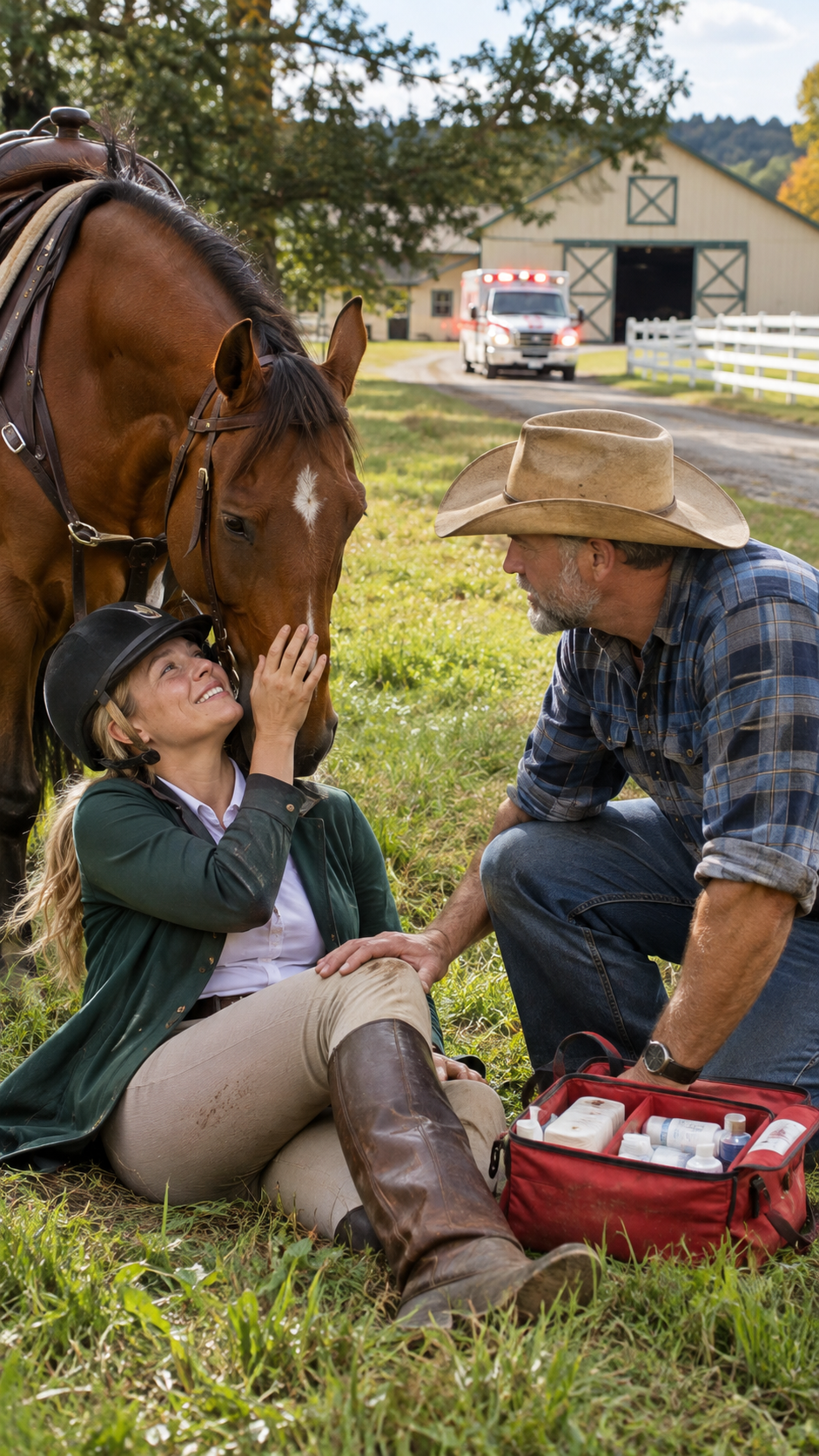
As the farmer contacted emergency services and kept the injured woman still, her loyal chestnut horse gently lowered its muzzle toward her shoulder. An ambulance approached along the distant ranch driveway as the farmer reassured her, “Help is coming. Your horse brought me here.” With an emotional smile, the woman stroked her beloved companion and whispered, “Good boy. You saved me.” Their extraordinary encounter ended with a beautiful reminder of loyalty, trust, and the remarkable bond that can exist between humans and animals.