An Unexpected Encounter on the Lakeside Boardwalk
It was a beautiful day beside a peaceful lake. Gentle waves moved toward the shoreline, birds sang from nearby trees, and recreational boats could be heard in the distance.
A 26-year-old brunette woman wearing a fitted black tank top, short denim shorts, and white sneakers was walking along the wooden lakeside boardwalk.
The peaceful surroundings offered little indication that she was about to become involved in an extraordinary encounter.
Suddenly, a large white swan appeared directly in front of her.
The bird spread its magnificent wings, flapping them urgently as it stretched its long neck toward the startled woman.
She immediately stopped walking.
“Whoa! What’s wrong with you?”
The swan continued honking.
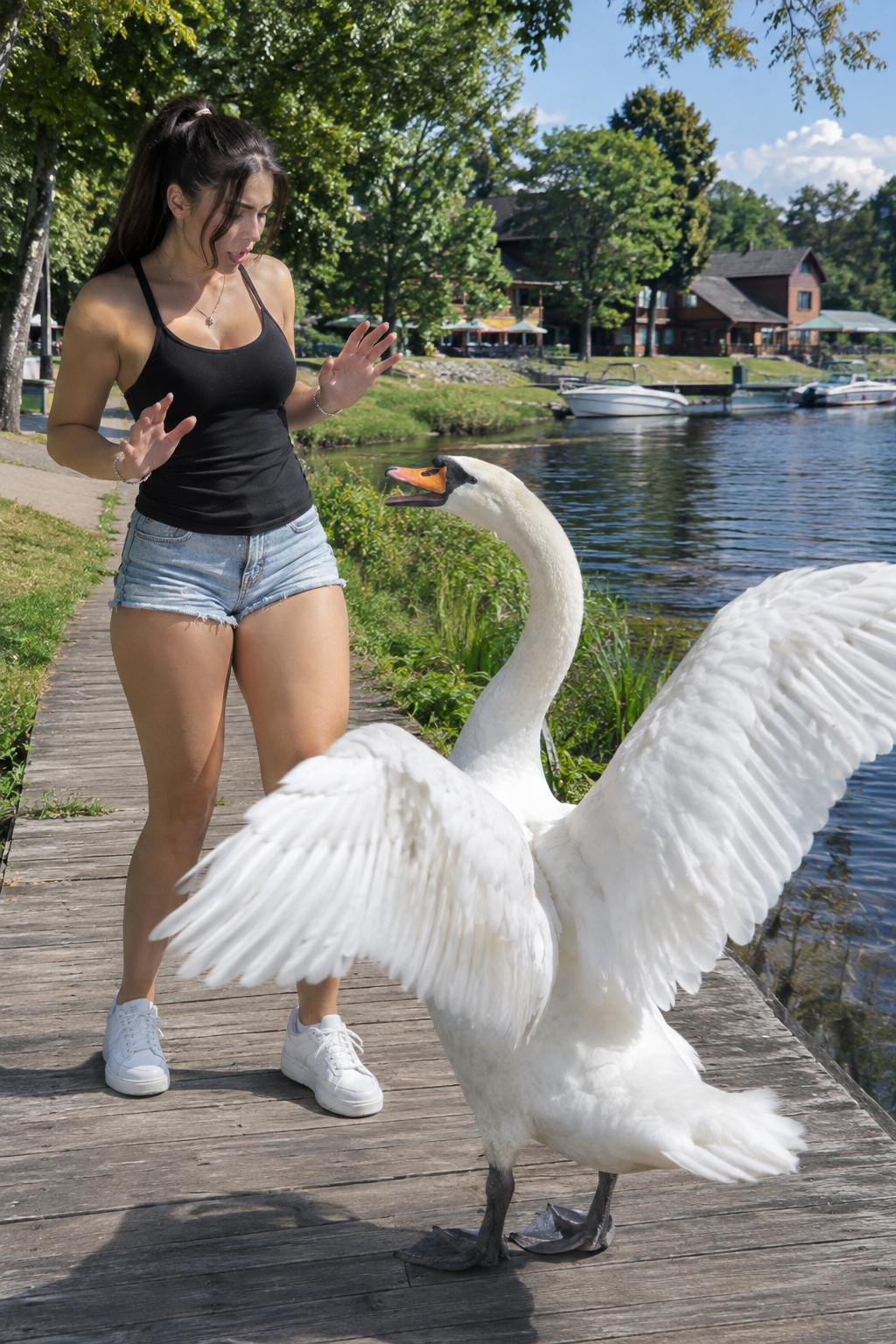
Its behavior seemed unusually persistent, and the loud movement of its wings interrupted the peaceful atmosphere surrounding the lake.
The woman looked toward the bird with a mixture of surprise and confusion.
She had no apparent reason to believe that the swan needed anything from her.
Perhaps it was simply reacting to her presence near the water.
However, the bird continued directing its attention toward her.
Its repeated calls and unusual movements suggested that something else might be happening.
The young woman remained on the wooden boardwalk, watching the large white swan.
What initially appeared to be an uncomfortable encounter with a wild bird was about to develop into something far more meaningful.
The swan’s persistent behavior would eventually lead her toward a discovery she could never have anticipated.
The Swan Refused to Leave Her Alone
After the initial surprise, the young woman continued walking along the lakeside boardwalk.
She expected the white swan to remain behind or return to the water.
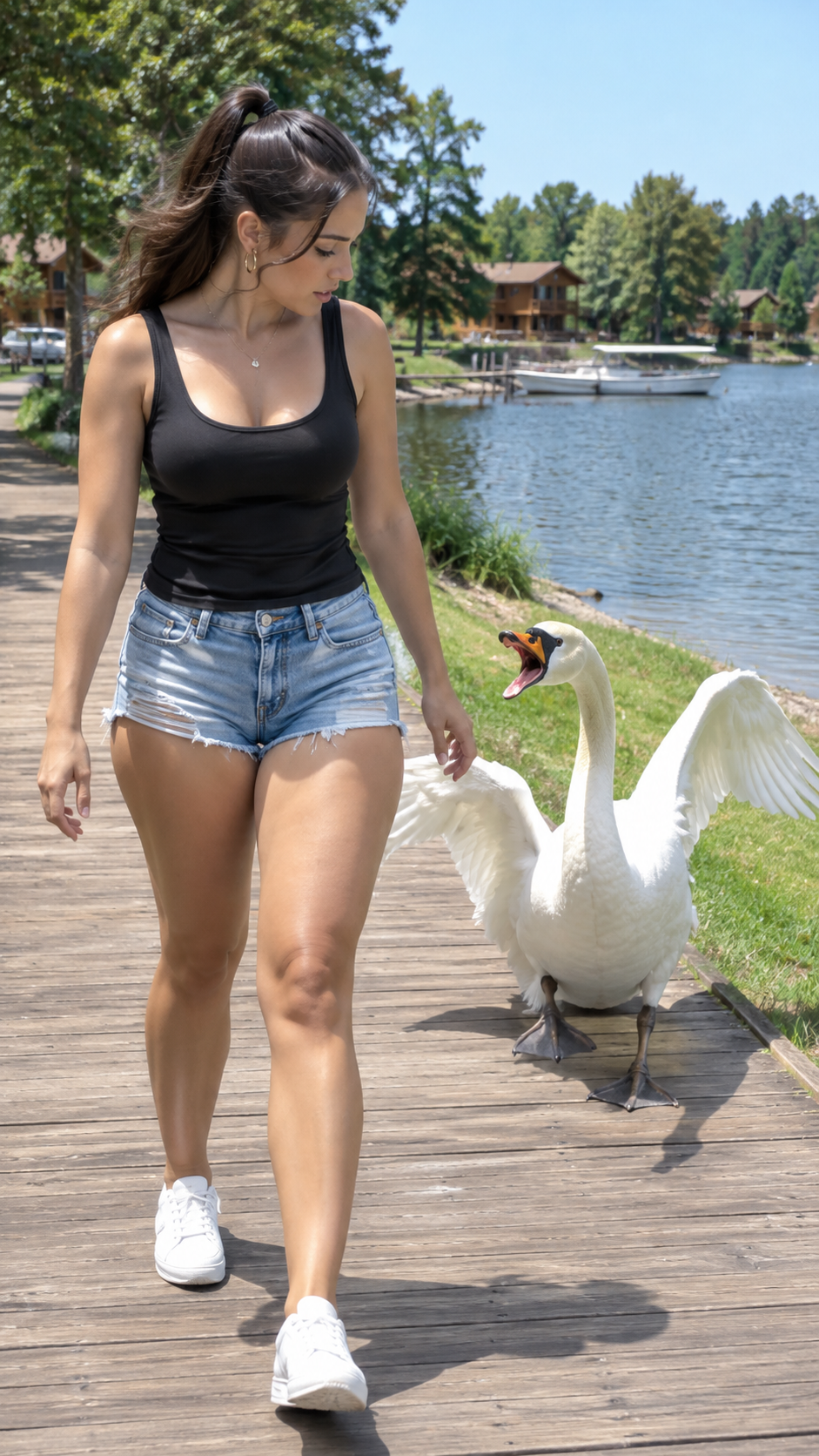
Instead, the bird began following closely beside her.
Its webbed feet moved across the wooden surface while it repeatedly honked and turned its head toward the lake.
The woman glanced down at the persistent bird.
Something about its behavior seemed unusual.
Every time she continued walking, the swan followed.
Its attention appeared divided between the woman and something near the shoreline.
Eventually, she stopped again.
“Are you trying to show me something?”
The question reflected her growing curiosity.
The swan turned toward a grassy path leading away from the boardwalk and down toward the water.
The woman watched as it began moving in that direction.
Within the fictional narrative, the bird’s actions suggested that it wanted her to follow.
However, she still had no idea what might be waiting near the shoreline.
The lake appeared peaceful from where she stood.
Gentle waves reflected the daylight, while the surrounding vegetation moved softly in the breeze.
Nothing immediately revealed the reason behind the swan’s urgent calls.
The young woman decided to investigate.
She cautiously stepped away from the wooden boardwalk and followed the bird toward the grassy path.
The swan continued moving ahead of her.
Its unusual persistence had captured her attention, transforming an ordinary lakeside walk into an unexpected journey.
Following the White Swan Toward the Water
The grassy path led toward a shallow section of the lake.
The adult white swan walked ahead, occasionally spreading its wings and turning its head toward the woman.
She followed cautiously, maintaining her attention on the bird and the surrounding shoreline.
The familiar sounds of footsteps against the wooden boardwalk gradually disappeared.
They were replaced by gentle wind, soft water movements, and the distant sounds of recreational boats.
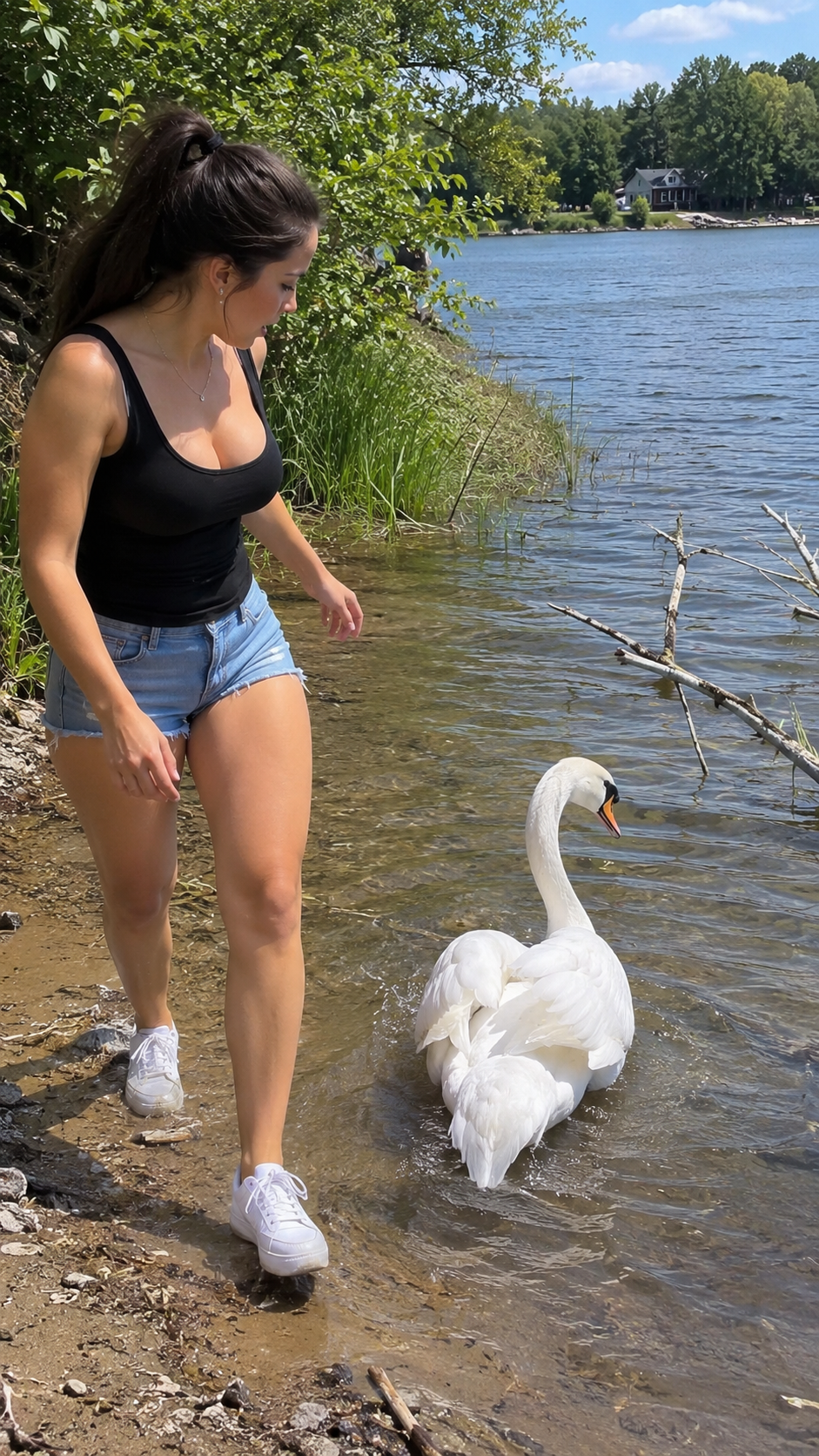
When the swan reached the shoreline, it entered the lake.
The woman stopped near the water’s edge.
She watched as the large white bird moved through the shallow water.
Its repeated calls continued.
The woman leaned forward slightly, attempting to understand what had attracted its attention.
Then she noticed movement near a partially submerged branch.
“Wait… what’s over there?”
Something small appeared to be struggling close to the branch.
From her initial position, she could not immediately determine what it was.
The adult swan remained nearby, moving anxiously through the water.
The woman stepped closer to the shoreline.
Her expression gradually changed from curiosity to concern.
The fictional narrative does not establish how long the adult swan had been attempting to attract attention or whether other people had previously noticed its behavior.
What it does show is the bird leading the woman away from the boardwalk and toward this particular section of the lake.
The movement near the submerged branch became increasingly noticeable.
The woman looked more closely.
The explanation for the swan’s unusual behavior was finally beginning to emerge.
A Heartbreaking Discovery Near a Submerged Branch
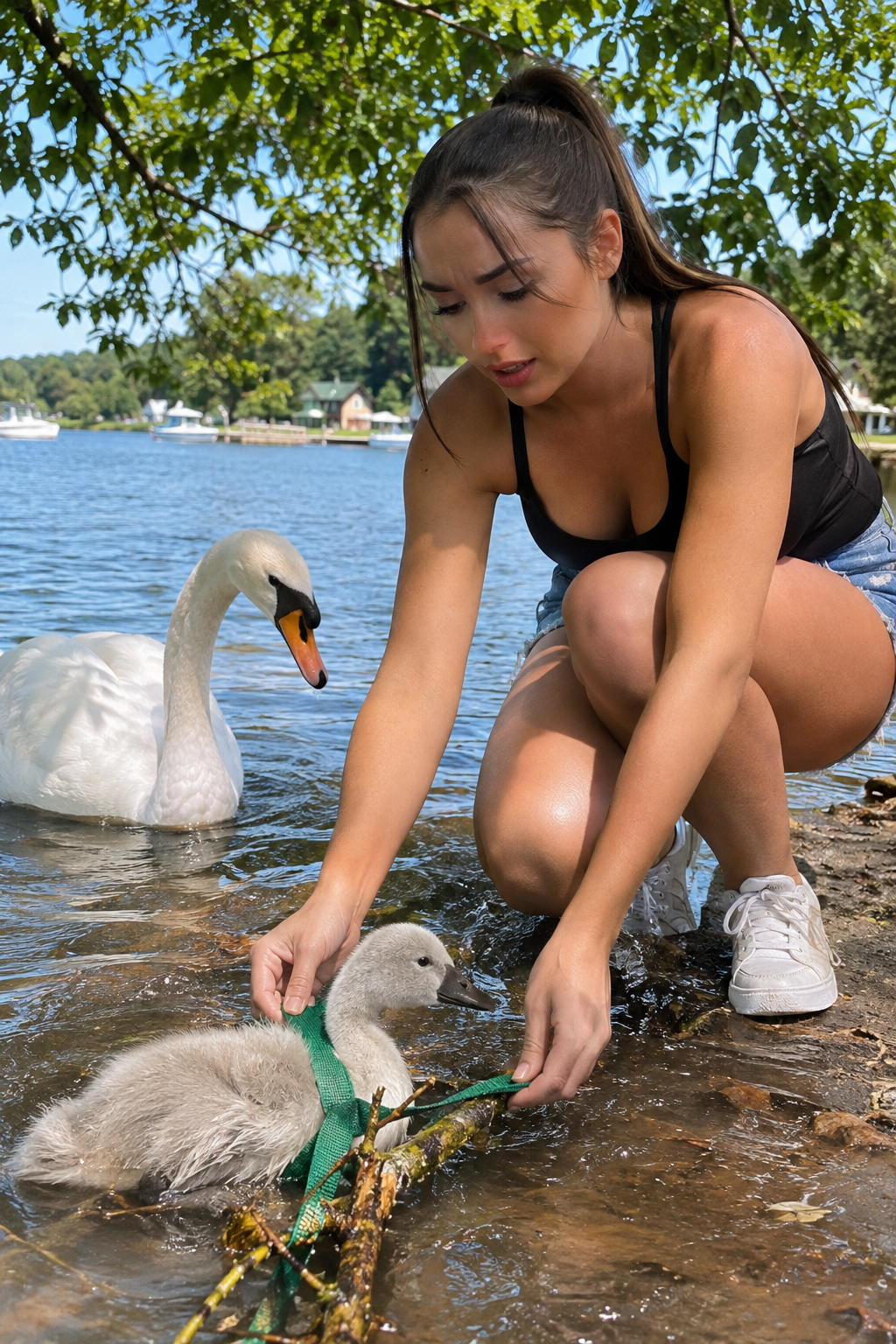
The young woman crouched beside the shoreline.
There, struggling in the shallow water, was a small gray baby swan.
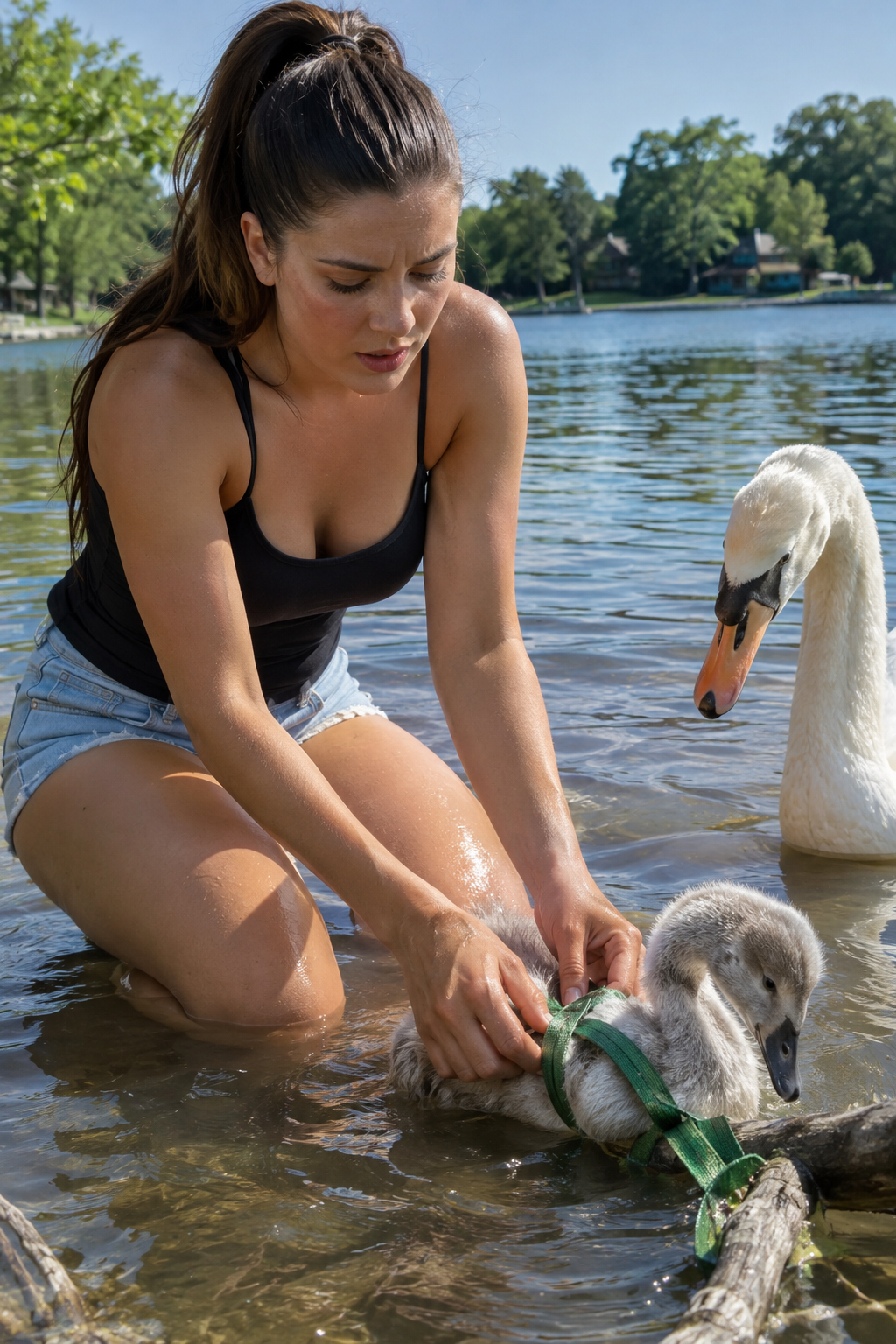
The cygnet’s body had become tangled in a green nylon strap that was caught around a partially submerged branch.
The frightened little bird attempted to move, but the strap prevented it from swimming freely.
The adult white swan remained close, honking anxiously as the cygnet struggled.
The woman’s expression immediately changed.
“Oh my God! Your baby’s stuck!”
She looked at the green nylon strap surrounding the young bird.
The situation suddenly explained the adult swan’s persistent behavior within the fictional story.
What had appeared to be an unexpected interruption on the boardwalk had brought her directly to a vulnerable animal that needed assistance.
The little cygnet continued releasing distressed calls.
Water moved around its gray feathers as it attempted to escape the obstruction.
The woman remained crouched near the shoreline, carefully observing the situation.
The green strap was visibly caught around the submerged branch, restricting the young swan’s movements.
The fictional video does not establish where the strap originally came from or how the cygnet became entangled.
Nevertheless, the immediate danger was apparent.
The baby swan could not swim away independently.
Its mother remained nearby throughout the encounter.
The young woman carefully reached toward the green strap.
She understood that the frightened animal needed assistance, but its delicate body and restricted movements required considerable care.
The peaceful lake had become the setting of an emotional wildlife emergency.
The Woman Carefully Tried to Free the Baby Swan
The brunette woman stepped into the shallow lake.
She was still wearing her original black tank top, denim shorts, and white sneakers.
Water moved around her legs as she carefully approached the trapped cygnet.
She knelt beside the little bird and gently supported its body.
“Easy, sweetheart. I’ve got you.”
The baby swan continued releasing soft calls.
Its white mother remained close, watching the woman’s movements.
Within the dramatized rescue, the woman carefully began loosening the green nylon strap.
She concentrated on the obstruction while supporting the frightened cygnet.
The partially submerged branch remained beside them.
Gentle splashes interrupted the quiet sounds of the lake as the young bird moved slightly.
The woman continued working patiently.
The fictional sequence emphasizes her concern for the animal and her determination to avoid causing additional distress.
There were no visible injuries or blood.
However, the absence of visible injuries would not establish that an animal was completely unharmed in a real entanglement emergency.
The adult swan remained nearby throughout the woman’s efforts.
Its presence added another emotional dimension to the rescue.
The woman was not simply helping an individual bird escape an obstruction.
She was also creating an opportunity for a mother and her young to remain together.
The green nylon strap gradually loosened.
The cygnet was closer to regaining its freedom.
The woman maintained her attention on the little bird as she addressed the remaining section of the strap.
Only one final moment separated the young swan from the opportunity to swim freely again.
How Discarded Materials Can Endanger Aquatic Wildlife
Although the events in this story are fictional, entanglement involving discarded human-made materials is a genuine concern for aquatic wildlife.
Lakes, rivers, ponds, and coastal environments can accumulate various forms of litter.
Fishing lines, plastic straps, ropes, discarded netting, and packaging materials may remain in the water or become caught around submerged vegetation and branches.
These objects can create serious hazards for animals that encounter them.
Waterbirds may accidentally become entangled while swimming, feeding, or moving through shallow areas.
Once caught, their natural attempts to escape can sometimes make the obstruction more difficult to remove.
Young birds may be especially vulnerable because of their smaller size and limited experience navigating unfamiliar surroundings.
The green nylon strap in this fictional story illustrates how an ordinary discarded object can become a dangerous obstruction.
The cygnet’s movements are restricted because the strap has become caught around a submerged branch.
Its mother remains nearby, while the young bird struggles to swim freely.
The narrative encourages viewers to consider the consequences of leaving waste near natural waterways.
Proper disposal of fishing equipment, packaging materials, and other waste can help reduce preventable wildlife hazards.
Even relatively small objects may create significant problems when they enter aquatic environments.
Protecting lakes and their inhabitants begins with responsible behavior from the people who visit them.
The Remarkable Connection Between Swans and Their Young
Swans are among the most recognizable waterbirds, admired for their graceful movements, long necks, and distinctive appearance.
Their young are known as cygnets.
Unlike the bright white plumage commonly associated with adult swans, many young cygnets have grayish feathers during their early development.
These young birds depend on parental protection while developing the abilities necessary to survive independently.
Adult swans can be highly protective of their offspring, particularly when they perceive a nearby threat.
The fictional story emphasizes this parental connection through the white swan’s continued presence near the trapped cygnet.
At the beginning, the adult bird approaches the woman on the boardwalk.
It then leads her toward the shoreline, where the frightened young swan is discovered.
This behavior is dramatized to suggest that the mother deliberately sought human assistance.
Such a complex intention cannot be established simply from observing similar behavior in real wildlife.
Nevertheless, the fictional narrative uses the encounter to celebrate the emotional significance of parental protection.
The adult swan remains close while the woman attempts to remove the obstruction.
The little cygnet’s opportunity to return to its mother becomes the central emotional goal of the rescue.
Rather than removing the young bird from its natural environment permanently, the story focuses on restoring its freedom.
The intended outcome is a continuation of the natural relationship between the two animals.
Why Approaching Wild Swans Requires Caution
The young woman’s compassionate response is an important element of the fictional narrative.
However, real encounters with wild swans require appropriate caution.
Adult swans are powerful birds that may behave defensively, especially when protecting their offspring or nesting areas.
Wing movements, vocalizations, and changes in posture can communicate agitation or perceived threats.
A person should not automatically interpret an approaching or honking swan as an animal requesting assistance.
There may be numerous explanations for its behavior.
In the fictional story, the adult swan’s persistence leads the woman toward an actual obstruction involving its young.
In real circumstances, approaching a distressed bird without appropriate experience can create additional risks.
The animal may struggle, become more frightened, or react defensively.
Entering unfamiliar water can also expose a person to slippery surfaces, unstable ground, unexpected depths, and submerged hazards.
Qualified wildlife rescuers are trained to assess these conditions and determine appropriate methods of assistance.
Anyone discovering an entangled waterbird should contact a licensed wildlife rehabilitator, animal rescue organization, or relevant wildlife authority.
The fictional rescue is intended to communicate compassion, not provide a practical demonstration of wildlife handling.
Responsible assistance requires consideration of both animal welfare and human safety.
Sometimes Unusual Animal Behavior Deserves Attention
One of the most interesting elements of the fictional story is the change in the woman’s interpretation of the swan’s behavior.
Initially, she is startled when the large white bird spreads its wings directly in front of her.
She does not understand why it continues honking or following her along the boardwalk.
As the swan repeatedly turns toward the water, her curiosity grows.
She eventually decides to investigate the area toward which the bird is moving.
The discovery near the submerged branch transforms her understanding of the entire encounter.
Within the story, the adult swan’s behavior becomes an unexpected connection between a human and an animal in distress.
Animals communicate through movements, sounds, posture, and other behavioral signals.
People may sometimes notice changes in those signals that indicate discomfort or distress.
However, animal behavior should not automatically be interpreted through human intentions.
A bird may approach someone because of territorial behavior, previous experiences involving food, curiosity, or other environmental factors.
The fictional sequence presents an imaginative explanation designed to create an emotional rescue story.
Its broader message is that paying attention to one’s surroundings can sometimes reveal problems that would otherwise remain unnoticed.
When there is credible evidence that wildlife is endangered, contacting appropriate professionals can help ensure that the situation is addressed responsibly.
Keeping Lakes Clean Is Everyone’s Responsibility
The beautiful lakeside setting creates an important contrast with the dangerous nylon strap.
The water appears peaceful, the surrounding trees provide natural beauty, and birds contribute to the tranquil atmosphere.
Yet beneath the surface, a discarded object has become caught around a branch.
This contrast illustrates how environmental hazards are not always immediately visible.
Plastic and synthetic materials can persist in aquatic environments, where they may affect wildlife long after being discarded.
Visitors to lakes and other natural areas can help reduce these risks through responsible waste disposal.
Fishing equipment should be collected and disposed of appropriately.
Packaging straps, plastic bags, and other loose materials should never be left near the shoreline.
Organized environmental cleanup activities can also help remove litter from accessible areas when conducted safely and responsibly.
Hazardous waste and submerged debris may require specialized assistance.
The fictional rescue encourages viewers to consider the relationship between everyday human behavior and the welfare of wild animals.
The green nylon strap is a relatively ordinary object.
However, its presence in the lake creates the central emergency of the story.
Preventing similar hazards requires awareness, responsible disposal, and respect for shared natural environments.
Protecting wildlife is not limited to dramatic rescue efforts.
It also involves preventing dangerous situations from developing in the first place.
Why Returning Wildlife to Its Natural Environment Matters
The young woman in the fictional story does not intend to keep the rescued cygnet.
Her goal is to remove the obstruction that prevents it from swimming freely.
Its mother remains nearby, creating an opportunity for the young bird to return to its natural family group.
Wild animals have specific behavioral, nutritional, and environmental needs.
Their development often depends on appropriate interactions with their own species and natural surroundings.
Unnecessary removal from those surroundings can interfere with important aspects of their lives.
When a wild animal is genuinely injured or endangered, licensed wildlife professionals can determine whether temporary rehabilitation is necessary.
The appropriate response depends on the animal’s condition and the circumstances of the emergency.
Entanglement injuries may not always be immediately visible.
Professional assessment can help identify complications that require further care.
The fictional story does not establish whether the rescued cygnet receives a veterinary examination or additional monitoring.
Its focus remains on the immediate removal of the nylon strap.
The emotional significance comes from the possibility of the young bird returning to its mother.
The narrative reminds viewers that helping wildlife does not mean taking ownership of it.
Sometimes the most beautiful outcome is simply restoring an animal’s opportunity to continue its natural life.
Compassion Can Begin With an Unexpected Encounter
The young woman’s lakeside walk begins without any expectation of becoming involved in an animal rescue.
She is simply moving along the wooden boardwalk when the large white swan suddenly interrupts her path.
Her initial reaction is surprise.
As the bird continues following her, that surprise becomes curiosity.
The discovery near the submerged branch transforms curiosity into concern.
Finally, the woman’s efforts to remove the green nylon strap bring the fictional narrative toward an emotional resolution.
This progression gives the story much of its inspirational character.
It demonstrates how an unexpected encounter can encourage someone to pay attention to the vulnerability of another living creature.
The woman’s actions are dramatized, but the underlying theme of compassion remains meaningful.
People can support animal welfare in many responsible ways, including protecting natural habitats, reporting endangered wildlife, supporting qualified rescue organizations, and disposing of waste appropriately.
Not every act of kindness requires direct physical intervention.
Sometimes recognizing a problem and contacting the right people is the most valuable contribution someone can make.
The fictional story celebrates the willingness to notice an animal in distress rather than ignore it.
It also highlights the importance of respecting the natural relationships that exist between wild animals.
One Final Moment Beside the Peaceful Lake
Golden sunlight reflected across the shallow water.
The young woman remained kneeling near the partially submerged branch.
Her black tank top, denim shorts, and white sneakers were unchanged.
The adult white swan stayed nearby while the gray cygnet remained close to the woman.
The green nylon strap was almost completely removed.
The frightened calls that had filled the shoreline earlier were becoming quieter.
The gentle movement of lake water and distant birdsong once again dominated the surroundings.
The woman concentrated on the final part of the obstruction.
Her unexpected encounter on the boardwalk had brought her to this quiet section of the lake, where two vulnerable animals had been unable to continue their natural journey together.
The young swan was now moments away from regaining its freedom.
Its mother waited nearby.
The final seconds of the fictional rescue would reveal the beautiful outcome of the woman’s compassionate efforts.
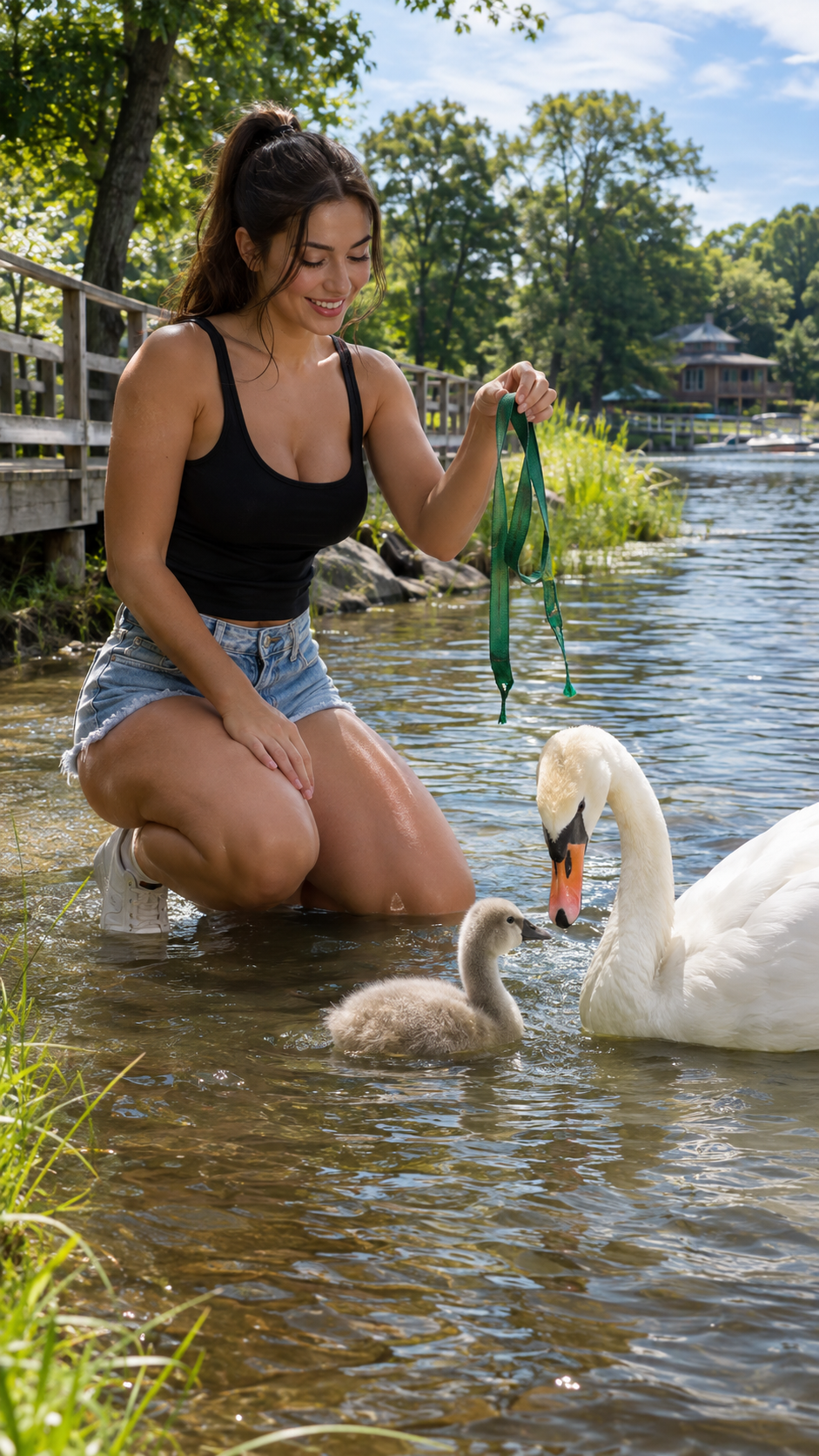
The woman completely removed the green nylon strap and held it above the water as the little gray cygnet immediately swam toward its white mother. Watching the two birds reunite beneath the golden sunlight, she smiled with relief and softly said, “There you go. Back to your mama.” As the mother and baby swam peacefully together, the extraordinary fictional encounter ended with a beautiful reminder of compassion, freedom, and the importance of protecting wildlife.