A Frightening Discovery in the Backyard
Bright summer sunlight illuminated a peaceful suburban backyard. Red petunias decorated the garden beside a brick pathway, while a cream-colored farmhouse and wooden deck created a welcoming atmosphere.
A cedar privacy fence surrounded the green lawn, and birds sang from the nearby trees.
Everything appeared calm until a sudden metallic rattling interrupted the peaceful surroundings.
A tiny spotted white-tailed fawn was desperately attempting to pull itself backward from a cylindrical silver wire plant cage.
Its head and shoulders had become trapped inside the metal structure.
Every attempt to escape caused the cage to rattle against the bricks.
The frightened animal struggled to understand what was preventing it from moving freely.
Its large eyes reflected its distress as it attempted another unsuccessful movement.
Standing nearby on the green lawn was an adult female deer.
The mother watched anxiously as her baby continued struggling.
She remained close to the garden, unable to remove the metal obstruction surrounding the little animal.
At that moment, Rachel, a 42-year-old woman with auburn hair tied in a low ponytail, noticed the unusual activity.
She wore a light-blue denim shirt, beige cargo pants, brown work boots, and gray gardening gloves.
As she approached the garden pathway, she immediately realized that something was terribly wrong.
“Oh my God! Hang on, little one!”
Rachel looked toward the frightened fawn and the metal cage restricting its movements.
What had started as an ordinary summer day had suddenly become an unexpected wildlife emergency.
The little animal needed assistance, and its mother remained nearby, watching every movement.
Rachel knew that whatever happened next would require patience and considerable care.
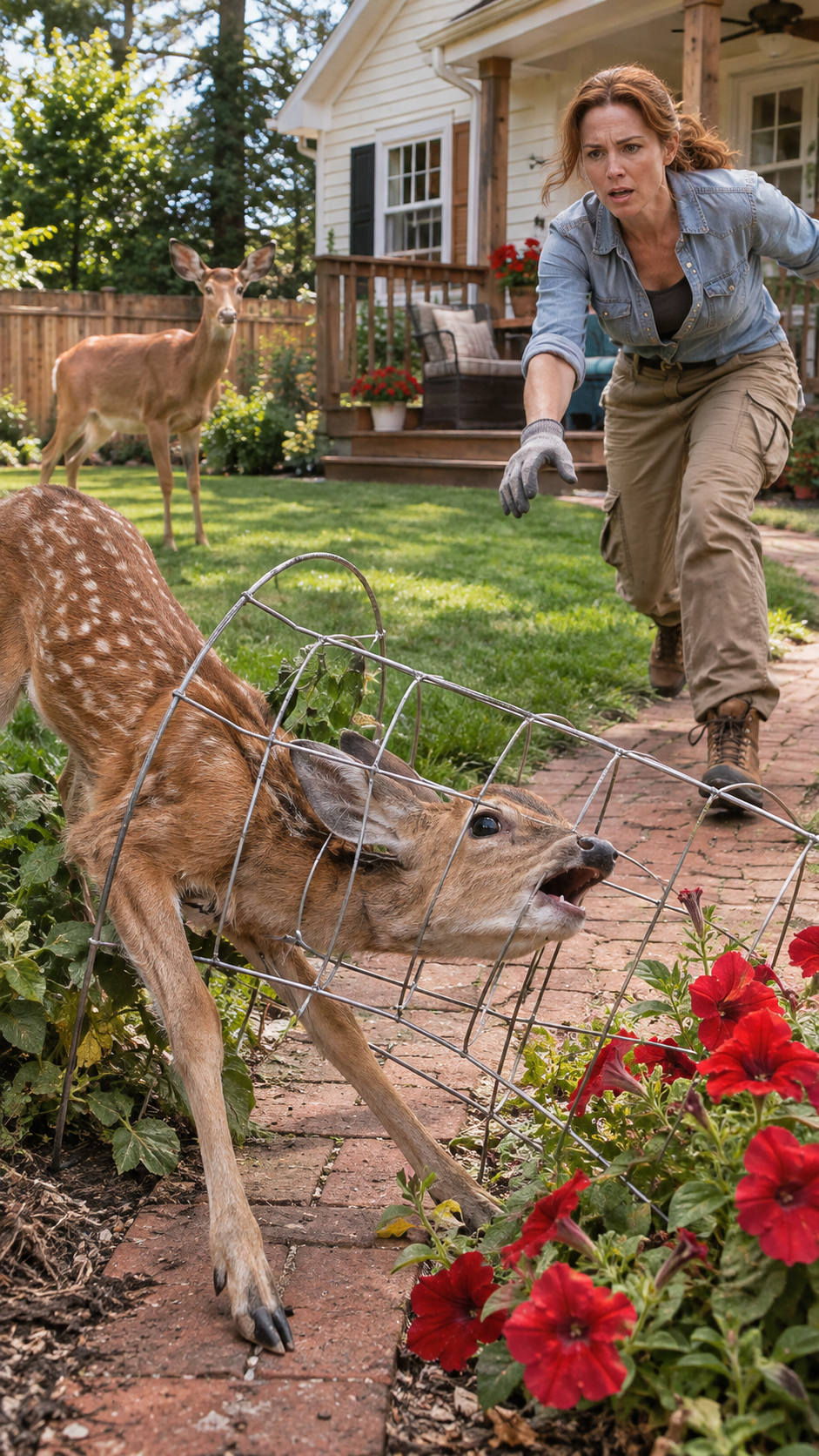
Rachel Slowly Approached the Frightened Fawn
The spotted fawn remained trapped beside the red petunias.
Its head and shoulders were still inside the cylindrical wire cage, preventing it from escaping independently.
The adult female deer continued watching from the lawn.
Rachel returned toward the brick pathway holding a pair of orange-handled wire cutters in her right hand.
She moved slowly, avoiding sudden movements that might frighten the little animal further.
Her brown work boots pressed gently against the bricks as she approached.
The fawn looked toward her, its breathing audible beneath the peaceful sounds of birdsong and rustling leaves.
Rachel carefully knelt beside the silver cage.
“Easy, sweetheart. I’m here to help.”
Her voice remained gentle and reassuring.
The mother deer stood several steps away, maintaining her attention on the trapped fawn.
The fictional encounter does not establish exactly how the young deer became trapped inside the garden structure.
It may have approached the plants out of curiosity, but the precise circumstances remain unknown.
What mattered in that moment was that the metal cage was preventing the animal from moving freely.
Rachel examined the obstruction while remaining beside the frightened fawn.
She could see that the opening would need to become wider before the little animal could escape.
The orange-handled wire cutters offered a possible solution within the fictional rescue.
However, the animal’s proximity to the metal strands meant that every movement required care.
The fawn remained on the brick pathway, while its mother continued observing from the lawn.
Rachel prepared to address the tangled situation.
The peaceful garden had become the setting of an extraordinary encounter between a concerned woman and two vulnerable wild animals.
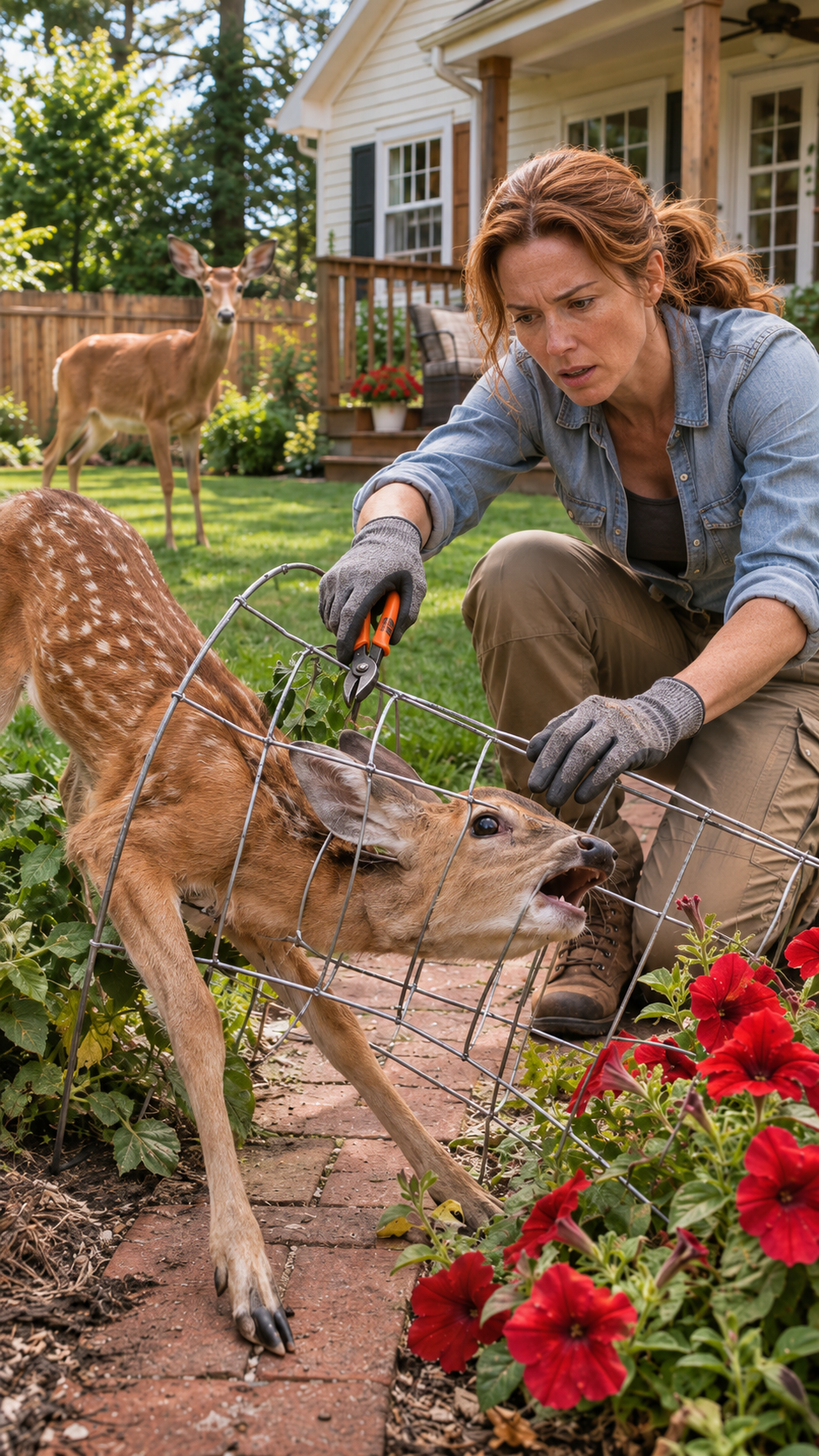
The Difficult Process of Removing the Metal Obstruction
Rachel remained kneeling beside the trapped fawn.
With her left gloved hand, she carefully held the outside of the cylindrical wire cage.
In her right hand were the orange-handled wire cutters.
The little deer remained frightened, occasionally moving its head as Rachel examined the metal strands.
The mother deer was still visible in the background.
Rachel began carefully addressing the obstruction.
A sharp metallic snapping sound interrupted the gentle birdsong as one of the wire strands was cut.
The cage moved slightly.
The frightened fawn continued breathing softly while Rachel remained focused on the task.
“Just a little longer. You’re doing great.”
Her reassuring words reflected her concern for the young animal.
Within the dramatized sequence, Rachel continued cutting the metal strands away from the fawn.
She worked carefully, maintaining the same position beside the brick pathway.
The red petunias remained immediately beside the damaged garden cage.
Each metallic snapping sound indicated that the obstruction was gradually being opened.
The adult female deer continued watching from the lawn, occasionally raising her head toward the activity.
Rachel understood that the young animal needed sufficient space to escape without becoming caught again.
The fictional rescue emphasizes her patience and attention rather than sudden or forceful movements.
The little fawn remained close to the ground as the opening gradually became larger.
Several strands of wire had already been separated.
However, part of the cage continued restricting the animal’s movements.
Rachel focused on the remaining section.
The frightened little deer was closer to freedom than it had been when she first discovered it.
Its mother remained nearby throughout the entire encounter.
One final section of metal still stood between the fawn and its opportunity to return to the lawn.
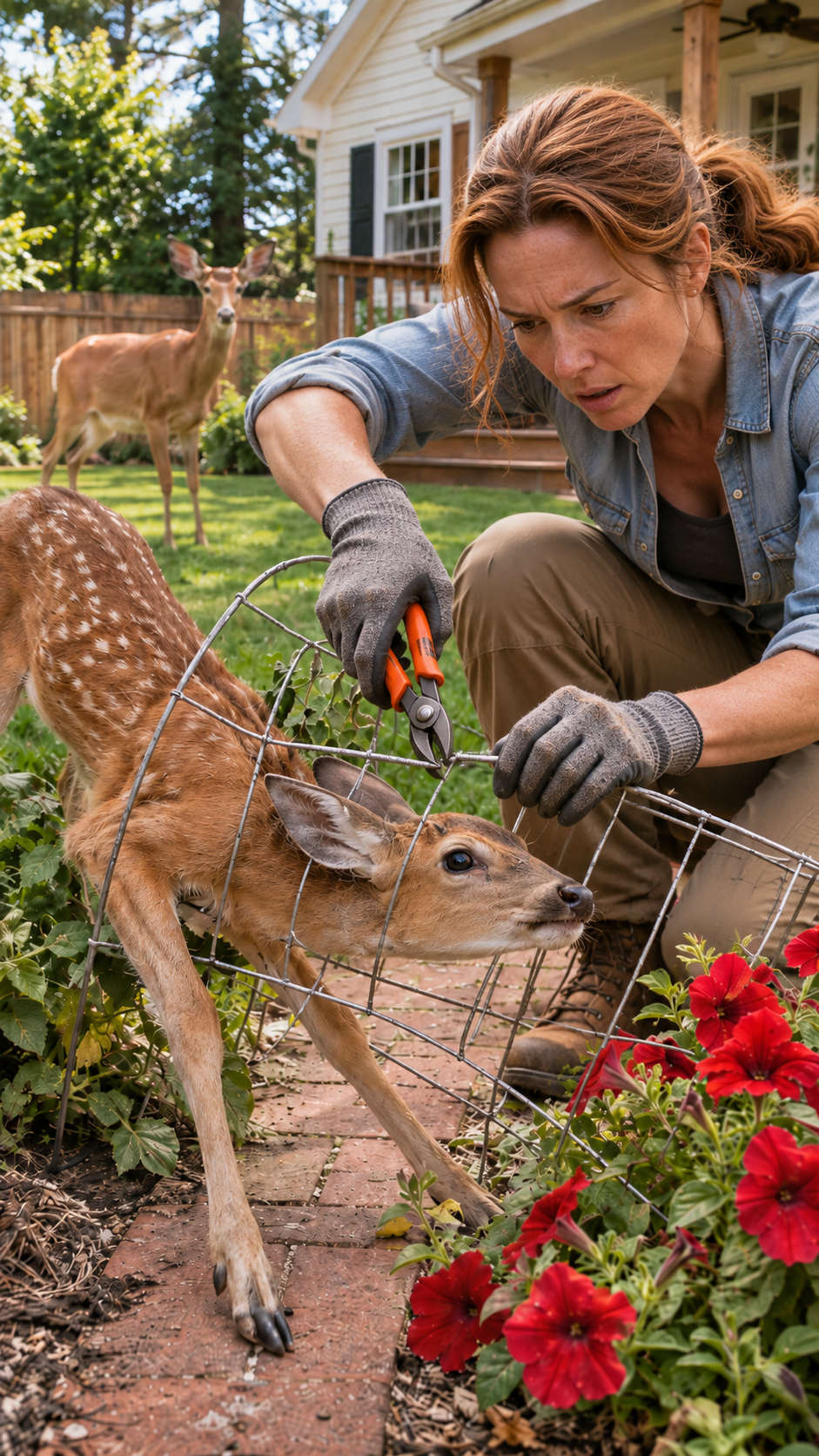
The Moment the Little Deer Finally Escaped
Rachel carefully addressed the remaining wire strand.
The orange-handled cutters produced another metallic snapping sound.
Within the fictional sequence, she gently moved the loosened section of the silver cage outward.
The opening was finally wide enough for the spotted fawn to move through.
Rachel remained kneeling beside the garden pathway.
The little animal lowered its head.
For a moment, it appeared hesitant.
Then it carefully began stepping through the enlarged opening.
Its small hooves touched the brick pathway as its shoulders moved beyond the metal structure.
The cage no longer prevented it from moving forward.
Rachel smiled with visible relief.
“There you go! You’re free!”
The spotted fawn stood outside the opened cage.
Its delicate legs supported its body as it regained its freedom of movement.
Nearby, the mother deer raised her head and began taking several steps closer.
The frightening metallic rattling that had interrupted the peaceful backyard was replaced by gentle hoofsteps and birdsong.
Rachel remained beside the damaged cage, watching the young animal.
The fictional story shows the fawn standing and walking independently after being freed.
However, it does not establish whether the animal required a veterinary examination or whether it experienced any medical complications.
The immediate obstruction had been removed, allowing the fawn to move away from the garden structure.
The mother deer continued approaching across the lawn.
For Rachel, the moment brought considerable relief.
The young animal was no longer trapped.
But something even more touching was about to happen as the mother and her baby moved toward one another.
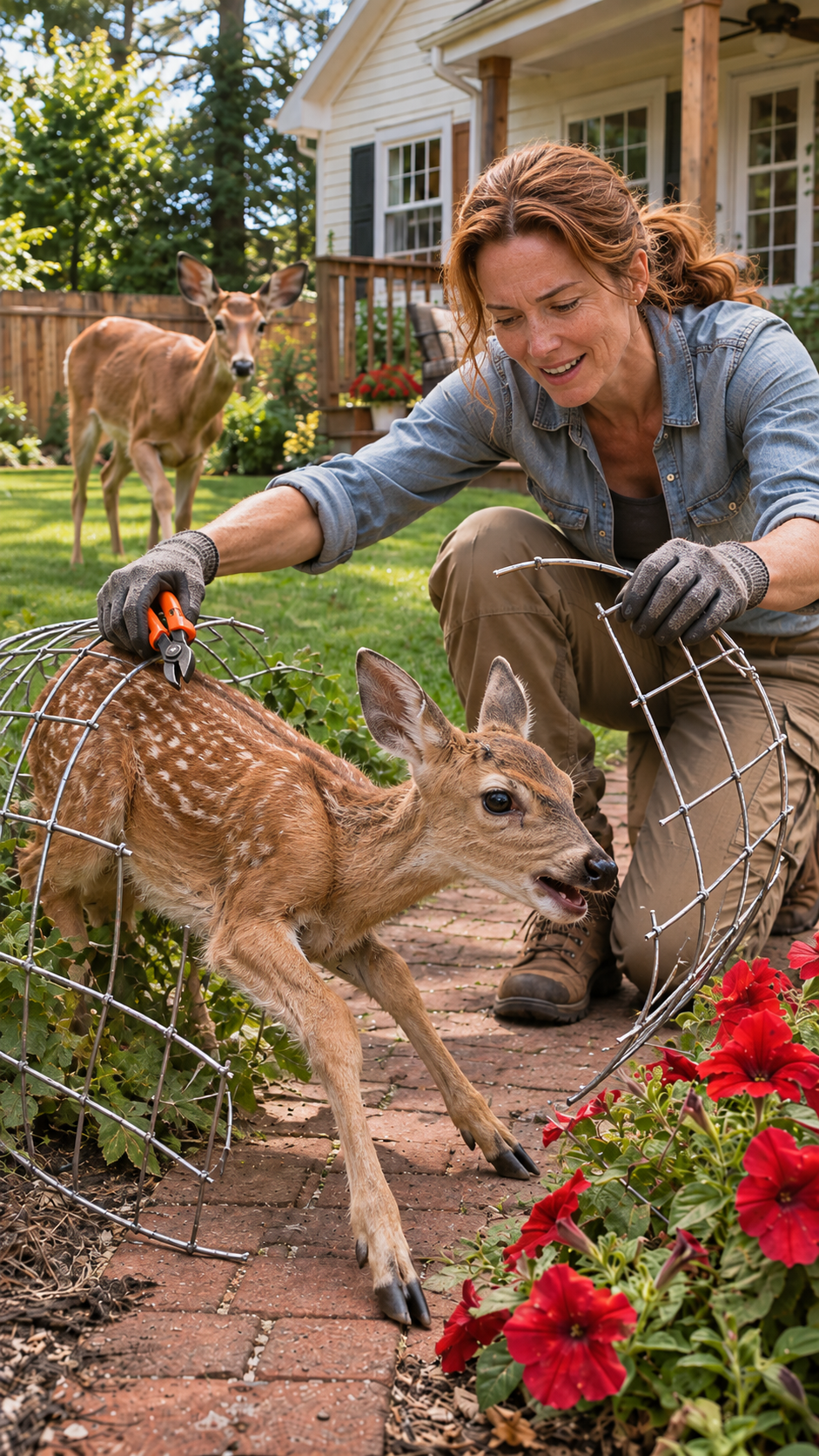
The Reunion Rachel Had Been Waiting to See
Rachel remained kneeling beside the opened silver wire cage.
She continued holding the same orange-handled cutters while watching the rescued fawn.
The little deer stood near her briefly before turning its attention toward the green lawn.
Its mother was approaching.
The spotted fawn began walking away from the brick pathway.
Its small hooves moved gently across the grass as the distance between the two animals gradually disappeared.
Rachel watched with a warm smile.
“Look who’s waiting for you.”
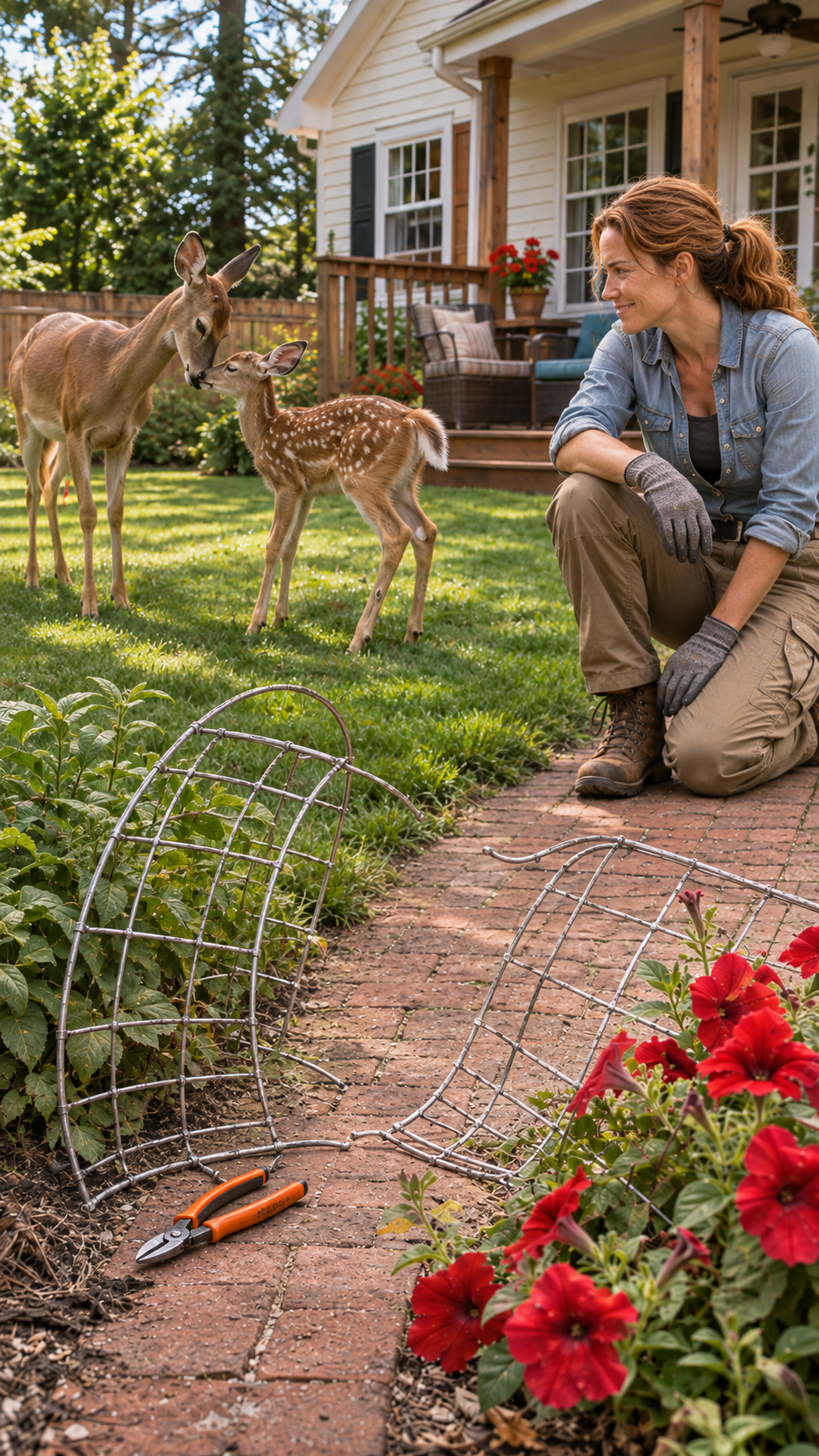
The adult female deer lowered her head toward the young animal.
She gently touched the fawn’s forehead with her nose.
The small gesture created one of the most emotional moments of the fictional rescue.
Throughout the encounter, the mother had remained nearby.
She had watched while her baby struggled inside the metal cage and while Rachel attempted to remove the obstruction.
Now the two animals were together again.
The little fawn stood close to its mother beneath the bright summer sunlight.
The surrounding backyard appeared peaceful once more.
The cream-colored farmhouse, wooden deck, cedar fence, and red petunias remained unchanged.
Yet the atmosphere was completely different from the frightening opening moments.
Rachel no longer needed to concentrate on the damaged wire cage.
She could simply observe the two animals standing together.
The fictional narrative presents their reunion as a quiet celebration of freedom and the connection between a mother and her offspring.
There was no need for dramatic movement or elaborate gestures.
The gentle touch of the mother’s nose against her baby’s forehead communicated the emotional significance of the moment.
Rachel remained beside the garden pathway, allowing the deer space to move freely.
Their extraordinary encounter was approaching its conclusion.
Why Garden Equipment Can Become Dangerous to Wildlife
Although Rachel’s rescue story is fictional, ordinary gardening equipment can present genuine hazards to wild animals.
Wire plant cages, garden netting, fencing, ropes, and other structures are commonly used to protect plants and support growing vegetables or flowers.
These materials can serve useful purposes, but their design and placement may create unintended risks.
Young animals are particularly vulnerable because they may enter narrow openings without being able to move backward easily.
Their natural curiosity can bring them into unfamiliar areas, including residential gardens.
When an animal becomes trapped, its attempts to escape may cause the surrounding material to tighten or shift.
A frightened animal may also struggle unpredictably, increasing the possibility of injury.
The cylindrical silver wire cage in this fictional story illustrates how a familiar garden object can become an unexpected obstruction.
Rachel initially discovers the fawn with its head and shoulders trapped inside the structure.
The metallic rattling and frightened movements communicate the seriousness of the situation.
Homeowners can help reduce wildlife hazards by regularly inspecting garden equipment and removing damaged or unnecessary materials.
Unused wire cages and loose netting should be stored securely when they are not needed.
Gardening structures should also be selected and positioned with consideration for the wildlife that may visit the surrounding area.
The story encourages viewers to recognize that protecting plants and protecting animals do not need to be competing priorities.
Thoughtful garden maintenance can help create safer environments for both.
The Special Connection Between a Mother Deer and Her Fawn
White-tailed deer are known for the distinctive spotted coats of their young.
These spots provide camouflage, helping fawns blend into vegetation and patches of sunlight.
During the early stages of a fawn’s life, its mother plays an important role in providing nourishment and protection.
Mother deer may temporarily leave their young in sheltered locations while searching for food.
This natural behavior can sometimes cause people to mistakenly believe that a healthy fawn has been abandoned.
Finding a young deer alone does not automatically mean that it needs human intervention.
In Rachel’s fictional encounter, however, the fawn faces a visible physical obstruction.
Its mother remains nearby throughout the rescue, watching from the lawn.
The narrative uses this continued presence to emphasize the connection between the two animals.
The mother’s eventual approach and gentle contact with the fawn create a touching reunion.
Although viewers may interpret the gesture as affection or reassurance, animal behavior should not automatically be assigned human emotions or intentions.
The fictional sequence dramatizes a natural-looking interaction to communicate its message of compassion.
Its emotional strength comes from seeing a vulnerable young animal regain the opportunity to remain with its mother.
Rather than separating the fawn from its natural environment, the story celebrates their continued journey together.
Why Patience Matters When Helping Frightened Animals
One of the central themes of the story is Rachel’s careful approach.
When she first discovers the trapped fawn, she immediately recognizes its distress.
However, her subsequent movements are presented as slow and controlled.
She speaks gently and remains focused on the animal’s immediate circumstances.
This approach creates an emotional contrast with the frightened movements and metallic rattling shown at the beginning.
Wild animals may experience significant stress when approached by people.
Even a small fawn can react unexpectedly when frightened, trapped, or injured.
Sudden movements and unnecessary handling can increase that stress.
For this reason, real wildlife emergencies should be assessed by qualified professionals whenever possible.
Licensed wildlife rehabilitators, animal control personnel, and wildlife authorities can determine the safest appropriate response.
The presence of a mother deer introduces additional considerations because an adult animal may react defensively when its offspring is threatened.
Rachel’s actions in the video are dramatized and should not be treated as practical instructions for handling trapped wildlife.
The most important message is her willingness to recognize an animal in distress rather than ignore it.
Compassion becomes most effective when accompanied by responsible judgment and respect for the animal’s natural behavior.
Creating Safer Spaces for Animals Around Our Homes
Residential gardens can attract a wide variety of wildlife.
Birds, butterflies, squirrels, rabbits, and deer may visit areas containing vegetation, flowers, water, and shelter.
As residential development expands near natural habitats, encounters between people and wild animals can become more common.
These encounters provide opportunities to appreciate wildlife, but they also create responsibilities.
Gardeners can help reduce unnecessary risks by choosing appropriate materials and maintaining their outdoor spaces carefully.
Loose wire, damaged fencing, discarded plastic, and unsecured garden netting can become hazardous when animals encounter them.
Regular inspections can help identify problems before they cause an emergency.
The peaceful backyard in Rachel’s fictional story contains many familiar features.
Its red petunias, brick pathway, wooden deck, and cedar fence create an ordinary residential setting.
That familiarity makes the rescue particularly meaningful.
The danger does not appear in a remote wilderness or an unfamiliar environment.
It appears beside a garden that could resemble countless other backyards.
The story reminds viewers that animal welfare begins with awareness of the spaces people create and maintain.
Even small adjustments to everyday surroundings can contribute to safer conditions for visiting wildlife.
The Importance of Allowing Wildlife to Remain Wild
After the fawn is freed, Rachel does not attempt to carry it into the farmhouse or keep it as a pet.
Instead, she remains beside the opened cage while the young animal moves toward its mother.
This is an important part of the fictional narrative.
Wild animals have specific environmental, nutritional, and behavioral needs.
Their natural development depends on appropriate interactions with their own species and surroundings.
Unnecessary human intervention can sometimes interfere with those processes.
When a young wild animal genuinely requires assistance, qualified wildlife professionals can assess its condition and determine whether rehabilitation is necessary.
The goal of appropriate wildlife rehabilitation is generally to support the animal’s welfare and, when possible, its eventual return to a suitable natural environment.
Rachel’s story focuses on removing the immediate obstruction and allowing the mother and fawn to remain together.
It does not establish whether additional professional assessment would be required in a real situation.
Nevertheless, its intended message is clear.
Helping wildlife does not mean taking ownership of it.
Sometimes the most meaningful outcome is simply seeing an animal regain its freedom and continue its natural life.
A Small Act of Compassion With a Powerful Meaning
Rachel’s fictional adventure begins with a sudden discovery in an otherwise peaceful garden.
She notices a frightened animal that cannot escape independently.
Rather than overlooking the situation, she responds with concern.
Her patience becomes an important part of the story, as does her visible relief when the fawn finally moves beyond the metal cage.
The mother deer’s continued presence adds another emotional dimension.
The rescue is not only about freeing an individual animal.
It is also about preserving the connection between a mother and her young.
That simple idea gives the narrative its heartwarming appeal.
The story does not require extraordinary celebrations or dramatic speeches.
Its most meaningful moments are communicated through small gestures.
Rachel’s reassuring words, the fawn’s first steps outside the cage, and the mother’s gentle touch each contribute to the emotional progression.
The fictional encounter celebrates the importance of noticing vulnerability and responding with kindness.
It also encourages viewers to consider how their everyday surroundings may affect animals.
Compassion can begin with something as simple as recognizing that a familiar garden object has become a danger to an unexpected visitor.
Time for the Two Deer to Continue Their Journey
The bright summer sunlight continued illuminating the backyard.
Rachel remained beside the opened silver wire cage, wearing her original light-blue denim shirt, beige cargo pants, brown work boots, and gray gardening gloves.
The red petunias stood beside the brick pathway, while the cedar fence extended toward the trees at the far end of the lawn.
The mother deer and her spotted fawn stood together on the green grass.
The frightened sounds that had filled the garden earlier were gone.
Birdsong and the gentle movement of leaves once again dominated the peaceful surroundings.
Rachel watched quietly.
The little animal that had been unable to move beyond the metal cage could now walk beside its mother.
The two deer began moving toward the trees.
Rachel remained where she was, allowing them to continue without interference.
The extraordinary fictional encounter was nearly over.
Before disappearing into the shade, however, the mother and her baby shared one final moment with the woman who had helped them.
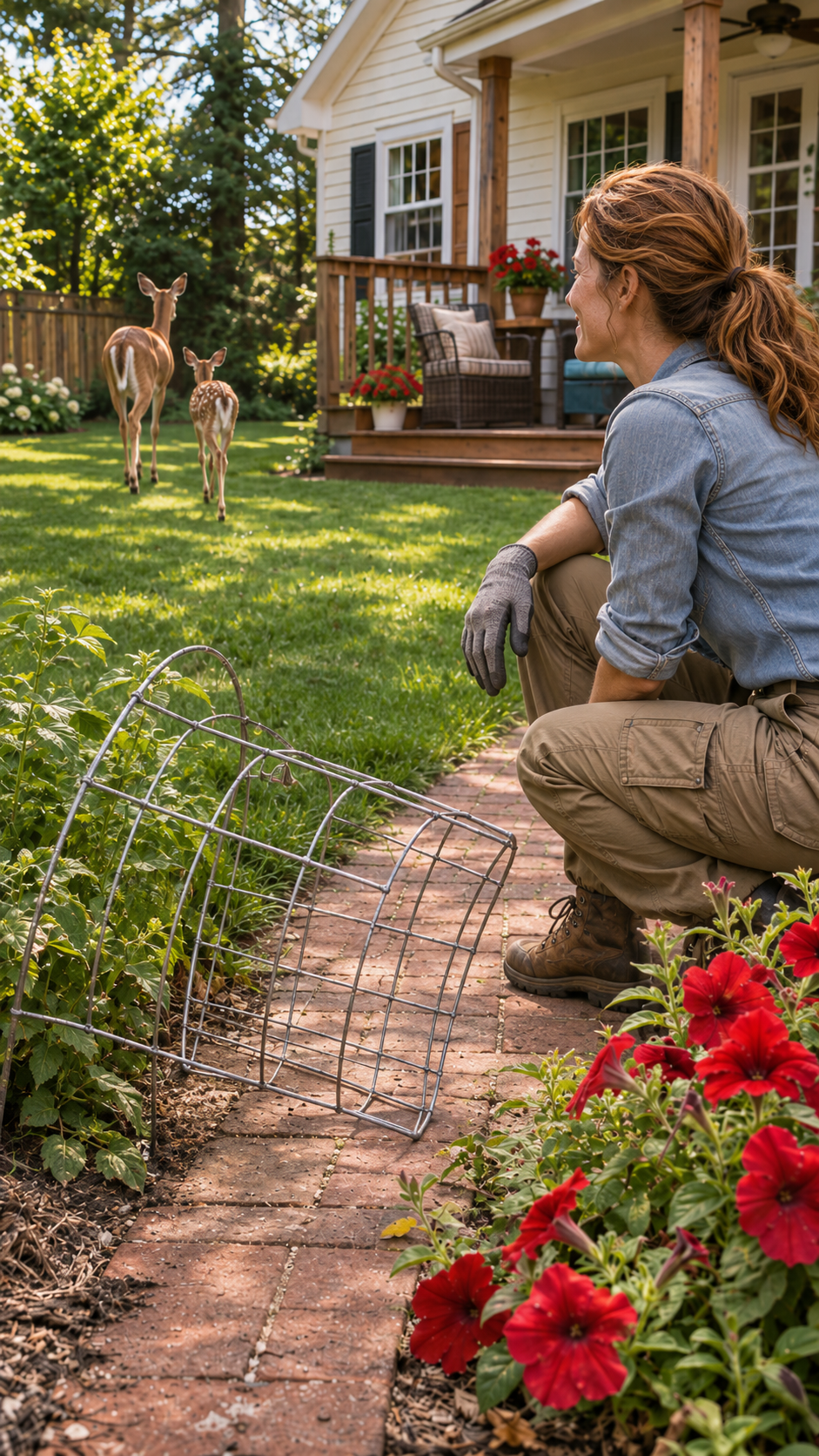
The mother deer and her rescued spotted fawn briefly turned their heads toward Rachel before continuing across the green lawn. Watching them walk peacefully into the shade of the trees, Rachel smiled with relief and whispered, “Stay safe, little buddy.” The quiet summer backyard returned to its familiar tranquility, bringing the fictional rescue to a beautiful conclusion and offering a heartwarming reminder that compassion, patience, and respect for wildlife can make a meaningful difference.