An Afternoon That Nobody in the Restaurant Expected
The upscale steakhouse was filled with the familiar sounds of an enjoyable afternoon. Customers exchanged conversations over their meals, glasses clinked against beautifully arranged tables, and warm sunlight illuminated the polished wooden flooring.
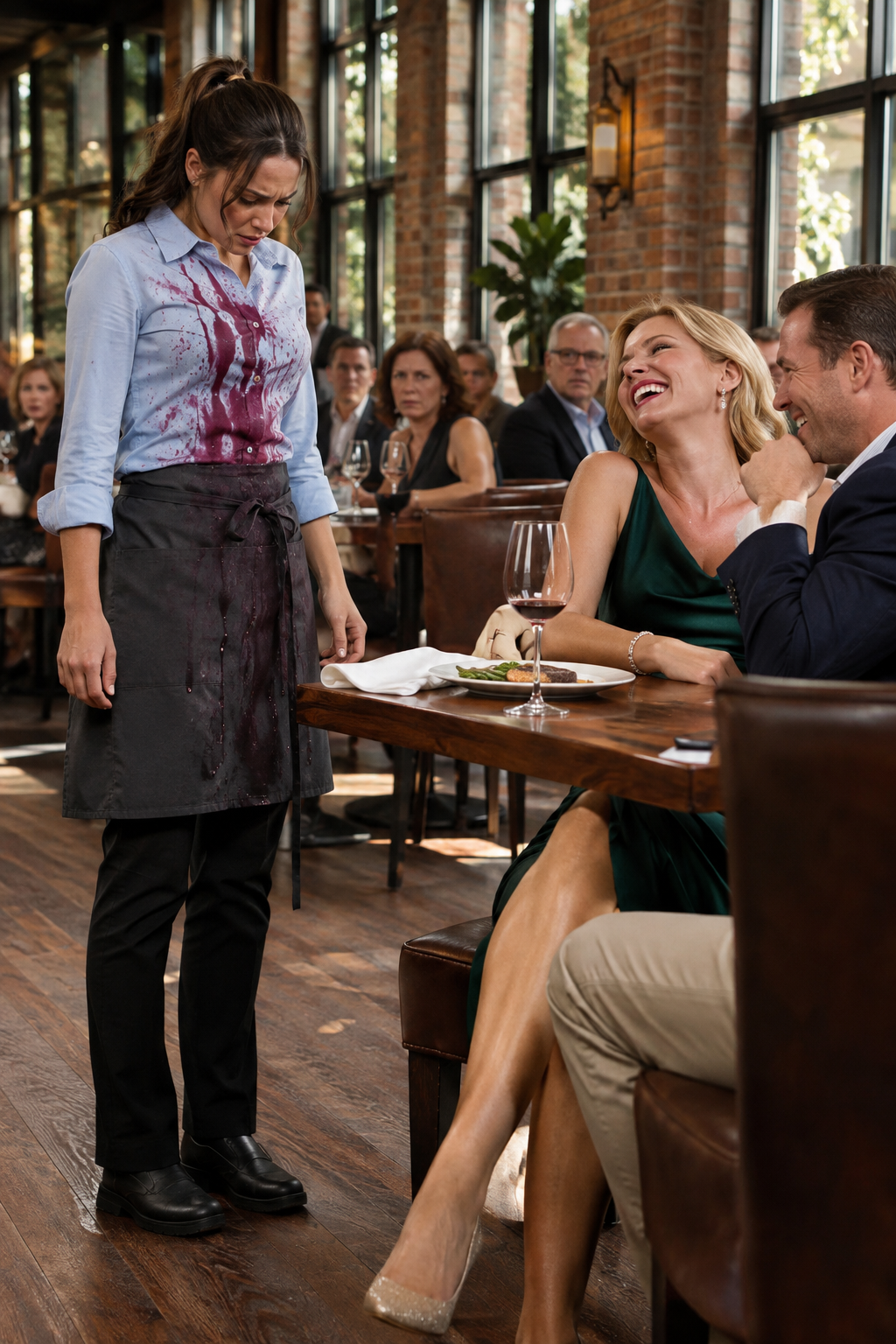
Emily, a waitress wearing a light-blue shirt and charcoal apron, was attending to customers when an unexpected confrontation interrupted the peaceful atmosphere.
She stood beside a walnut dining table where Vanessa, a woman dressed in an elegant emerald-green dress, was enjoying a meal with her male companion.
Without warning, Vanessa lifted her glass and threw red wine directly onto Emily’s shirt.
The liquid splashed across the waitress’s chest, immediately leaving a large red stain.
Several nearby customers turned toward the table.
Emily stood frozen in disbelief.
Vanessa looked at her with a mocking expression.
“Maybe next time you’ll listen!”
Her companion began laughing as though the incident were nothing more than an entertaining joke.
Emily looked down at her ruined uniform before turning toward Vanessa.
“Why would you do that?”
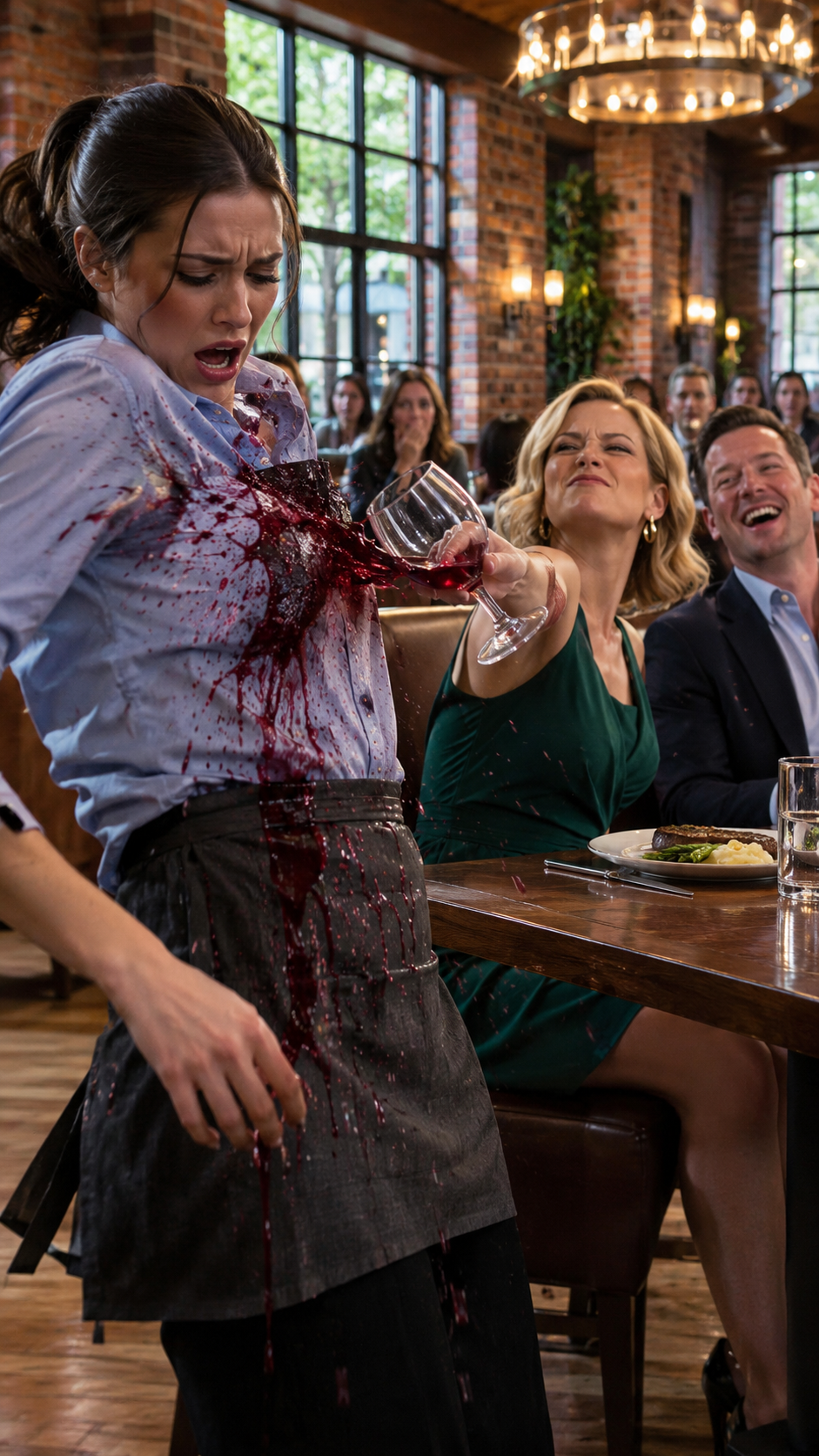
The waitress appeared genuinely shocked by the customer’s behavior.
What should have been an ordinary afternoon at work had suddenly become a deeply embarrassing experience.
The fictional narrative does not establish what conversation preceded the incident or why Vanessa became dissatisfied.
However, her decision to throw wine onto another person transformed the situation into something far more serious than an ordinary customer complaint.
Vanessa continued smiling, apparently unaware that her behavior would soon attract the attention of someone in the restaurant’s kitchen.
The Laughter Made Everything Worse
Emily remained beside the walnut table, looking down at the large wine stain covering her light-blue shirt and charcoal apron.
The surrounding customers watched with uncomfortable expressions.
Some exchanged glances while others quietly observed the situation.
Vanessa remained seated beside her companion.
Rather than apologizing, she continued mocking the waitress.
“What a disaster!”
Her companion laughed again.
Emily attempted to maintain her composure despite the public embarrassment.
She could not simply remove the large stain from her uniform, and everyone nearby could clearly see what had happened.
The uncomfortable silence surrounding the table made Vanessa’s laughter even more noticeable.
Emily took a moment before responding.
“Excuse me.”
She turned away and began walking toward the kitchen.
Her footsteps moved across the polished wooden floor as she passed the surrounding dining tables.
The customers watched her leave.
For Emily, the incident was not merely about a damaged uniform.
She had been deliberately humiliated while performing her professional responsibilities.
Her decision to walk away allowed her to remove herself from the confrontation without escalating it.
Vanessa, meanwhile, remained at the table with her companion.
She appeared to believe that the incident was over.
However, Emily was heading toward someone who would immediately recognize that something was wrong.
The large red wine stain was impossible to overlook.
And the person about to notice it was Chef Daniel.
The Chef Immediately Noticed Emily’s Stained Uniform
Inside the professional kitchen, the atmosphere was considerably different from the elegant dining area.
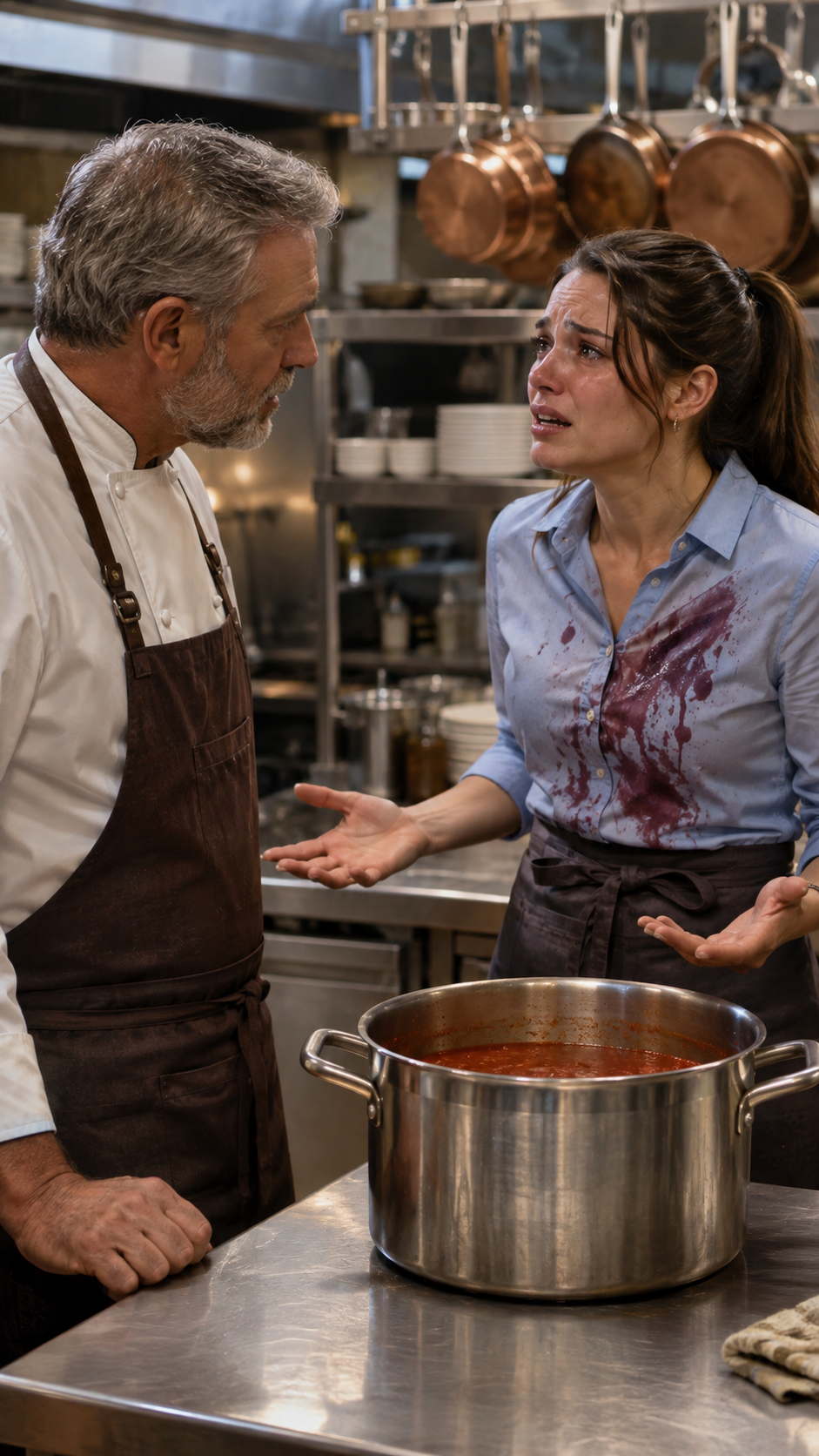
Stainless-steel countertops reflected the bright overhead lighting, copper pans hung above the working stations, and the sounds of kitchen utensils mixed with the steady ventilation system.
Chef Daniel wore a white chef jacket and dark brown apron.
A large stainless-steel pot filled with cooled tomato sauce rested on a nearby countertop.
When Emily entered, Daniel immediately noticed the red stain covering her uniform.
His expression changed from concentration to concern.
“Emily, what happened?”
The waitress stopped beside him.
“That customer threw wine at me.”
Daniel listened as Emily explained the situation.
The visible stain provided an immediate indication of what she had experienced.
His expression became increasingly serious.
Within the fictional story, Daniel is presented as a chef who believes his employees deserve respectful treatment.
Seeing Emily return to the kitchen in such an uncomfortable condition clearly affected him.
The sounds of the dining room remained audible through the kitchen entrance.
Vanessa and her companion were still seated at their table.
They had no apparent reason to expect another confrontation.
Daniel looked toward the restaurant entrance.
Emily watched him, uncertain about what he intended to do.
She had simply explained what happened after he noticed her uniform.
However, the chef’s attention soon shifted toward the large stainless-steel pot resting on the countertop.
It contained cooled tomato sauce.
Daniel stepped toward it.
What followed would become the most unexpected part of the afternoon.
Something Unexpected Came Out of the Kitchen
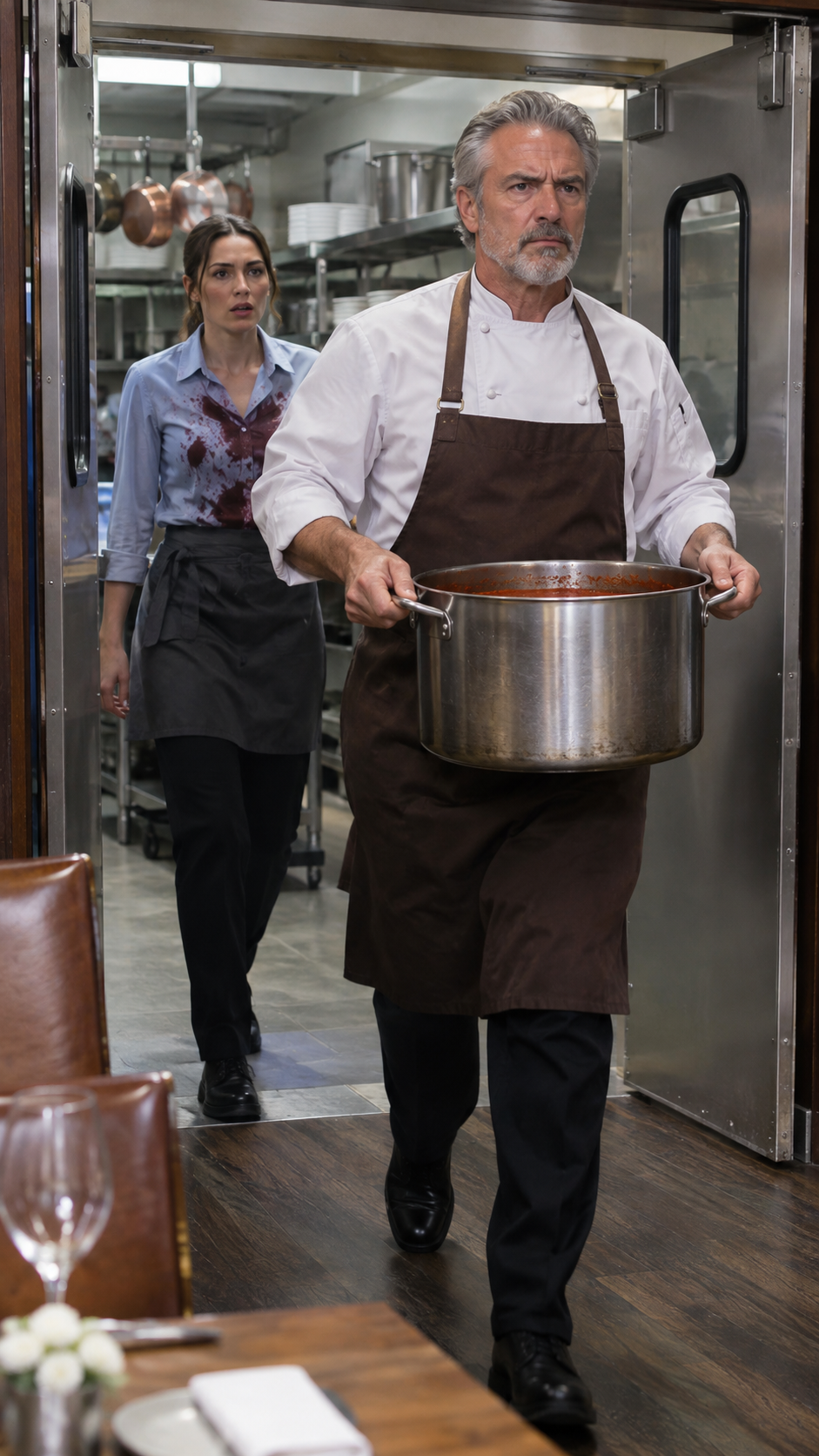
Chef Daniel firmly gripped both handles of the stainless-steel pot.
Emily watched with a surprised expression as he lifted it from the countertop.
The chef turned toward the kitchen doorway.
“Chef, what are you doing?”
Daniel continued walking.
“Nobody treats my staff like that.”
His footsteps echoed through the kitchen as he carried the large pot toward the dining room.
Emily followed several steps behind him, still wearing her wine-stained shirt and charcoal apron.
The kitchen doors swung open.
Several customers noticed the chef emerging with the unusually large stainless-steel pot.
His serious expression suggested that this was not an ordinary part of the restaurant’s food service.
Daniel continued walking between the walnut dining tables.
Vanessa was still sitting with her male companion.
When she noticed the chef approaching, her laughter suddenly stopped.
She looked toward the pot, visibly confused.
Emily remained behind Daniel as he approached the same table where the earlier incident had occurred.
The surrounding customers began paying closer attention.
The restaurant’s ordinary conversations became quieter.
Nobody appeared certain about what the chef intended to do.
Daniel stopped beside Vanessa’s table.
The woman looked up at him.
Her companion also turned his attention toward the chef.
The large pot remained firmly in Daniel’s hands.
Within the fictional narrative, the situation had reached its dramatic turning point.
The customer who had laughed at Emily’s embarrassment was about to experience a very different atmosphere.
The Moment Vanessa Stopped Laughing
Daniel stood beside the walnut dining table holding the stainless-steel pot.
Vanessa looked toward him with a confused expression.
Her emerald-green dress remained perfectly clean.
Emily watched from several steps behind the chef.
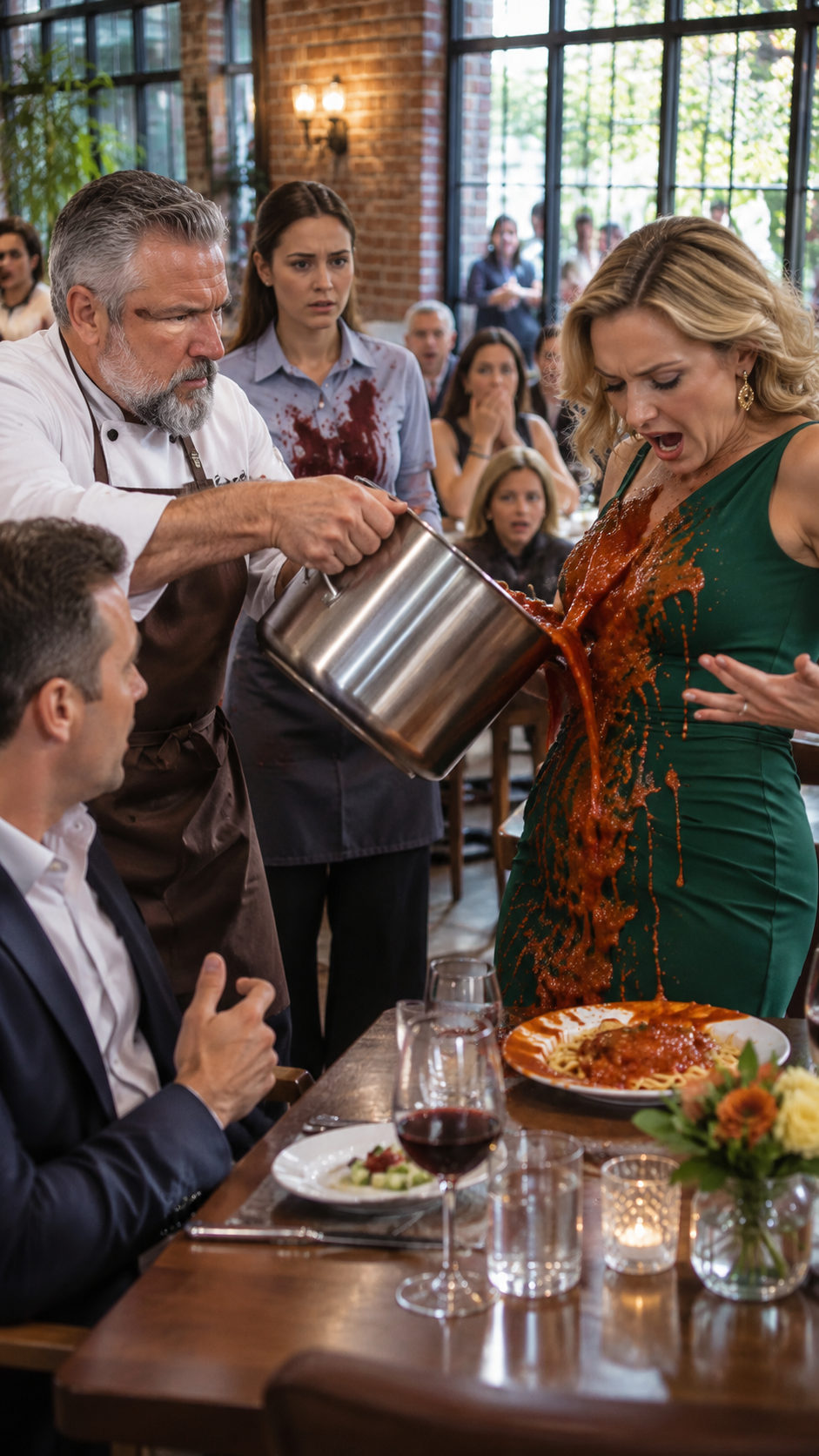
Then Daniel tipped the pot forward.
Cooled tomato sauce spilled across the front of Vanessa’s dress and onto her plate.
The thick red sauce immediately covered the elegant fabric.
Several customers gasped in surprise.
Vanessa stood up abruptly.
“Are you serious?!”
Her male companion stopped smiling.
Daniel responded with a short statement.
“Respect goes both ways.”
The fictional scene deliberately mirrored the earlier moment when Vanessa threw red wine onto Emily’s uniform.
The tomato sauce was depicted as being at room temperature, without steam, burns, or visible injuries.
However, the chef’s response was still an act of retaliation rather than an appropriate professional solution.
The dramatic reversal was designed to expose the difference between Vanessa’s reaction when someone else was humiliated and her reaction when she experienced similar embarrassment.
Only moments earlier, she had laughed while Emily stood beside the table with stained clothing.
Now Vanessa appeared angry and shocked as she looked down at her own dress.
The surrounding customers watched the unexpected confrontation.
Emily remained behind Daniel, observing the situation.
Vanessa’s companion no longer appeared amused.
The laughter that had filled their table earlier had completely disappeared.
But the fictional story was not finished.
Its final moments would shift attention away from the confrontation and toward the waitress whose dignity had been disregarded.
Why Service Employees Deserve Better Treatment
Although the restaurant encounter is fictional, mistreatment of customer-facing employees is a genuine workplace concern.
Restaurant servers often perform demanding responsibilities that require patience, organization, communication, and physical effort.
They may serve numerous tables simultaneously while coordinating with kitchen employees and responding to different customer requests.
During busy periods, these responsibilities can become particularly challenging.
Customers may occasionally experience delays, incorrect orders, or other service problems.
However, dissatisfaction with a meal or service does not justify humiliating another person.
Respectful communication allows problems to be addressed without creating unnecessary conflict.
Emily’s fictional experience illustrates how quickly an ordinary workplace interaction can become upsetting when a customer disregards basic boundaries.
Vanessa’s decision to throw wine onto her uniform creates an uncomfortable situation not only for Emily but also for the surrounding customers.
The waitress attempts to remain professional despite the embarrassment.
Her response highlights the difficult position that service employees may face when confronted with aggressive or disrespectful behavior.
They are often expected to remain calm even when someone treats them unfairly.
That expectation should never be interpreted as permission for customers to mistreat them.
Every employee deserves a workplace where personal dignity and safety are respected.
The Difference Between Confidence and Entitlement
Vanessa’s elegant emerald-green dress and the upscale restaurant environment establish a visually sophisticated setting.
However, expensive clothing and access to luxury experiences do not determine a person’s character.
The fictional narrative uses Vanessa’s appearance to contrast with her disrespectful behavior.
She is seated comfortably at a beautiful walnut table while Emily performs her professional duties.
Their different roles within the restaurant do not make either person more deserving of basic respect.
Confidence involves expressing one’s needs and expectations appropriately.
Entitlement, by contrast, can involve expecting special treatment without considering the rights or feelings of others.
Vanessa’s fictional behavior illustrates this distinction.
Instead of communicating her dissatisfaction respectfully, she chooses to embarrass Emily publicly.
Her companion’s laughter contributes to the uncomfortable atmosphere.
The story challenges the idea that customers are automatically entitled to behave however they wish simply because they are paying for a service.
A restaurant transaction involves people on both sides.
Customers deserve professional service, while employees deserve reasonable and respectful treatment.
Those expectations can exist together.
The most meaningful lesson is that a person’s occupation, clothing, or financial circumstances should never determine whether they receive basic human dignity.
What Responsible Workplace Leadership Looks Like
Chef Daniel’s initial reaction to Emily’s stained uniform introduces an important theme of workplace leadership.
He notices that something is wrong and immediately asks her what happened.
Rather than dismissing the situation, he listens to her explanation.
Employees who experience mistreatment should be able to report it without fearing that their concerns will be ignored.
Responsible supervisors and managers can provide support by listening carefully, documenting incidents, and taking appropriate action.
They can also establish clear expectations regarding acceptable customer behavior.
However, Daniel’s subsequent decision to spill tomato sauce onto Vanessa’s dress is an exaggerated fictional response.
Real workplace leadership requires maintaining professional boundaries even during emotionally charged situations.
Retaliation can create additional conflict and undermine the original effort to protect an employee.
A restaurant manager dealing with an aggressive customer could intervene verbally, refuse further service when appropriate, request that the customer leave, or seek assistance from security personnel.
If someone has been physically assaulted or threatened, contacting the appropriate authorities may also be necessary.
The fictional story uses a dramatic reversal to attract attention, but its underlying message should not be confused with an endorsement of revenge.
Supporting employees means protecting their safety and dignity through responsible action.
Why the Reactions of Other People Matter
Throughout the encounter, several customers observe what happens near Vanessa’s table.
They turn toward Emily after the wine is thrown.
Some exchange uncomfortable looks while Vanessa and her companion laugh.
These reactions contribute to the emotional atmosphere of the story.
Public mistreatment can become especially difficult when the affected person feels that nobody recognizes what is happening.
Witnesses may not always know how to respond, particularly when a confrontation develops suddenly.
Nevertheless, there are responsible ways to offer support.
A witness can notify restaurant management, check whether the affected employee needs assistance, or provide an accurate account of the incident if requested.
Direct confrontation is not always necessary or advisable.
The fictional customers initially observe the uncomfortable situation from their tables.
Their eventual response emphasizes that Emily’s treatment has not gone unnoticed.
This aspect of the narrative highlights the importance of recognizing disrespectful behavior rather than treating it as ordinary entertainment.
People working in customer service are human beings with emotions, responsibilities, and personal boundaries.
Recognizing that simple fact can help create more respectful public environments.
Accountability Does Not Require Repeating Harmful Behavior
The most dramatic element of the fictional story is the reversal involving Vanessa’s emerald-green dress.
The woman who threw wine onto Emily’s uniform subsequently experiences a similar public embarrassment.
This type of narrative structure is often used in fictional storytelling to expose hypocrisy and illustrate consequences.
It creates an immediate contrast between a character’s behavior toward others and their reaction when treated similarly.
However, real accountability should focus on addressing misconduct rather than reproducing it.
Deliberately spilling food or drinks onto another person can escalate a confrontation and potentially create legal or workplace consequences.
The fact that the tomato sauce is cooled does not make the action an appropriate professional response.
Daniel’s statement that respect goes both ways communicates an important principle.
His method of expressing that principle is dramatized for entertainment.
The distinction matters.
Viewers can appreciate the fictional story’s emotional structure while recognizing that real disagreements require different solutions.
Respectful boundaries, appropriate management intervention, and support for affected employees offer more constructive approaches.
The central lesson is that nobody should be permitted to humiliate another person simply because they occupy a different social or professional position.
Emily’s Dignity Was More Important Than Her Uniform
At the beginning of the fictional encounter, Emily’s light-blue shirt becomes covered in red wine.
The stain is the most visible evidence of Vanessa’s behavior.
However, the emotional consequences extend beyond the damaged clothing.
Being publicly humiliated while performing one’s job can create feelings of embarrassment, frustration, and helplessness.
Emily initially questions the customer’s actions before quietly removing herself from the situation.
Her decision to leave the dining area does not suggest weakness.
Instead, it allows her to disengage from an uncomfortable confrontation.
When Daniel notices her uniform and listens to her explanation, Emily receives recognition that something unacceptable has happened.
That acknowledgment is important.
Employees who experience mistreatment should not be expected to simply forget the incident and continue working without appropriate support.
Depending on the circumstances, they may need time to recover, replacement clothing, assistance documenting what happened, or other workplace accommodations.
The fictional story ultimately shifts its focus toward Emily’s emotional relief.
The most meaningful resolution is not the damage to Vanessa’s dress.
It is the recognition that Emily deserves to be treated with dignity.
The Restaurant Was About to Return to Normal
Vanessa stood beside the walnut dining table with tomato sauce covering her emerald-green dress.
Her companion appeared embarrassed.
The earlier laughter had disappeared.
The surrounding customers watched as Vanessa angrily collected her handbag.
She began moving toward the restaurant exit, accompanied by the man who had previously laughed at Emily’s humiliation.
The elegant dining room gradually became quieter.
Daniel remained beside Emily.
Her original light-blue shirt and charcoal apron were still visibly stained with red wine.
The afternoon had taken an extraordinary fictional turn, but the waitress was no longer standing alone beside Vanessa’s table.
Daniel turned his attention toward his employee.
He held a clean, folded black towel.
The simple gesture marked a transition away from the confrontation and toward supporting Emily.
Several nearby customers watched as the chef approached her.
The story’s final moments were about to deliver a message that extended far beyond the restaurant itself.
No matter someone’s occupation or social position, basic respect should never be optional.

As Vanessa and her embarrassed companion walked toward the exit, Chef Daniel handed Emily the clean folded black towel. Several customers began applauding. “You deserve respect, Emily,” Daniel told her. The waitress accepted the towel and smiled gratefully. “Thank you, Chef.” Her relieved expression brought the fictional encounter to an emotional conclusion, reminding viewers that every person deserves dignity and that standing against mistreatment should ultimately mean protecting others rather than humiliating them.