A Frightening Sight Beside the Highway
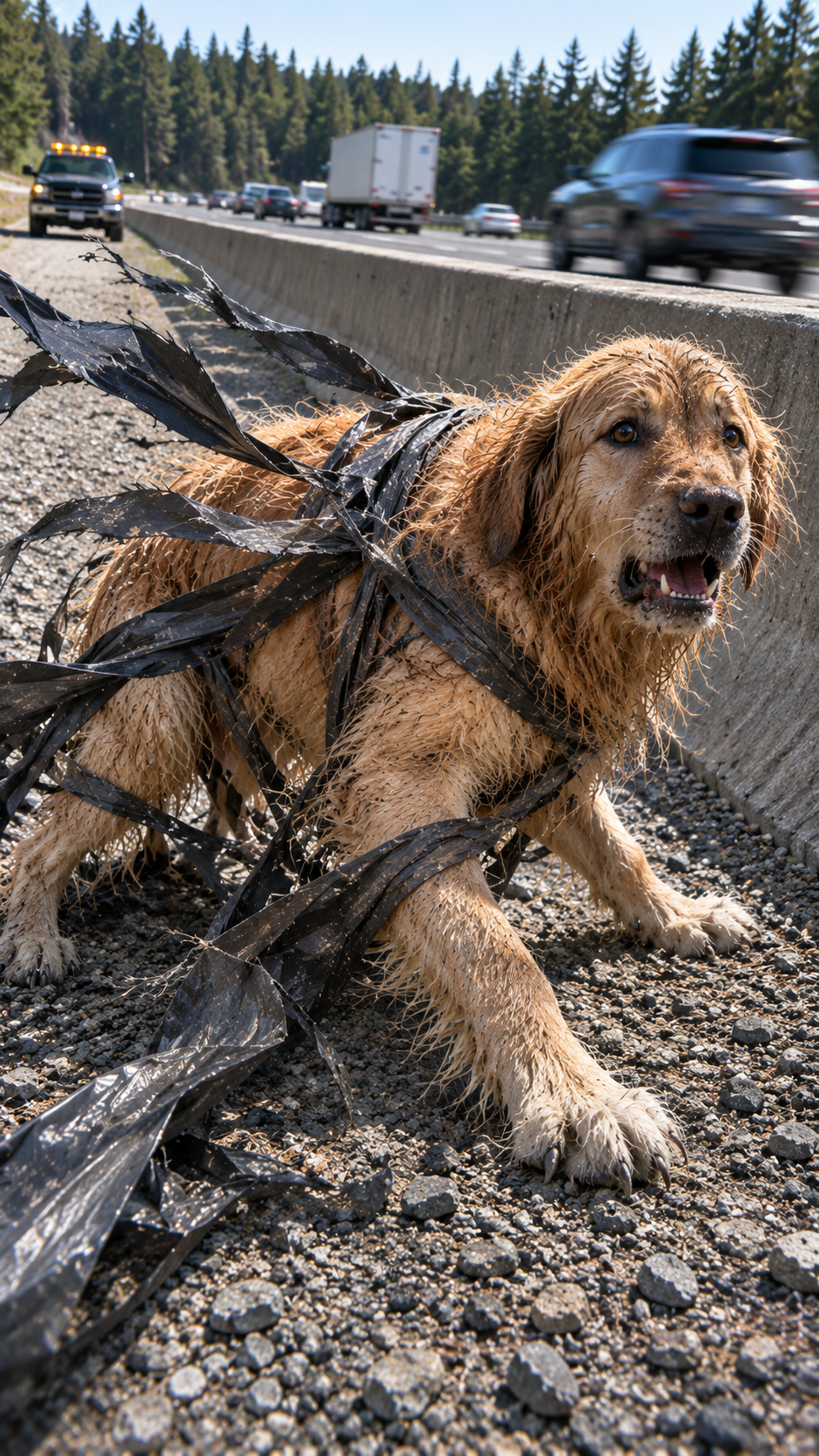
The sound of heavy trucks and passing vehicles filled the air along a busy interstate highway. Beyond the concrete road barrier, traffic continued moving rapidly while powerful gusts of wind swept across the gravel shoulder.
Amid the noise and movement, an exhausted golden retriever struggled to take another step.
Large pieces of torn black plastic sheeting were wrapped around its torso and legs, making even the simplest movements difficult.
The dog’s frightened eyes revealed its distress.
Every time it attempted to walk, the tangled plastic restricted its movements.
A passing semi-truck created a powerful gust of wind, causing the loose material to flap violently around the animal.
The golden retriever lowered its head and released a quiet whimper.
Its golden-brown fur was wet, and its movements appeared increasingly exhausted.
The surrounding highway was filled with activity, yet the dog remained alone on the gravel shoulder.
Vehicles continued passing behind the concrete barrier while the frightened animal attempted to move forward.
The fictional story does not establish how the dog became tangled in the plastic or how long it had been struggling beside the highway.
What was immediately clear, however, was that the animal could not easily escape the material surrounding its body.
It needed assistance.
The dog attempted another difficult step across the gravel.
The black plastic rustled loudly in the wind, adding to the frightening atmosphere.
Then, in the distance, a dark-blue highway maintenance pickup began approaching.
Its flashing amber warning lights stood out against the surrounding traffic.
Someone was finally about to notice the exhausted animal.
The Highway Worker Who Refused to Keep Driving
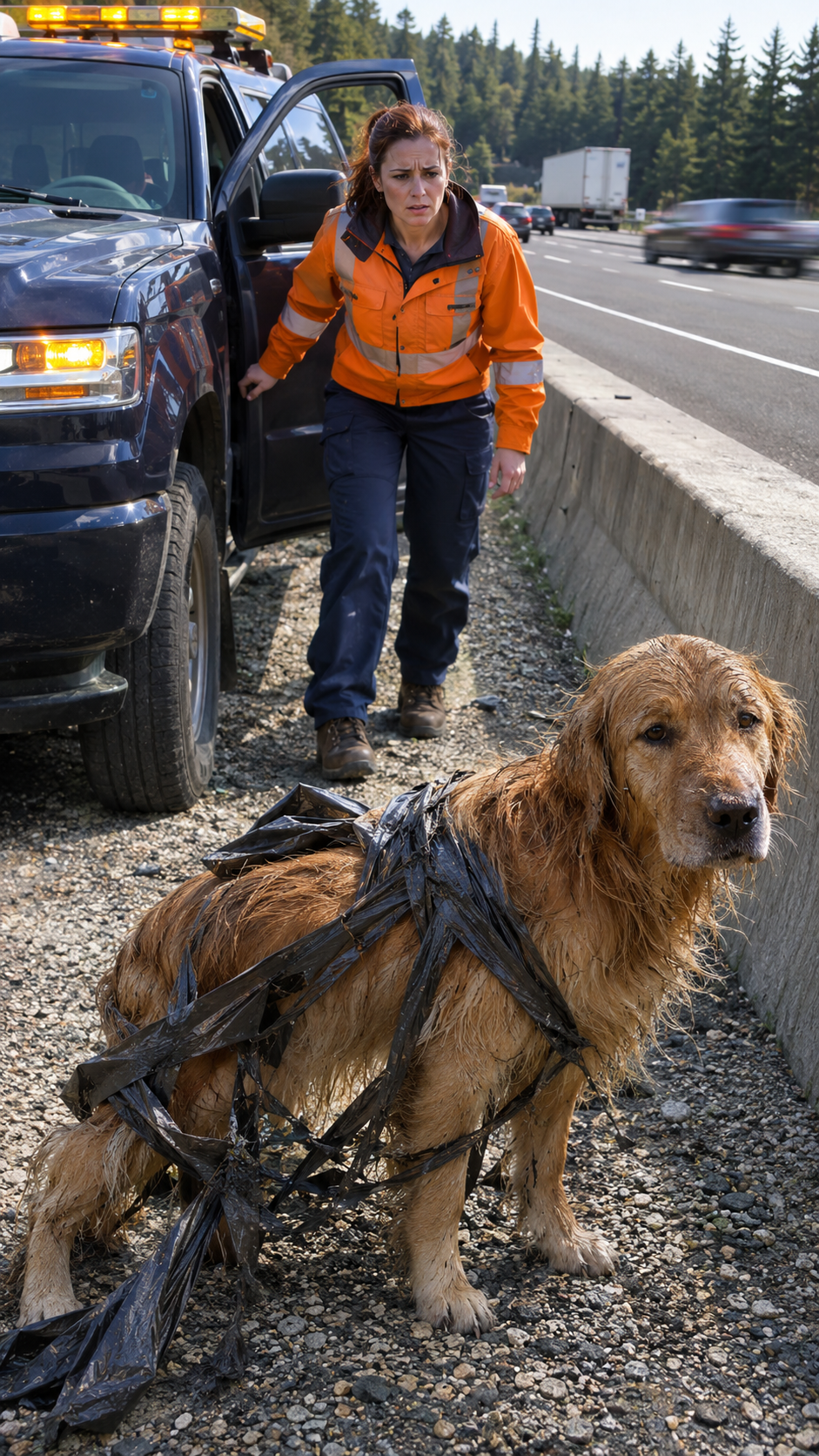
Inside the approaching maintenance pickup was a 38-year-old female highway worker.
She wore an orange reflective safety jacket, navy work pants, and brown boots. Her auburn hair was tied neatly into a ponytail.
As the vehicle approached the gravel shoulder, she noticed something unusual.
A golden retriever was standing helplessly near the highway, surrounded by torn black plastic.
The worker immediately recognized that the animal was struggling.
The dark-blue maintenance pickup slowed and pulled safely onto the shoulder with its amber warning lights flashing.
Looking through the open driver’s window, the woman examined the unusual sight.
The dog remained tangled in the plastic, its movements restricted by the material wrapped around its body.
She opened the vehicle door and stepped outside.
“Oh my God! What happened to you?”
Her expression reflected genuine concern.
The golden retriever looked toward her but remained hesitant.
The noise of passing traffic continued in the background, while the wind caused the loose plastic to move around its legs.
The woman stood near the maintenance pickup, carefully observing the frightened animal.
She could see that approaching too quickly might increase its distress.
Rather than immediately reaching for the tangled material, she began moving toward the dog calmly.
Her orange reflective jacket stood out against the gray gravel and dark plastic.
The retriever watched her approach.
For the first time in the fictional encounter, someone had stopped specifically to help.
The woman still needed to determine whether the animal would allow her to come close enough to provide assistance.
That required something just as important as the equipment she carried.
It required patience.
Earning the Frightened Dog’s Trust
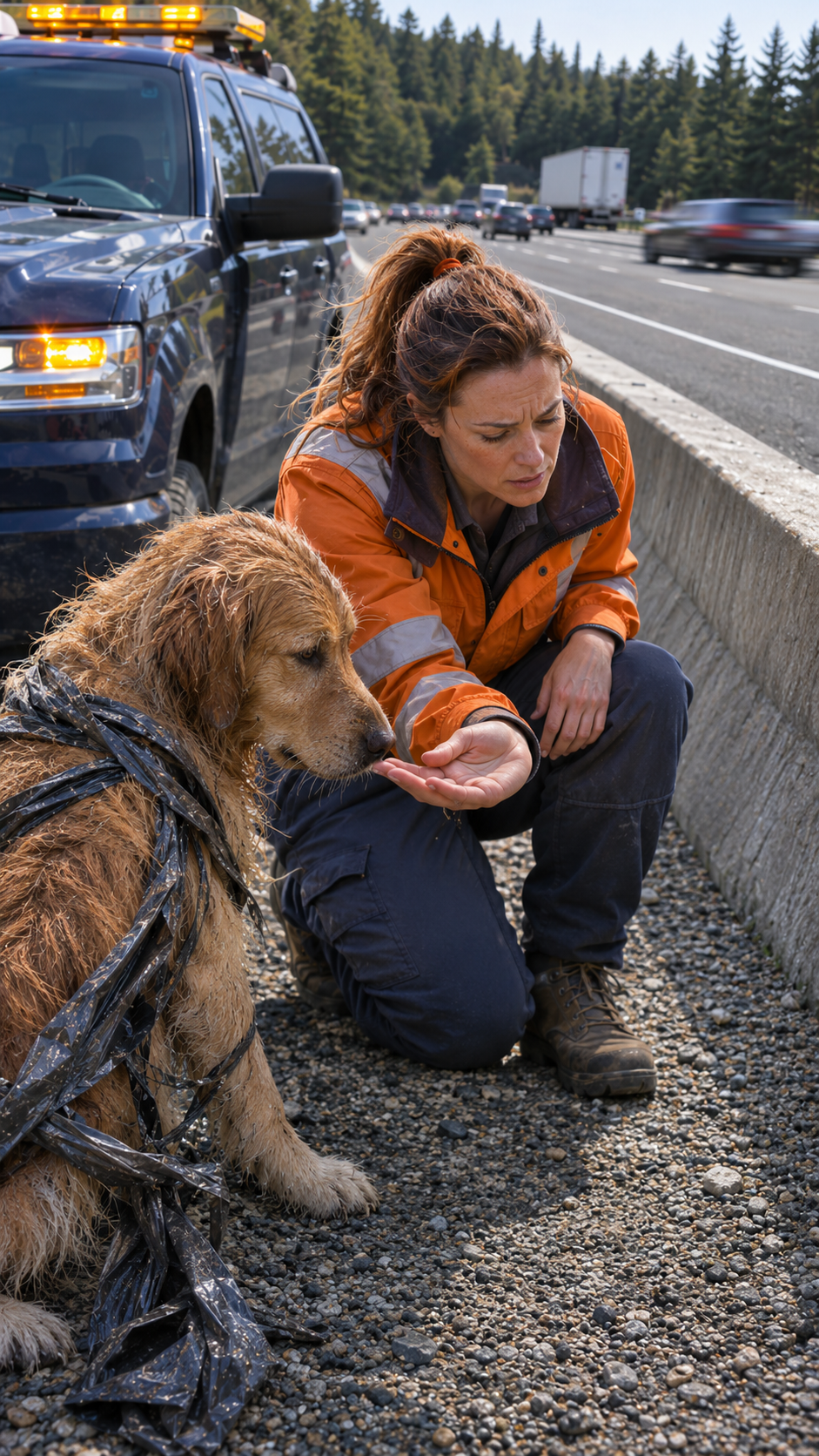
The highway worker slowly knelt on the gravel beside the golden retriever.
The animal remained wrapped in black plastic, with wet golden-brown fur visible around its head and paws.
Its eyes followed her movements carefully.
The woman gently extended her open hand toward the dog’s nose.
“It’s okay, buddy. I’m here to help you.”
Her voice remained soft and reassuring.
The frightened retriever hesitated.
It looked toward her hand without immediately moving closer.
The surrounding traffic continued producing a steady background noise, while the plastic rustled gently in the wind.
The woman remained patient.
She did not suddenly grab the dog or attempt to pull the material away from its body.
Instead, she allowed the animal a moment to become familiar with her presence.
Slowly, the golden retriever leaned forward.
Its nose approached her fingers before gently sniffing her hand.
The small gesture marked an important change in the encounter.
Although the dog remained frightened and physically restricted, it appeared increasingly comfortable with the woman’s presence.
She continued speaking softly while observing its condition.
The animal’s breathing remained audible beneath the distant highway noise.
Within the fictional story, this quiet interaction established the emotional connection between the highway worker and the trapped dog.
She had stopped because she recognized an animal in need.
Now she was attempting to help without causing unnecessary additional fear.
The black plastic still surrounded the retriever’s torso and legs.
Removing it would require care, particularly because the material was close to the animal’s fur and skin.
Fortunately, the woman had access to suitable equipment, and another highway worker was nearby to monitor the surrounding traffic.
The next stage of the rescue was about to begin.
Carefully Removing the Tangled Plastic
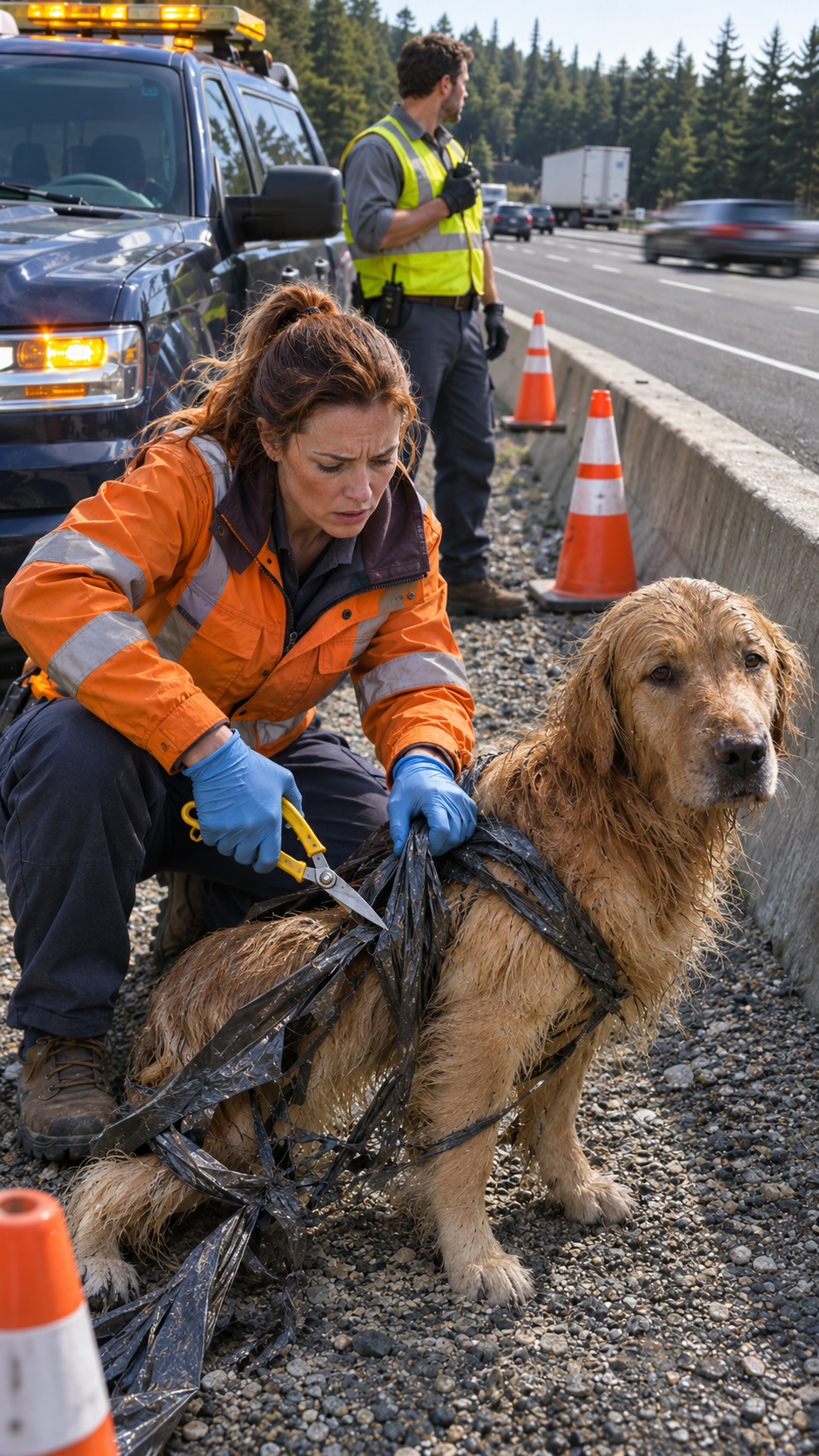
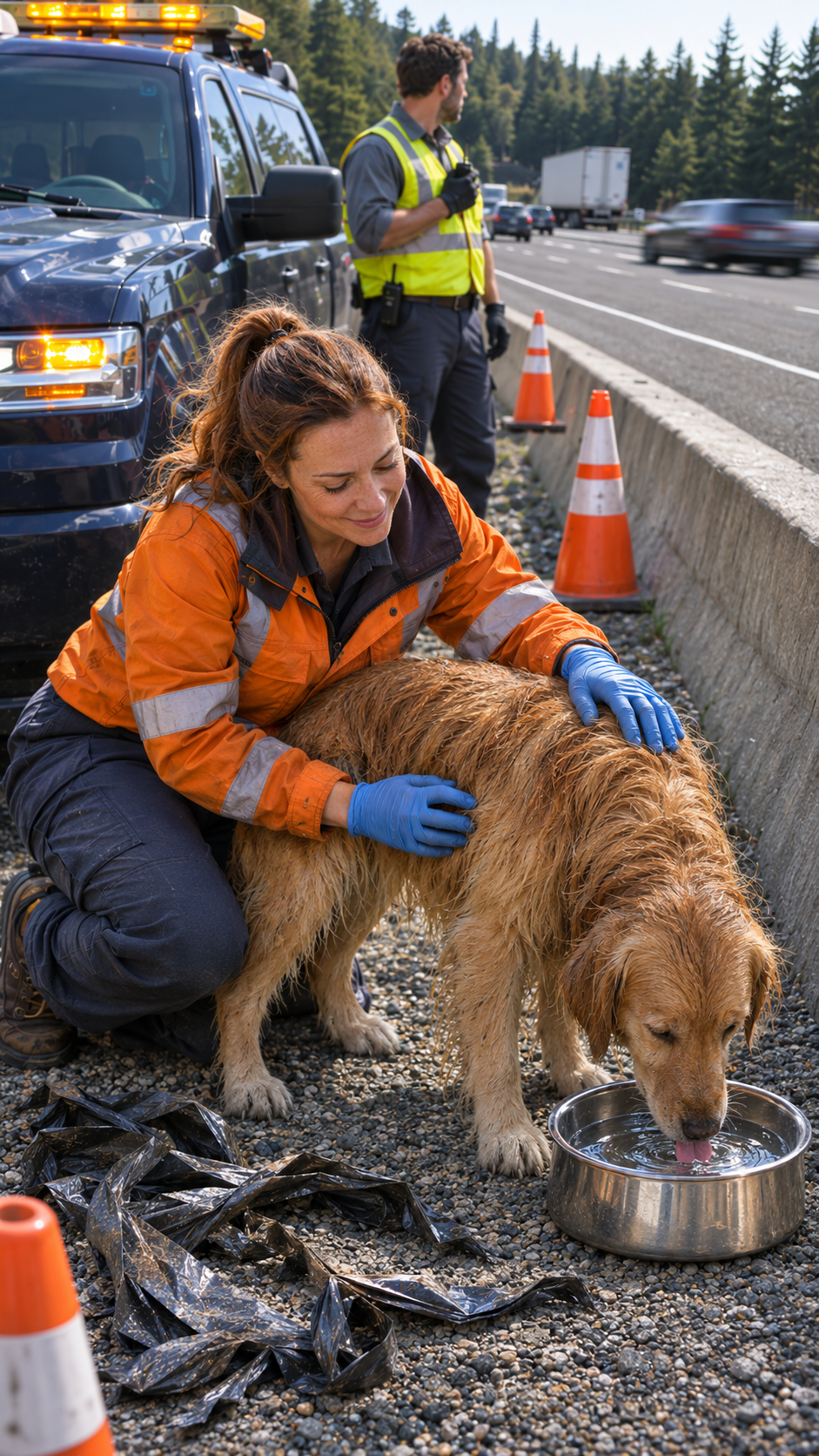
The female highway worker put on a pair of blue protective gloves.
Beside her was a pair of yellow-handled safety shears.
Orange safety cones marked the roadside working area, while the dark-blue maintenance pickup remained parked nearby with its amber warning lights flashing.
A male highway worker stood behind her near the vehicle, monitoring passing traffic.
“Take your time. I’ve got traffic covered.”
His reassurance allowed the woman to concentrate on the frightened golden retriever.
She carefully began separating the loose black plastic from the animal’s fur.
The sound of the material being cut mixed with the distant noise of passing trucks.
The dog remained close to her, breathing quietly as she worked.
“Almost there, sweetheart.”
The woman continued removing the tangled material with controlled movements.
Within the dramatized rescue, she carefully avoided touching the animal’s skin with the safety shears.
The black plastic gradually began falling away from the retriever’s body.
The male worker remained near the maintenance pickup, watching the surrounding highway environment.
The rescue required more than simply removing the obstruction.
The roadside location presented additional risks because of the nearby traffic and powerful gusts of wind created by passing vehicles.
The fictional sequence shows the workers cooperating to address the situation.
One concentrated on the animal while the other monitored the surroundings.
The golden retriever remained remarkably calm during the final moments of the rescue.
Its movements were no longer as restricted as they had been when the woman first noticed it.
The remaining pieces of plastic began separating from its body.
What had appeared to be an overwhelming obstruction was finally being removed.
The exhausted animal was about to experience something it had desperately needed since the beginning of the encounter.
Freedom of movement.
The Golden Retriever Was Finally Free
The last pieces of black plastic fell onto the gravel beside the highway worker.
For the first time in the story, the golden retriever stood completely free from the tangled material.
Its wet golden-brown fur was now fully visible.
The woman remained kneeling beside the animal, gently stroking its coat.
The dog appeared tired, but its movements were no longer restricted by the plastic that had surrounded its torso and legs.
The highway worker placed a stainless-steel bowl filled with fresh water in front of it.
The retriever lowered its head and began drinking.
The quiet sound of the animal drinking provided a peaceful contrast to the earlier moments of distress.
“There you go. You’re safe now.”
The woman continued watching the dog with a compassionate expression.
After drinking, the retriever raised its head and looked toward her.
The discarded black plastic remained on the gravel nearby.
Only moments earlier, that same material had prevented the animal from walking normally.
Now it lay separated from its body.
The highway worker’s gentle presence appeared to provide reassurance as the dog recovered from the frightening experience.
The fictional story does not establish whether the retriever was dehydrated, injured, or experiencing another medical condition.
Although the animal was shown drinking and moving more comfortably, its long-term health would require appropriate assessment in a real rescue situation.
Nevertheless, the immediate danger associated with the tangled plastic had been addressed within the narrative.
The woman had recognized the problem, stopped to investigate, and helped remove the obstruction.
The exhausted golden retriever was no longer struggling alone beside the highway.
But the most emotional moment of their encounter was still to come.
The Hidden Dangers of Discarded Plastic
Although the events depicted in this story are fictional, discarded plastic presents a genuine threat to domestic animals and wildlife.
Large pieces of plastic sheeting, packaging materials, bags, and other flexible waste can become wrapped around an animal’s body.
When this happens, ordinary movements may become increasingly difficult.
An animal attempting to escape can sometimes become more deeply entangled.
Plastic surrounding the legs may interfere with walking, while material wrapped around the torso can create additional discomfort and potentially serious risks.
Loose plastic can also frighten animals when it moves suddenly or produces unfamiliar sounds.
In the fictional highway encounter, passing trucks create powerful gusts of wind that cause the black material to flap violently.
The dog’s frightened reaction illustrates how an environmental hazard can become even more dangerous in an already stressful location.
Roadside litter can reach surrounding fields, waterways, and natural habitats through wind and rain.
Once scattered, it may remain in the environment for extended periods.
Responsible waste disposal is therefore an important part of protecting animals.
Securing materials during transportation, collecting unwanted packaging, and properly disposing of damaged plastic can help prevent unnecessary hazards.
The discarded black sheeting in this fictional rescue serves as a reminder that seemingly ordinary waste can have serious consequences when it comes into contact with vulnerable animals.
Why Animals Near Highways Need Immediate Attention
Busy highways present numerous dangers for animals.
Fast-moving vehicles, unfamiliar noises, barriers, and limited escape routes can create frightening conditions.
A distressed animal may behave unpredictably, particularly when it is exhausted, injured, or unable to move normally.
The golden retriever in this story remains on the gravel shoulder, separated from moving traffic by a concrete barrier.
However, its restricted movements make the situation especially concerning.
The presence of heavy vehicles creates additional noise and powerful air movement.
The fictional highway workers are shown using a maintenance pickup, flashing amber warning lights, and orange safety cones.
These details emphasize that roadside emergencies require attention to both animal welfare and human safety.
Members of the public should never enter active highway lanes or stop in an unsafe location to approach an animal.
Instead, they should contact highway authorities, emergency services, or qualified animal rescue organizations and provide the animal’s location from a safe position.
Professional responders can determine the appropriate measures based on traffic conditions and the animal’s circumstances.
The rescue shown in the video is compressed into a brief cinematic sequence.
It should not be interpreted as a complete demonstration of real highway emergency procedures.
The central message is the importance of noticing an animal in distress and obtaining appropriate assistance without creating additional danger.
The Importance of Patience During an Animal Rescue
One of the most meaningful moments in the fictional story occurs before the highway worker begins removing the plastic.
She kneels beside the frightened golden retriever and gently extends her hand.
Rather than immediately attempting to handle the animal, she gives it time to respond.
This moment highlights the importance of recognizing that distressed animals may react differently from animals in familiar, comfortable environments.
Fear, pain, exhaustion, and unfamiliar surroundings can influence behavior.
Even a normally friendly dog may become defensive when it feels trapped or threatened.
The fictional retriever eventually leans forward and sniffs the woman’s fingers.
Its response creates a touching moment of connection between the two characters.
However, this behavior should not be considered a guarantee that an unfamiliar distressed dog will respond safely to a similar approach.
Professional animal handlers assess body language, environmental conditions, and potential risks before attempting physical contact.
The story dramatizes the interaction to emphasize compassion and patience.
The woman’s calm voice and careful movements contrast with the loud highway environment and the frightening movement of the plastic.
Her behavior communicates reassurance rather than urgency alone.
That emotional contrast is an important part of the rescue narrative.
It reminds viewers that helping a vulnerable animal involves considering its fear as well as addressing its immediate physical circumstances.
Golden Retrievers and Their Connection With People
Golden retrievers are widely appreciated for their sociable personalities, intelligence, and responsiveness to human interaction.
Many develop strong relationships with their owners and enjoy companionship.
Their ability to learn and cooperate with people has made them suitable for various roles, including assistance work, therapy programs, and trained search-and-rescue operations.
The golden retriever in this fictional story represents the emotional connection that many people associate with the breed.
At the beginning, it appears frightened and exhausted.
Its movements are restricted, and it has no apparent way to remove the tangled plastic independently.
When the highway worker approaches, the animal gradually becomes more comfortable with her presence.
The interaction creates a transition from fear to reassurance.
After the plastic is removed, the retriever drinks water and looks toward the woman.
These small moments contribute to the emotional appeal of the story.
However, the narrative does not establish whether the dog had an owner, had become lost, or had previously experienced neglect.
Those details remain unknown.
The focus is instead placed on the immediate encounter between a vulnerable animal and a person willing to help.
The golden retriever’s final interaction with the woman is presented as a fictional expression of comfort and affection.
Its behavior reminds viewers of the meaningful relationships that can develop between humans and their animal companions.
The People Behind Roadside Safety
Highway maintenance workers perform important responsibilities that often receive little public attention.
Their duties can include maintaining road infrastructure, monitoring hazards, supporting traffic management, and responding to unexpected roadside conditions.
Working near moving vehicles requires training, awareness, and appropriate safety procedures.
In the fictional story, the female highway worker encounters an emergency that involves an animal rather than damaged road equipment.
Her decision to stop introduces the compassionate element of the narrative.
The male worker’s presence also contributes to the rescue.
While she concentrates on removing the plastic, he monitors the surrounding traffic.
Their cooperation illustrates the importance of teamwork when responding to potentially dangerous situations.
The maintenance pickup, reflective clothing, protective gloves, and safety cones establish the professional setting of the encounter.
However, the emotional center of the story remains the woman’s willingness to recognize the frightened dog as an animal deserving assistance.
She does not dismiss it as another roadside inconvenience.
Instead, she responds with concern and patience.
The fictional sequence celebrates the idea that ordinary working days can sometimes present unexpected opportunities to demonstrate compassion.
It also acknowledges that meaningful assistance frequently depends on people cooperating rather than acting alone.
Freedom From the Plastic Was Only the Beginning
Removing the tangled material resolves the immediate problem shown in the fictional rescue.
However, real animal rescues often involve additional responsibilities.
A dog found beside a highway may require veterinary assessment, identification checks, and assistance locating its owner.
Even when an animal appears comfortable after being freed, injuries or medical complications may not be immediately visible.
Appropriate veterinary care can help determine whether further treatment is necessary.
Animal welfare organizations may also assist with checking identification tags or microchips and arranging temporary care.
The story does not show these subsequent procedures or establish the golden retriever’s permanent living arrangements.
It does not confirm that the highway worker adopted the animal.
Instead, the narrative focuses on the immediate rescue and the emotional connection that develops afterward.
The next scene takes place outside a small highway maintenance facility.
The dark-blue pickup is parked beside the building, away from the busy roadside environment.
The setting is quieter, and the warm light of the approaching sunset creates a peaceful atmosphere.
The woman remains dressed in the same orange reflective safety jacket, navy work pants, and brown boots.
Beside her is the golden retriever, now completely free from the black plastic.
The frightening highway encounter has given way to a moment of calm.
Sometimes the Smallest Gesture Means the Most
The final moments of the fictional story bring attention to the emotional significance of the rescue.
There are no elaborate celebrations or dramatic speeches.
Instead, the highway worker and the golden retriever share a quiet moment outside the maintenance facility.
The surrounding traffic noise has been replaced by birdsong and a gentle evening breeze.
The golden sunset illuminates the woman’s reflective jacket and the dog’s golden-brown fur.
Earlier, the retriever could barely take another step because of the material wrapped around its body.
Now it sits comfortably beside the person who stopped to help.
The contrast between those two moments captures the central message of the narrative.
Compassion can transform a frightening situation into one of reassurance and comfort.
The woman’s actions began with a simple decision to pay attention.
She noticed an animal struggling beside the highway and recognized that it needed assistance.
Her subsequent patience and cooperation with another worker allowed the fictional rescue to reach a positive conclusion.
The golden retriever slowly moved closer to her.
Its next gesture would provide the most touching moment of their extraordinary encounter.
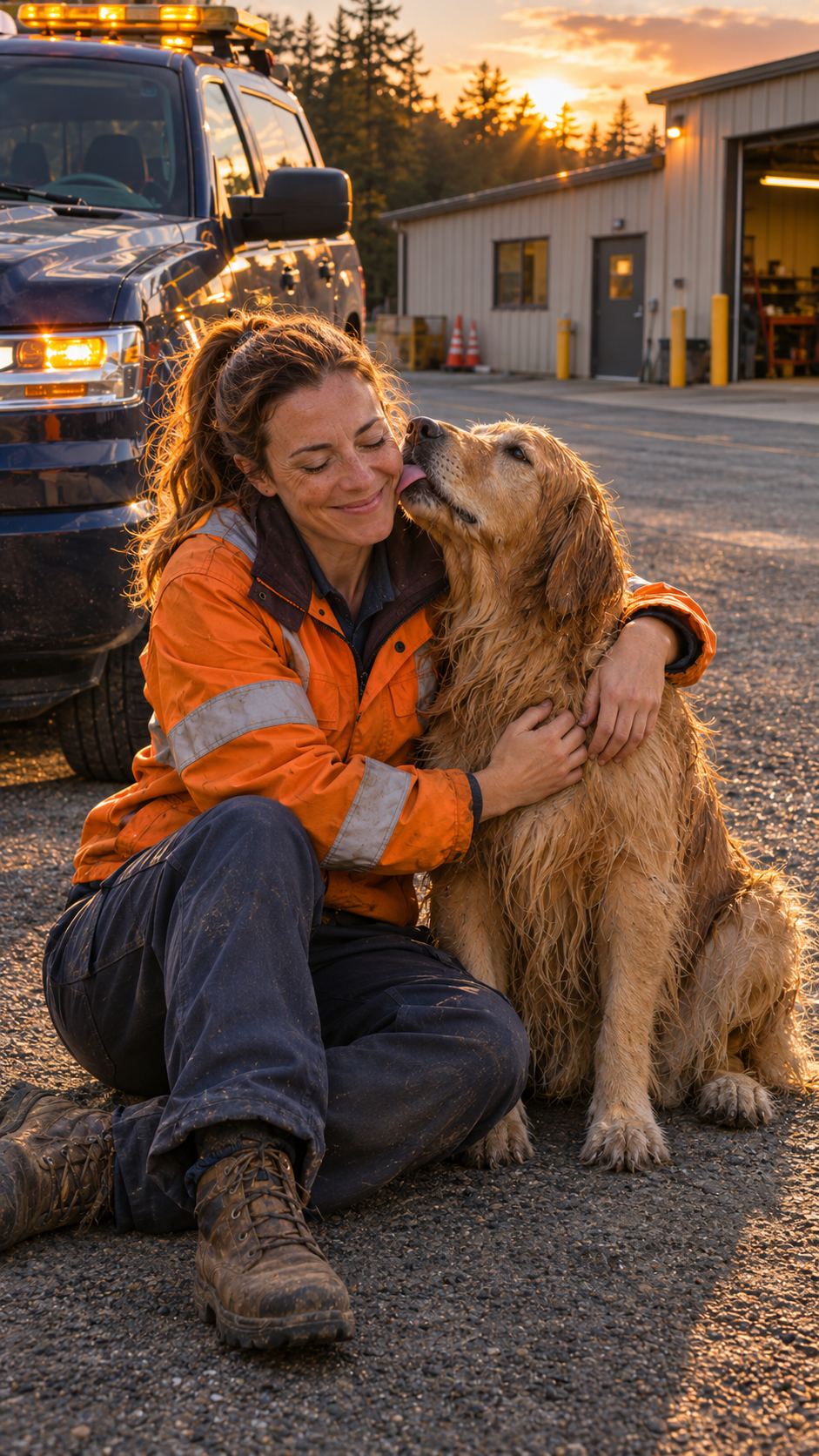
The rescued golden retriever gently rested its head against the highway worker’s shoulder before affectionately licking her cheek. She smiled emotionally and wrapped her arms around the animal. “You’re not alone anymore, buddy.” As warm golden sunset light illuminated their faces, the frightening roadside encounter ended with a beautiful fictional reminder that compassion, patience, and the willingness to help can make an extraordinary difference in the life of a vulnerable animal.