Desperate Cries Inside the Old Ranch Barn
Warm afternoon sunlight streamed through the windows of a rustic red wooden barn. Golden straw covered the floor, dust particles floated through the air, and birds could be heard singing outside.
The surrounding ranch appeared peaceful.
Inside the barn, however, a frightening situation was unfolding.
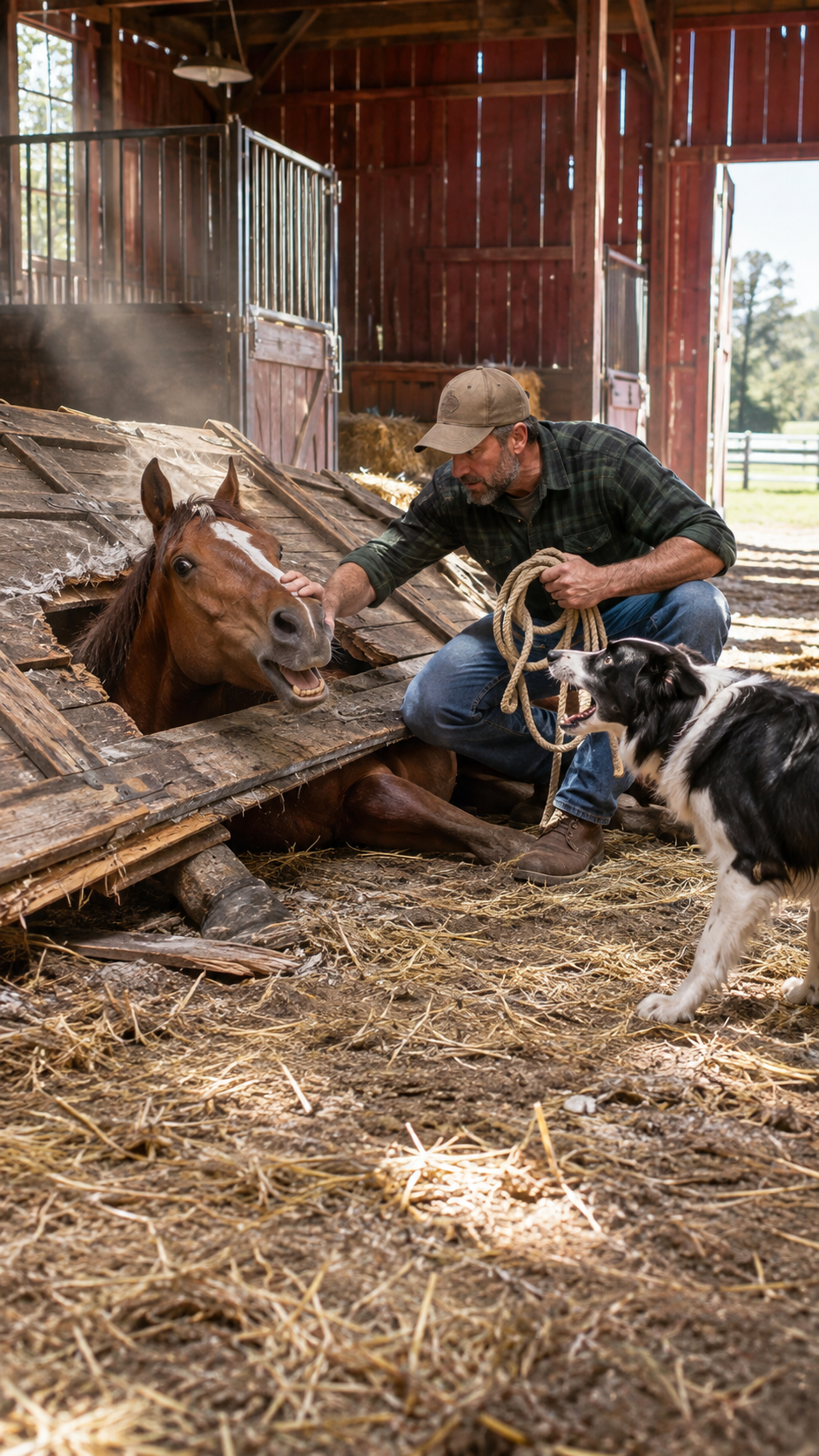
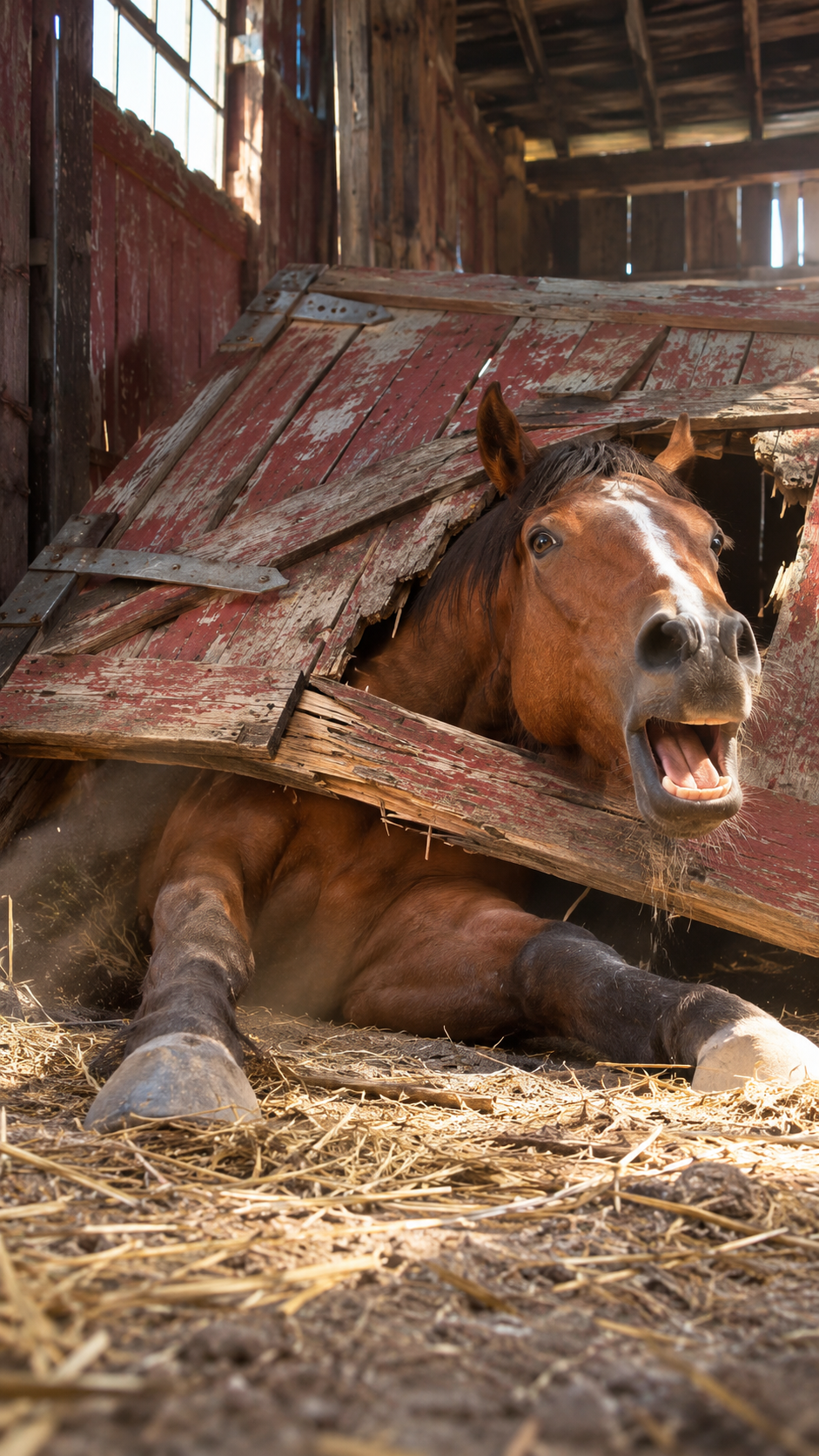
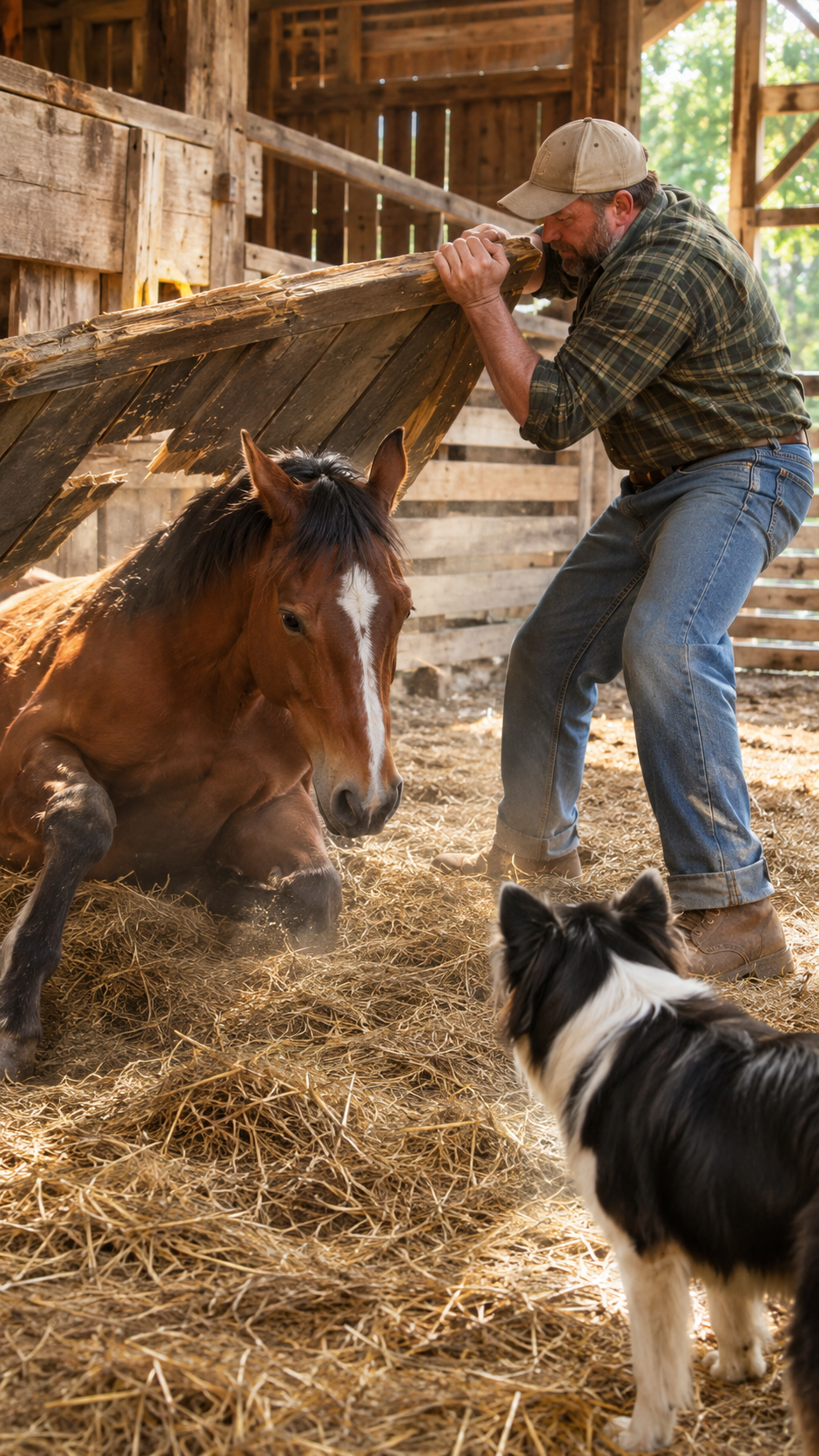
A chestnut-brown horse lay on the straw-covered ground beneath a heavy, broken wooden stall door.
The fallen structure rested directly across its body, while its head protruded through a large jagged opening in the damaged wood.
The horse desperately raised its head and released a loud, distressed neigh.
Its hooves scraped against the straw as it attempted to move.
The heavy wooden door creaked, but the animal remained trapped.
Every movement appeared difficult because of the weight and position of the fallen structure.
The horse could raise its head, but it could not gather its legs beneath its body and stand.
There was nobody immediately beside it.
Outside, the ranch continued to appear calm, giving little indication of the emergency taking place inside the barn.
The frightened animal released another desperate cry.
It needed assistance, but there was no way for it to move the heavy obstruction independently.
Then something began moving near the open barn entrance.
A familiar black-and-white Border Collie was approaching.
The dog was about to discover a situation that would transform an ordinary afternoon into an extraordinary rescue story.
The Border Collie Discovered Something Terribly Wrong
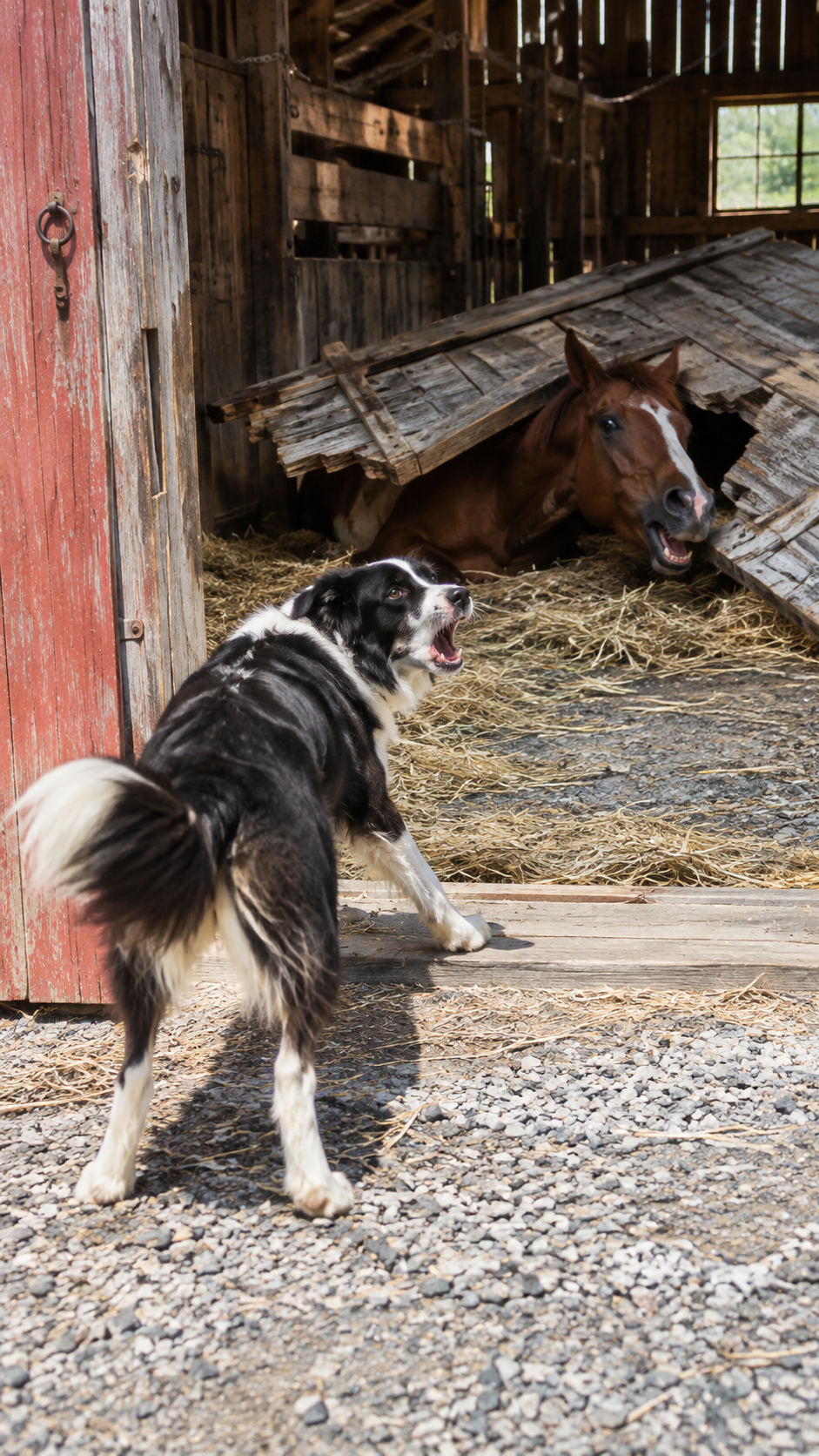
The black-and-white Border Collie rushed toward the entrance of the red wooden barn.
Its paws moved quickly across the gravel before reaching the straw-covered floor.
As the dog entered, it suddenly stopped.
Directly ahead was the chestnut horse lying beneath the broken wooden stall door.
The horse raised its head through the jagged opening and released another distressed neigh.
The Border Collie immediately began barking.
It stepped closer, watching the frightened animal struggle beneath the heavy wooden structure.
The dog’s attention remained fixed on the horse.
The familiar barn environment had suddenly become the setting of an unexpected emergency.
The horse attempted to move again, but the fallen door continued restricting its body.
The Border Collie barked repeatedly.
For a brief moment, it remained near the trapped animal, observing the situation.
Then the dog suddenly turned around.
It raced toward the open barn entrance, leaving the horse behind as it rushed into the bright afternoon sunlight.
Within this fictional narrative, the dog’s behavior suggested that it was searching for assistance.
The horse remained on the straw-covered ground, unable to escape independently.
The sound of its distressed breathing and occasional neighing continued echoing through the barn.
Meanwhile, the Border Collie ran across the ranch yard.
Its black-and-white coat stood out against the gravel driveway and surrounding green vegetation.
The dog appeared determined to reach someone who could respond to the emergency.
Fortunately, the farmer was not far away.
He was standing beside an old tractor, completely unaware of what had happened inside the barn.
The Farmer Noticed the Dog’s Unusual Behavior
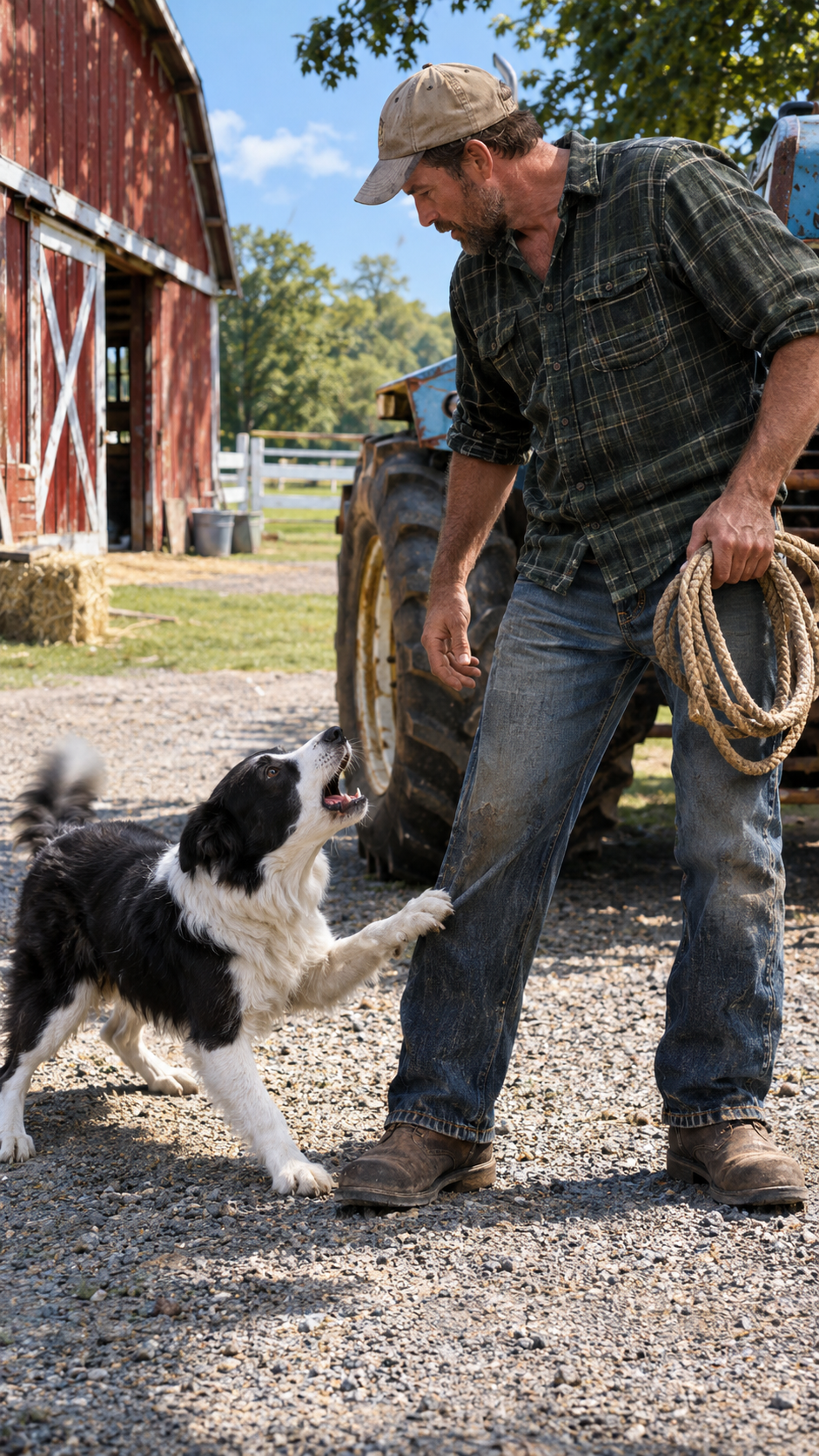
Outside the barn, a 48-year-old farmer stood beside a faded blue tractor.
He was holding a coiled rope when the Border Collie suddenly rushed toward him.
The dog barked urgently, attracting his attention.
At first, the farmer appeared surprised.
The Border Collie continued moving around his boots before looking back toward the red wooden barn.
It gently pulled at the bottom of his jeans, then ran several steps toward the building.
The farmer watched closely.
The dog’s behavior was noticeably different from its ordinary movements around the ranch.
It repeatedly barked, looked toward the barn, and returned its attention to the farmer.
“What’s wrong, buddy? Show me!”
His expression became increasingly concerned.
The Border Collie immediately turned toward the barn again.
The farmer began following it while still carrying the coiled rope.
Gravel crunched beneath his boots as he moved away from the faded blue tractor.
The dog continued ahead, occasionally looking back toward him.
Within the fictional sequence, its persistent behavior served as a warning that something unusual was happening.
The farmer did not yet know what awaited him inside the barn.
He had only recognized that the Border Collie was behaving with unexpected urgency.
The dog moved quickly across the ranch yard, guiding him toward the open entrance.
As they approached, the farmer began hearing sounds coming from inside.
The distressed neighing of the horse became increasingly noticeable.
He quickened his pace.
What he discovered upon entering the barn immediately explained the dog’s desperate attempts to attract his attention.
The Farmer Rushed to the Frightened Horse
The Border Collie entered the barn ahead of the farmer.
Bright sunlight illuminated the entrance before giving way to the warm, dusty interior.
The farmer followed closely behind, carrying the same coiled rope.
Then he saw the chestnut horse.
The animal was lying on the straw-covered ground beneath the heavy broken wooden door.
Its head remained visible through the large damaged opening.
The farmer immediately recognized the seriousness of the situation.
“Oh my God! Easy, boy. I’m right here.”
He quickly approached and knelt beside the frightened horse.
The animal continued breathing heavily, occasionally moving its head as the wooden structure creaked.
The Border Collie remained nearby, barking as the farmer examined what had happened.
The farmer looked toward the fallen stall door.
Its position prevented the horse from standing, while the jagged opening surrounded its head and neck.
The situation required considerable care.
Horses are powerful animals, and their movements can become unpredictable when they are frightened or physically restricted.
A sudden attempt to stand while still trapped could potentially create additional danger.
The farmer spoke reassuringly as he remained beside the animal.
The horse continued looking toward him, its frightened expression reflecting the distress of being unable to move freely.
The fictional narrative does not establish exactly why the stall door collapsed or how long the horse had been trapped beneath it.
What mattered in that moment was the immediate obstruction preventing the animal from standing.
The farmer examined the heavy wooden structure while the Border Collie watched nearby.
The dog had successfully brought him to the barn.
Now the horse depended on the farmer’s response.
The Difficult Moment of Freeing the Horse
The farmer carefully approached the upper edge of the broken wooden stall door.
The Border Collie remained at a safe distance, watching the unfolding rescue.
Within the dramatized sequence, the farmer gripped the heavy wooden structure and began moving it away from the horse’s body.
The wood scraped against the straw-covered floor.
Dust particles rose into the warm sunlight entering through the barn windows.
The farmer continued working carefully, gradually shifting the fallen door away from the animal’s head and neck.
The horse remained on the ground as the obstruction was moved aside.
Then, for the first time since the beginning of the encounter, it had enough space to move freely.
The chestnut horse began gathering its legs beneath its body.
Straw scattered across the floor as it slowly attempted to stand.
“That’s it, buddy. Take your time.”
The farmer watched attentively.
The horse gradually raised itself from the ground.
Its hooves pressed into the straw as it regained its standing position.
The Border Collie began barking excitedly.
The heavy wooden door that had prevented the horse from moving was now beside it rather than across its body.
The farmer’s expression reflected visible relief.
The frightening situation that had begun with desperate neighing was finally changing.
The horse was standing again.
However, the farmer remained close, observing the animal rather than immediately assuming that everything was fine.
The fictional sequence shows the horse regaining its feet, but it does not establish whether the animal sustained internal injuries or required further veterinary treatment.
The immediate obstruction had been removed.
The Border Collie, which had discovered the emergency and brought the farmer to the barn, remained nearby.
One final moment was about to capture the emotional significance of its actions.
Why Horses Can Become Vulnerable Inside Their Stalls
Although this rescue story is fictional, accidents involving horses and damaged stable equipment are a genuine concern.
Horses are large, powerful animals that require appropriately designed and maintained living spaces.
Stall doors, fences, gates, and other structures must be strong enough to withstand regular use while minimizing potential hazards.
Damaged hinges, weakened wooden panels, loose fittings, and deteriorating materials can create dangerous conditions.
A horse that becomes trapped beneath a fallen structure may struggle to regain its footing.
Its natural reaction to fear can involve sudden movements, which may increase the risk of injury.
The chestnut horse in this story illustrates a dramatized version of such an emergency.
The heavy wooden door restricts its body, leaving it unable to stand independently.
Its distressed neighing communicates the urgency of the situation.
The Border Collie’s discovery introduces the possibility of assistance before the farmer arrives.
In real circumstances, regular inspections of barn structures and stall equipment can help identify potential hazards before accidents occur.
Damaged components should be repaired or replaced appropriately, and animals should be kept away from unsafe areas.
Maintaining a secure environment is an essential part of responsible horse ownership.
The Extraordinary Intelligence of Border Collies
Border Collies are widely recognized for their intelligence, attentiveness, and ability to learn complex tasks.
Originally developed for herding livestock, they are particularly responsive to movement and changes in their surroundings.
Many Border Collies develop strong working relationships with their handlers.
They often thrive when provided with appropriate physical activity, mental stimulation, and opportunities to use their natural abilities.
The black-and-white dog in this fictional story draws upon these familiar characteristics.
It notices the distressed horse, reacts to the unusual situation, and subsequently attracts the farmer’s attention.
Its repeated barking and movements toward the barn create a connection between the trapped animal and the person who can respond.
However, the story should not be interpreted as evidence that every Border Collie would understand such an emergency or deliberately seek human assistance.
Individual dogs respond differently depending on their training, temperament, experience, and surroundings.
The fictional narrative dramatizes the breed’s attentiveness and responsiveness to create an emotional rescue story.
Its appeal comes from the idea that an animal’s unusual behavior can bring human attention to a problem that might otherwise remain unnoticed.
The Border Collie’s persistence becomes the driving force behind the entire encounter.
Without its discovery, the farmer would not have known about the emergency at that particular moment.
The Special Relationship Between Farm Animals
Ranches and farms often bring different animal species into close proximity.
Horses, dogs, cattle, and other animals may become familiar with one another through their daily routines.
Under appropriate supervision, some develop comfortable relationships and become accustomed to sharing their surroundings.
Working dogs frequently spend considerable time around livestock.
They may accompany farmers during daily activities, observe animals, and respond to familiar sounds and movements.
The fictional Border Collie and chestnut horse share the same ranch environment.
When the horse becomes trapped, the dog’s attention is immediately drawn toward its distressed behavior.
The narrative does not establish how long the two animals have known each other or whether they normally spend time together.
Nevertheless, their shared surroundings make the dog’s discovery an important part of the story.
The emotional ending emphasizes the connection between the farmer and both animals.
It presents the ranch not simply as a workplace, but as an environment where responsibility and care are central to daily life.
The farmer’s concern for the horse and appreciation for the dog reflect those themes.
Although the encounter is imagined, the importance of responsible animal care remains relevant.
Why Large Animal Rescues Require Professional Assistance
The rescue depicted in the video takes place within a brief cinematic sequence.
Real emergencies involving trapped horses can be significantly more complicated.
A horse may weigh several hundred pounds, and heavy structures can shift unexpectedly during an attempted rescue.
A frightened animal may kick, struggle, or suddenly attempt to stand.
These movements can create serious risks for the animal and anyone nearby.
Specialized large-animal rescue teams and veterinarians are trained to assess such situations and determine appropriate methods of assistance.
Depending on the circumstances, they may require specialized lifting equipment, additional personnel, veterinary supervision, and measures to stabilize the surrounding environment.
The farmer’s actions in this fictional story should therefore not be treated as practical rescue instructions.
Attempting to move a heavy structure alone can be dangerous.
Anyone discovering a horse trapped beneath a collapsed door or other heavy object should contact qualified emergency responders, a veterinarian, or specialized large-animal rescue professionals.
Keeping other animals and unnecessary bystanders away from the immediate area can also reduce additional risks.
The most important message is recognizing the emergency and obtaining appropriate assistance.
Compassion must be accompanied by caution, preparation, and respect for the strength and vulnerability of large animals.
The Importance of Listening to Unusual Animal Behavior
At the beginning of the story, the farmer is occupied beside his faded blue tractor.
Nothing in his immediate surroundings suggests that a horse is trapped inside the barn.
The situation changes when the Border Collie rushes toward him.
Its urgent barking, repeated movements, and attempts to draw him toward the building attract his attention.
Instead of dismissing the dog’s behavior, the farmer responds.
“What’s wrong, buddy? Show me!”
That simple decision becomes one of the most important moments in the fictional narrative.
Animals can sometimes notice sounds, movements, or environmental changes before people become aware of them.
Unusual behavior does not always indicate an emergency, but it can provide a reason to investigate safely.
The farmer recognizes that the Border Collie’s actions are different from its ordinary behavior.
His willingness to pay attention leads him directly to the trapped horse.
The story celebrates awareness as an important part of caring for animals.
Recognizing changes in behavior, maintaining safe environments, and responding appropriately to signs of distress can all contribute to animal welfare.
Sometimes the first indication of a problem comes from an unexpected source.
In this fictional encounter, that source is a determined black-and-white dog.
The Quiet Moments After the Rescue
The atmosphere inside the barn gradually became peaceful again.
The heavy wooden stall door had been moved away from the horse.
Straw and dust settled across the floor as the animal stood beneath the warm afternoon sunlight.
The farmer remained close, gently observing the chestnut horse.
The Border Collie sat beside his boots, its fluffy tail wagging.
Only moments earlier, the dog had been racing across the gravel driveway, barking urgently and attempting to attract the farmer’s attention.
Now the emergency that had brought them together was no longer unfolding.
The farmer looked toward the horse, then toward the loyal dog.
The Border Collie had not possessed the strength necessary to move the heavy wooden door.
Its contribution had been something different.
It had noticed the distressed animal and brought someone to the barn.
That distinction gives the fictional story its emotional meaning.
Helping does not always require performing the most physically demanding part of a rescue.
Recognizing danger and attracting appropriate assistance can be equally important.
The chestnut horse stood quietly as the farmer remained beside it.
The dog continued wagging its tail, unaware of how meaningful its actions had become within the story.
The farmer slowly reached toward his loyal companion.
The final moments were about to reveal the beautiful connection between all three.
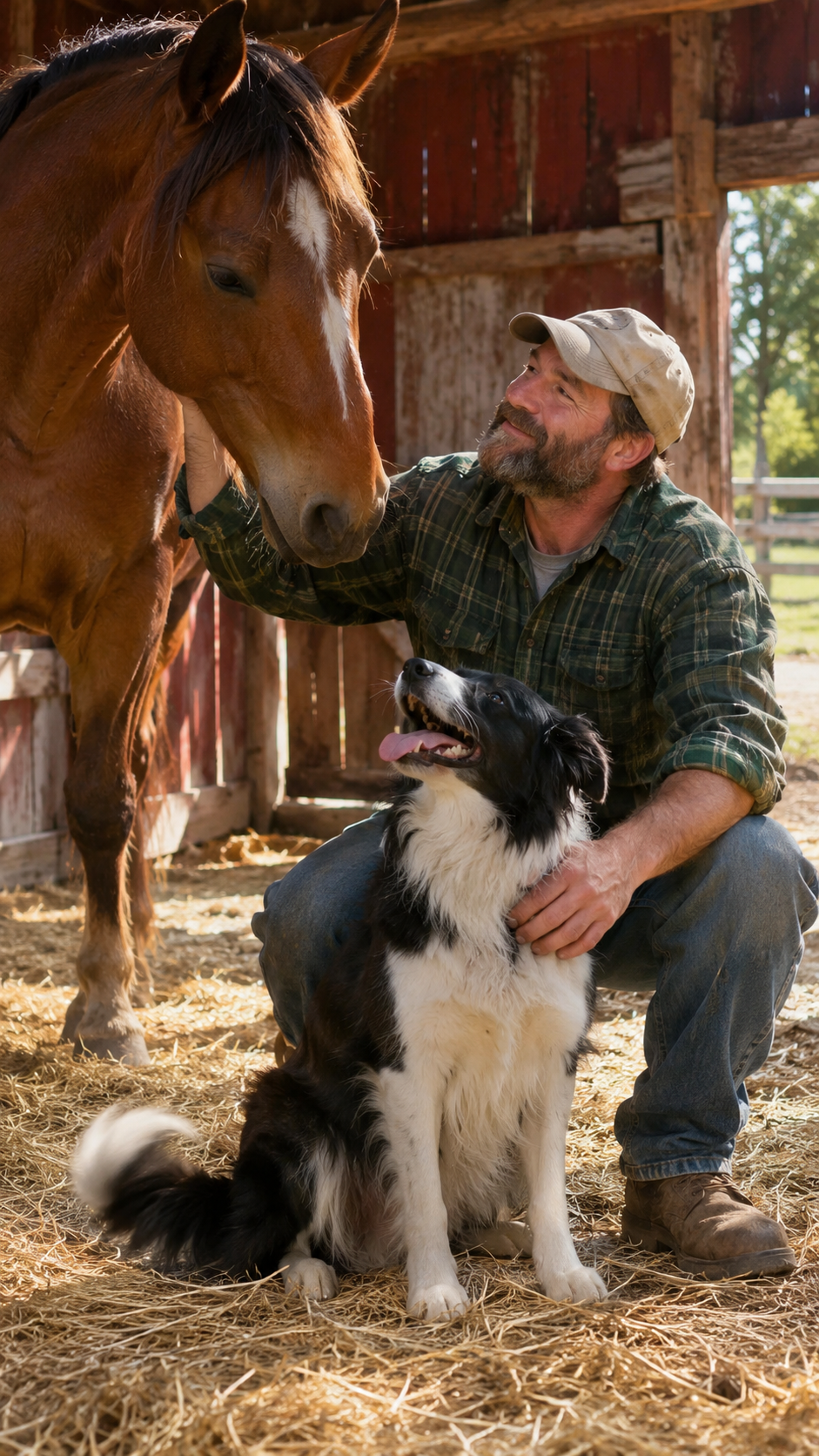
The rescued chestnut horse lowered its muzzle toward the farmer and the black-and-white Border Collie. After gently stroking the horse’s neck, the farmer bent down and affectionately patted the dog’s head. “Good boy! You saved his life.” The Border Collie wagged its fluffy tail as warm afternoon sunlight filled the peaceful barn. Their extraordinary fictional encounter ended with a heartwarming reminder of loyalty, compassion, and the remarkable bond that can exist between people and animals.