An Ordinary Morning Took an Unexpected Turn
Bright natural sunlight streamed through the large windows of a roadside diner. Customers occupied turquoise booths, employees moved behind the wooden service counter, and the familiar sound of a coffee machine filled the restaurant.
It appeared to be an ordinary morning.
Near the center of the dining area, an elderly woman named Eleanor was carefully mopping the tiled floor.
With short silver hair, a beige cardigan, and a dark green cleaning apron, she appeared to be another member of the restaurant’s cleaning staff.
She worked patiently, moving her mop across the tiles and making sure the surrounding area was clean.
However, Vanessa, the restaurant manager, approached carrying a large paper cup filled with iced coffee.
Without warning, she deliberately emptied its contents onto the freshly cleaned floor.
Dark coffee splashed across the tiles, scattering ice cubes just inches from Eleanor’s shoes.
The elderly woman stopped moving.
She looked down at the enormous spill, visibly shocked by what had happened.
Vanessa looked at her with an arrogant expression.
“You missed a spot. Clean it again.”
Eleanor remained silent, gripping the handle of her mop.
She had just finished cleaning that particular section of the restaurant. Now she was being instructed to repeat her work because someone had deliberately created another mess.
Vanessa appeared completely unconcerned about the elderly woman’s feelings.
To her, Eleanor seemed to be nothing more than an employee expected to follow instructions.
But there was something important about the elderly woman that Vanessa did not know.
And before the morning was over, her behavior would have unexpected consequences.

The Manager Walked Away Without Regret
Instead of apologizing or offering assistance, Vanessa dropped the empty paper cup onto the wet floor.
She gave Eleanor a dismissive smile before walking toward the wooden service counter.
Her black heels moved carefully around the coffee she had deliberately spilled.
“Maybe you’ll get it right this time,” she remarked without turning around.
Eleanor looked at the scattered ice cubes and dark liquid spreading across the tiles.
“I just finished cleaning here,” she replied quietly.
Her voice carried disappointment rather than anger.
The elderly woman continued holding her mop, looking exhausted and embarrassed by the situation.
Around her, the restaurant continued operating.
Customers conversed in their booths, dishes moved behind the counter, and employees carried on with their responsibilities.
The contrast between the ordinary restaurant atmosphere and Eleanor’s humiliation made the encounter particularly uncomfortable.
Vanessa had not simply asked someone to clean an accidental spill.
She had deliberately created unnecessary work and then mocked the person responsible for cleaning it.
The difference was significant.
Every restaurant experiences spills, accidents, and unexpected cleaning requirements. Employees regularly work together to maintain a safe and welcoming environment.
But this situation was different.
The mess had been created intentionally, and the person responsible appeared to enjoy exercising her authority over someone she considered less important.
Eleanor began attempting to clean the floor again.
The wet mop moved across the tiles as she tried to recover the area she had already cleaned.
Vanessa continued toward the counter, apparently believing that the matter was finished.
However, someone else had noticed what was happening.
An employee named Daniel was watching Eleanor struggle with the mess.
Unlike Vanessa, he was not prepared to simply walk away.

One Employee Decided to Help
Daniel was wearing a forest-green employee polo shirt when he noticed the elderly woman attempting to clean the spilled coffee.
He immediately collected several white cleaning towels from the wooden counter.
Moving quickly between the turquoise booths, he approached Eleanor and lowered himself beside the spill.
Without waiting for someone to instruct him, Daniel began absorbing the coffee with the towels.
Eleanor looked at him with genuine surprise.
“Ma’am, please. Let me help you.”
His voice was calm and compassionate.
“Thank you, sweetheart,” Eleanor replied softly.
Daniel continued working beside her.
He did not make a dramatic announcement or attempt to attract the attention of the other customers.
He simply recognized that another person was struggling and decided to offer assistance.
His response created a powerful contrast with Vanessa’s earlier behavior.
Where the manager had created unnecessary work, Daniel helped reduce it.
Where Vanessa had spoken dismissively, Daniel addressed Eleanor respectfully.
And where the manager had walked away, Daniel chose to remain beside her.
The spilled coffee gradually began disappearing beneath the white cleaning towels.
Eleanor watched the young employee with an appreciative expression.
For Daniel, the situation appeared straightforward.
Someone needed help, and he was available to provide it.
He had no apparent expectation of receiving recognition, a reward, or special treatment for his actions.
However, across the restaurant, Vanessa noticed what he was doing.
Her expression immediately changed.
Rather than appreciating an employee who was helping maintain a clean and safe dining area, she appeared irritated that Daniel had stepped away from his usual responsibilities.
She began walking toward him.
The situation was about to become even more uncomfortable.

The Manager Questioned His Kindness
Vanessa approached Daniel and Eleanor with an angry expression.
She folded her arms and gestured toward the wooden service counter.
Daniel was still kneeling beside the spilled coffee, holding several wet cleaning towels.
“What are you doing? That’s not your job!”
Her sharp voice interrupted the quiet atmosphere surrounding the two employees.
Daniel slowly stood up.
He looked directly at Vanessa while continuing to hold the towels.
Despite her aggressive tone, he remained composed.
“Helping someone shouldn’t require permission.”
His response was simple, but it challenged the attitude Vanessa had demonstrated throughout the encounter.
Daniel was not arguing that workplace responsibilities were unimportant.
He was expressing the belief that basic consideration for another person should not depend entirely on someone’s position or job description.
The spilled coffee was still on the restaurant floor.
Helping Eleanor was also contributing to a cleaner environment for employees and customers.
Nevertheless, Vanessa appeared more concerned about asserting her authority than acknowledging the value of his assistance.
Eleanor watched the exchange carefully.
Until that moment, she had appeared disappointed and embarrassed.
Now her expression began to change.
She looked increasingly serious and confident.
Daniel had demonstrated something important without realizing it.
He had chosen compassion even when the person supervising him openly criticized that decision.
His behavior revealed qualities that could not necessarily be identified through a résumé, job title, or formal interview.
Vanessa, meanwhile, appeared unaware that her own behavior was being evaluated just as closely.
The elderly woman standing beside them was about to reveal something that would completely change the situation.

The Elderly Cleaner Revealed Her True Identity
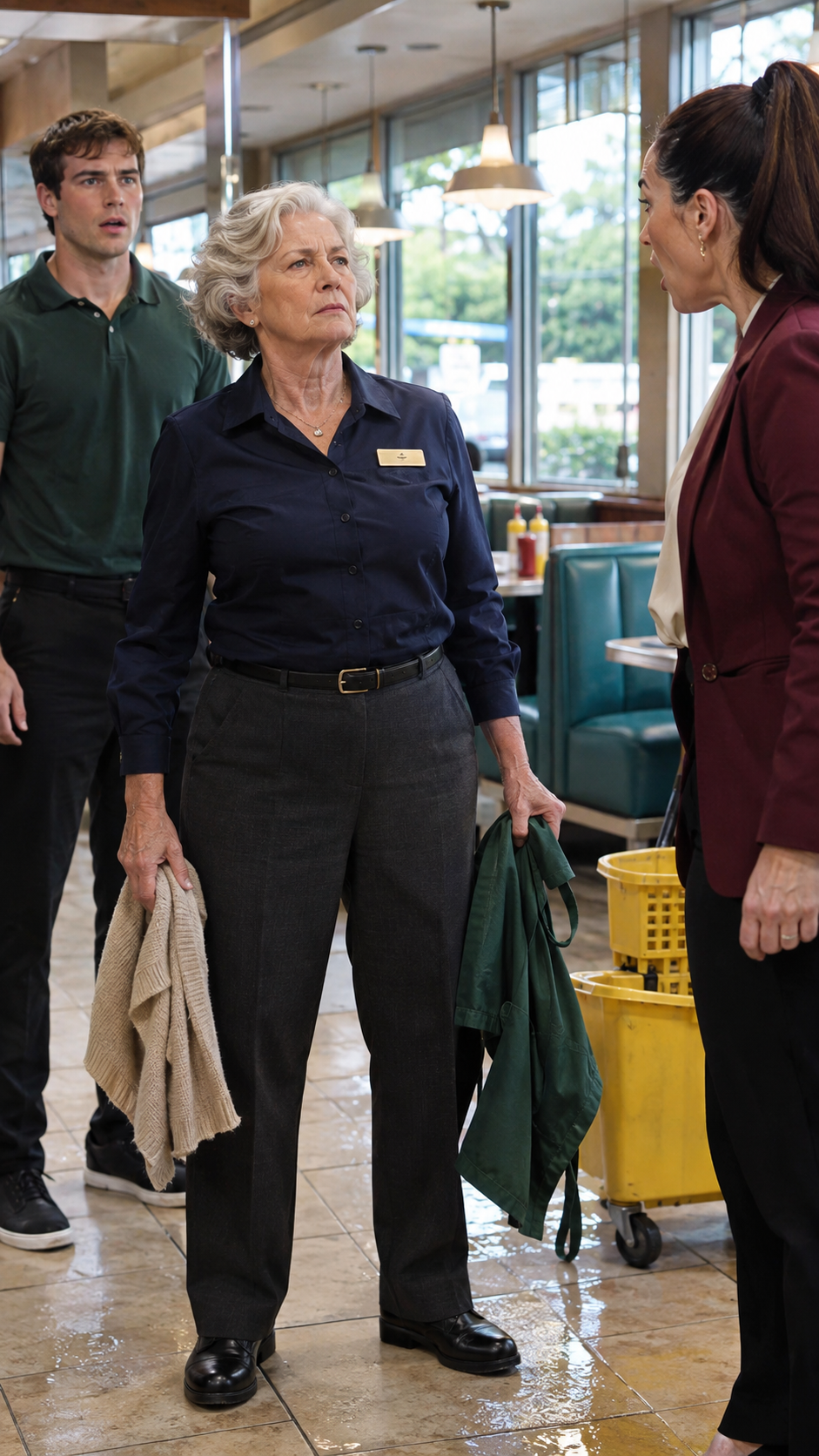
Eleanor calmly placed her mop against the yellow cleaning bucket.
She reached toward the ties of her dark green apron and began removing it.
Then she took off her beige cardigan.
Beneath the ordinary cleaning clothes was a professional navy executive shirt with a small gold identification badge.
Vanessa’s confident expression immediately disappeared.
Daniel looked toward Eleanor with visible surprise.
The elderly woman stood before them with a completely different presence.
She was no longer quietly attempting to clean the mess Vanessa had created.
She looked directly at the manager and spoke firmly.
“I own this restaurant. I came here to see how my employees treat people.”
For a moment, Vanessa appeared unable to respond.
The woman she had deliberately humiliated was not simply another cleaning employee.
She was the owner of the restaurant.
Eleanor had entered the diner wearing ordinary cleaning clothes to observe how employees behaved when they believed they were interacting with someone who held little authority.
The experience had revealed far more than an ordinary workplace inspection might have shown.
Vanessa had demonstrated how she treated someone she believed was beneath her position.
Daniel had demonstrated how he treated someone who appeared unable to offer him anything in return.
Neither employee had known Eleanor’s true identity when making those choices.
That was what made the revelation so significant.
Their behavior had not been influenced by an awareness that the restaurant owner was watching.
Vanessa’s earlier comments suddenly carried a completely different weight.
The spilled coffee, the dismissive smile, and the criticism directed toward Daniel were no longer isolated moments of disrespect.
They had become direct examples of the manager’s leadership style.
Eleanor had witnessed everything herself.
And she was ready to respond.
The Difference Between Authority and Leadership
Eleanor’s unexpected revelation completely changed the atmosphere inside the diner.
Vanessa, who had previously spoken with confidence and authority, now stood speechless.
Daniel remained visibly surprised by the discovery.
He had offered assistance to someone he believed was an ordinary cleaning employee.
He had not known that Eleanor owned the restaurant or that his actions were being observed by the person responsible for its leadership.
That distinction is central to the fictional story.
Anyone can behave respectfully when they know they are speaking to someone powerful.
The more meaningful question is how they behave toward people who appear to have less authority.
Vanessa had used her position to create unnecessary work and embarrass another person.
Daniel had used his available time and resources to help.
The contrast illustrates the difference between possessing authority and demonstrating leadership.
A management title gives someone responsibility for organizing employees, maintaining standards, and supporting the operation of a business.
It does not automatically guarantee that the person holding that title possesses empathy, sound judgment, or the ability to earn genuine respect.
Leadership involves more than issuing instructions.
It also requires understanding how decisions affect other people.
Daniel demonstrated those qualities through an ordinary act of assistance.
He recognized a problem and responded constructively.
Vanessa demonstrated the opposite by criticizing him for helping someone whose difficulties she had deliberately created.
Eleanor had witnessed both approaches.
The question was no longer whether the restaurant needed someone capable of giving instructions.
It was whether the person currently exercising that authority deserved to continue leading the team.
Why Every Employee Deserves Respect
Restaurants depend on people performing many different responsibilities.
Some prepare food, others serve customers, manage orders, wash dishes, clean floors, or supervise daily operations.
Each responsibility contributes to the overall experience of everyone who enters the establishment.
Cleaning employees perform particularly important work.
They help maintain hygiene, reduce hazards, and create an environment where customers and other employees can feel comfortable.
Their contributions should never be dismissed simply because their work does not involve a prestigious title.
Eleanor’s experience illustrates how easily someone can underestimate the importance of another person’s responsibilities.
Vanessa treated the cleaning task as something she could deliberately make more difficult without considering the person performing it.
Her statement, “You missed a spot,” was not constructive feedback.
It was an attempt to humiliate someone after intentionally creating a problem.
The fictional story challenges that attitude.
A person’s dignity should not depend on their occupation, income, clothing, age, or position within a workplace.
The elderly woman deserved respectful treatment before Vanessa discovered that she owned the restaurant.
Her true identity did not suddenly make her worthy of consideration.
She had deserved it from the beginning.
That is one of the most important messages behind the story’s unexpected revelation.
The Employee Who Helped Without Expecting Anything
Daniel’s actions were particularly meaningful because they occurred before Eleanor revealed her identity.
He did not collect the cleaning towels because he believed helping her would improve his career.
He did not kneel beside the spill because he expected the restaurant owner to reward him.
He simply noticed someone struggling and offered assistance.
Even when Vanessa criticized him, Daniel remained calm.
His response demonstrated that he was willing to stand behind his decision without insulting or threatening the manager.
“Helping someone shouldn’t require permission.”
Those words captured the central message of his behavior.
In a healthy workplace, employees should feel encouraged to cooperate when appropriate.
A team becomes stronger when its members recognize shared responsibilities and support one another during difficult moments.
That does not mean ignoring safety requirements or abandoning important duties.
It means understanding that cooperation, consideration, and sound judgment can be essential parts of professional conduct.
Daniel’s assistance was a practical example.
He helped clean a spill that could otherwise create a slipping hazard while supporting an elderly colleague.
His behavior demonstrated initiative without requiring an elaborate display of authority.
The fictional narrative suggests that these qualities are exactly what Eleanor hoped to discover during her visit.
She had seen someone who understood that leadership could begin with a simple act of kindness.
What Happens When Employees Fear Their Managers?
The confrontation between Vanessa and Daniel also highlights an important workplace issue.
Employees who fear being criticized for reasonable decisions may become reluctant to take initiative.
They may hesitate to assist colleagues, report problems, or suggest improvements if they believe their manager will respond negatively.
Over time, such an environment can damage cooperation and trust.
Vanessa’s reaction illustrates this problem within the fictional diner.
Instead of recognizing that Daniel was helping resolve a situation, she questioned why he was performing a task outside his usual responsibilities.
Her response focused on control rather than the needs of the restaurant or its employees.
A constructive manager might have acknowledged his assistance, ensured the spill was safely cleaned, and then helped him return to his regular duties.
The difference lies in the way authority is exercised.
Good managers establish expectations while treating employees with dignity.
They recognize initiative, communicate respectfully, and address problems without unnecessary humiliation.
The story presents Vanessa as someone who failed to demonstrate those qualities during Eleanor’s visit.
Daniel, despite not holding the manager’s position, displayed several of the interpersonal qualities associated with effective leadership.
His actions gave Eleanor a reason to reconsider who should be responsible for guiding the restaurant’s team.
The Most Important Lesson Was Not About Wealth
Stories involving an undercover business owner often focus on the dramatic moment when someone discovers that an apparently ordinary person possesses considerable authority.
However, the strongest message in this fictional encounter is not that people should behave respectfully because someone might secretly be wealthy or powerful.
It is that people deserve respect regardless of whether they possess wealth or power.
If Eleanor had actually been an ordinary cleaning employee, Vanessa’s behavior would still have been unacceptable.
If Daniel had never received recognition for helping her, his kindness would still have been meaningful.
The revelation does not change the moral significance of their earlier choices.
It simply creates an opportunity for Eleanor to address what she witnessed.
This distinction matters because genuine kindness should not be motivated entirely by the possibility of receiving something in return.
Respect becomes meaningful when it is offered consistently.
The restaurant owner had deliberately placed herself in a position where employees would not immediately recognize her authority.
Through that experience, she observed two very different approaches to human interaction.
One employee attempted to establish superiority by humiliating another person.
The other demonstrated consideration without expecting a reward.
Their choices revealed more about their character than their respective job titles ever could.
Eleanor Was Ready to Make Her Decision
The bright diner remained filled with the familiar sounds of restaurant activity.
The turquoise booths, wooden service counter, and tiled floor looked exactly as they had earlier that morning.
But the relationship between the three people standing near the cleaning bucket had completely changed.
Vanessa was no longer speaking with the confidence she had displayed while ordering Eleanor to clean the spilled coffee.
Daniel stood nearby, still processing the unexpected revelation.
Eleanor looked calmly toward the manager.
She had witnessed the deliberate spill, the humiliating remarks, and the confrontation that followed when Daniel offered assistance.
She had also seen an employee demonstrate compassion despite being criticized for it.
The contrast could hardly have been clearer.
Eleanor did not need another demonstration of their behavior.
She had already seen how each person responded when they believed nobody with greater authority was watching.
Now she was ready to address Vanessa directly and acknowledge the employee who had chosen to help.
Her next words would bring the fictional encounter to its dramatic conclusion.
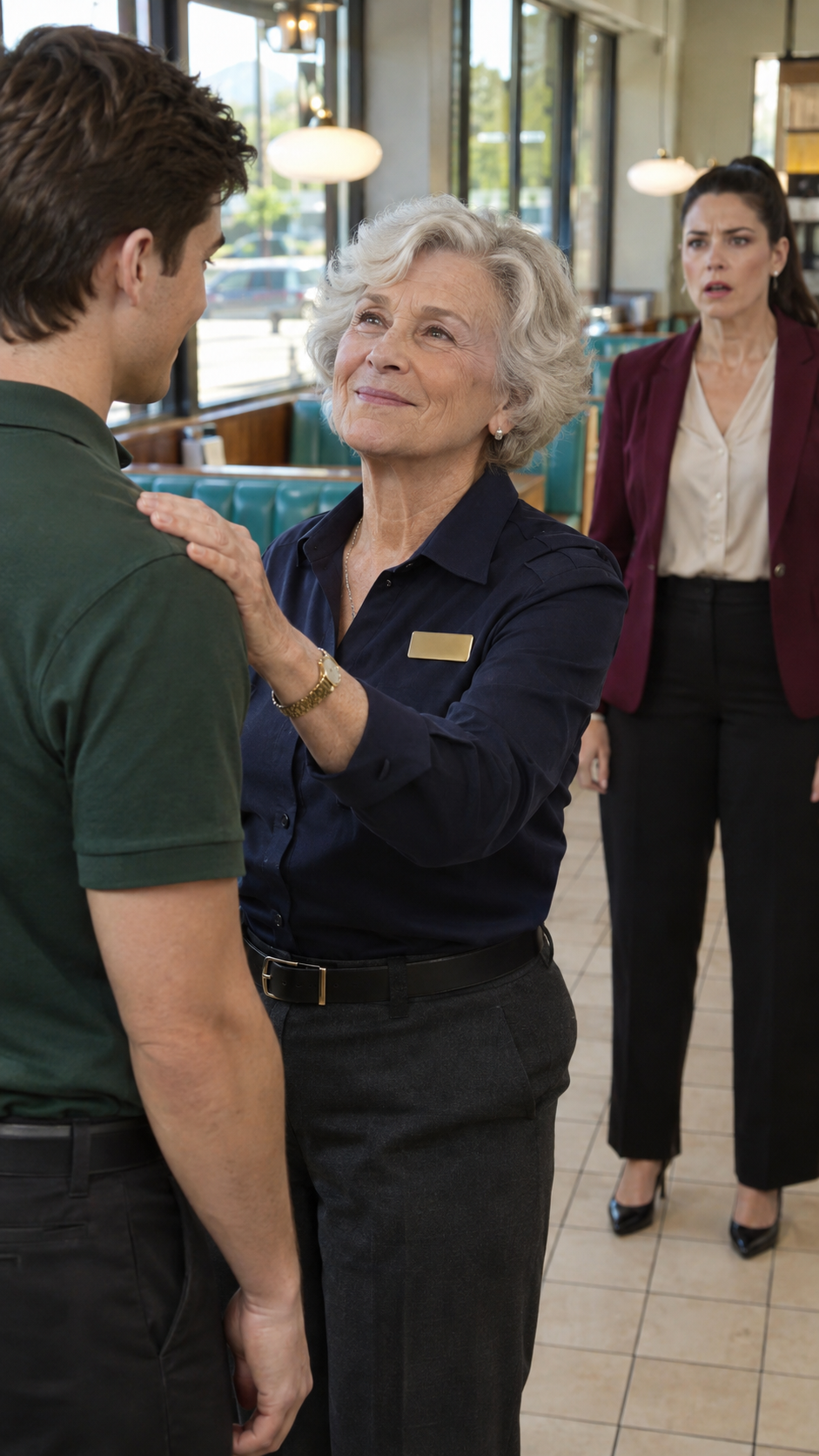
“Hand over your manager’s badge,” Eleanor told Vanessa firmly. She then turned toward Daniel, placed a reassuring hand on his shoulder, and smiled warmly. “You’re exactly the kind of person I want leading this team.” Daniel smiled with genuine surprise and gratitude while Vanessa remained speechless in the background. What began with a deliberate act of humiliation ended with a powerful fictional reminder that genuine leadership is earned through character, compassion, and respect for others—not through a title alone