An Unexpected Attack Beside the Water
The peaceful afternoon began with a sudden burst of movement.
Tall grass beside a quiet fishing area shook violently.
A female duck came charging out, her wings beating as she hurried directly toward a fisherman named Frank.
Frank stood near a wooden canoe rack, wearing his fishing waders and holding a cork-handled fishing rod.
He had been preparing for an ordinary afternoon beside the pond.
But the duck had other plans.
She rushed toward his left boot, stretched her neck forward, and grabbed a loose fold of his waders with her bill.
Then she pulled.
The fabric tightened as the duck leaned backward.
Frank rocked onto his other foot, startled by the unexpected tug.
His fishing reel rattled as he lifted his rod.
“Whoa! Easy, girl!”
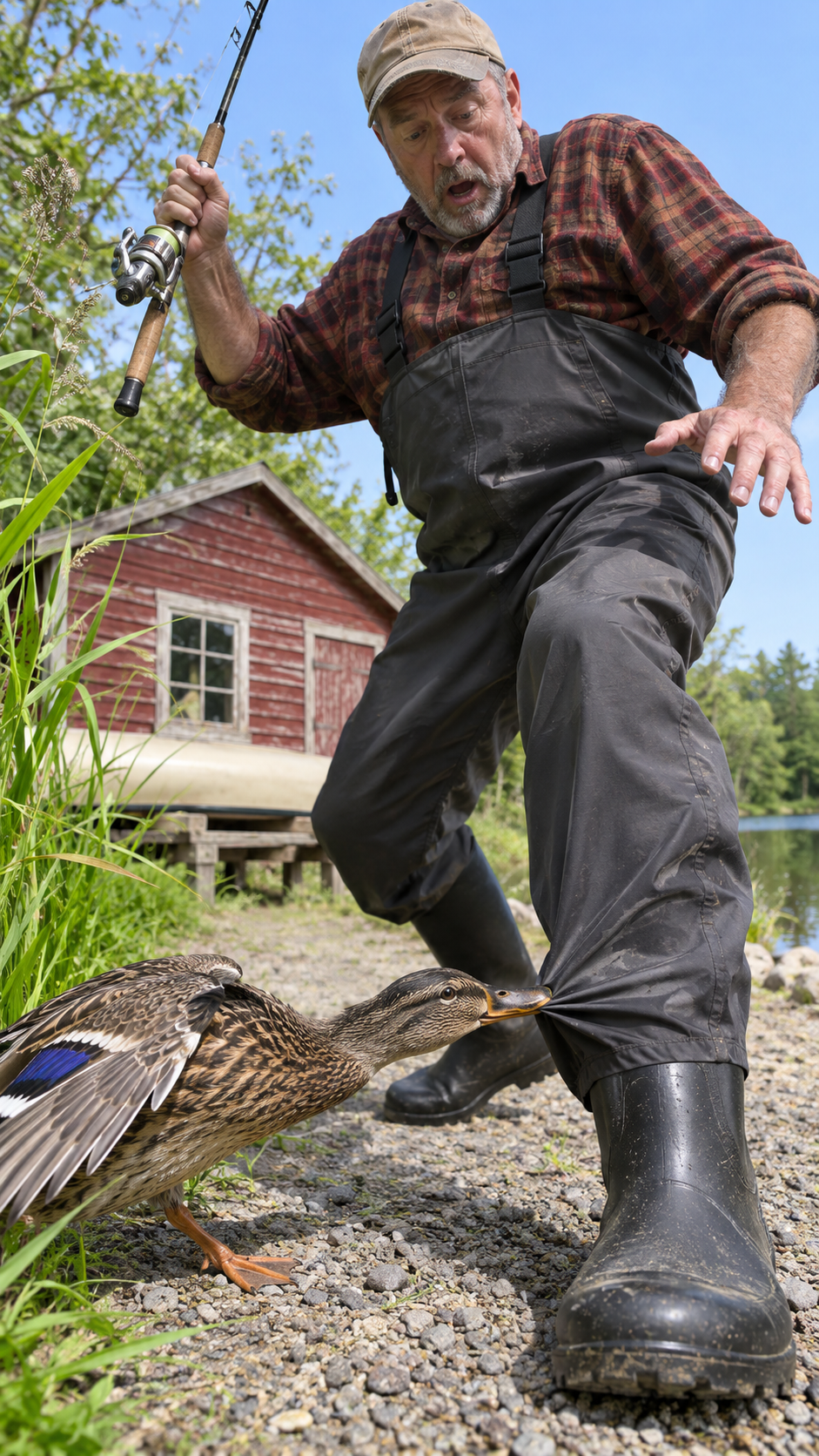
The duck did not immediately release him.
She continued pulling at the fabric, seemingly determined to get his attention.
Frank stared down at the animal.
He had no idea why she was behaving this way.
But within moments, he would discover that her unusual actions were connected to something hidden near the water.
Something that needed immediate attention.
The Duck Suddenly Changes Direction
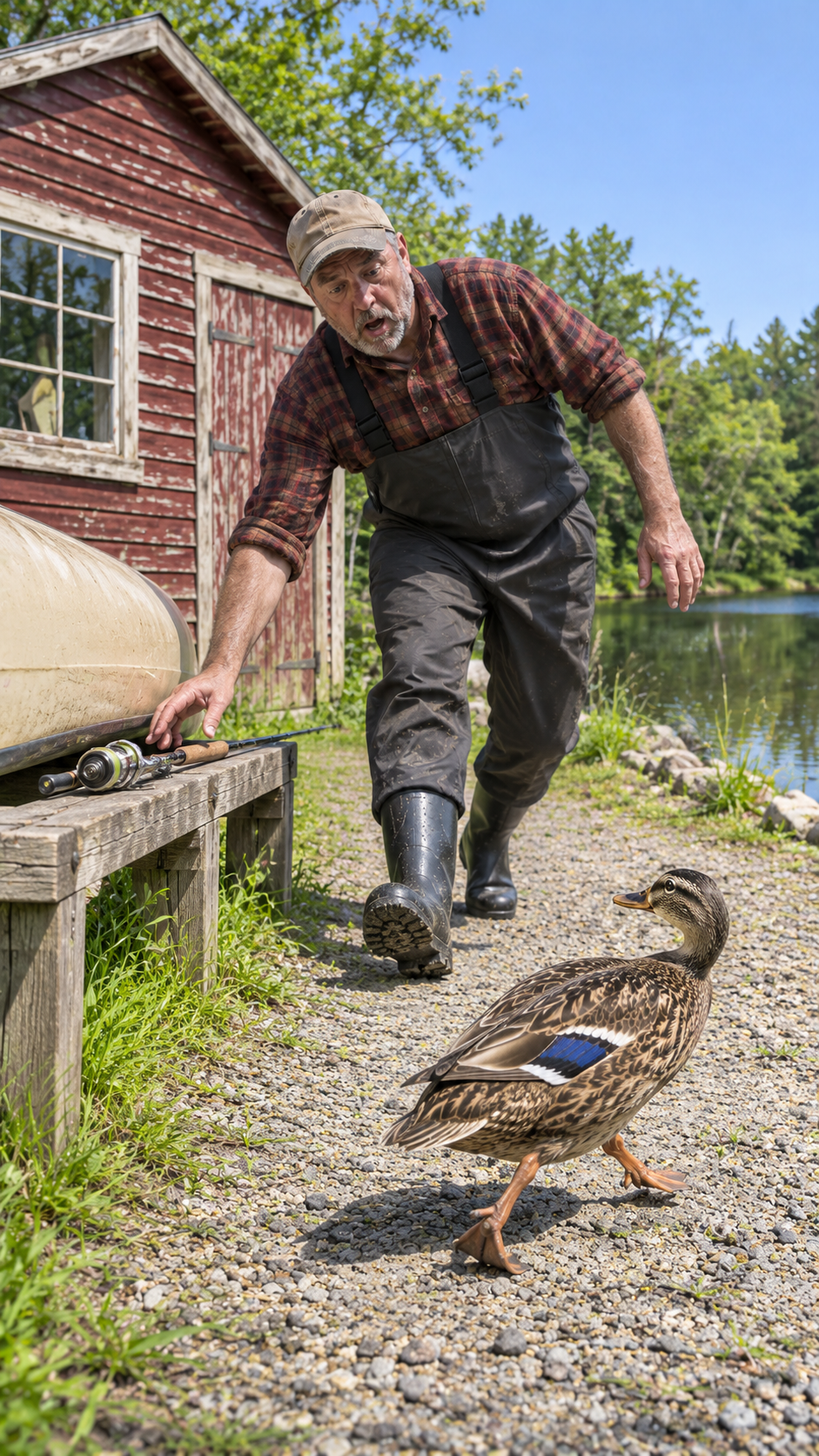
The duck finally released Frank’s wader leg.
Instead of continuing to confront him, she hurried along the gravel path beside the canoe rack.
Frank watched her move away.
Her behavior was strange.
She had rushed from the grass, grabbed his clothing, and pulled hard enough to make him lose his balance for a moment.
Now she seemed interested in leading him somewhere.
The duck stopped beside the bow of a cream-colored canoe.
She turned her head.
Then she looked back toward Frank.
He remained beside the rack, holding his fishing rod.
The duck waited.
Frank glanced toward the path.
He began to suspect that the animal wanted him to follow.
He rested his fishing rod on the wooden rack.
The rod tapped against the wood.
“Okay, I’m coming.”
As soon as his boot crunched against the gravel, the duck turned away again.
She hurried around a nearby red shed toward the pond.
Frank followed.
He still did not understand what was happening.
But the duck’s repeated glances suggested that something important was waiting beyond the shed.
A Strange Journey Around the Shed
Frank walked along the gravel beside the canoe rack.
The duck remained ahead of him.
She moved quickly, stopping only briefly to check his position.
The cream canoe stood beside the path.
Its bow partially blocked the view of the water beyond.
The red shed marked the edge of the small waterfront area.
Frank rounded the building.
As he approached the boat ramp, the duck moved toward the shallows.
Then Frank saw something that made him stop.
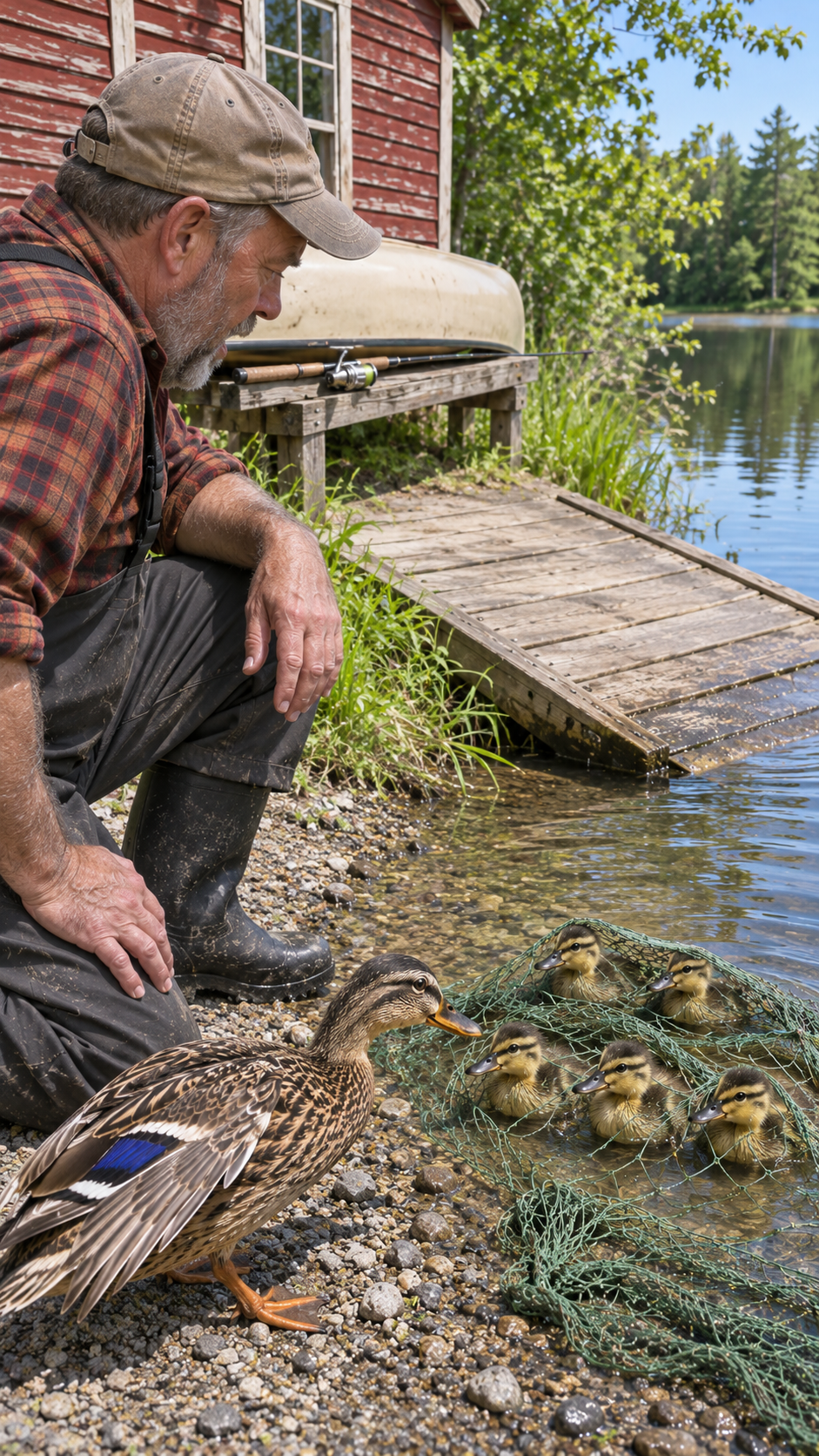
Near the foot of the ramp, a loose section of green fishing net lay partly submerged in the water.
Beneath the mesh were several tiny moving shapes.
Frank stepped closer.
He looked down.
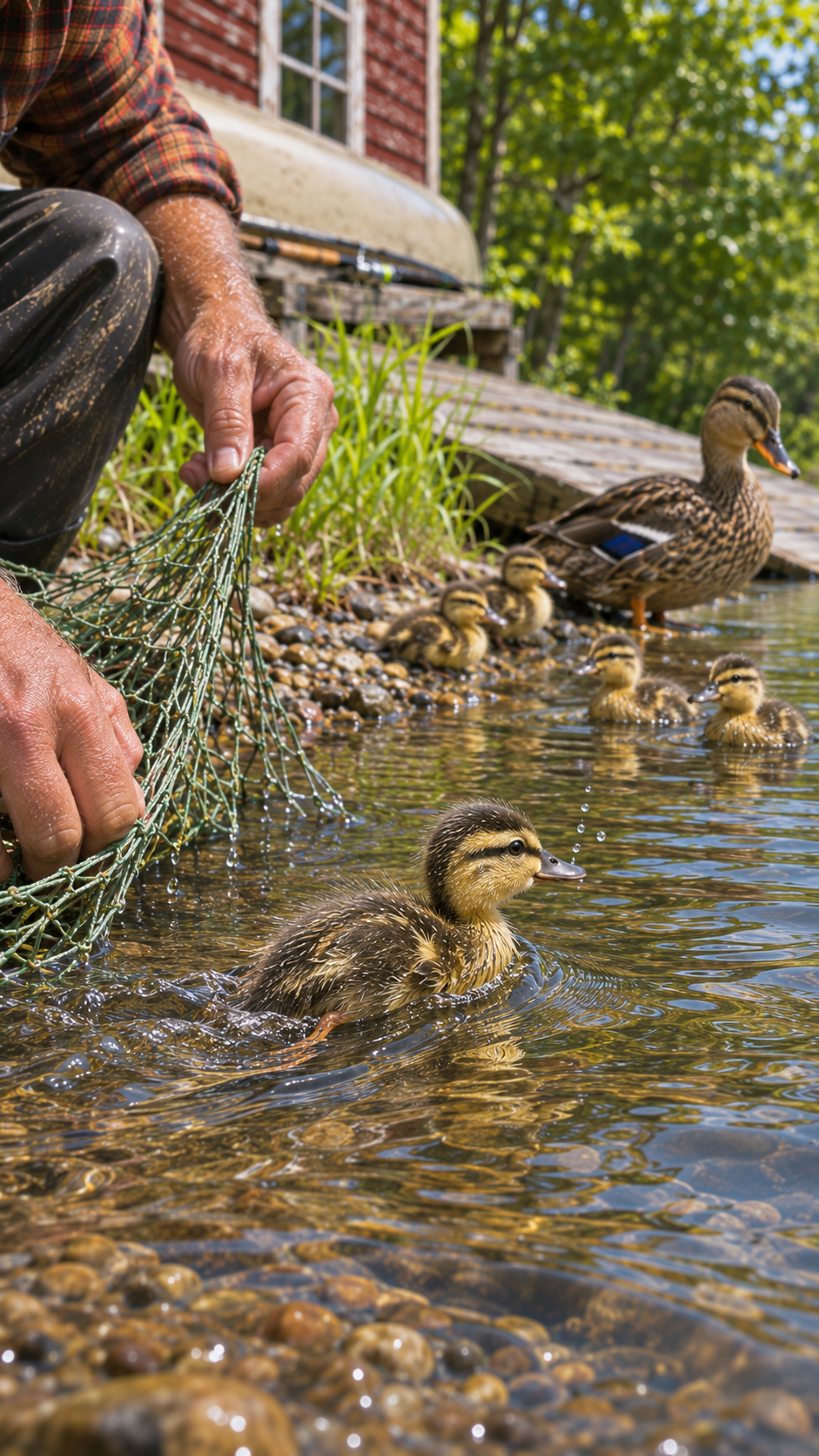
Five little ducklings were huddled together beneath the net.
Their yellow-and-brown feathers were damp.
Their heads remained above the water.
But the loose fishing mesh covered their backs and restricted their movement.
The ducklings peeped repeatedly.
Frank immediately understood why the adult duck had been so agitated.
“Oh, you’re all caught up.”
He lowered himself onto one knee beside the water.
Five Ducklings Trapped Beneath the Net
The five ducklings were clustered together in the shallow water.
A loose fold of green fishing net covered their small bodies.
Their heads remained clear of the surface, allowing them to breathe.
But they could not move freely.
The water lapped gently against the wooden boards of the ramp.
The ducklings continued peeping.
Their mother remained nearby.
Frank studied the position of the net.
He needed to free the little animals without pulling the mesh tightly against them.
He leaned closer.
The net was tangled loosely around the group, but the ducklings were small and delicate.
A sudden movement could frighten them or make the situation worse.
Frank kept his hands low.
He examined the edge of the mesh.
Then he began working carefully.
The mother duck watched from the gravel.
The fisherman had arrived exactly where she had led him.
Now the rescue could begin.
The First Careful Movement
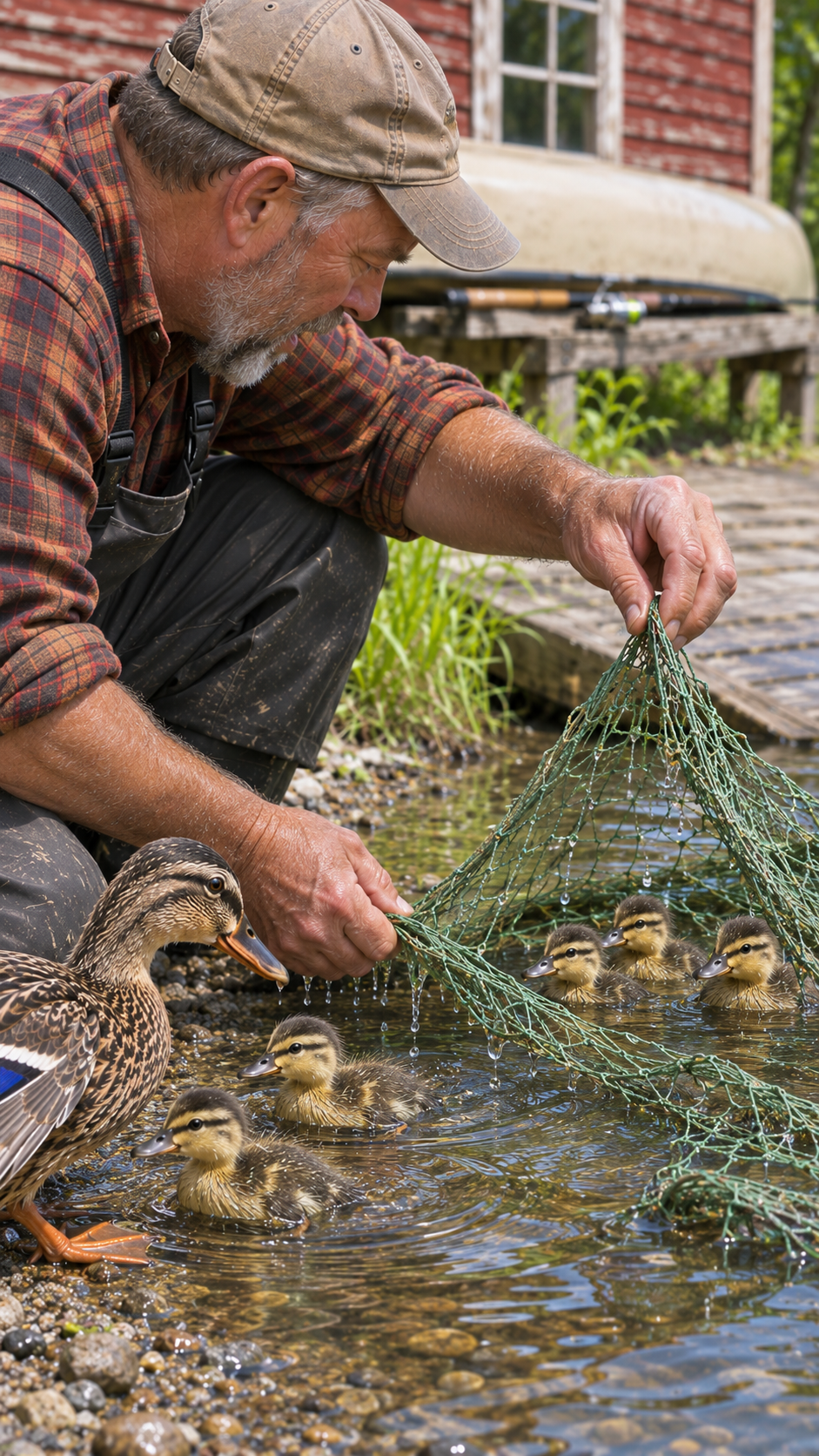
Frank placed his left fingertips beneath the green fishing mesh.
He lifted it slowly.
The wet material rose away from the ducklings’ backs.
Water dripped from the net.
With his right hand, Frank folded the nearest edge toward his knee.
The opening widened.
The ducklings shifted beneath the raised fabric.
“Easy now.”
His voice remained calm.
The first little duckling moved toward the gap.
Its tiny feet paddled through the shallow water.
Then it slipped free.
A second duckling followed.
Both moved away from the net and stopped in the shallows beside their mother.
The adult duck gave a low quack.
Frank looked toward the remaining animals.
Three ducklings were still beneath the raised fold.
He had freed two.
But the rescue was not finished.
Two Safe, Three Still Trapped
The first two ducklings remained close to their mother.
Their little bodies floated in the shallow water.
They were no longer beneath the green mesh.
Frank kept his left hand steady, holding the net away from the remaining three.
He did not release the fabric.
The other ducklings were still close to his knee.
Their tiny heads moved as they peeped.
The mother duck watched from nearby.
Frank shifted the edge of the net carefully with his right hand.
He needed to create enough room for the remaining animals to escape.
The wet mesh clung together in places.
Small droplets fell into the pond.
Frank continued holding it above the ducklings.
He had already seen two escape successfully.
Now he needed to help the others follow.
The Next Two Ducklings Escape
Frank gently eased the raised net toward the shore.
Two of the remaining ducklings began moving together.
Their small feet paddled rapidly.
They passed through the opening and emerged beside the first two.
Four ducklings were now free.
The mother remained close.
But one duckling had not moved.
It was the smallest of the group.
The little animal stayed beneath the edge of the net.
Frank watched carefully.
He kept the mesh raised.
He did not reach suddenly toward the duckling.
Instead, he waited.
“Come on, little one.”
The smallest duckling remained still for another moment.
Then it began paddling.
Its tiny body moved toward the opening.
Frank kept his hands steady.
The duckling reached the edge of the mesh.
Then it slipped through.
It joined the other four.
All five ducklings were finally free.
The Last Duckling Makes It Out
The smallest duckling paddled toward its siblings.
Its yellow-and-brown feathers were wet.
The other four remained in the shallows beside their mother.
Frank watched the little animal reach them.
Then he looked back toward the green fishing net.
It was empty.
He carefully drew the wet mesh onto the gravel bank.
The material scraped softly against the stones.
Water dripped from the folds.
The dangerous obstruction was no longer covering the ducklings.
Frank remained kneeling.
He looked toward the family.
Five small ducklings were gathered beside the adult duck.
Every one of them had escaped.
The most difficult part of the rescue was over.
Why the Mother’s Behavior Suddenly Made Sense
Only minutes earlier, Frank had been startled by the duck charging out of the grass.
Her wings had beaten rapidly.
Her bill had caught his waders.
She had pulled at the fabric.
At first, the encounter appeared aggressive.
But the duck had not remained beside him.
Instead, she had moved toward the canoe rack.
She had looked back repeatedly.
Then she had led him around the red shed.
The five trapped ducklings explained the sequence.
Within this fictional story, the mother’s unusual behavior is portrayed as an attempt to attract human assistance.
She could not lift the fishing net herself.
Her ducklings were trapped beneath the loose mesh.
So she approached Frank.
Her actions brought him to the water.
And his careful movements allowed the five little animals to escape.
The encounter had begun with confusion.
Now it was ending with relief.
A Fishing Net Becomes a Dangerous Obstacle
The green fishing net was the central danger in the story.
It was loose enough for the ducklings’ heads to remain above water.
But it covered their backs and restricted their movement.
The ducklings were clustered beneath it near the foot of the ramp.
They were unable to swim away normally.
Fishing line, nets, and discarded tackle can create serious hazards for wildlife.
Birds and other animals may become entangled when loose material remains in or near waterways.
Small animals can be especially vulnerable because their feet, wings, or bodies may become caught.
The fictional rescue illustrates one possible form of entanglement.
Frank is able to lift the loose mesh and allow the ducklings to paddle through an opening.
In real situations, however, entangled wildlife may require assistance from trained animal rescue professionals.
The condition of the animal and the type of material involved can make removal difficult or dangerous.
The story’s happy ending should not be taken as a guarantee that every entanglement can be resolved so easily.
The Importance of Moving Slowly
Frank’s actions are deliberately careful.
He does not yank the fishing net.
He does not pull the ducklings out by their wings or legs.
Instead, he lifts the mesh away from their backs.
He folds one edge toward his knee.
Then he gives the animals room to move.
The first two ducklings paddle through.
The next two follow.
Finally, the smallest escapes.
The sequence emphasizes patience.
Frank keeps the opening available until every duckling is free.
He also makes sure the net is empty before pulling it onto the bank.
Within the fictional scene, those choices help prevent the ducklings from becoming more entangled.
The slow pace of the rescue contrasts with the frantic opening.
The mother duck’s initial movements are fast and urgent.
Frank’s movements at the waterline are controlled and gentle.
Both contribute to the outcome.
Five Ducklings, Not Four
The number of ducklings matters throughout the story.
When Frank first reaches the water, he sees five yellow-and-brown ducklings beneath the green mesh.
The first two escape together.
That leaves three trapped.
Then another two paddle through the opening.
That leaves one.
The smallest duckling hesitates briefly before moving toward the others.
Finally, all five are free.
This sequence makes the rescue easy to follow.
The audience can count the animals as they escape.
The final scene confirms the result.
Frank looks toward the mother duck and her five ducklings.
“All five. Take care, mama.”
The line establishes that the entire group has been reunited.
No duckling is left behind.
The Smallest Duckling Creates the Final Suspense
The fifth scene is especially important because it delays the resolution.
Four ducklings have already escaped.
The mother is nearby.
Frank continues holding the net open.
Only one little duckling remains.
It is the smallest.
For a moment, the animal does not move.
The audience has already watched four siblings reach safety.
Now attention focuses on the final duckling.
Frank speaks gently.
“Come on, little one.”
The small animal finally begins paddling.
It passes through the opening.
Then it joins the others.
The final escape creates a satisfying emotional moment.
The rescue is complete only when the fifth duckling is free.
A Quiet Moment Beside the Pond
Frank remained kneeling beside the water.
The empty green fishing net lay on the gravel.
His fishing rod was still resting on the canoe rack.
The cream canoe stood near the red shed.
The mother duck moved into the pond.
Her five ducklings followed.
Their little bodies created small ripples across the surface.
Frank watched them.
His eyes moved over the group.
He counted them.
All five were together.
“All five. Take care, mama.”
The ducklings continued swimming.
Their peeps softened as they moved farther away.
The mother stayed beside them.
The water reflected the red shed.
Small wakes spread behind the family.
Frank remained at the bank, watching until they were safely moving across the pond.
Why This Story Begins With a Strong Hook
The opening does not begin with Frank quietly preparing his fishing equipment.
Instead, it begins with the mother duck charging out of tall grass.
Her wings beat rapidly.
She grabs his left wader leg.
Then she pulls.
The action is unexpected.
A duck pulling at a fisherman’s clothing creates an immediate question.
Why is the animal behaving this way?
Frank’s startled response makes the moment more dramatic.
“Whoa! Easy, girl!”
The audience initially sees an animal confronting a person.
But the second scene changes the interpretation.
The duck releases his leg and moves away.
Then she looks back.
That small action transforms the encounter from an apparent attack into a mystery.
The viewer wants to know where the duck is leading him.
The answer arrives when Frank discovers the five trapped ducklings.
A Story Told Through Movement
The six scenes follow one connected journey.
The mother duck begins in the tall grass.
She rushes toward Frank.
Then she moves along the gravel beside the canoe rack.
Frank follows her around the red shed.
They reach the boat ramp.
Frank kneels beside the trapped ducklings.
He lifts the net.
The ducklings escape in stages.
Finally, the mother and her five young swim away.
Every scene moves the story forward.
The setting remains consistent.
The canoe rack, red shed, gravel, boat ramp, and pond all belong to the same waterfront area.
The green fishing net remains the same object throughout the rescue.
And the number of ducklings remains exactly five.
Those details help the fictional event feel continuous and believable.
The Relationship Between the Fisherman and the Duck
Frank and the mother duck do not share a history established by the story.
There is no indication that he has fed her before.
There is no evidence that she recognizes him personally.
Their interaction begins unexpectedly.
The duck rushes toward him and grabs his clothing.
Frank reacts with surprise.
Then he notices her movements.
He chooses to follow.
When he discovers the ducklings, he responds to the situation.
The connection between them is built entirely through actions.
The duck draws attention.
Frank investigates.
He finds the trapped animals.
Then he helps them escape.
The story does not require the duck to understand human language or possess human-like reasoning.
It presents her behavior cinematically as an urgent attempt to direct Frank toward the ducklings.
The Final Scene Brings Everything Together
The last scene returns to the pond.
The empty fishing net rests on the gravel.
Frank remains kneeling near the waterline.
The mother duck slips into the pond.
Five ducklings swim beside her.
Their little wakes spread across the surface.
The red shed is reflected in the water.
Frank watches quietly.
He does not try to approach the family again.
He does not pick up the ducklings.
He simply allows them to swim away.
The moment contrasts with the beginning.
At first, the mother duck was rushing through tall grass, beating her wings and tugging at Frank’s clothing.
Now she is swimming calmly beside her young.
The urgency has disappeared.
The family is together.
And Frank’s work is finished.
A Reminder About Wildlife and Fishing Equipment
The fictional rescue carries a broader environmental message.
Discarded fishing nets and lines can pose hazards to aquatic animals and birds.
Even a small amount of loose material may create an entanglement risk.
Responsible handling and disposal of fishing equipment helps reduce those dangers.
Anyone encountering trapped wildlife should consider their own safety and the animal’s condition before intervening.
A frightened animal may struggle or become injured if handled improperly.
Wildlife rescue organizations and qualified professionals can provide guidance when an animal is entangled, injured, or in immediate danger.
The fictional scene shows Frank carefully freeing five ducklings from a loose net.
It does not establish that the ducklings received veterinary assessment afterward.
The story focuses on their release and reunion.
Its emotional message is about paying attention to wildlife and responding responsibly when animals appear to need help.
The Moment Frank Counts All Five
The mother duck was already moving into the pond.
The ducklings followed.
Frank looked toward the group.
He counted the little bodies as they moved through the water.
One.
Two.
Three.
Four.
Five.
Every duckling was there.
The smallest had caught up with its siblings.
The empty net lay behind Frank on the gravel.
The danger that had held the animals in place was gone.
He spoke softly.
“All five. Take care, mama.”
The family continued across the pond.
The ducklings’ peeps became quieter.
Their wakes spread across the reflection of the red shed.
The moment needed no further explanation.
Frank had followed the mother duck.
He had found the trapped young.
And all five had escaped.
The Final Moments at the Waterline
Frank remained on one knee beside the boat ramp.
The empty green fishing net lay on the gravel nearby.
The mother duck entered the water.
Her five ducklings followed closely.
Their yellow-and-brown bodies floated beside her.
Small ripples formed behind them.
Frank watched the family move through the reflection of the red shed.
“All five. Take care, mama.”
The ducklings peeped softly.
The mother continued swimming.
Frank stayed at the edge of the pond as the family moved farther away.
The last sounds were gentle splashes and water lapping against the ramp.
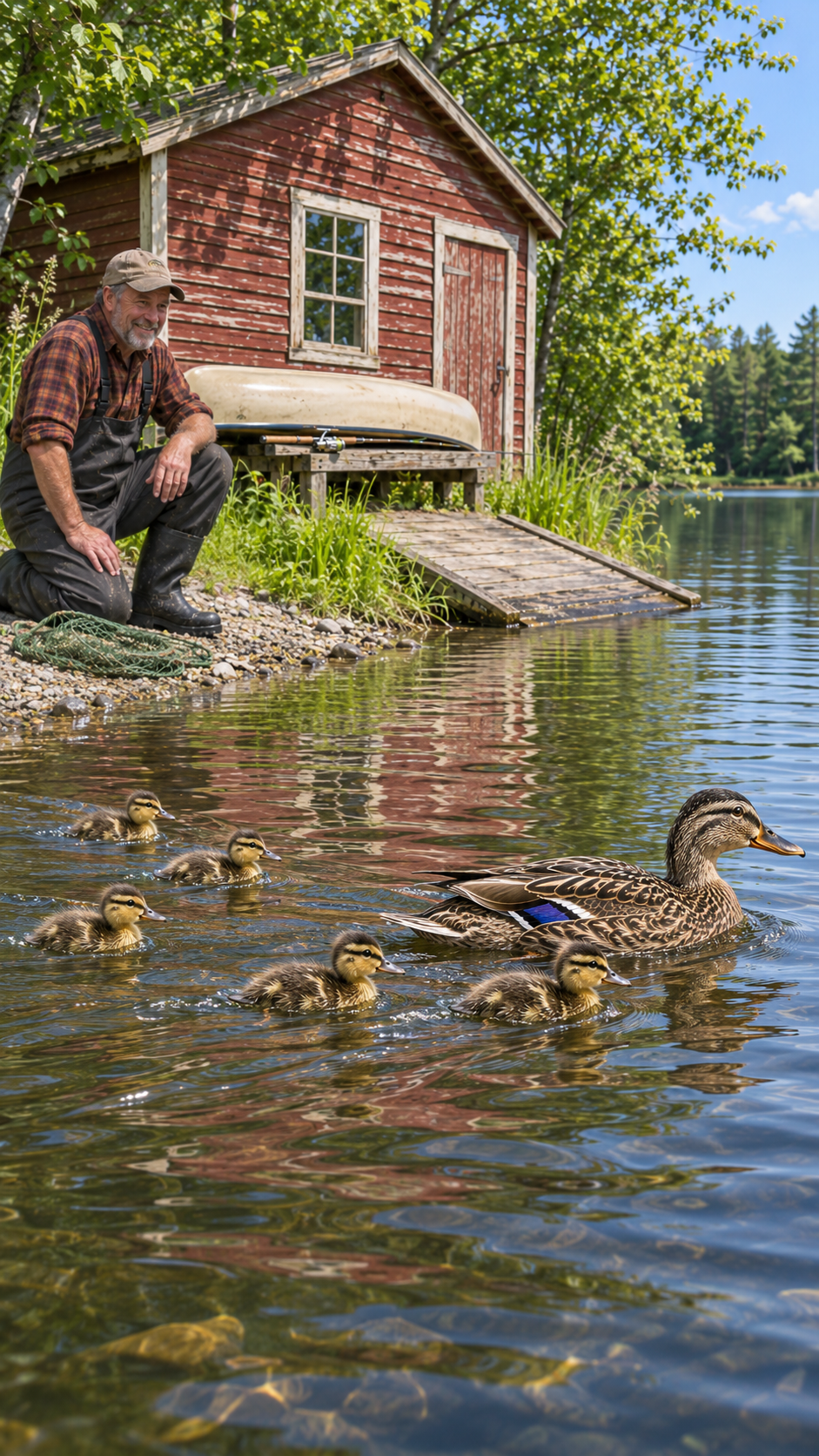
Frank knelt beside the pond, the empty green fishing net resting on the gravel behind him. The mother duck had entered the water, and all five yellow-and-brown ducklings were swimming beside her. Their tiny wakes spread across the surface, passing through the red shed’s reflection. Frank watched them carefully, counting each little body. “All five. Take care, mama,” he said. The family continued across the pond, their soft peeps fading into the afternoon air. The fisherman remained at the waterline, watching as the mother and her five ducklings moved away together.
What began as a startling encounter beside a canoe rack ended as a fictional wildlife rescue. A mother duck had charged from the grass, grabbed Frank’s waders, and pulled at his leg. When she released him and repeatedly looked back, he followed her around the red shed. There, he discovered five ducklings trapped beneath a loose green fishing net in the shallows. The most emotional moment came when the smallest duckling finally paddled through the opening Frank had created, joining its four siblings beside their mother. After pulling the empty net onto the bank, Frank watched all five ducklings swim away safely with the adult duck. The story closes with a quiet reminder that an unexpected encounter with wildlife can sometimes reveal an animal in need of help.