The Morning That Started With a Warning
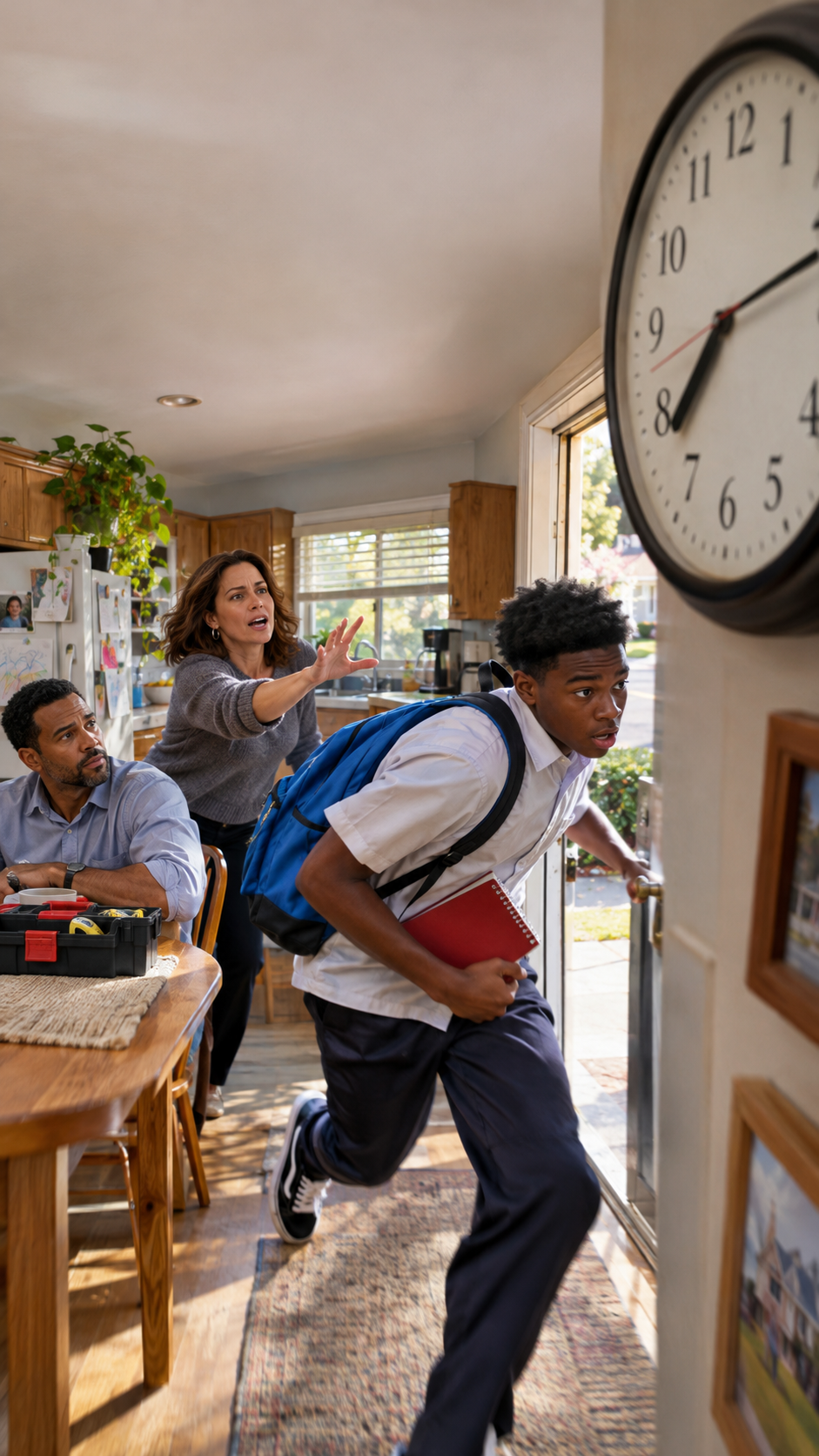
Morning sunlight streamed through the windows of a modest suburban home.
Inside the kitchen, a clock ticked steadily as a family prepared for another busy day.
Fifteen-year-old Oliver was getting ready for school.
He had short curly black hair and wore a white short-sleeve school shirt, dark navy pants, and black-and-white sneakers.
A bright blue backpack hung from his shoulders.
On the kitchen table lay a small red notebook.
Suddenly, his mother Leah called from across the room.
“Oliver! The seven-oh-six! You’re going to miss it!”
Oliver looked toward the clock.
He was running late.
He quickly grabbed the red notebook and hurried toward the door.
“I’m going, Mom!”
His father, David, sat beside a toolbox at the kitchen table.
David was 41 years old and wore a light blue shirt.
He watched his son rushing to leave.
The morning already felt hurried.
Oliver needed to catch the school bus.
And every second mattered.
But before he could leave, his father reached toward him with something in his hand.
His Father’s Last Granola Bar
David held out a wrapped granola bar.
“Take this, son.”
Oliver stopped briefly.
He looked at the snack.
Then he looked at his father.
“What about you, Dad?”
David smiled gently.
“I’ll be fine.”
Oliver accepted the granola bar.
The wrapper crinkled in his hand.
He adjusted the straps of his bright blue backpack.
Leah watched anxiously from the kitchen.
Oliver was already close to missing the bus.
He had little time to spare.
He hurried through the doorway into the cool morning air.
Behind him, the door creaked softly.
Distant traffic could be heard along the suburban streets.
The granola bar was a small gesture, but it showed David’s concern for his son.
Oliver was leaving for school in a rush.
His father wanted to make sure he had something to eat.
Neither of them knew that the morning was about to take an unexpected turn.
A Familiar Route to School
Oliver hurried along the damp sidewalk.
His black-and-white sneakers splashed through shallow puddles.
The bright blue backpack bounced against his shoulders.
His red notebook was tucked safely inside.
He knew the morning bus schedule.
The seven-oh-six was important.
If he missed it, he would arrive late.
As he continued down the street, he passed an elderly neighbor struggling with a garbage bin.
Oliver briefly raised his hand in acknowledgment.
Then he continued toward the intersection.
A small pharmacy stood nearby.
Cars moved along the road.
A pedestrian crossing signal sounded at the intersection.
Oliver was focused on reaching the bus.
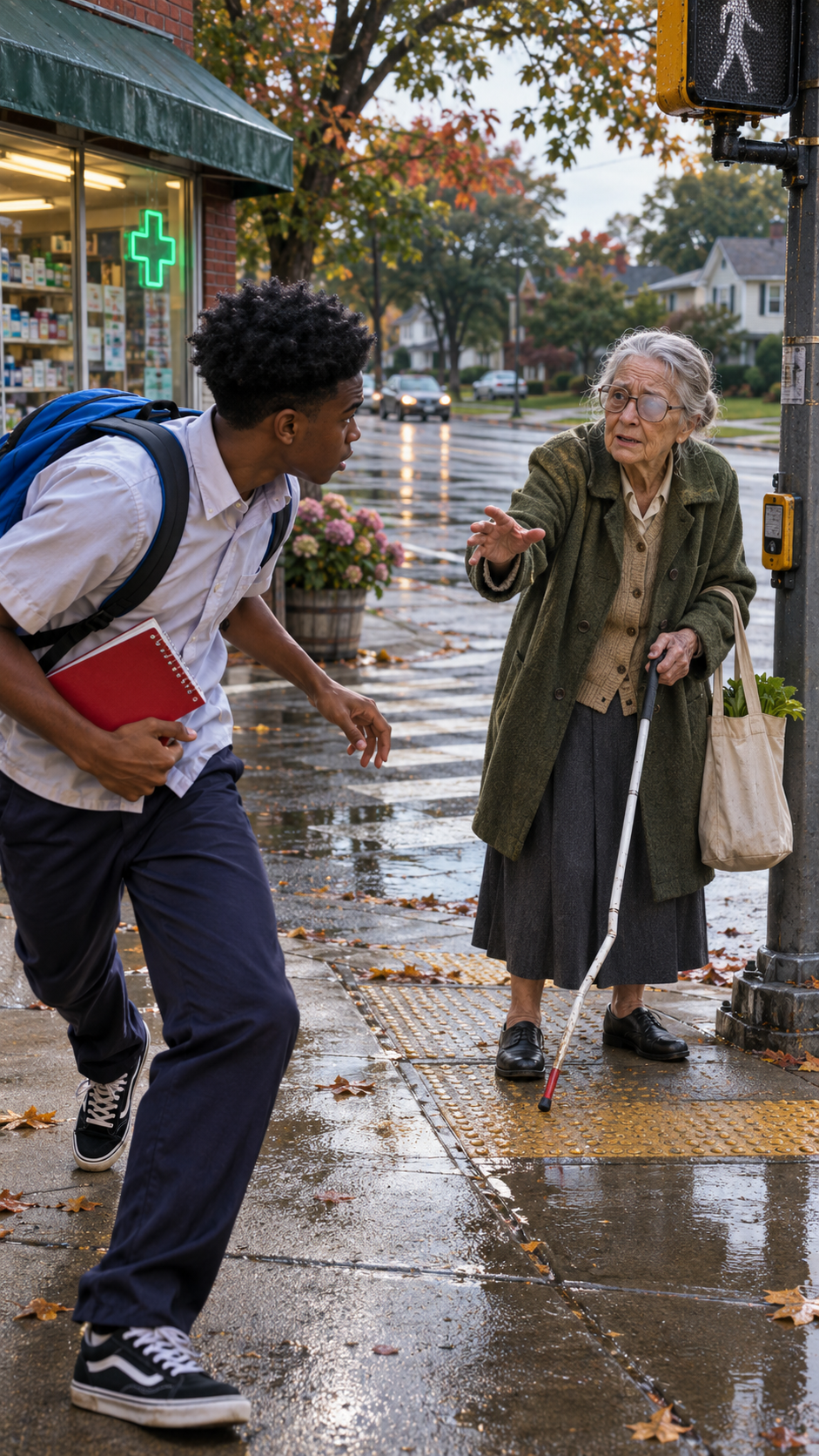
Then he heard a trembling voice.
“Excuse me! Is that the pharmacy?”
He stopped immediately.
The voice belonged to an elderly woman standing near the sidewalk.
Oliver turned around.

The Woman With the Damaged Cane
The woman appeared to be about 78 years old.
Her silver hair was pinned back neatly.
She wore large glasses, a moss-green coat, a beige cardigan, a gray skirt, and black shoes.
A cream canvas shopping bag hung at her side.
In one hand, she held a white mobility cane.
The lower section of the cane was slightly bent.
Oliver noticed the problem as he approached.
The woman seemed uncertain about the crossing.
She was trying to find the pharmacy, but the intersection was difficult for her to navigate.
Oliver glanced toward the road.
Cars were waiting near the broad pedestrian crossing.
The signal continued sounding.
He knew he was running out of time.
But the woman needed help.
And she had stopped him for a reason.
The Choice at the Crossing
Oliver stepped closer.
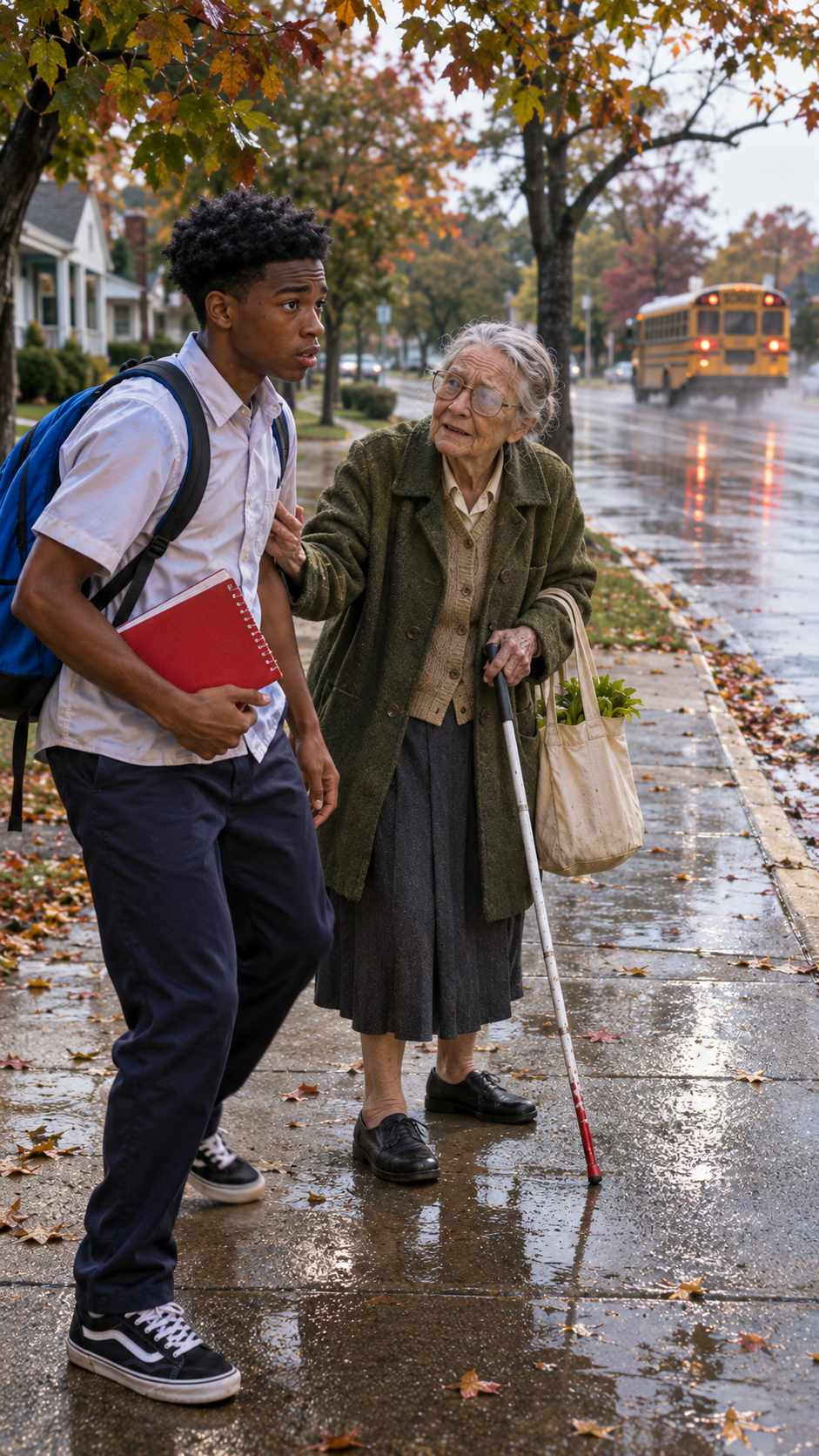
The bent lower section of the woman’s cane caught against the edge of the sidewalk.
She paused.
“I can’t see the crossing clearly.”
Oliver looked toward the intersection.
Then he looked at her.
He understood that crossing alone could be difficult.
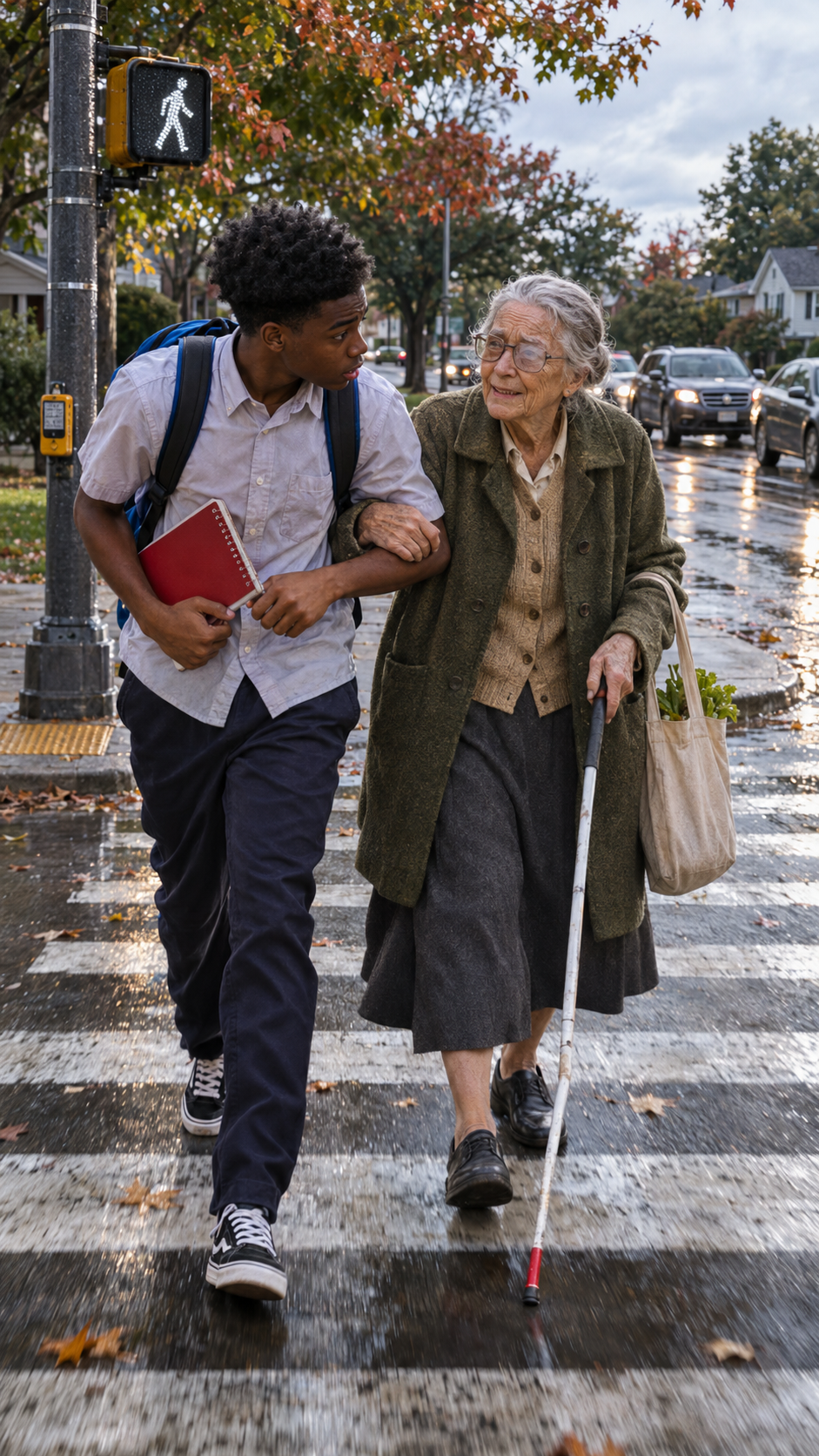
He gently offered his arm.
“It’s okay, ma’am. I’ll help you.”
The woman accepted his assistance.
Together, they approached the pedestrian crossing.
Oliver adjusted his pace to match hers.
The woman tapped her cane carefully against the pavement.
The pedestrian signal sounded.
Cars remained waiting.
Oliver guided her forward.
He was no longer thinking only about reaching school.
His immediate priority was helping the woman reach the opposite sidewalk safely.
Every Second Counts
The crossing was broad.
Oliver walked beside the elderly woman, keeping his arm available for support.
Her cream canvas bag moved gently at her side.
The slightly bent white cane tapped against the pavement.
Traffic waited at the intersection.
The two continued toward the opposite curb.
Oliver could hear the distant sounds of the neighborhood.
He knew the bus would not wait indefinitely.
Still, he did not abandon the woman halfway across.
He remained beside her until they reached the opposite sidewalk.
Only then did he look toward the nearby pickup area.
And that was when he saw it.
The yellow school bus was moving away.
The Bus Leaves Without Him
Oliver turned toward the bus.
For a moment, he hurried forward.
But the vehicle was already pulling away.
Its engine grew quieter as it continued down the street.
Oliver stopped.
He caught his breath.
The elderly woman noticed his reaction.
“Was that your bus?”
Oliver looked toward the departing vehicle.
Then he turned back to her.
“Yeah… but you’re safe now.”
The woman gently squeezed his arm.
Oliver had missed the seven-oh-six.
The exact bus his mother had warned him about.
He knew there might be consequences at school.
But he had made a decision.
He had chosen to help someone who needed assistance.
And now he would have to explain why he was late.
A Difficult Arrival at School
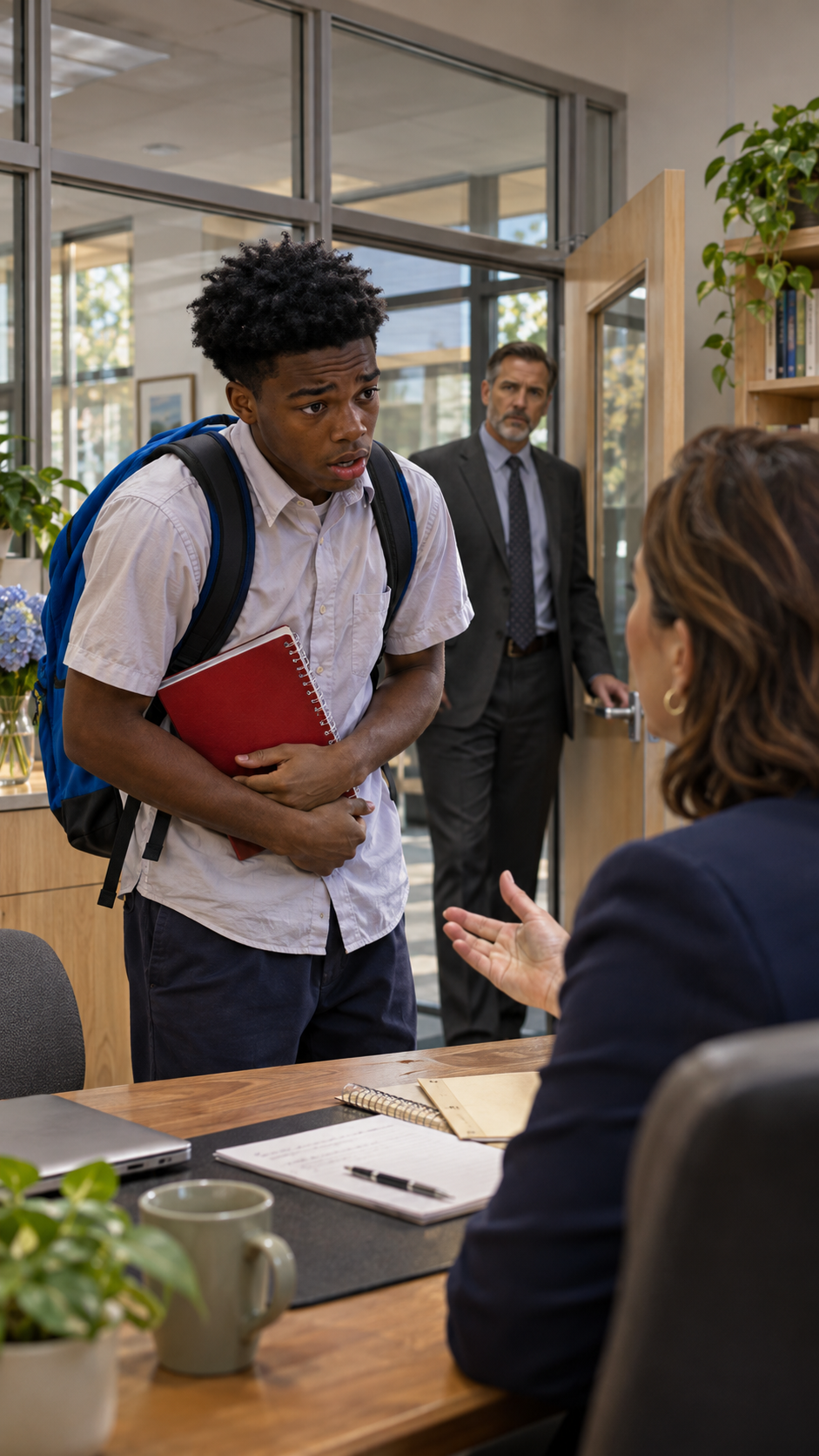
Later that morning, Oliver entered the school administration office.
The room had pale wooden furniture, glass partitions, and soft daylight coming through the windows.
His bright blue backpack remained on his shoulders.
His white school shirt and navy pants were unchanged.
He looked nervous.
Standing in front of him was a female school counselor.
She was about 45 years old, with brown hair and a navy blazer.
She looked at Oliver with concern.
“Oliver, late again?”
Oliver hesitated.
He knew how the situation appeared.
He had arrived after the expected time.
And the counselor’s question suggested that his punctuality had already become an issue.
He answered quietly.
“I was helping a woman cross the street.”
Before the conversation could continue, the office door opened.
A serious-looking male administrator stepped inside.
He wore a charcoal suit.
“What happened here?”
Oliver turned toward him.
The atmosphere in the office became tense.
The Principal’s Final Warning
The administrator was the school principal.
He was about 50 years old, with short salt-and-pepper hair and a trimmed beard.
He stood near his desk.
Oliver faced him nervously.
The female counselor remained nearby.
The principal looked directly at the teenager.
“Oliver, this is your final warning.”
Oliver lowered his eyes.
The words were serious.
He had missed the bus.
He had arrived late.
And now the principal was warning him about the consequences.
But Oliver knew there was more to the situation than the time he entered the school building.
He had helped an elderly woman cross a busy road.
He had also been paying attention to something else.
Something he had recorded in the small red notebook inside his backpack.
And he was finally ready to show it.
The Red Notebook
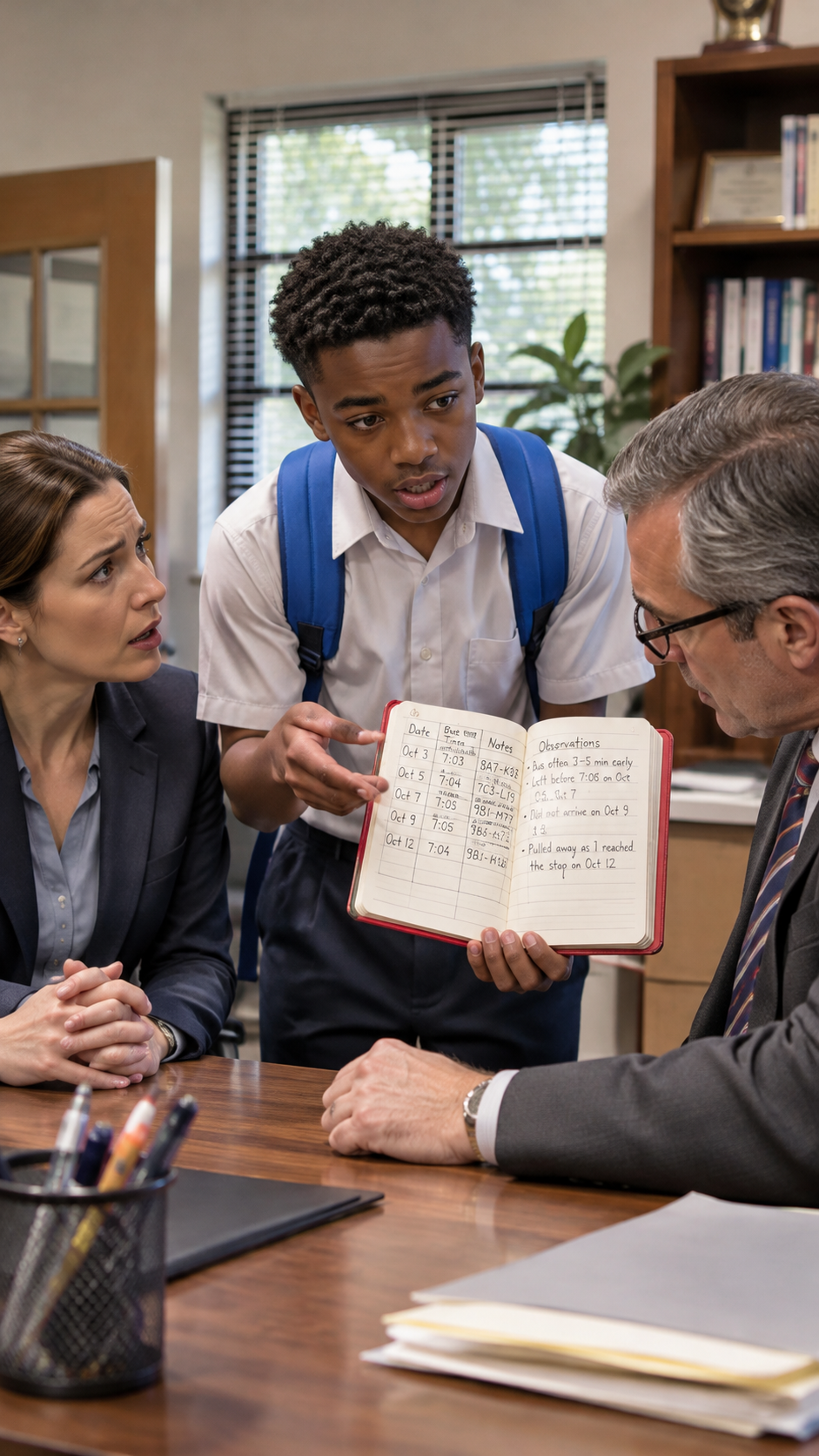
Oliver reached for his small red spiral notebook.
He placed it on the principal’s wooden desk.
Then he opened it.
Inside were handwritten records of school bus arrival and departure times.
Oliver had been documenting the schedule.
The notebook was not simply a collection of ordinary school notes.
It contained information he believed was relevant to his repeated lateness.
The principal leaned forward.
The counselor watched closely.
Oliver looked toward the open pages.
Then he spoke.
“The bus keeps leaving early. I wrote down every time.”
The principal examined the records.
His expression changed.
The notebook introduced an issue that had not been addressed during the initial warning.
Oliver was claiming that the bus had repeatedly departed earlier than scheduled.
And he had written down the times.
A Different Side of the Story
Until the notebook appeared, the conversation had focused on Oliver being late.
The counselor had questioned him.
The principal had issued a final warning.
But the handwritten records offered a different perspective.
Oliver was not simply asking the school to believe his explanation without supporting information.
He had documented what he observed.
The principal looked through the pages.
The story does not establish that every recorded time had already been independently verified.
But the notebook gave the school something specific to investigate.
That distinction mattered.
A student’s explanation could now be compared against bus records.
The principal was beginning to see that the situation might be more complicated than it first appeared.
And another unexpected development was about to change the conversation again.
Someone Enters the Office
The office door suddenly opened.
A school office assistant entered with an elderly woman.
Oliver turned toward the doorway.
He immediately recognized her.
It was the same woman he had helped near the pharmacy.
Her silver hair was pinned back.
She wore the same large glasses, moss-green coat, beige cardigan, and gray skirt.
She carried her cream canvas bag.
Her slightly bent white mobility cane tapped against the office floor.
The principal looked surprised.
The woman stepped forward.
Then she spoke.
“That boy helped me when nobody else stopped.”
Oliver stared at her.
He had not expected to see her at school.
The woman had arrived to confirm what happened at the crossing.
Her presence changed the atmosphere in the room.
The Unexpected Witness
The elderly woman’s statement was simple.
But it carried considerable weight.
Oliver had told the counselor that he was late because he helped someone cross the street.
Now the person he had assisted was standing inside the office.
She described the help he had given.
The principal listened.
The counselor watched.
Oliver remained beside the desk, his blue backpack still on his shoulders.
He had been nervous only moments earlier.
Now he looked astonished.
The woman had come to speak on his behalf.
Her statement did not automatically prove every detail of the bus schedule.
But it supported Oliver’s explanation for why he had stopped that morning.
The red notebook and the woman’s testimony addressed two separate issues.
One concerned the bus departures.
The other concerned Oliver’s decision to help.
Together, they gave the principal a fuller understanding of the situation.
A Teenager Who Chose to Stop
Oliver’s decision at the intersection had not been easy.
He was already rushing.
His mother had warned him about the bus.
His father had handed him a granola bar just before he left.
He knew he needed to reach the pickup area quickly.
Then an elderly woman asked for help.
He could have continued walking.
He could have told himself that someone else would stop.
But he chose to turn around.
He noticed her damaged cane.
He listened when she said she could not see the crossing clearly.
And he offered his arm.
He stayed with her until she reached the opposite sidewalk.
Only afterward did he discover that the bus had left.
The fictional story presents this as a moment of compassion.
Oliver accepted a personal inconvenience to help someone facing an immediate difficulty.
Why the Woman’s Appearance Matters
The elderly woman’s return is the emotional turning point of the school-office sequence.
At the intersection, she is the person who needs assistance.
Oliver helps her.
Then they separate.
When Oliver arrives at school, he faces questioning about his lateness.
The audience might expect the story to end with a disciplinary decision.
Instead, the woman returns.
This time, she is the person offering help.
Her testimony supports Oliver’s explanation.
The roles have changed.
Earlier, Oliver helped her navigate the crossing.
Now she helps the school understand Oliver’s actions.
The connection gives the story a sense of reciprocity.
A thoughtful action has an unexpected consequence.

The Principal Reconsiders
The principal stood beside his wooden desk.
Oliver’s red notebook remained open in front of him.
The elderly woman stood nearby.
The counselor watched from her chair.
The principal had heard Oliver’s explanation.
He had examined the handwritten bus times.
And he had listened to the woman Oliver helped.
The situation was no longer simply a matter of a student arriving late.
There was a potential transportation scheduling issue to investigate.
There was also an eyewitness who could confirm Oliver’s act of assistance.
The principal looked toward the notebook.
Then he closed it.
His next words were different from the warning he had delivered earlier.
“I’ll investigate those bus records. And Oliver… thank you.”
Oliver looked up.
His expression softened.
The principal had not claimed that the bus records were already verified.
He had promised to investigate.
And he had acknowledged Oliver’s kindness.
Relief After the Warning
Oliver smiled with visible relief.
The elderly woman stood beside him.
She gently rested her hand on his shoulder.
The female counselor smiled in the background.
The principal remained near his desk.
The red notebook lay closed on the wooden surface.
Only moments earlier, Oliver had been standing nervously in the same room.
He had been told that he was receiving a final warning.
Now the principal was thanking him.
The emotional change was significant.
Oliver had been able to explain himself.
He had provided the records he had kept.
And the woman he assisted had confirmed the reason for his delay.
The scene did not show a completed investigation.
It did not reveal whether the school’s attendance record was formally corrected.
But it showed an important change in the principal’s response.
He was willing to examine the evidence and reconsider the situation.
The Meaning of the Red Notebook
The small red notebook connects several parts of the story.
Oliver grabs it while rushing out of the kitchen.
He carries it in his backpack as he heads toward school.
He still has it when he enters the administration office.
Then he places it on the principal’s desk.
The notebook becomes evidence.
Its handwritten records suggest that Oliver has been tracking a recurring concern about the bus schedule.
That detail gives the teenager an opportunity to present something more concrete than a verbal complaint.
He does not need to shout.
He does not need to argue aggressively.
He simply opens the notebook.
Then he explains what he recorded.
The principal can examine the information and determine what needs verification.
The story highlights the practical value of keeping records when an issue happens repeatedly.
Two Different Kinds of Evidence
Oliver’s situation involves two separate questions.
The first is why he missed the bus that particular morning.
The elderly woman provides direct testimony about the assistance he gave her.
The second is whether the school bus has repeatedly departed earlier than expected.
Oliver’s notebook contains handwritten times relevant to that claim.
Neither piece of information should be confused with the other.
The woman’s statement supports the account of the crossing.
The notebook provides a basis for investigating the bus schedule.
The principal’s response reflects that distinction.
He thanks Oliver for helping the woman.
And he promises to investigate the transportation records.
The story’s resolution does not require pretending that every question has already been answered.
It is enough that the principal is now willing to listen and examine the facts.
The Father’s Small Act of Care
David’s role appears early in the story.
He is sitting beside a toolbox at the kitchen table.
Oliver is rushing toward the door.
David reaches out with a wrapped granola bar.
“Take this, son.”
Oliver asks whether his father needs it.
David replies that he will be fine.
The exchange is brief.
But it adds warmth to the opening.
Oliver’s family is trying to get through an ordinary school morning.
His mother is worried about the bus.
His father is concerned that he has something to eat.
Oliver is caught between the urgency of leaving and the care his parents show him.
The story does not establish the family’s financial situation or explain why David has a toolbox beside him.
Those details remain part of the setting.
What matters is the small gesture between father and son.
It shows that Oliver begins the day surrounded by people who care about him.
The Importance of the First Warning
Leah’s opening words establish the time pressure.
“The seven-oh-six! You’re going to miss it!”
Without that warning, Oliver’s later decision might seem less consequential.
The audience needs to understand that he is already running late.
The bus is not an abstract concern.
It is a specific vehicle with a specific departure time.
Oliver knows that missing it could create trouble.
The warning makes his decision at the intersection more meaningful.
When the elderly woman asks for help, Oliver has competing priorities.
He needs to reach school.
But someone nearby is struggling to cross the road.
He chooses to help.
The story’s tension comes from the consequences of that decision.
Why the School Office Scene Matters
The story could have ended when Oliver missed the bus.
But the school-office sequence adds another layer.
Oliver must explain his actions to adults who are responsible for school attendance.
The counselor initially questions his lateness.
The principal delivers a warning.
Oliver feels nervous.
Then the notebook appears.
Finally, the elderly woman arrives.
The sequence explores the difference between making an immediate judgment and understanding the full circumstances.
From the school’s perspective, Oliver is late.
From Oliver’s perspective, he stopped to help someone.
His notebook raises an additional transportation concern.
The principal’s eventual response shows that listening can change how a situation is handled.
A Lesson About Compassion and Responsibility
The fictional story does not suggest that school attendance is unimportant.
Students have responsibilities.
Schools need schedules.
Transportation systems need to operate reliably.
But unusual circumstances can affect even a student who is trying to do the right thing.
Oliver’s actions at the crossing are compassionate.
His notebook demonstrates an effort to document a recurring concern.
The principal’s decision to investigate shows a willingness to examine information rather than rely only on assumptions.
The elderly woman’s testimony provides context.
Each character contributes something different.
Together, they move the situation toward a more informed response.
Ten Scenes, One Connected Story
The fifty-second video follows ten moments.
It begins with Leah warning Oliver that he might miss the seven-oh-six bus.
David gives him a granola bar before he leaves.
Oliver then encounters an elderly woman near a pharmacy.
He helps her cross the street.
The school bus leaves before he reaches the pickup area.
At school, the counselor questions his lateness.
The principal gives him a final warning.
Oliver produces his red notebook containing recorded bus times.
The elderly woman arrives and confirms that he helped her.
Finally, the principal promises to investigate the bus records and thanks Oliver.
The events are connected through Oliver’s choices.
His hurry creates the initial tension.
His compassion leads to the missed bus.
The missed bus leads to the school-office confrontation.
The notebook and the witness lead to a more complete understanding.
And the final exchange provides emotional resolution.
The Moment the Truth Is Heard
The elderly woman stands in the office with her white mobility cane.
She has the same moss-green coat and cream canvas bag from the intersection.
Oliver recognizes her immediately.
The principal listens as she explains what happened.
Her words are direct.
“That boy helped me when nobody else stopped.”
She does not exaggerate the situation.
She does not claim to know everything about Oliver’s attendance record.
She simply describes the assistance she received.
That makes her statement important.
She is speaking about something she personally experienced.
And her presence gives Oliver the chance to be understood.
What Happens When Someone Listens
The principal’s final response is measured.
He does not announce that every problem has been solved.
He does not claim that Oliver’s handwritten notes have already been verified.
Instead, he commits to investigating the bus records.
Then he thanks Oliver.
Those words mark a significant change from the earlier warning.
The principal is now acknowledging the teenager’s helpful action.
The counselor smiles.
The elderly woman rests a hand on Oliver’s shoulder.
Oliver smiles with relief.
The room feels different.
The same office that had been a place of anxiety now becomes a place where Oliver’s explanation is heard.
The Final Moments in the Office
Soft daylight filled the school administration office.
The pale wooden desk stood between Oliver and the principal.
Oliver’s small red notebook lay closed on the desk.
The principal looked toward the teenager.
“I’ll investigate those bus records. And Oliver… thank you.”
Oliver smiled.
The elderly woman stood beside him in her moss-green coat.
Her white mobility cane rested against the floor.
She gently placed her hand on Oliver’s shoulder.
The counselor smiled from her chair.
The tension that had filled the room began to ease.
Oliver had missed his bus.
He had arrived late.
But he had also helped someone who needed assistance.
And now the adults in the room understood why.

Oliver stood beside the elderly woman in the bright school administration office. His white short-sleeve school shirt, navy pants, black-and-white sneakers, and bright blue backpack were unchanged from the morning. On the principal’s desk rested the small red notebook containing his handwritten bus records. The principal, wearing a charcoal suit, closed the notebook and looked toward Oliver. “I’ll investigate those bus records. And Oliver… thank you.” Oliver smiled with visible relief. The elderly woman gently rested her hand on his shoulder while the counselor smiled in the background. The moment ended with Oliver and the woman standing together, no longer facing the situation alone.
The fictional story began with a teenager rushing to catch his morning school bus. His mother warned him about the seven-oh-six, and his father handed him a granola bar before he left. On the way to school, Oliver encountered an elderly woman with a damaged mobility cane who needed help crossing a busy intersection. He chose to assist her, even though it meant missing his bus. At school, he faced a final warning for arriving late. The turning point came when Oliver presented his red notebook documenting bus departure times and the elderly woman arrived to confirm that he had helped her. The principal promised to investigate the transportation records and thanked Oliver for his kindness. The story ends not with every question answered, but with a teenager finally being heard and a compassionate decision receiving recognition.