The Customer She Never Bothered to Understand
Inside an elegant jewelry boutique, expensive necklaces, bracelets, rings, and other beautifully crafted pieces sparkled beneath illuminated glass display counters. The polished flooring and sophisticated surroundings created an atmosphere of luxury, while employees attended to the store’s daily business.
An elderly man entered carrying a worn dark-brown leather briefcase. His olive-green jacket appeared dirty, and his outer trousers showed visible signs of wear. Compared with the elegant surroundings, his appearance seemed unusually modest.
He approached the glass display counter, where a blonde employee stood waiting.
Before the man could explain the purpose of his visit, the employee abruptly pushed his leather briefcase away across the glass surface.
“Sir, you clearly can’t afford anything here!”
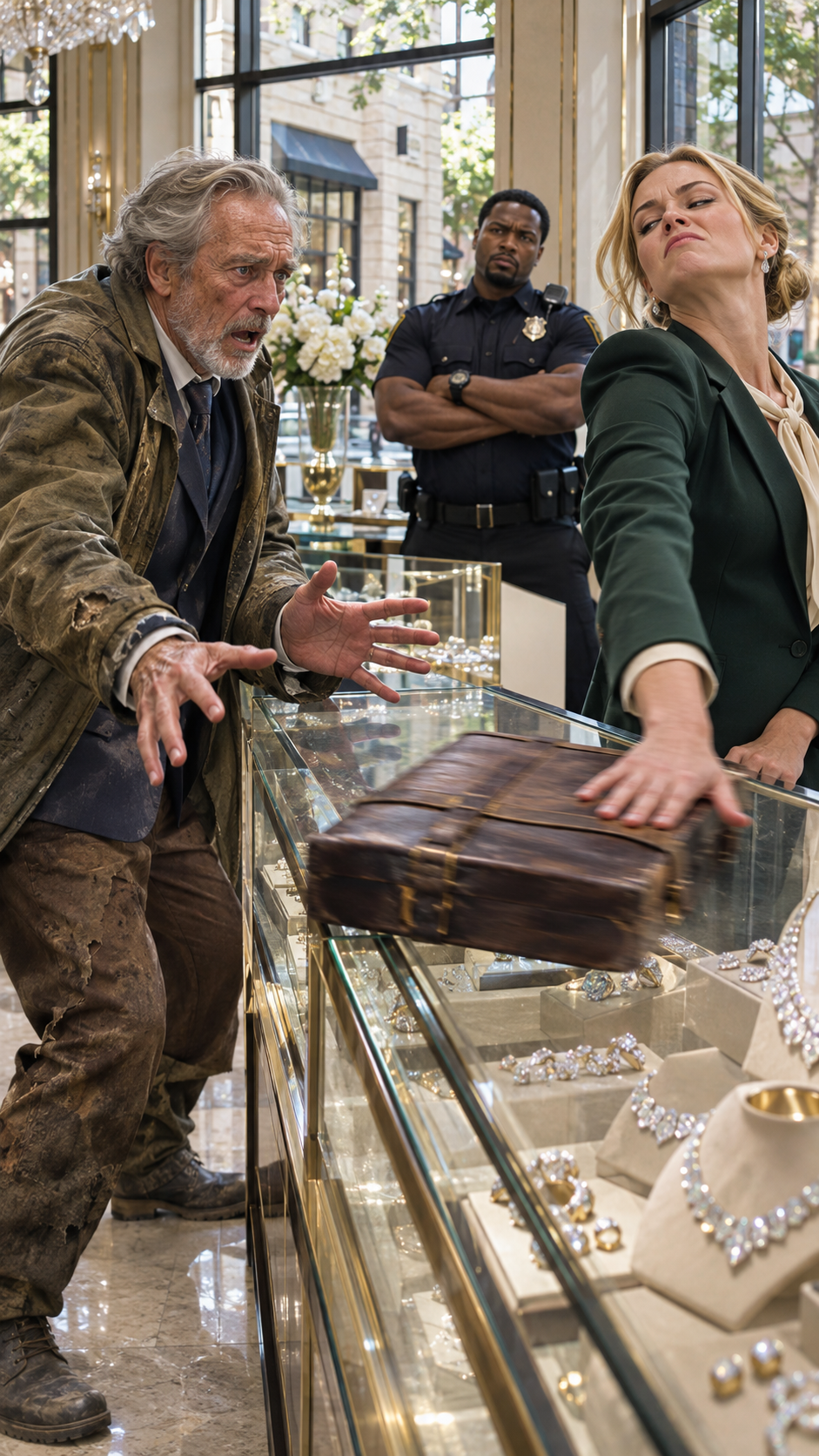
The elderly man looked at her with a mixture of surprise and disappointment. He had barely been given an opportunity to speak, yet the employee had already reached a conclusion about his financial circumstances.
“You haven’t even asked what I need,” he replied calmly.
Behind them, a security guard watched the uncomfortable exchange.
The elderly man did not respond with insults or raise his voice. Instead, he attempted to point out the obvious problem with the employee’s behavior: she knew nothing about him or his reasons for entering the boutique.
Nevertheless, she appeared unwilling to reconsider her judgment.
The expensive jewelry continued sparkling beneath the glass, but the atmosphere surrounding the counter had become increasingly uncomfortable.
What the employee did not realize was that the elderly man’s worn clothing revealed very little about his actual circumstances.
Her assumptions were about to lead her toward an embarrassing discovery.
Security Was Called Before He Could Explain Himself
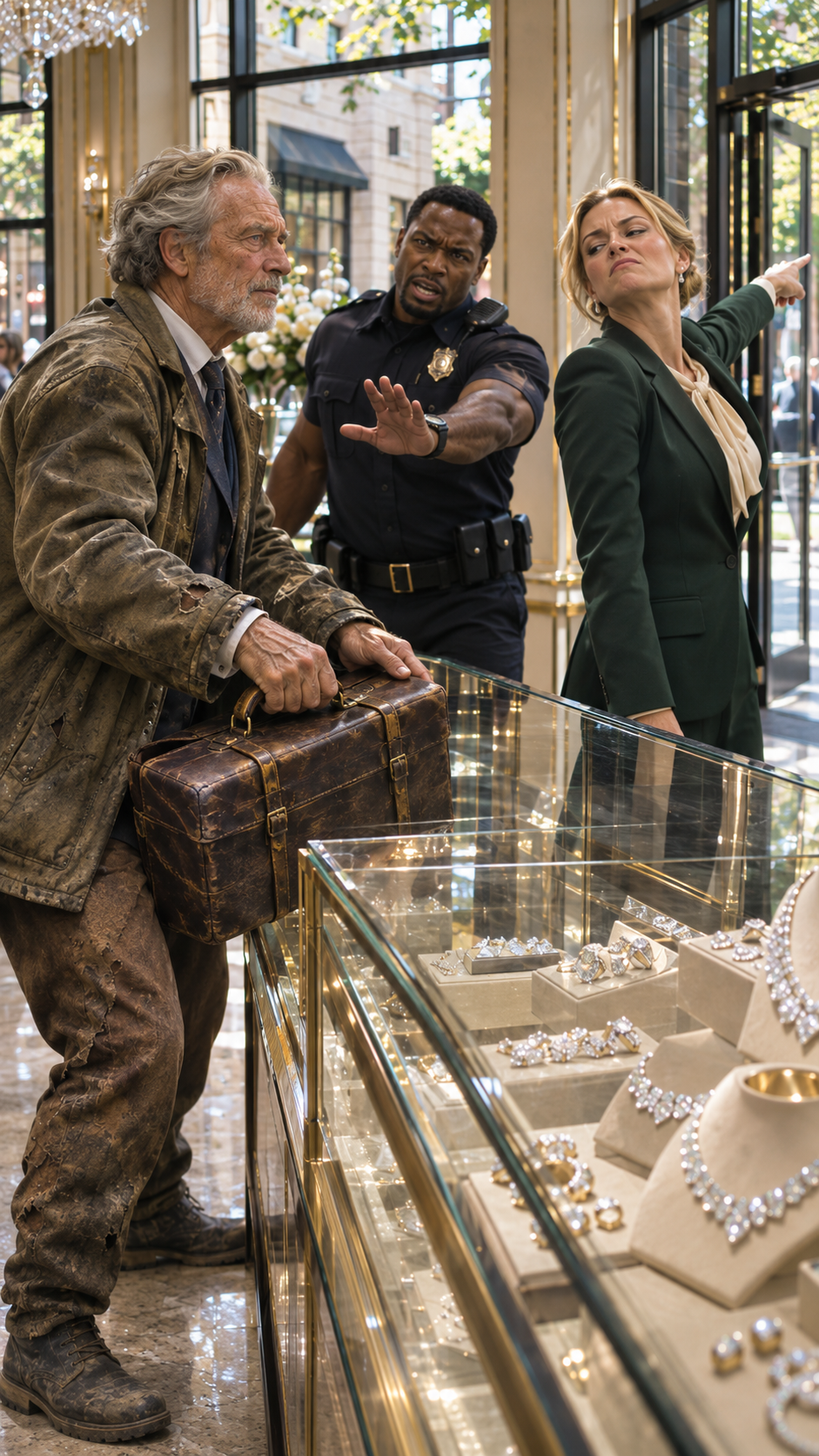
Rather than asking the elderly gentleman what he wanted to purchase or whether he needed assistance, the employee impatiently pointed toward the entrance.
“Security, please show him outside.”
The guard approached the counter and gestured toward the boutique’s exit.
The elderly man quietly retrieved his worn leather briefcase. His fingers closed around its handle as he prepared to leave the store.
Despite the humiliating treatment, he maintained his composure.
“You’re making a big mistake.”
His words were delivered without unnecessary anger. He appeared disappointed by the way he had been treated, but he made no attempt to create a larger confrontation.
The employee remained behind the glass counter, apparently convinced that removing him from the boutique was the appropriate decision.
She had not asked about his budget, the type of jewelry he was interested in, or whether he had visited the store for another purpose.
Instead, his clothing had become the basis for her entire judgment.
The security guard continued directing him toward the entrance.
The elderly gentleman could have attempted to defend his financial circumstances or explain why the employee’s assumptions were incorrect. However, he chose not to do so.
He simply carried his briefcase across the polished floor.
The employee had made her decision, and he appeared willing to let her discover its consequences independently.
As the man approached the tall glass entrance, the luxurious surroundings remained unchanged. Yet the boutique had already failed to provide something far more fundamental than an impressive selection of expensive jewelry: respectful customer service.
The elderly man stepped toward the exit, leaving the employee behind.
The Luxury Vehicle Waiting Outside
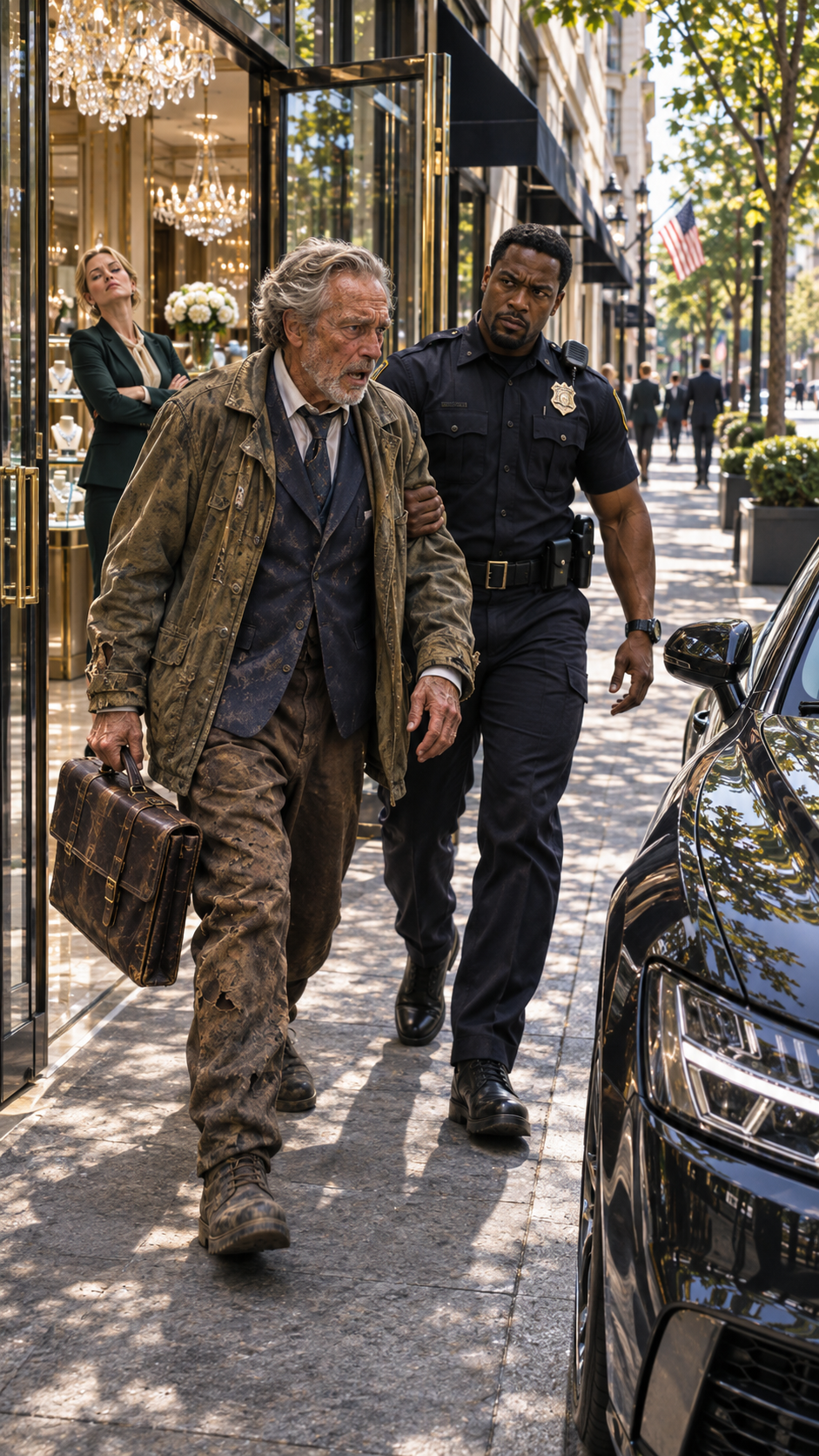
The security guard escorted the elderly man through the tall glass doors and onto the shopping street.
Passing vehicles and distant pedestrians filled the surrounding area with the familiar sounds of everyday life.
“Keep moving, sir,” the guard instructed.
“Don’t worry. I’m leaving,” the elderly gentleman replied.
He continued walking calmly along the sidewalk, carrying his dark-brown leather briefcase.
Inside the boutique, the blonde employee watched dismissively through the glass entrance.
From her perspective, the situation appeared to have been resolved. The customer she believed could not afford the store’s merchandise had been removed.
However, the elderly man’s next movements revealed something unexpected.
Instead of continuing farther down the shopping street, he approached a beautiful metallic black luxury sports sedan parked beside the sidewalk.
The vehicle’s polished exterior reflected the surrounding buildings and daylight. Its elegant appearance contrasted sharply with the man’s worn jacket and trousers.
He stopped beside the vehicle.
There was nothing uncertain about his movements. He approached the luxury sedan confidently, carrying the same briefcase the employee had pushed away only moments earlier.
The sight introduced the first indication that her assumptions might have been completely wrong.
The elderly man had not attempted to impress anyone while standing inside the boutique. He had not mentioned the expensive vehicle or used his financial circumstances to demand better treatment.
Instead, he had allowed the employee and security guard to judge him according to his outward appearance.
Now, standing beside the luxury sedan, he was about to reveal another surprising detail.
The Transformation Nobody Expected
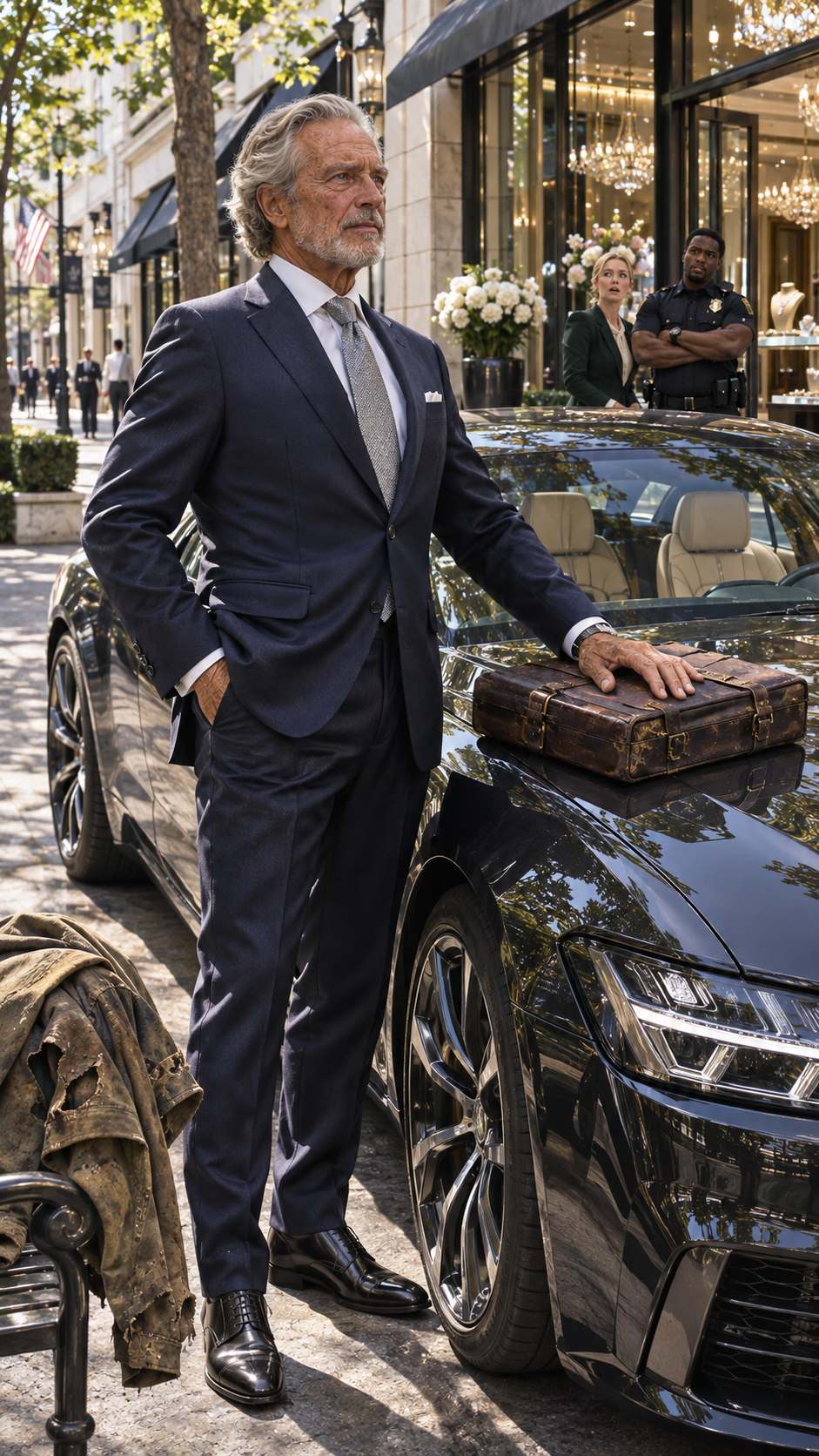
The elderly gentleman placed his worn leather briefcase on the hood of the metallic black sedan.
He then began removing his dirty olive-green jacket.
Beneath the worn outer garment was an immaculate, beautifully tailored navy-blue suit jacket. A crisp white dress shirt and elegant silver tie completed the upper portion of his sophisticated appearance.
He removed his worn outer trousers, revealing matching tailored suit pants underneath.
The transformation was remarkable.
The same elderly man who had been dismissed from the jewelry boutique now stood beside an expensive vehicle wearing an elegant business suit.
He calmly straightened his cuffs, adjusting his clothing with confidence.
“Appearances can be deceiving,” he said quietly.
His face had not changed. Neither had his age, identity, or fundamental character.
Only the clothing visible to the people around him was different.
That contrast became one of the most important elements of the story.
Inside the jewelry boutique, his worn jacket had been enough for the employee to conclude that he could not afford anything. Now, his tailored suit and luxury vehicle challenged that assumption.
The elderly man remained composed throughout the transformation. He did not appear interested in creating an argument or attracting unnecessary attention.
His actions spoke for themselves.
The worn dark-brown leather briefcase remained on the hood of the sedan, providing a connection between his earlier appearance and the elegant gentleman now standing outside.
The employee had dismissed that very briefcase when he approached the display counter.
She had no idea what was inside it.
Within moments, she would discover another reason to regret the way she had treated him.
The Contents of His Briefcase Left Them Speechless
Standing beside his luxury sedan, the elderly gentleman reached toward the worn leather briefcase.
He opened its latches and lifted the lid.
Inside were neatly arranged bundles of money.
The contents presented another striking contrast with the briefcase’s worn exterior. What the employee had treated as an unwanted object on her glass display counter contained a substantial amount of cash within the fictional story.
Meanwhile, the blonde employee and security guard stepped outside the boutique.
Their expressions changed immediately when they noticed the elderly man standing beside the expensive metallic black sedan.
The dirty jacket was gone, and the man was now dressed in an elegant navy-blue suit.
“Wait… that’s his car?” the employee asked in disbelief.
The security guard stared toward the vehicle and the elderly gentleman.
“We just turned away that man?”
Neither appeared prepared for what they were witnessing.
Only moments earlier, they had escorted the same person outside because the employee assumed he could not afford the merchandise.
Now, the expensive vehicle, tailored clothing, and contents of his briefcase contradicted her original judgment.
The elderly man calmly closed the briefcase.
The sound of its latches clicking marked the end of the unexpected revelation.
He did not count the money in front of them or announce how wealthy he was. The story does not establish his exact fortune, profession, or the amount of cash inside the briefcase.
Those details were unnecessary.
The important revelation was that the employee had made a confident judgment without knowing anything meaningful about the person standing before her.
Her behavior had potentially cost the boutique a valuable customer, but the mistake was about much more than a missed financial opportunity.
She had failed to treat another person with dignity.
Suddenly, She Wanted to Help Him
The elderly gentleman picked up his dark-brown leather briefcase and began walking toward the driver’s door of his luxury sedan.
The blonde employee hurried toward him.
Her earlier impatience had disappeared, replaced by embarrassment and an apparent desire to correct the situation.
“Sir, please! We can help you!”
The elderly man stopped and calmly turned toward her.
The contrast between her two approaches was unmistakable.
Inside the boutique, she had insisted that he could not afford anything and requested that security remove him.
Now that she had seen his expensive vehicle, elegant suit, and bundles of money, she was eager to offer assistance.
The elderly gentleman listened, but he did not return to the store.
Instead, he delivered a simple statement that captured the central message of the entire encounter.
“You should treat everyone with respect, not just the wealthy.”
His words challenged the idea that someone must demonstrate financial success before receiving basic courtesy.
He was the same person who had entered the boutique wearing worn clothing. His ability to purchase expensive merchandise should never have determined whether he deserved respectful treatment.
The employee remained on the sidewalk as the elderly gentleman prepared to leave.
There was no elaborate argument or public display of anger.
His calm response made the lesson particularly powerful.
He entered the metallic black luxury sedan, closed the driver’s door, and started the engine.
The employee and security guard watched as the vehicle began moving away.
The opportunity to provide him with a positive customer experience had passed.
The Real Mistake Was Not Losing a Wealthy Customer
At first glance, the story might appear to be about an employee discovering that someone she dismissed was actually wealthy.
The luxury sedan, tailored navy-blue suit, and briefcase filled with money provide a dramatic reversal that makes the encounter memorable.
However, focusing entirely on the man’s financial circumstances would overlook the most important part of the narrative.
The employee’s behavior would have been inappropriate even if the elderly gentleman had genuinely been unable to afford the expensive jewelry.
A person’s financial position does not determine their right to enter a business, ask questions, or receive basic courtesy.
The man could have been interested in purchasing a modest gift, asking about a particular item, arranging a repair, or simply exploring the available merchandise.
The fictional story does not reveal his original reason for visiting the boutique because the employee never gave him an opportunity to explain it.
That missing conversation is itself significant.
Instead of learning what the customer needed, she allowed an assumption about his appearance to replace professional communication.
Her mistake was therefore not simply failing to recognize someone with money.
It was failing to recognize the dignity of another human being.
Why Appearances Can Be Misleading
Clothing can communicate aspects of someone’s personal style, occupation, or immediate circumstances, but it cannot reliably reveal their complete identity.
People wear modest or worn clothing for many different reasons. Someone might have been working outdoors, traveling, completing household repairs, or simply choosing practical clothing over expensive fashion.
Others may genuinely be experiencing financial hardship.
None of those possibilities provides a justification for humiliating them.
The elderly gentleman’s transformation beside the luxury sedan illustrates how easily outward appearances can create inaccurate impressions.
His dirty olive-green jacket concealed an immaculate tailored suit, while his worn briefcase contained neatly arranged bundles of money.
However, the story’s message extends beyond the possibility that a poorly dressed person might secretly be wealthy.
Even when an initial impression about someone’s financial circumstances is accurate, treating that individual disrespectfully remains unacceptable.
Courtesy should not function as a reward reserved for people who can demonstrate purchasing power.
The elderly man’s final statement makes this distinction clear.
He does not tell the employee that she should have recognized his wealth.
He tells her that everyone deserves respect.
Professionalism Should Apply to Every Customer
Businesses often invest considerable resources in creating attractive environments, presenting their products beautifully, and maintaining a strong reputation.
The jewelry boutique in this fictional story possesses many of those qualities.
Its elegant glass counters, expensive merchandise, polished flooring, and sophisticated entrance create an impressive setting.
Yet the employee’s behavior undermines that appearance of professionalism.
Good customer service begins with listening.
An employee can ask what someone is looking for, explain available options, provide information about prices, and establish whether the business can meet the customer’s needs.
None of those ordinary interactions requires judging someone according to the condition of their clothing.
Security personnel also have an important role in maintaining safe and orderly environments. However, the elderly man in this story is not depicted threatening anyone or behaving aggressively.
He is simply attempting to explain that the employee has not asked what he needs.
The decision to remove him reinforces her premature judgment.
The fictional encounter illustrates how poor communication and unnecessary assumptions can turn an ordinary customer interaction into an embarrassing experience for everyone involved.
An elegant storefront may attract customers, but respectful treatment is essential to earning their trust.
The Power of Remaining Calm
Another meaningful aspect of the story is the elderly gentleman’s response to the humiliation.
When the employee pushes his briefcase away, he does not respond with physical aggression or insulting language.
When security approaches, he retrieves his belongings and leaves.
Even after the employee discovers his wealth and attempts to regain his attention, he remains composed.
His final words communicate disappointment without becoming unnecessarily hostile.
The story presents his calmness as a form of confidence.
He does not need to convince the employee that he is important or demand that she acknowledge his financial status.
Instead, he communicates the principle that should have guided her behavior from the beginning.
Respect should be consistent.
It should not disappear when someone wears inexpensive clothing and suddenly return when that same person is seen beside a luxury vehicle.
The elderly man’s decision to leave reinforces his message. He chooses not to reward the sudden change in attitude simply because the employee has discovered that her original assumption was incorrect.
The Lesson That Remained After He Drove Away
The metallic black sedan moved along the shopping street as the elderly gentleman departed.
Behind him, the blonde employee and security guard remained on the sidewalk, visibly embarrassed by the encounter.
The elegant jewelry boutique was still standing, and its expensive merchandise continued sparkling beneath the glass counters.
But the experience had exposed an important difference between appearing sophisticated and behaving professionally.
The elderly man had entered the store carrying a worn leather briefcase and wearing dirty outer clothing.
He left without receiving the assistance he had originally sought.
The employee’s change of attitude came only after discovering his expensive vehicle, elegant suit, and apparent wealth.
By then, her opportunity to demonstrate genuine courtesy had already passed.
The story does not reveal whether she later changed her approach to customer service. It also does not establish whether the elderly gentleman purchased jewelry somewhere else.
Instead, the final scene leaves the audience with the message he delivered before entering his car.

As the luxury sedan disappeared down the shopping street, the employee and security guard remained speechless outside the boutique. The elderly gentleman had revealed far more than the wealth hidden beneath his worn clothing. Through his calm response and powerful final words, he delivered a timeless reminder that dignity is not something people should have to purchase, prove, or earn through their financial status. Everyone deserves to be treated with respect.Disclaimer: This article and its accompanying video are fictional, AI-generated content created for entertainment and inspirational storytelling. The characters, jewelry boutique, vehicle, financial circumstances, and events depicted do not represent a verified real-life incident. The story is intended to promote dignity, equality, kindness, and respectful treatment regardless of appearance or financial status. No real individuals or businesses are depicted or accused of misconduct.