A Frightening Discovery on the Farm
Bright natural sunlight illuminated a peaceful countryside farm. White fences stretched across the green landscape, while a traditional red barn stood nearby. Birds chirped in the distance, and a gentle breeze moved across the grassy fields.
However, the peaceful atmosphere was suddenly interrupted by the sound of splashing water.
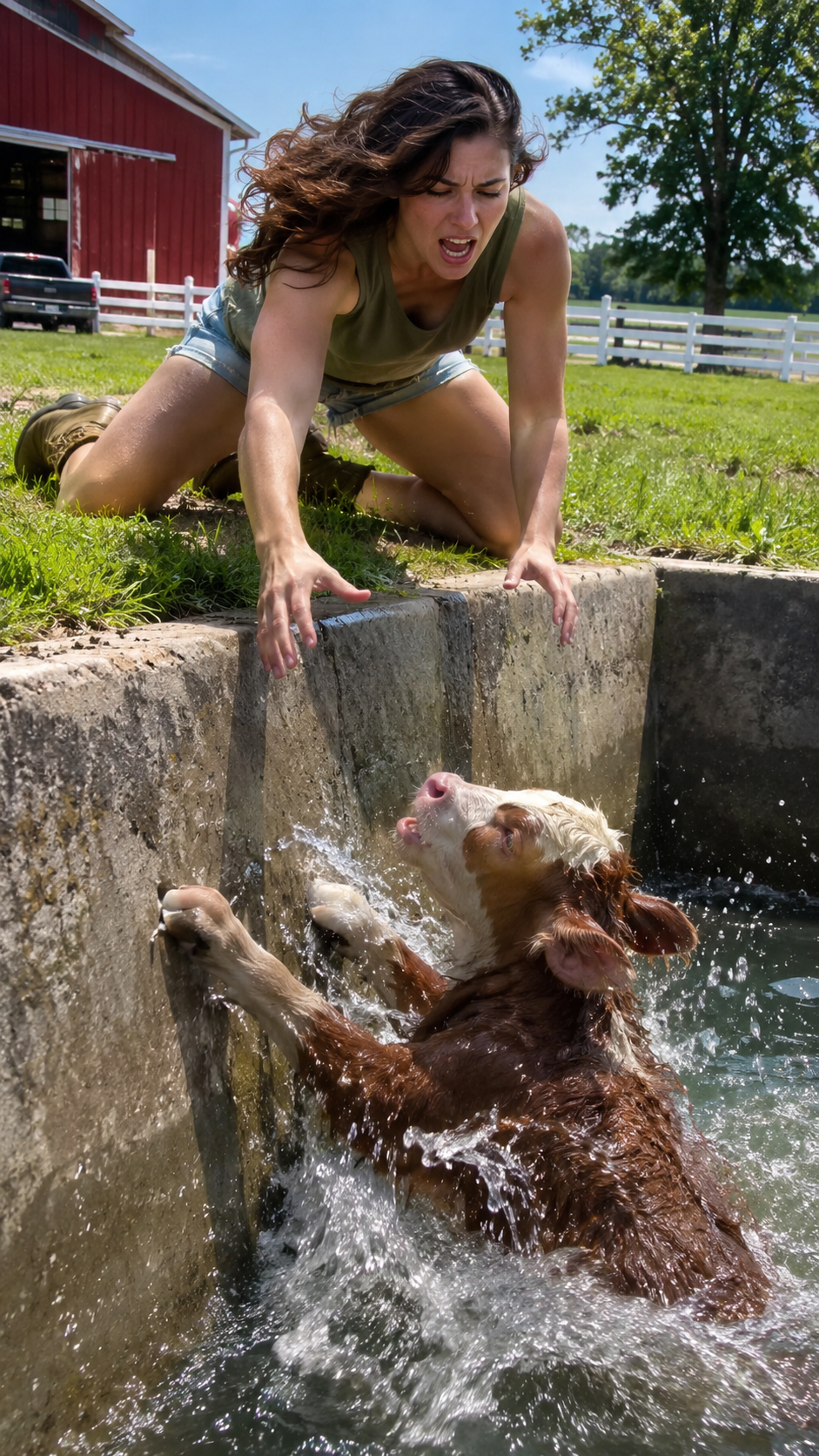
Inside a concrete livestock pond, a small brown-and-white calf was struggling desperately to escape.
The frightened animal repeatedly attempted to place its front hooves against the concrete wall, but the slippery surface prevented it from gaining sufficient traction.
Each unsuccessful attempt sent water splashing around its wet body.
An adult brunette woman wearing an olive-green sleeveless top, short blue denim shorts, and brown hiking boots stood beside the pond.
She immediately recognized that the little calf was in trouble.
“Oh my God! Hang on!”
She urgently reached toward the animal as it continued struggling against the concrete wall.
The calf raised its head above the water and released another distressed call.
Its wet brown-and-white coat reflected the bright daylight, while its small front hooves continued slipping against the concrete.
The fictional story does not establish how the calf entered the livestock pond or how long it had been trapped.
However, its repeated unsuccessful attempts to climb out made the immediate problem clear.
The concrete edge was preventing the young animal from reaching dry ground.
The woman moved closer, hoping she could provide enough support to help it escape.
What appeared to be a straightforward rescue would soon prove considerably more difficult than she expected.
She Tried Desperately to Help the Calf Climb Out
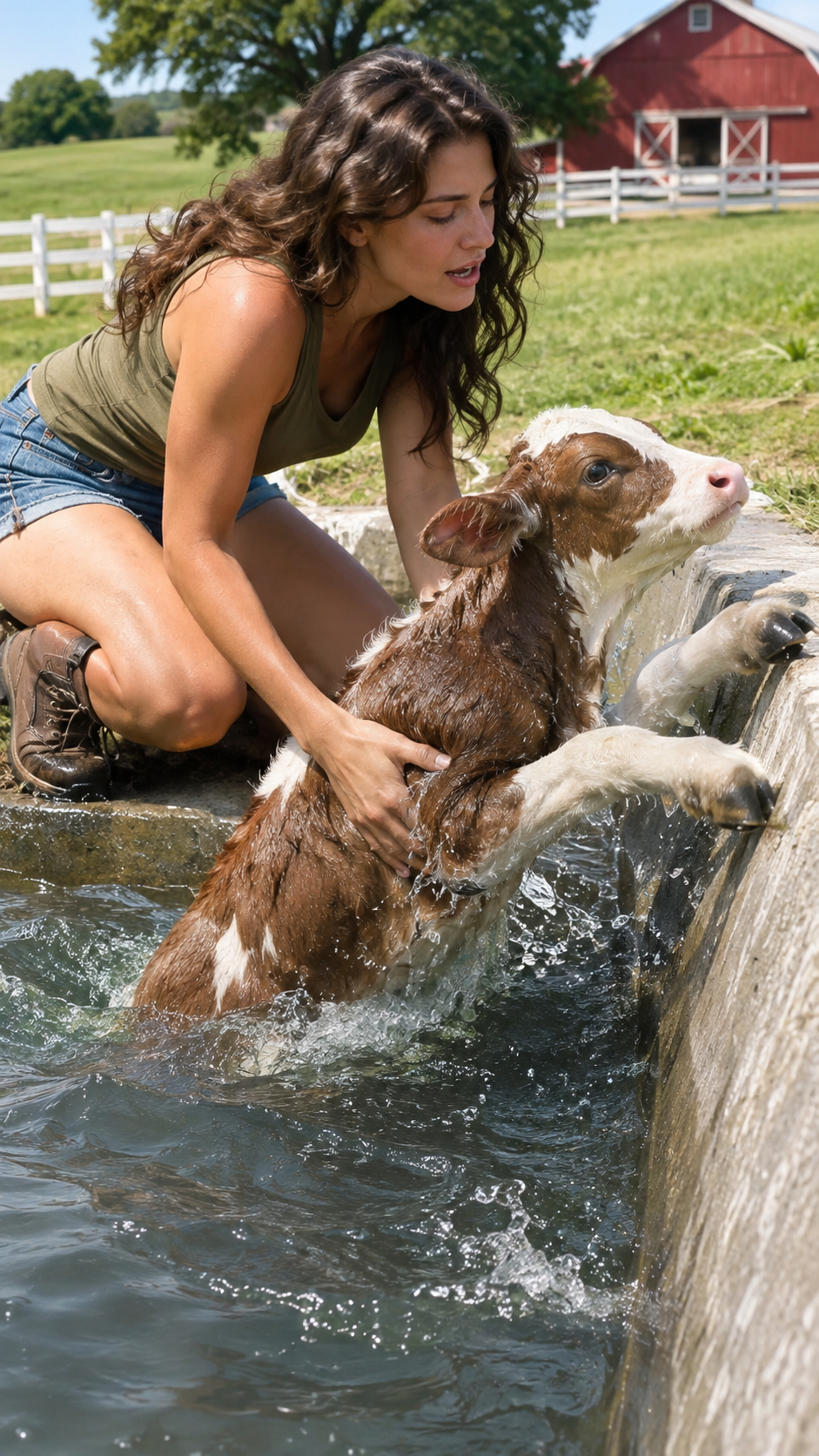
The brunette woman carefully knelt beside the concrete livestock pond.
The frightened calf remained inside the water, attempting to move its front legs toward the edge.
She reached down and gently supported the wet animal around its chest.
“Come on, buddy. You can do it!”
Her encouraging voice mixed with the sounds of splashing water and distant birds.
The calf attempted to climb upward.
For a brief moment, its front hooves appeared to gain some traction against the concrete.
The woman continued supporting its chest, hoping the animal would be able to move its body toward the grassy edge.
Unfortunately, the slippery surface presented a significant obstacle.
The calf’s front hooves gradually lost their grip.
Water splashed against the concrete as the young animal slipped back into the pond.
The woman remained kneeling beside it.
Her expression revealed growing concern as she realized that her initial efforts were not enough.
Although the calf was relatively small, supporting its wet body while it attempted to climb over a concrete wall presented a difficult physical challenge.
She could not provide the stable footing the animal needed.
The calf released another gentle call.
The woman continued reassuring it while considering what to do next.
The surrounding farm remained peaceful, but the situation beside the livestock pond was becoming increasingly urgent.
Every unsuccessful attempt required additional effort from the frightened animal.
The woman recognized that continuing alone might not resolve the problem.
She needed assistance.
More importantly, the calf needed a safer way to reach dry ground.
Her Desperate Call for Assistance
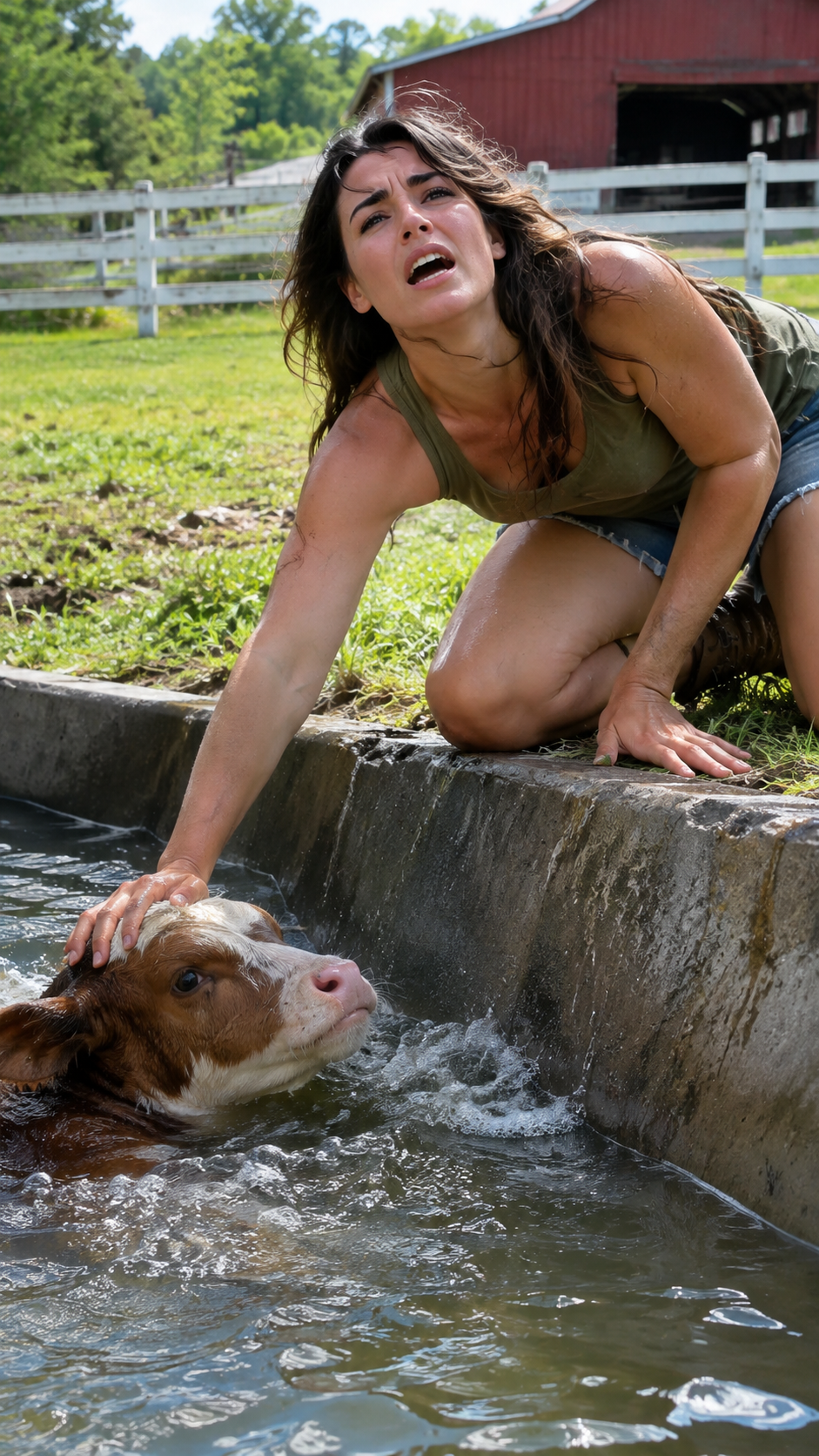
The woman remained beside the livestock pond, watching the frightened calf.
Its head stayed above the surface while the rest of its wet body remained inside the water.
She gently rested one hand on its distinctive white forehead.
The small gesture created a quiet moment amid the earlier splashing and struggling.
The woman appeared determined to remain beside the animal.
However, she understood that she could not simply lift it over the concrete edge by herself.
She turned toward the nearby red barn.
“Somebody help! I can’t get him out!”
Her urgent voice carried across the surrounding farm.
The calf remained close to the concrete wall.
Gentle water movements surrounded its body as it continued breathing and releasing occasional calls.
The woman kept her attention on the animal while looking toward the barn.
She had already attempted to support its chest and encourage it to climb.
Despite her efforts, the calf had been unable to escape.
The fictional encounter highlights an important moment of recognition.
Sometimes helping an animal requires acknowledging that a situation is beyond one person’s abilities.
Rather than continuing an unsuccessful approach, the woman called for assistance.
Her decision created the opportunity for someone with additional experience and equipment to become involved.
The red barn stood nearby, surrounded by the familiar white fences and green countryside.
The woman waited beside the pond, continuing to reassure the calf.
Then a gray-bearded farmer arrived.
He wore a beige baseball cap, a blue plaid shirt, dark jeans, and brown work boots.
He brought something that could potentially change the entire situation.
A wide wooden plank.
The Farmer Arrived With a Different Approach
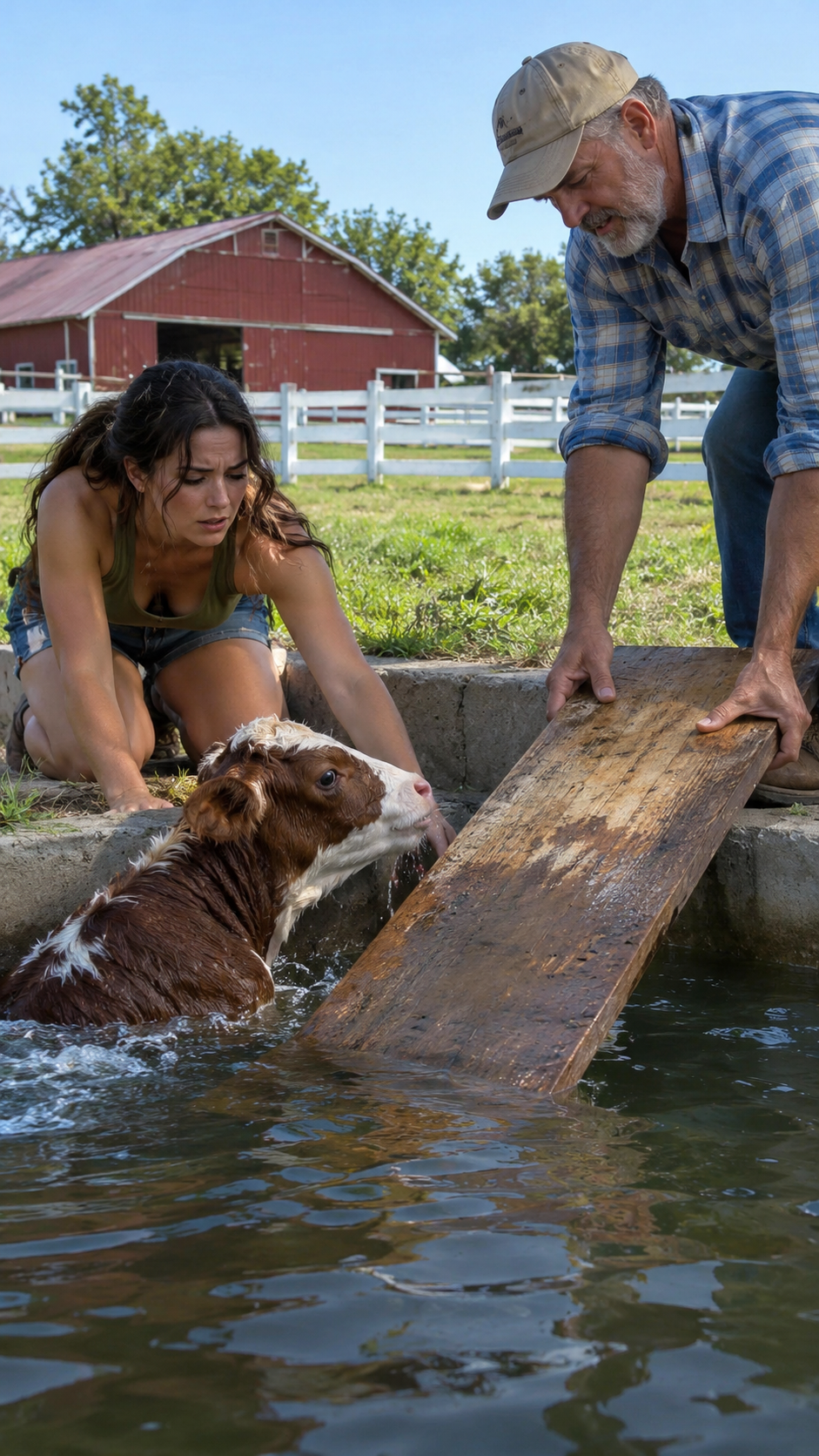
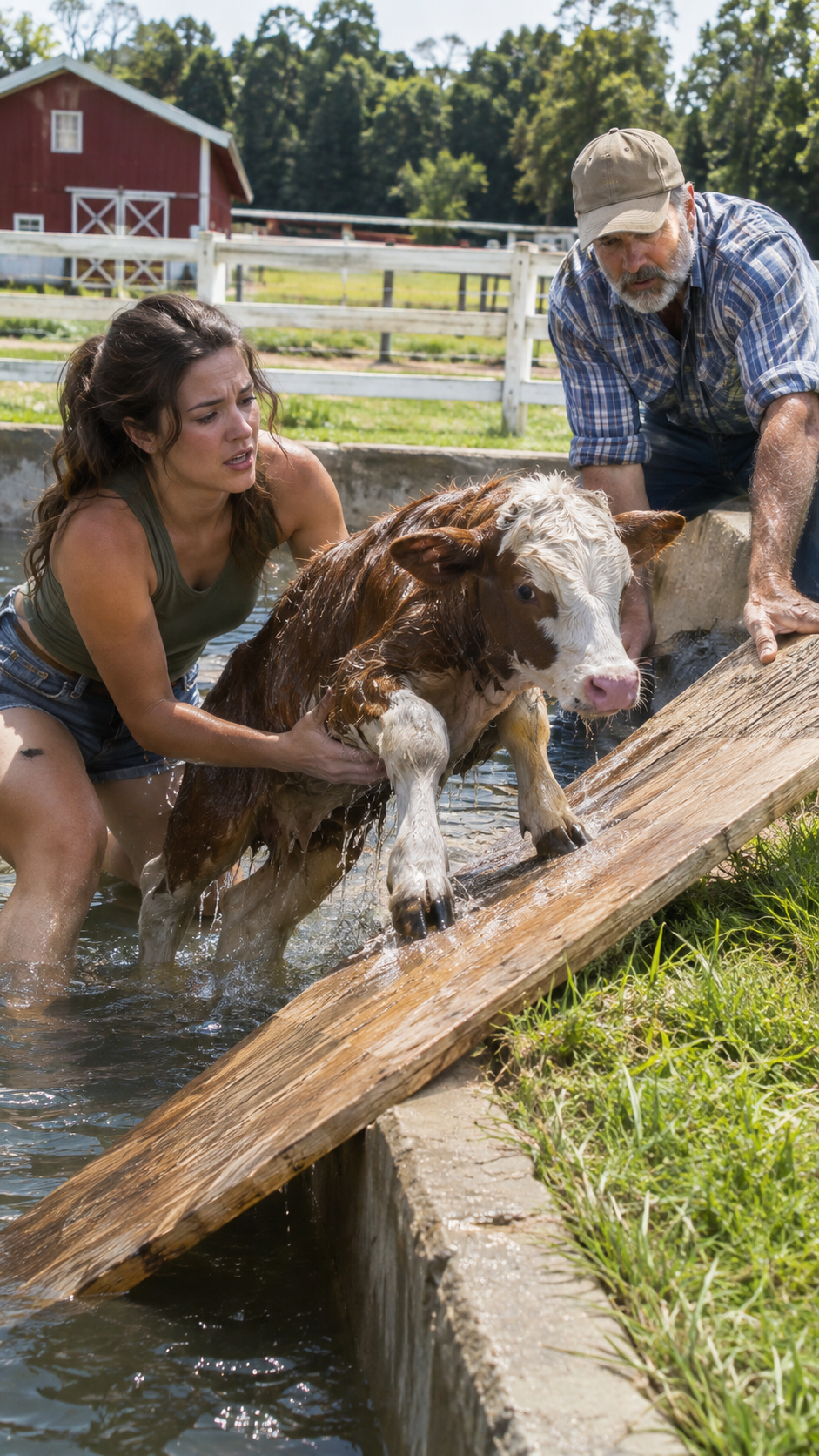
The gray-bearded farmer approached the concrete livestock pond carrying the wide wooden plank.
The woman remained kneeling beside the frightened brown-and-white calf.
Rather than attempting to lift the animal directly over the concrete wall, the farmer began positioning the plank as a ramp.
“Easy now. Let’s get him out.”
He carefully lowered the wooden plank into the livestock pond.
The sound of wood scraping against concrete interrupted the gentle countryside ambience.
The calf watched the unfamiliar object as it entered the water.
The woman continued supporting and reassuring the animal.
“Come on, little guy!”
Within the fictional rescue, the farmer positioned the plank securely against the concrete edge.
The wide wooden surface provided an alternative route toward dry ground.
Instead of relying entirely on the woman’s ability to support its weight, the calf would now have an opportunity to climb using its own legs.
The farmer remained beside the plank, ensuring that it stayed stable within the dramatized sequence.
The woman gently guided the frightened animal toward the wooden ramp.
The calf moved closer.
Water splashed softly around its legs as it approached the lower section of the plank.
The two rescuers concentrated on the animal’s movements.
Neither appeared interested in rushing the process.
The farmer’s arrival had introduced a different solution to the problem that had prevented the calf from escaping.
However, the little animal still needed to climb the ramp successfully.
The woman watched carefully as the calf prepared to place its hooves onto the wooden surface.
The next few moments would determine whether their combined efforts could finally bring it to safety.
Every Step Brought the Calf Closer to Freedom
The brown-and-white calf cautiously placed its front hooves onto the wooden plank.
Water dripped naturally from its wet fur.
The woman remained close, carefully supporting the animal as it began moving upward.
The gray-bearded farmer steadied the wooden ramp and gently guided the calf toward the grassy edge.
“That’s it, buddy. Keep going!”
The little animal took another slow step.
Its hooves produced a gentle sound against the wooden surface.
Unlike its earlier attempts against the concrete wall, the calf was now making visible progress.
The woman watched with growing relief.
“He’s almost out!”
The farmer continued monitoring the ramp while the calf moved toward the top.
Water dripped from its brown-and-white coat and returned to the pond below.
The frightened animal appeared increasingly capable of supporting itself as it approached dry ground.
The fictional rescue emphasizes the cooperation between the two adults.
The woman provided gentle support while the farmer maintained the stability of the ramp.
Their combined efforts allowed the calf to continue climbing without relying on a direct lift over the concrete wall.
Another careful step brought the animal closer to the grassy edge.
The sounds of splashing water gradually gave way to the sound of hooves moving across wood.
What had seemed impossible when the woman first attempted to help was now becoming achievable.
The calf was finally approaching freedom.
The two rescuers remained focused until the animal reached dry ground.
After the frightening struggle inside the concrete pond, the little calf could finally move beyond the obstacle that had trapped it.
But the most heartwarming moment of the fictional rescue was still to come.
Why Livestock Ponds Can Present Unexpected Dangers
Although the events in this story are fictional, livestock water facilities can present genuine safety concerns for farm animals.
Concrete ponds, watering tanks, troughs, and other water structures serve important agricultural purposes.
They provide animals with access to water and contribute to the daily operation of farms.
However, certain designs may create difficulties if an animal accidentally enters a structure that it cannot easily escape.
Young livestock may be particularly vulnerable because of their smaller size, developing coordination, and limited physical strength.
A steep or slippery concrete surface can prevent an animal from gaining sufficient traction.
Repeated attempts to climb may also lead to exhaustion.
The fictional calf in this story experiences exactly this type of difficulty.
Its front hooves repeatedly slide against the concrete wall, preventing it from reaching the grassy edge.
The woman’s initial efforts demonstrate how challenging such a situation can become without appropriate assistance.
Farm operators can help reduce potential hazards by regularly inspecting livestock water facilities and considering the needs of younger animals.
Appropriate barriers, suitable access arrangements, and professionally designed escape features may help prevent dangerous situations.
The specific requirements depend on the facility, animal species, and surrounding conditions.
Consulting agricultural safety professionals or experienced livestock specialists can help identify suitable preventive measures.
The fictional rescue serves as a reminder that familiar farm structures deserve regular attention and responsible maintenance.
The Vulnerability of Young Calves
Young calves require appropriate nutrition, shelter, supervision, and protection as they develop.
Their physical abilities differ from those of mature cattle.
While adult animals may possess greater strength and coordination, younger livestock can encounter difficulties navigating unfamiliar obstacles.
Water-related emergencies may create additional challenges.
An animal that repeatedly attempts to escape from a slippery structure can become tired, frightened, or physically stressed.
Even after reaching dry ground, it may require further assessment.
The brown-and-white calf in the fictional video appears frightened during its initial struggle.
Its wet fur, repeated calls, and unsuccessful attempts to climb communicate the seriousness of the situation.
However, the narrative does not establish the animal’s exact age, physical condition, or medical history.
It also does not confirm whether the calf experienced injuries or other complications during its time inside the pond.
These details would require appropriate veterinary evaluation in a real emergency.
The story focuses on the immediate challenge of helping the calf regain access to dry ground.
Its broader message encourages viewers to recognize the importance of protecting young livestock from preventable environmental hazards.
Regular supervision and suitable farm infrastructure can contribute to the safety and welfare of vulnerable animals.
Recognizing When Additional Help Is Necessary
One of the most meaningful moments in the fictional story occurs when the woman realizes that she cannot rescue the calf alone.
Her initial response is motivated by concern.
She immediately approaches the pond and attempts to support the frightened animal.
However, the calf’s hooves continue slipping against the concrete wall.
Despite her determination, she cannot provide everything the animal needs to escape.
Instead of ignoring that difficulty, she calls toward the nearby barn.
“Somebody help! I can’t get him out!”
This moment illustrates an important principle that extends beyond animal rescue.
Recognizing personal limitations can be essential when responding to an emergency.
Attempting to manage a difficult situation without appropriate equipment, experience, or assistance can create additional risks.
Livestock rescue situations may involve unpredictable animal movements, slippery surfaces, heavy equipment, and challenging environmental conditions.
Qualified responders can assess these factors and determine appropriate methods of assistance.
The fictional woman’s decision to request help allows another person to become involved.
The farmer introduces a different approach that changes the direction of the rescue.
Their cooperation becomes the central element of the story.
The narrative celebrates compassion while also demonstrating that effective assistance sometimes requires more than determination alone.
Knowing when to seek help can be just as important as the initial willingness to act.
How Teamwork Changed the Outcome
The woman and farmer perform different roles during the fictional rescue.
The woman remains close to the frightened calf, offering reassurance and gentle support.
The farmer introduces the wooden ramp and maintains its stability during the dramatized sequence.
Together, they address the problem that had prevented the animal from escaping.
The contrast between the initial unsuccessful attempt and their later cooperation gives the story much of its emotional strength.
At first, the woman attempts to help without assistance.
The calf struggles against the concrete wall and repeatedly loses its footing.
After the farmer arrives, the situation changes.
The wooden plank creates an alternative route toward the grassy edge.
The animal begins making gradual progress.
Neither rescuer is presented as accomplishing the entire task independently.
Their combined efforts contribute to the positive fictional outcome.
In real agricultural emergencies, effective teamwork may involve livestock owners, veterinarians, trained animal rescue personnel, and other qualified professionals.
Communication and appropriate planning can help reduce unnecessary risks to both people and animals.
The video compresses the entire rescue into a short cinematic sequence.
It should not be interpreted as a complete demonstration of real livestock rescue procedures.
Nevertheless, its intended message about cooperation remains valuable.
When people combine their knowledge, resources, and willingness to help, they may be better prepared to address difficult situations responsibly.
Why Calm Behavior Matters Around Frightened Livestock
Animals experiencing fear or physical distress may react unpredictably.
Their movements can become sudden, particularly when they feel trapped or threatened.
Even relatively young livestock can unintentionally injure people attempting to assist them.
The fictional rescue presents the woman and farmer speaking gently throughout their interaction with the calf.
Their reassuring words create an emotional contrast with the frightening sounds of splashing water at the beginning.
The woman encourages the calf during its initial attempts to climb.
Later, the farmer offers similar encouragement as the animal approaches the wooden ramp.
These moments contribute to the compassionate atmosphere of the narrative.
However, calm speech alone cannot guarantee that a distressed animal will respond safely.
Real livestock emergencies require careful assessment of the animal’s behavior, physical condition, and surrounding environment.
People should avoid placing themselves in positions where sudden animal movements could cause injury.
Appropriate equipment and professional assistance may be necessary.
The fictional sequence uses controlled movements to communicate patience and reassurance.
Its broader message is that helping frightened animals requires consideration of their welfare as well as the safety of the people involved.
Compassion is most effective when accompanied by responsible judgment.
Creating Safer Environments for Farm Animals
The countryside setting in this fictional story contains familiar agricultural features.
White fences surround the grassy areas, a red barn stands nearby, and a concrete livestock pond provides access to water.
These ordinary surroundings make the emergency particularly relatable.
The danger does not arise from an extraordinary natural disaster or an unfamiliar environment.
It develops around a structure that forms part of the farm itself.
This highlights the importance of identifying potential hazards within everyday agricultural spaces.
Regular inspections can help reveal damaged fencing, unstable surfaces, unsafe openings, and other conditions that may affect animal welfare.
Water facilities deserve particular attention because their design and maintenance can influence how animals interact with them.
Young livestock may require additional protection depending on their size and development.
Preventive measures should be appropriate for the animals and the specific farm environment.
Agricultural professionals can provide guidance on suitable infrastructure and management practices.
The fictional rescue reminds viewers that protecting animals involves more than responding after an emergency occurs.
Prevention, supervision, and responsible maintenance are equally important.
Small improvements to familiar surroundings may help reduce the likelihood of dangerous situations developing in the first place.
What Happens After a Calf Is Rescued From Water?
Reaching dry ground is an important milestone, but it may not represent the end of a real animal rescue.
Livestock that have been trapped in water can experience exhaustion, physical injuries, temperature-related problems, or other medical complications.
The appropriate response depends on the animal’s condition and the circumstances of the incident.
Veterinary professionals can assess whether further examination, monitoring, or treatment is necessary.
An animal appearing calm after a rescue does not automatically establish that it is completely healthy.
The fictional story depicts the brown-and-white calf successfully climbing the wooden ramp and reaching the grassy area beside the pond.
It does not show a veterinary examination or establish the animal’s long-term medical condition.
Those details remain outside the scope of the narrative.
The immediate focus is the successful removal of the calf from the concrete livestock pond.
The woman and farmer are shown remaining nearby after their combined efforts.
The emotional conclusion celebrates the relief associated with resolving the immediate danger.
In real circumstances, however, appropriate follow-up care remains an essential consideration.
Responsible animal welfare involves protecting the animal throughout the rescue and ensuring that any additional needs receive suitable attention afterward.
The Beautiful Meaning Behind Their Extraordinary Teamwork
The fictional story begins with a frightened calf struggling inside a concrete livestock pond.
Its attempts to climb the slippery wall repeatedly fail.
The brunette woman immediately notices its distress and tries to help.
When she realizes that her efforts alone are insufficient, she calls for assistance.
The gray-bearded farmer arrives with a wooden plank, introducing an alternative route toward dry ground.
Their cooperation allows the little animal to make gradual progress.
Each successful step represents a transition away from the frightening circumstances shown at the beginning.
The narrative’s emotional appeal comes from this transformation.
An apparently helpless situation becomes manageable when two people work together.
The woman demonstrates compassion by refusing to ignore the calf’s distress.
The farmer contributes a practical solution within the fictional sequence.
Their actions illustrate how concern and cooperation can complement one another.
The story does not require dramatic celebrations or extraordinary rewards.
Its central achievement is simply helping a vulnerable animal regain access to safety.
That uncomplicated message gives the encounter its inspirational character.
Sometimes the most meaningful moments arise when people recognize a problem, offer assistance, and cooperate toward a positive outcome.
A Peaceful Moment After the Frightening Rescue
Bright sunlight continued illuminating the countryside.
The red barn stood in the background, surrounded by white fences and green grass.
The wooden plank remained positioned beside the concrete livestock pond.
The frightening sounds that had interrupted the peaceful farm earlier were gone.
Birdsong and the gentle countryside breeze once again filled the surroundings.
The brunette woman remained close to the rescued calf.
Her olive-green sleeveless top, blue denim shorts, and brown hiking boots were unchanged.
The gray-bearded farmer stood nearby in his beige baseball cap, blue plaid shirt, dark jeans, and brown work boots.
Their combined efforts had brought the fictional rescue to its final moments.
After witnessing the calf struggle repeatedly against the concrete wall, both could finally experience a sense of relief.
The little brown-and-white animal was no longer inside the water.
The woman looked toward it with a warm smile.
The farmer watched quietly.
Their final interaction would capture the simple but powerful meaning behind everything that had happened beside the livestock pond.
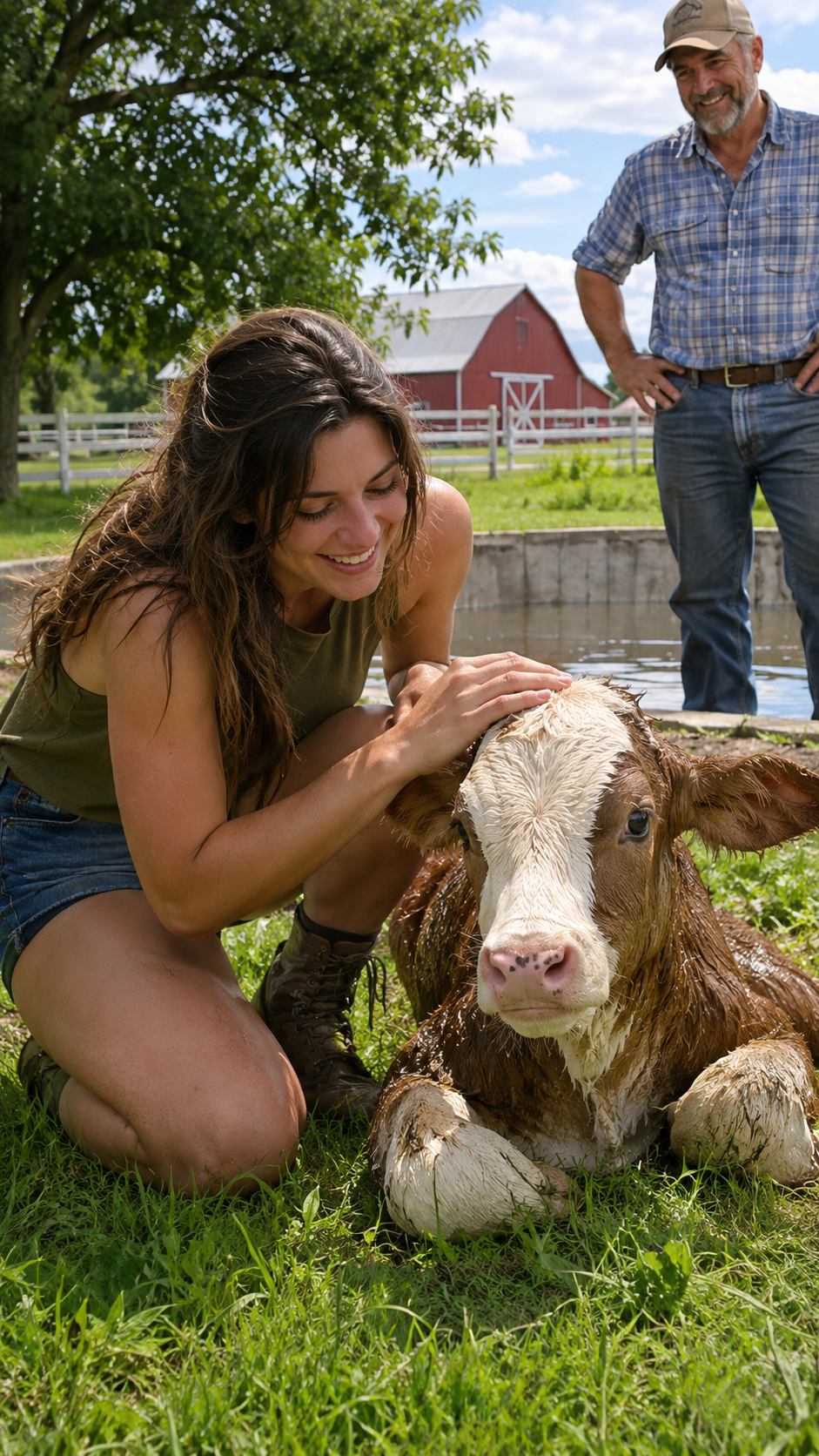
The rescued brown-and-white calf rested peacefully on the green grass as the woman knelt beside it and gently stroked its white forehead. “You’re safe now, little guy,” she said with a relieved smile. Standing nearby, the gray-bearded farmer smiled warmly and replied, “We did it.” With the red barn, white fences, and wooden ramp visible behind them, the fictional rescue ended with a beautiful reminder that compassion, patience, and teamwork can make an extraordinary difference in the life of a vulnerable animal.