The Moment Her Ordinary Day Fell Apart
Bright sunlight illuminated a quiet suburban shopping street lined with red-brick commercial buildings. Birds sang in the nearby trees, pedestrians walked along the sidewalk, and vehicles passed steadily along the road.
Among the familiar sights was an elderly woman named Margaret, pushing her faded yellow ice cream cart.
Wearing a burgundy shirt, beige apron, dark gray pants, and brown shoes, Margaret carefully guided the old cart along the pavement.
Its worn exterior reflected years of use. The metal advertising panel was damaged, and its wheels squeaked as they rolled across the sidewalk.
For Margaret, however, the cart represented something much more important than its appearance.
It was her livelihood.
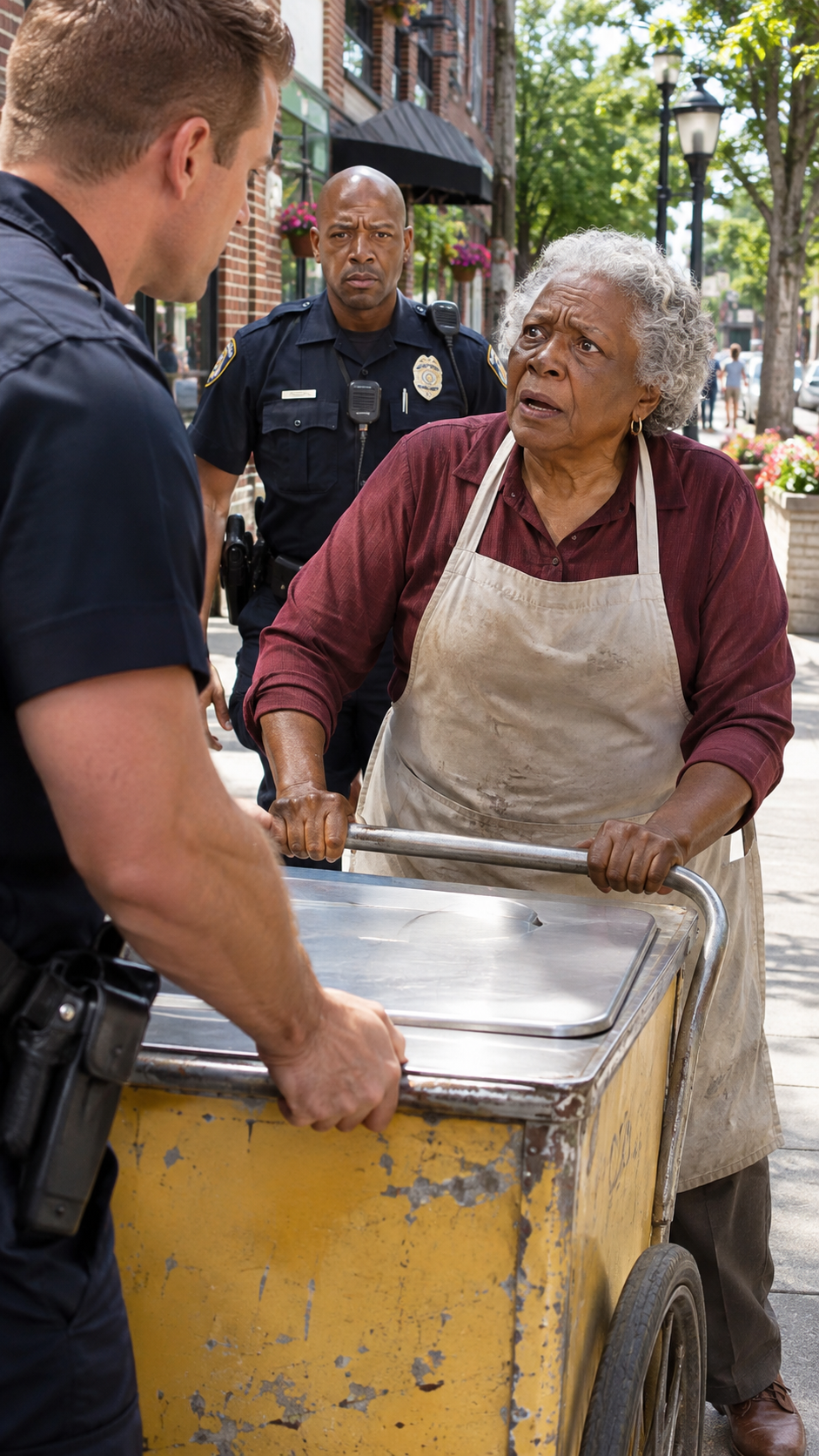
Suddenly, a uniformed police officer reached forward and grabbed its metal handle.
The cart stopped abruptly, causing its metal lid to rattle loudly.
Margaret tightened her grip on the opposite handle and looked up in shock.
Standing directly in front of her was Officer Daniel, while another uniformed officer, Marcus, approached from behind.
“Ma’am, we need to take this cart,” Daniel said.
Margaret stared at him in disbelief.
“What? Please, this is all I have!”
Her expression immediately changed from confusion to fear.
She could not understand why the officers wanted to take away the cart she depended on.
Neither officer immediately explained the reason behind their decision.
Margaret continued holding the metal handle, hoping that somehow she could persuade them to reconsider.
What she did not know was that the two officers had something entirely unexpected waiting for her.
But before she discovered their intentions, she would experience several deeply emotional moments.
She Begged Them Not to Take Away Her Livelihood
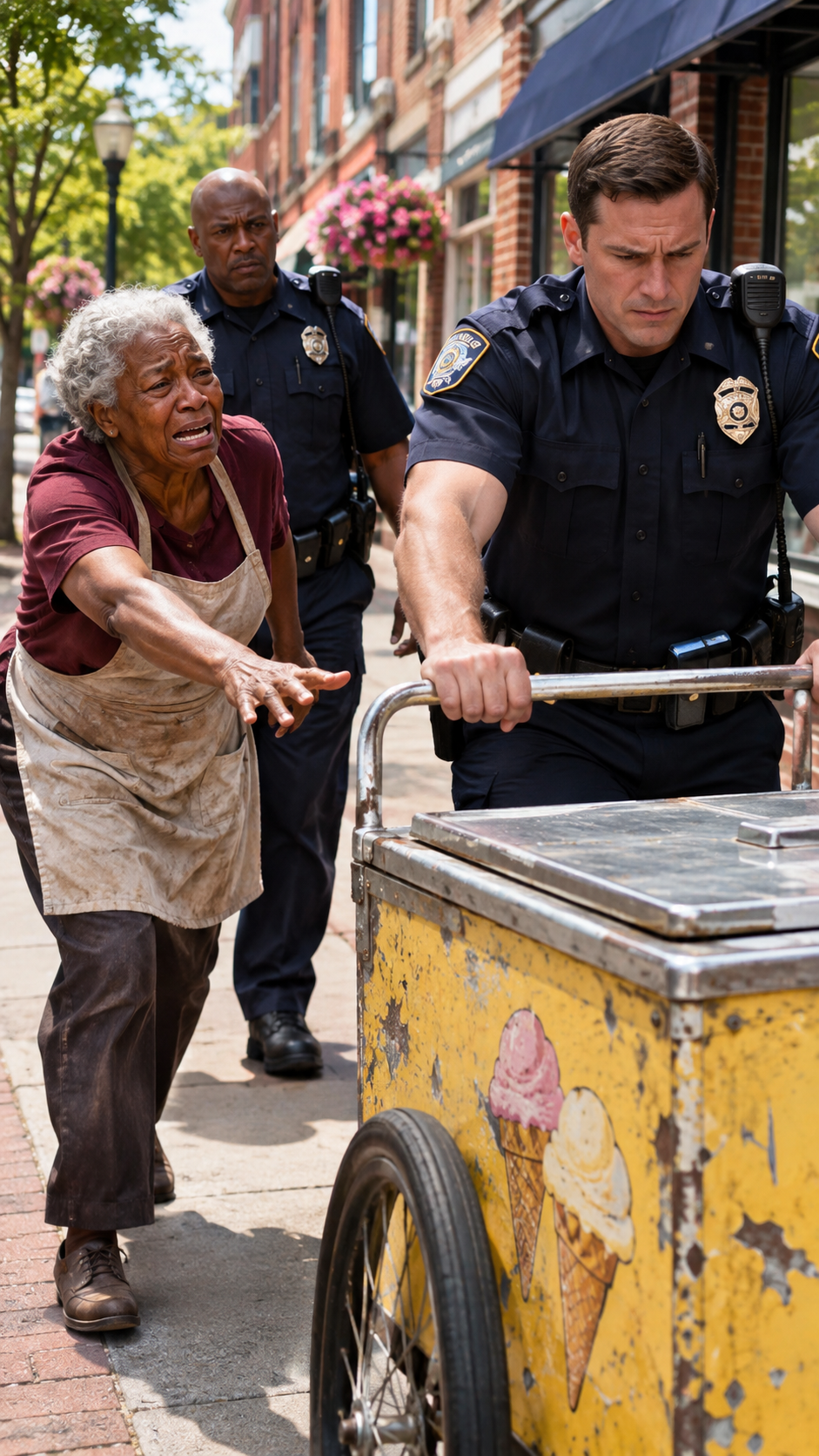
Officer Daniel slowly began pushing the faded yellow cart along the sidewalk.
Margaret desperately attempted to remain beside it, extending her hands toward the familiar metal handle.
Officer Marcus walked alongside her with a serious but calm expression.
The cart’s wheels continued squeaking as it moved farther away from its usual surroundings.
Margaret’s eyes began filling with tears.
“Please, how am I supposed to make a living?”
Her question revealed the fear behind her reaction.
The old ice cream cart was not simply an object she could easily replace.
It was connected to her daily work and her ability to support herself.
The thought of losing it without knowing what would happen next was overwhelming.
Officer Marcus looked toward her.
“Ma’am, please come with us.”
Margaret continued following the officers.
She watched Daniel push the cart along the sidewalk while struggling to understand why this was happening.
The surrounding street remained bright and peaceful, creating a striking contrast with her growing distress.
People continued going about their day, unaware of the extraordinary surprise that would eventually unfold.
Margaret had spent years working with the old cart.
Its faded yellow paint and damaged advertising panel might have appeared insignificant to someone unfamiliar with its history.
To her, however, every worn surface represented countless days of work.
She had become accustomed to pushing it along sidewalks, serving customers, and earning a living through her own efforts.
Now, without any clear explanation, that familiar part of her life appeared to be slipping away.
The officers continued toward the area behind the nearby commercial buildings.
Margaret followed them, still hoping that they might change their minds.
Twenty Years of Memories Seemed to Disappear
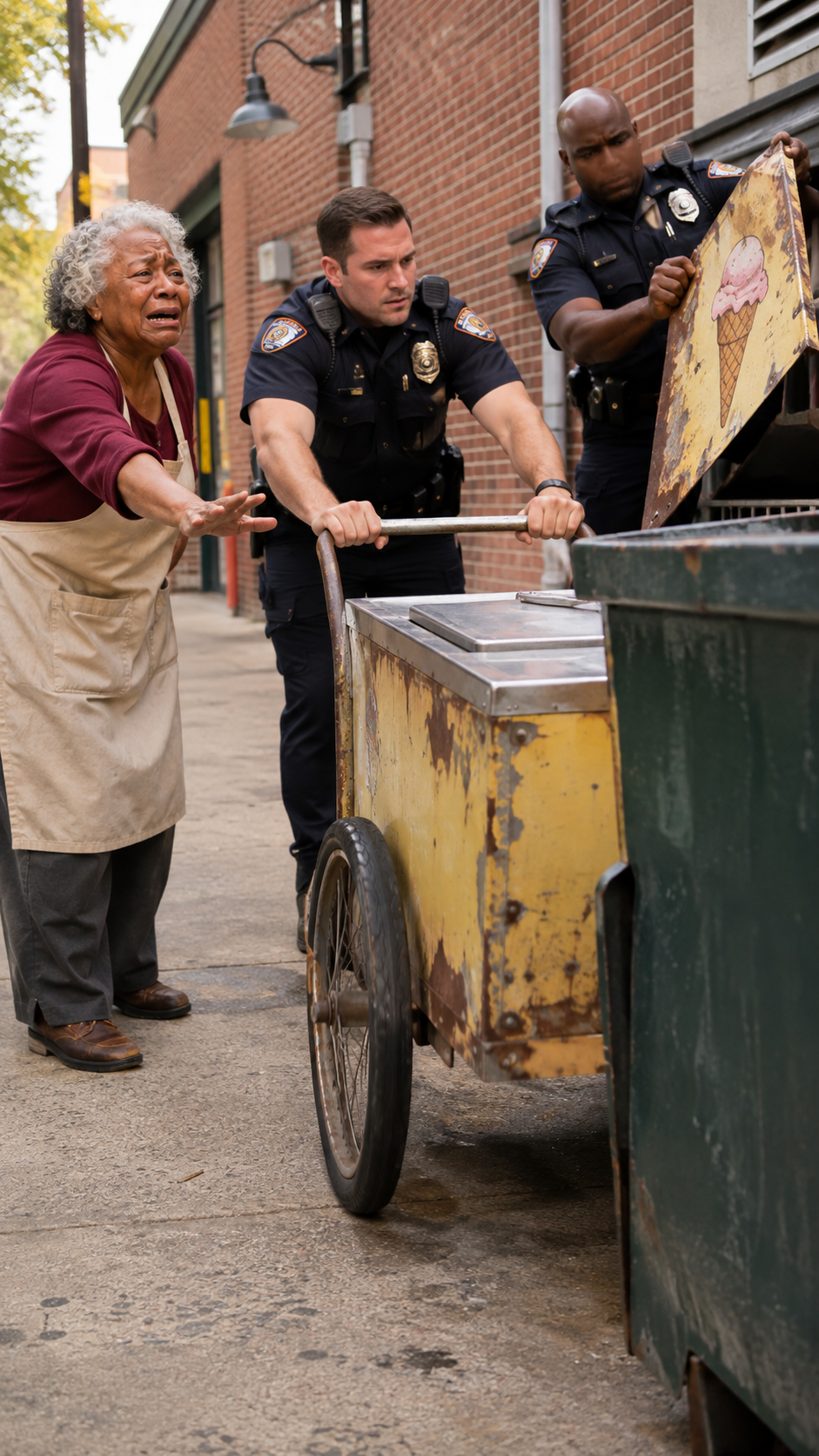
Behind the red-brick buildings stood a large dark-green commercial dumpster.
Officer Daniel pushed the worn yellow ice cream cart toward it.
Margaret watched anxiously as Officer Marcus began removing the damaged metal advertising panel from the cart.
The old panel made a loud metallic sound as he placed it inside the dumpster.
Margaret slowly reached toward the cart one last time.
Then she lowered her head.
Tears began running down her cheeks.
“I’ve worked with that cart for twenty years.”
Her words revealed the extraordinary length of time she had depended on it.
Two decades of work had connected Margaret to the little yellow cart.
It had become part of her daily routine and a symbol of her determination to continue earning a living.
The thought of leaving it behind was deeply painful.
Officer Marcus noticed her emotional reaction.
He gently placed his hand on her shoulder.
“Trust us, Margaret.”
His reassuring words suggested that there was more to the situation than she understood.
However, Margaret still had no idea what the officers were planning.
She looked toward the old cart and the dumpster, trying to process what was happening.
The fictional sequence shows the damaged advertising panel being discarded while the cart is brought beside the dumpster. It does not establish whether the entire cart is subsequently destroyed or thrown away.
For Margaret, the immediate emotional impact was nevertheless clear.
She believed she was losing something that had supported her for twenty years.
The officers remained beside her as she struggled with the uncertainty of what would happen next.
Their next destination would take her away from the familiar sidewalk and toward something she could never have imagined.
The Officers Asked Her to Get Inside Their Vehicle
A black-and-white police SUV was parked along a nearby tree-lined street.
Officer Marcus gently held Margaret’s hand as he helped her approach the open rear passenger door.
Officer Daniel waited beside the vehicle.
Margaret wiped tears from her face.
She was still wearing the same burgundy shirt and beige apron, the familiar clothing she had worn while working with her ice cream cart.
Her expression reflected worry and confusion.
The officers had taken her away from the cart, and now they were asking her to enter their vehicle.
“Where are you taking me?” she asked.
Officer Marcus responded calmly.
“There’s something you need to see.”
Margaret carefully entered the rear passenger seat.
The vehicle door closed, and the engine started.
Moments later, the police SUV began moving along the street.
Margaret still did not know where they were going.
She had no information about what awaited her at their destination.
The familiar surroundings gradually passed outside the vehicle windows.
For someone who had just experienced the apparent loss of her livelihood, the uncertainty made the journey particularly emotional.
The officers’ reassuring words suggested that their intentions were not what she initially feared.
Nevertheless, they had not yet revealed the purpose of the encounter.
Within the fictional narrative, the journey created a transition between Margaret’s earlier distress and the extraordinary surprise that was about to unfold.
The police SUV continued along the suburban street.
Somewhere ahead stood a place that looked completely different from the worn yellow cart she had pushed for so many years.
Margaret was about to discover why the officers had brought her there.
A Beautiful Storefront Was Waiting for Her
The officers accompanied Margaret toward a newly renovated ice cream shop.
Its pastel-green storefront immediately stood out from the surrounding buildings.
A cream-colored striped awning extended above the large glass windows, while decorative flowers added color around the entrance.
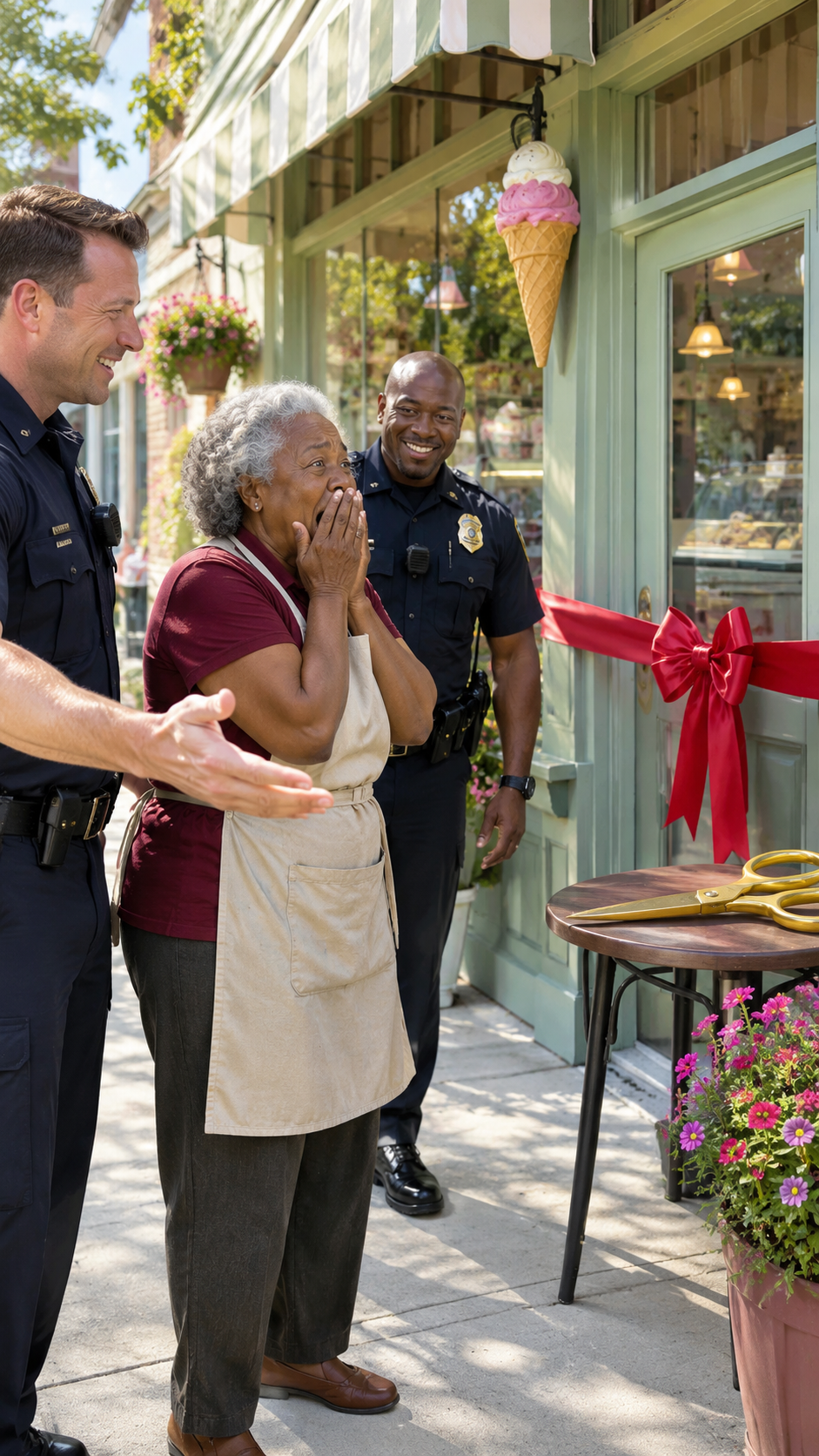
A wide red ribbon stretched across the doorway.
Nearby, a small wooden table held a pair of large golden ceremonial scissors.
Margaret looked at the decorated storefront with confusion.
She could not understand why the officers had brought her to such a beautiful establishment.
Officer Daniel stepped aside, allowing her to see the entrance more clearly.
Then he turned toward her.
“Margaret, this is your new ice cream shop.”
For a moment, Margaret appeared unable to believe what she had heard.
She raised both hands toward her mouth as her expression changed completely.
“Mine? Are you serious?”
The tears that had previously reflected fear and disappointment were now accompanied by astonishment and joy.
The little yellow cart she had depended on for twenty years was no longer the only opportunity available to her within the fictional story.
Standing before her was an entire ice cream shop.
The large windows, beautiful awning, colorful flowers, and carefully decorated entrance created an extraordinary contrast with her old cart.
Nearby pedestrians began applauding.
Margaret continued looking toward the storefront, overwhelmed by the unexpected announcement.
The officers stood beside her, sharing the emotional moment.
What she had initially believed was the end of her livelihood had become the beginning of a new opportunity.
The fictional story does not explain how the shop was financed, who renovated it, or what business arrangements were made behind the scenes.
Instead, the revelation focuses on Margaret’s emotional response to being presented with a place of her own.
One final surprise remained.
The red ribbon was waiting to be cut.
FOTO 5
The Meaning Behind Twenty Years of Hard Work
Margaret’s statement about working with her ice cream cart for twenty years gives the fictional story much of its emotional significance.
Twenty years represents an extraordinary amount of time.
For someone operating a small mobile business, daily work can involve considerable effort.
Preparing products, maintaining equipment, interacting with customers, and managing expenses all require dedication.
Working outdoors can introduce additional challenges, including changing weather conditions and the physical effort associated with moving equipment.
The story does not establish Margaret’s exact financial circumstances or provide details about her daily earnings.
However, her emotional attachment to the cart clearly demonstrates how important it was to her.
Its worn appearance did not diminish its value.
The faded paint, damaged panel, and squeaking wheels represented a familiar working environment that had remained part of her life for two decades.
When the officers began taking it away, Margaret was not simply reacting to the loss of an old piece of equipment.
She was responding to the possibility of losing her independence and the means through which she earned a living.
Her fear becomes understandable when viewed from that perspective.
The later revelation of the ice cream shop creates a powerful contrast.
Instead of being presented with the end of her working life, Margaret discovers a new opportunity to continue doing something familiar in a different environment.
The fictional transformation celebrates the persistence of someone who has spent years working to support herself.
Why Small Street Vendors Deserve Recognition
Street vendors are a familiar part of many communities.
They provide convenient products, interact directly with customers, and contribute to the character of public spaces.
An ice cream cart can become a recognizable part of a neighborhood, particularly during warm weather when people enjoy spending time outdoors.
Behind these seemingly simple businesses, however, there can be substantial responsibilities.
Vendors must manage supplies, maintain their equipment, follow applicable regulations, and respond to changing customer demand.
Their work may also require long periods of standing or walking.
Margaret’s character represents the determination often associated with people who operate modest independent businesses.
She continues working despite the worn condition of her cart.
Her beige apron and familiar yellow cart become visual symbols of her commitment.
The fictional story encourages viewers to recognize the human effort behind such businesses.
A person selling ice cream from a small cart deserves the same basic dignity and respect as someone operating a large commercial establishment.
The size of a business does not determine the value of the person working behind it.
Margaret’s transition from a mobile cart to a decorated storefront illustrates how meaningful new opportunities can be for someone who has already demonstrated years of dedication.
An Emotional Surprise With an Important Distinction
The narrative is structured around an unexpected reversal.
At first, the officers appear to be taking away Margaret’s livelihood.
Her distress increases as the cart is moved toward the dumpster and she is escorted to the police vehicle.
Only after arriving at the renovated shop does she discover the purpose of the fictional encounter.
This storytelling structure creates suspense by allowing the audience to experience Margaret’s uncertainty before revealing the surprise.
However, the emotional distress shown in the earlier scenes also deserves acknowledgment.
Margaret genuinely appears frightened by the possibility of losing her income.
In real life, surprising someone with a generous gift does not require deliberately making them believe their livelihood has been taken away.
Respectful communication, informed consent, and consideration for someone’s emotional well-being remain important.
Police officers also have professional responsibilities when interacting with members of the public.
Taking someone’s property or transporting them in a police vehicle must comply with applicable laws and procedures.
The fictional story should therefore be understood as a dramatized entertainment sequence rather than an example of appropriate police procedure.
Its intended positive message comes from the opportunity Margaret receives, not from the fear she experiences before the revelation.
The most meaningful aspect of the ending is the recognition of her hard work and the possibility of a more secure future.
More Than a Beautiful New Building
The pastel-green ice cream shop represents a significant change in Margaret’s fictional circumstances.
Unlike the old mobile cart, the storefront provides an enclosed commercial space with a permanent entrance, large windows, and an attractive exterior.
Its decorative flowers and striped awning create a welcoming appearance.
For Margaret, the announcement suggests an opportunity to continue selling ice cream without relying exclusively on the worn cart she had pushed for twenty years.
However, operating a permanent business also involves responsibilities.
A storefront may require equipment, permits, utilities, insurance, maintenance, inventory, and ongoing financial management.
The fictional narrative does not establish how those matters have been addressed.
Nor does it specify whether Margaret receives ownership of the building, a lease, or another business arrangement.
What it does establish is the officers’ announcement that the new ice cream shop is hers.
The emotional significance of that announcement remains the central focus.
Margaret sees a place that has been prepared for her, and she responds with overwhelming gratitude.
The storefront becomes a symbol of possibility.
It represents the idea that years of dedication can be recognized and that meaningful assistance can help someone begin a new chapter.
The Power of Supporting Someone’s Independence
One particularly meaningful element of the surprise is that Margaret is not simply presented with an ordinary gift.
She is offered an opportunity connected to the work she already knows.
For twenty years, she has operated an ice cream cart.
The new shop allows the fictional narrative to preserve that important part of her identity while introducing a different working environment.
Support can take many forms.
Sometimes people need immediate assistance with essential expenses.
Others may benefit from access to equipment, training, suitable working spaces, or opportunities to expand an existing business.
The most appropriate support depends on the individual’s circumstances, preferences, and goals.
Margaret’s character demonstrates the importance of respecting someone’s desire to remain active and independent.
Her earlier question was not about receiving an expensive possession.
It was about how she would continue making a living.
That concern makes the eventual surprise especially meaningful.
The fictional gift addresses the very uncertainty that had caused her distress.
Rather than suggesting that Margaret should abandon her familiar work, the ending celebrates her ability to continue pursuing it.
The new shop symbolizes a fresh beginning built around her existing experience and dedication.
When Gratitude Replaces Fear
The transformation in Margaret’s expression is one of the strongest emotional elements of the story.
At the beginning, she looks shocked when the officer suddenly stops her cart.
Later, she becomes increasingly distressed as the officers move it away.
Behind the commercial buildings, she cries while recalling the twenty years she has spent working with it.
During the journey in the police SUV, uncertainty remains visible on her face.
Then everything changes when she arrives at the pastel-green storefront.
Her hands rise toward her mouth.
Her eyes widen.
The fear that had dominated the earlier moments gives way to disbelief and happiness.
“Mine? Are you serious?”
Those words capture the unexpected nature of the revelation.
The nearby applause adds to the celebratory atmosphere.
For the first time since the beginning of the encounter, Margaret understands why the officers have brought her there.
The red ribbon and golden scissors suggest that the surprise has been prepared as a special occasion.
The fictional story reaches its emotional peak not through an elaborate speech, but through Margaret’s spontaneous reaction.
Her gratitude reflects the significance of receiving an opportunity she had not expected.
The Ribbon That Marked a New Beginning
Outside the newly renovated ice cream shop, Margaret stood between Officer Daniel and Officer Marcus.
The red ribbon stretched across the entrance beneath the cream-colored striped awning.
The large golden ceremonial scissors were ready.
Nearby pedestrians watched the emotional occasion.
Margaret held the scissors with trembling hands.
Only moments earlier, she had believed that her twenty years of hard work were ending with the loss of her beloved yellow cart.
Now she was preparing to open the doors of a beautiful ice cream shop.
The contrast between those two moments gave the fictional ceremony its extraordinary emotional impact.
The officers stood beside her as she prepared to cut the ribbon.
The decorative flowers, pastel-green storefront, and bright afternoon sunlight created a welcoming background.
For Margaret, the ceremony represented more than the opening of a commercial establishment.
It symbolized a new chapter after years of dedication.
The little yellow cart had been part of her past.
The shop standing before her represented an unexpected possibility for her future.
With the officers beside her and the nearby pedestrians ready to applaud, Margaret prepared to complete the final step of her extraordinary fictional journey.
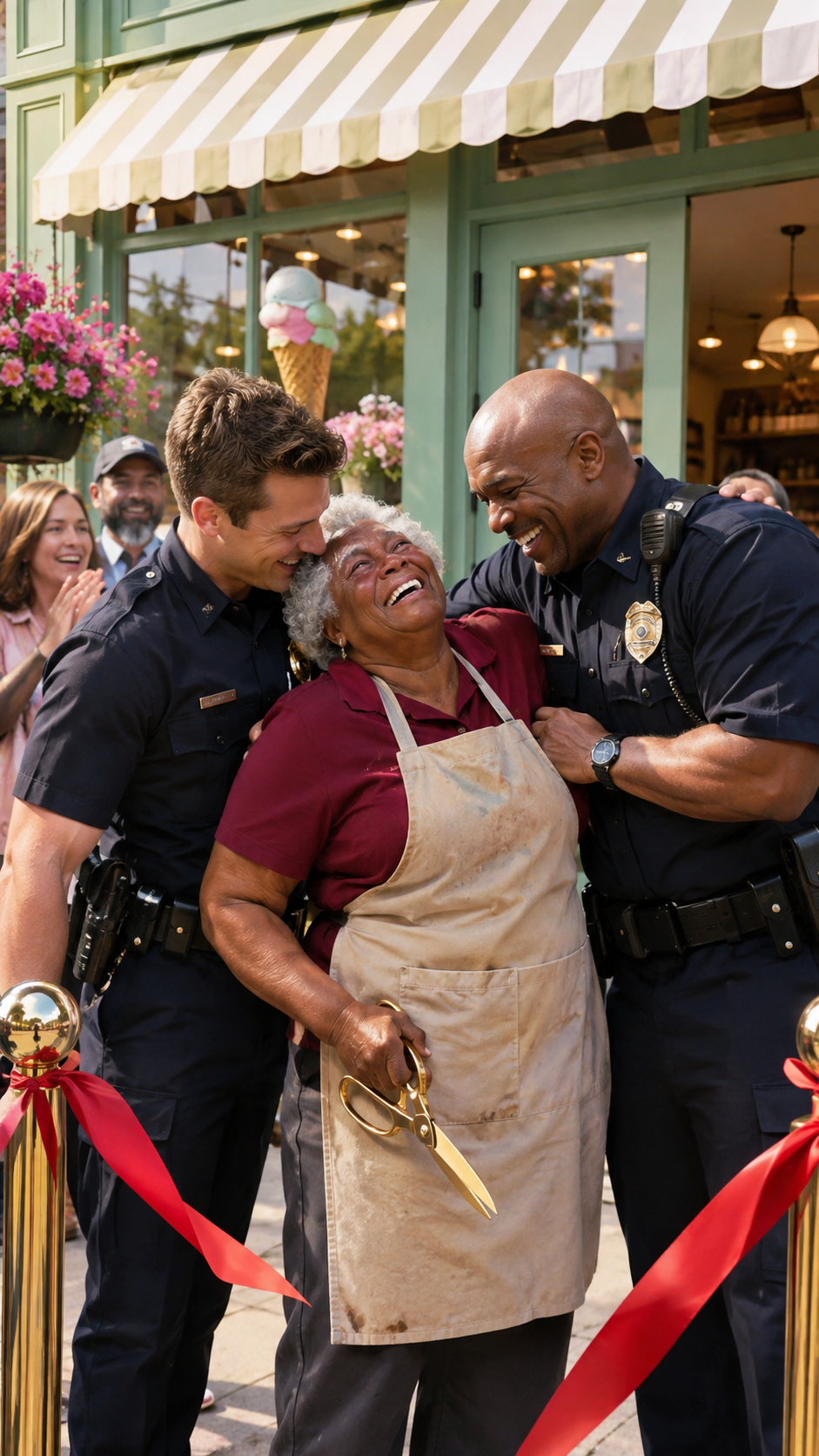
With tears of happiness running down her cheeks, Margaret cut through the red ribbon as the officers and nearby pedestrians burst into applause. She raised both arms in celebration before embracing Officer Marcus and Officer Daniel. “God bless you both! I’ll never forget this!” she exclaimed. Daniel smiled warmly. “You deserve it, Margaret.” Beneath the bright sunlight, the beautiful pastel-green ice cream shop stood behind them, marking the beginning of a new chapter and offering a heartwarming fictional reminder that years of honest work, determination, and perseverance deserve recognition