Something Was Wrong Beneath the Surface
Bright summer sunlight filtered through the blue-green water beneath an old wooden fishing pier. Barnacles covered the timber pilings, while pale shell gravel stretched across the seabed.
Beneath the peaceful surface, however, an enormous walrus was struggling with something that prevented it from swimming freely.
The animal’s cinnamon-brown skin, thick cream-colored whiskers, and two long ivory tusks made it an impressive presence in the underwater environment.
As the walrus attempted to sweep its left foreflipper forward, an olive-colored fishing net suddenly tightened.
The movement stopped halfway.
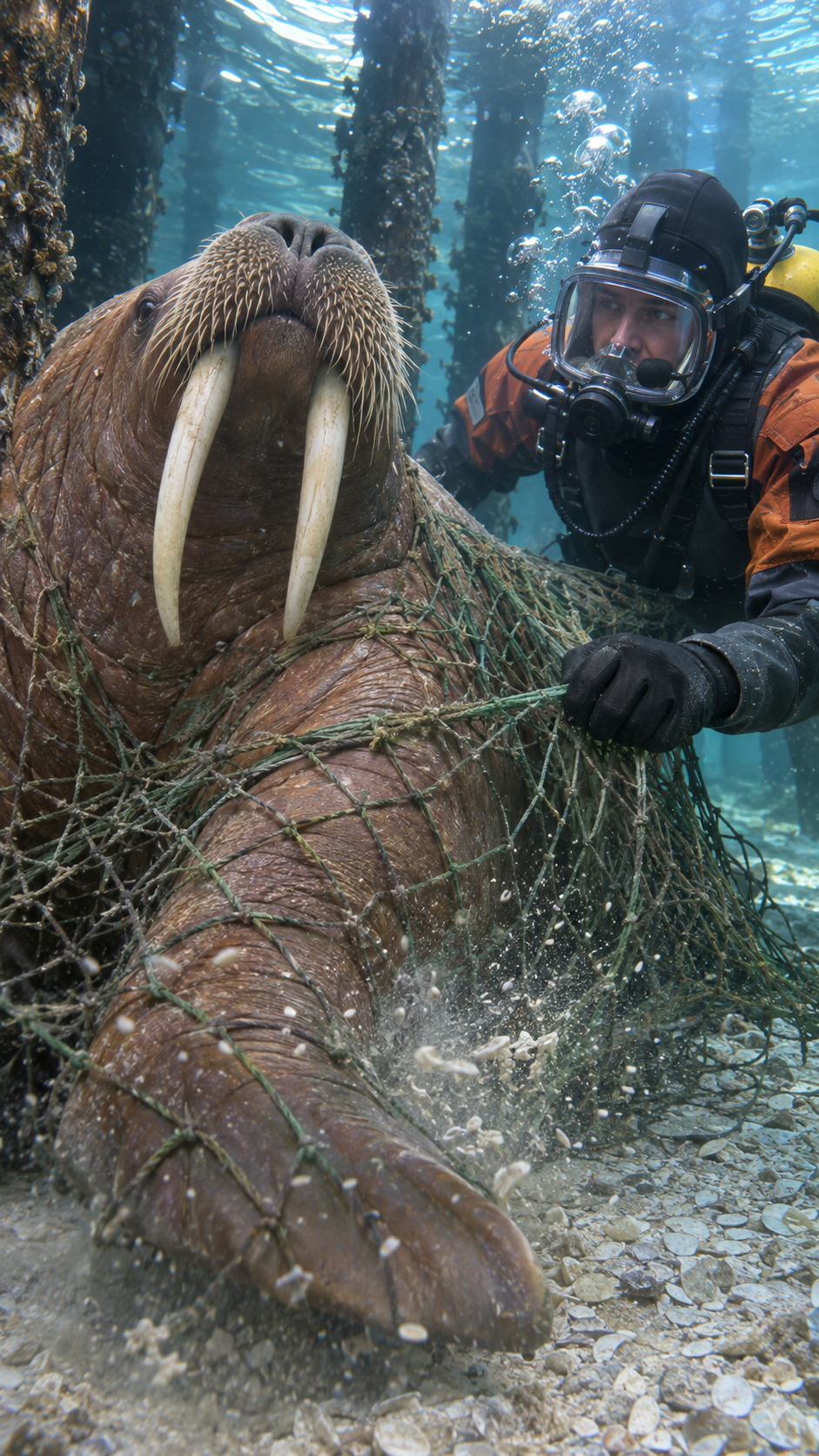
Small pieces of shell grit scattered across the seabed as the animal lifted its head. The net remained stretched against its body, restricting the natural movement of its flipper.
Nearby was Ben, a diver wearing a charcoal drysuit with burnt-orange shoulders, black gloves, a clear full-face radio mask, and a yellow air tank.
He was already positioned near the walrus’s shoulder when he noticed the extent of the entanglement.
Reaching toward a loose section of fishing net draped across the animal’s back, Ben carefully examined the situation.
Bubbles rose through the surrounding water as he contacted his surface partner.
“June, he’s snagged.”
The brief radio message marked the beginning of an extraordinary fictional underwater rescue.
The walrus was not simply swimming with discarded material resting on its body. A section of the net appeared to be preventing one of its powerful foreflippers from completing its natural movement.
Before the animal could swim freely again, the source of that restriction needed to be identified.
Searching for the Hidden Entanglement
Ben remained close to the walrus as he examined the olive-colored fishing net.
The material stretched across the animal’s broad back, creating several overlapping folds that made it difficult to immediately identify the section responsible for restricting its movement.
The walrus slowly turned its whiskered face toward the diver.
Its enormous ivory tusks remained clearly visible beneath the filtered sunlight, emphasizing the size and strength of the animal Ben was attempting to assist.
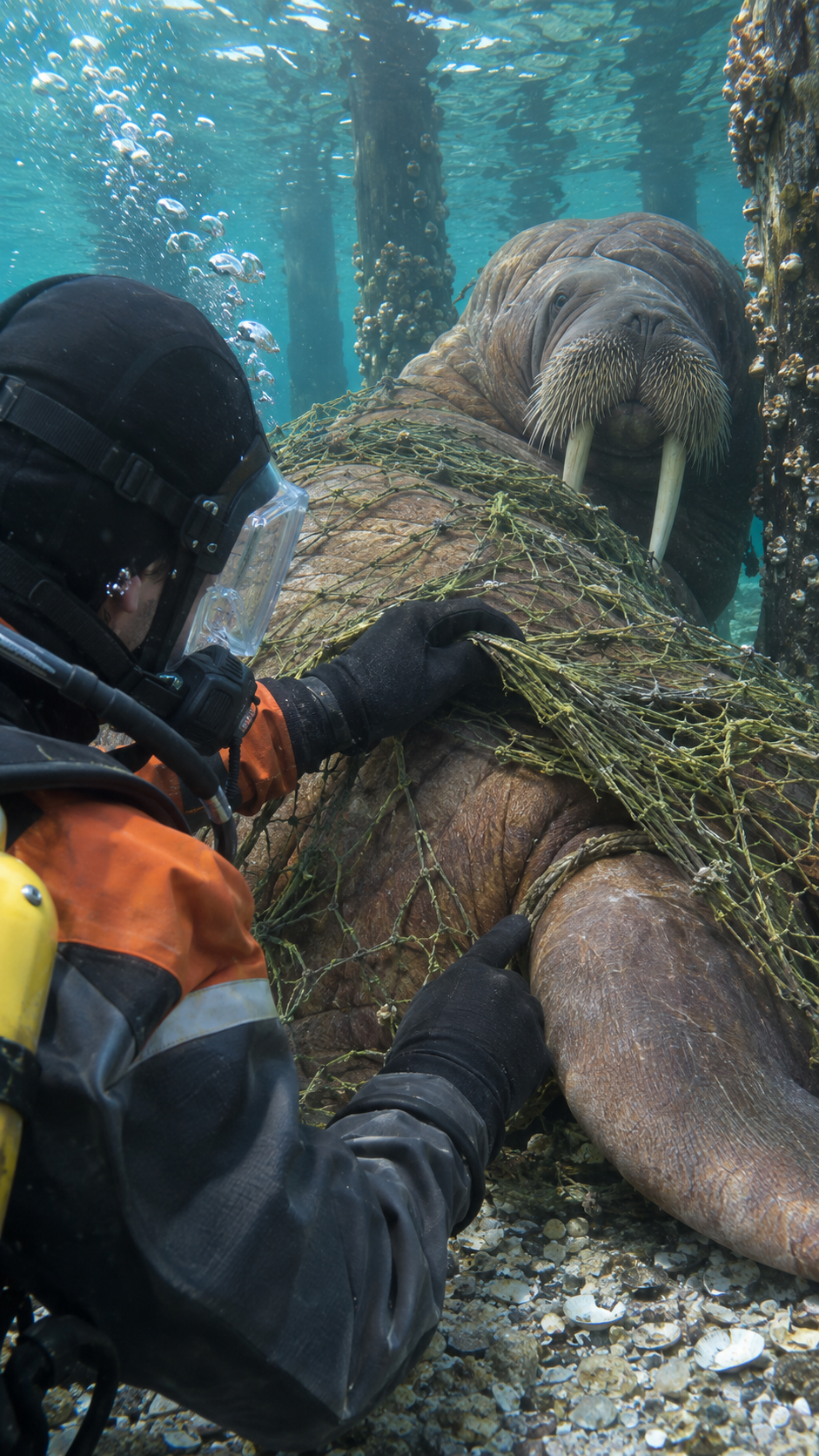
Through his black gloves, Ben carefully examined the loose mesh.
As he lifted one section away from the walrus’s back, he discovered something more concerning.
A tight loop had formed near the base of its left foreflipper.
Unlike the loose material resting across the animal’s body, this section of net appeared to be directly responsible for stopping the flipper during its forward movement.
Ben held the loose fold apart from the restrictive loop.
Above the surface, June remained connected to him through the dive radio.
“Can you see where?” she asked.
“Left flipper,” Ben replied.
The communication was brief but important within the fictional rescue sequence.
Ben had identified the specific area where the animal’s movement was being restricted.
Around them, the old timber pilings creaked gently. The sound of the diver’s breathing continued through his mask, while small bubbles moved upward toward the surface.
The walrus remained nearby, its body shifting naturally in the underwater environment.
The loose net was still spread across its back, but the hidden loop had finally been located.
The discovery represented an important turning point.
Until that moment, the full extent of the entanglement had been difficult to understand. Now the diver could see which section of fishing material was preventing the walrus from moving normally.
The First Unrestricted Movement
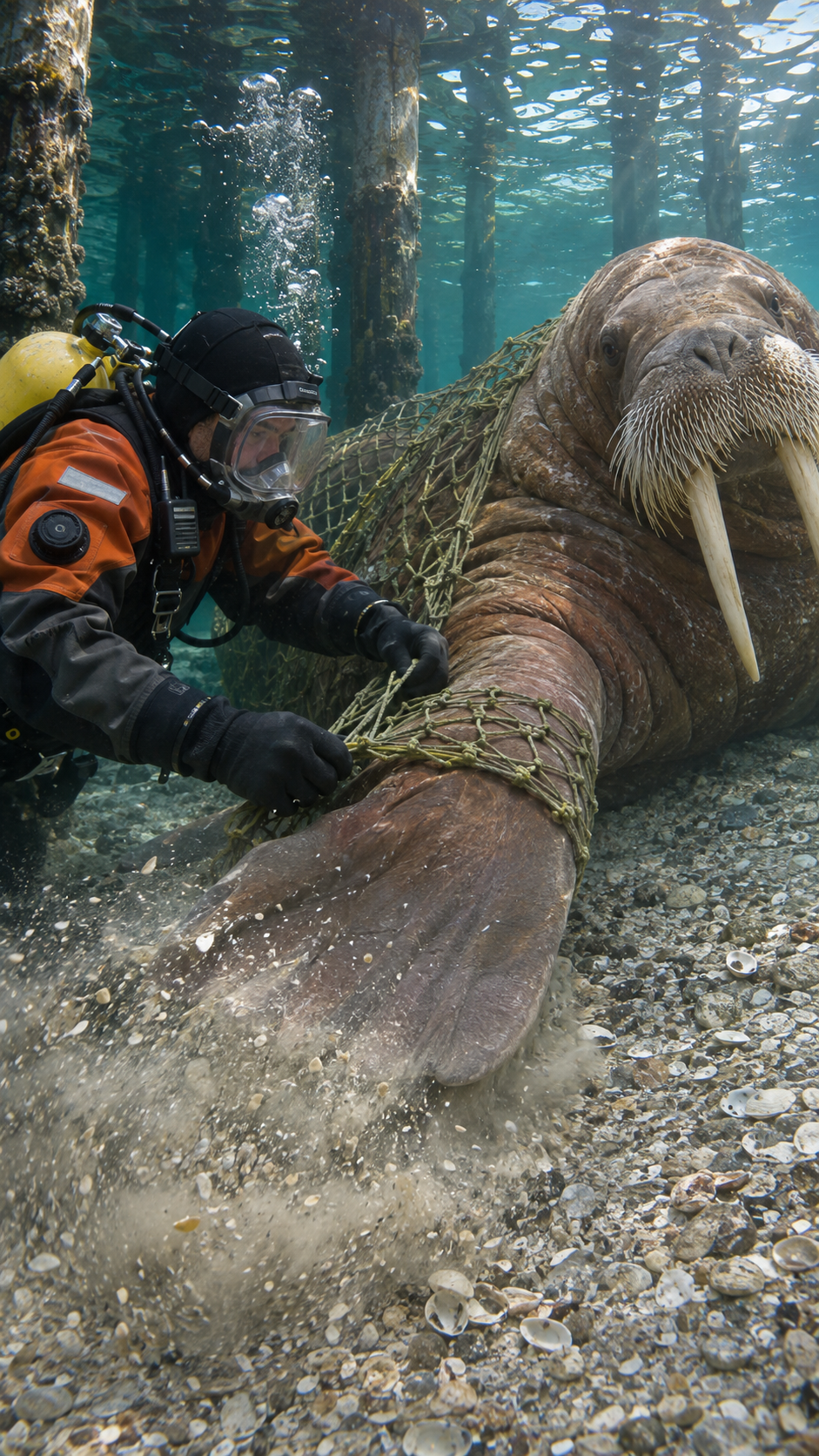
The walrus began folding its left foreflipper inward.
Ben remained beside the animal as the olive mesh shifted around its broad flipper.
Within the dramatized rescue, the diver carefully introduced enough slack into the restrictive loop to allow the flipper to move through it.
“One more inch … there.”
The mesh slipped away from the broad tip.
For the first time since the beginning of the encounter, the walrus extended its left foreflipper without the tight loop stopping its movement.
The powerful stroke disturbed the pale shell gravel beneath the animal, sending a cloud of fine particles into the surrounding water.
Ben’s next breath released another ribbon of bubbles toward the surface.
The freed flipper moved naturally through the blue-green water.
It was a significant moment in the rescue, but the animal was not completely free.
The remaining fishing net was still draped across its broad back.
Although the most restrictive loop had been removed within the fictional sequence, the loose material could still interfere with the animal’s movements or become entangled again.
The rescue therefore needed to continue.
The walrus’s newly unrestricted stroke offered a clear visual contrast with the opening moments of the story.
Earlier, the flipper had stopped halfway through its movement as the net tightened.
Now it could extend outward, allowing the animal to move more naturally.
The shell grit gradually settled around the seabed as the diver remained near the walrus.
The underwater environment continued to shift with the gentle movement of the current.
There was still one important task remaining: separating the rest of the discarded fishing material from the animal entirely.
Removing the Remaining Fishing Net
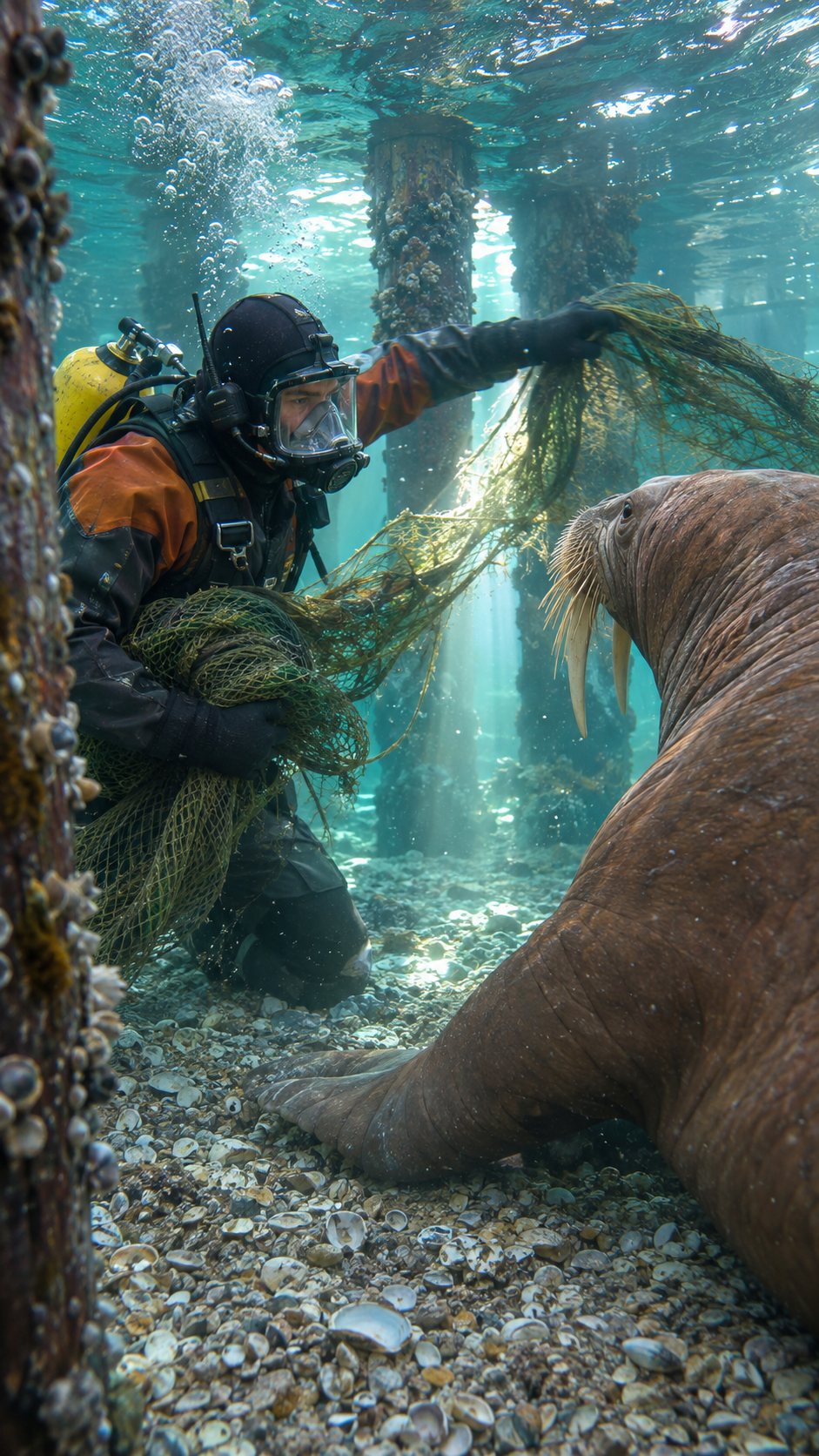
The enormous walrus moved beside one of the barnacled wooden pilings.
Ben remained nearby, holding the remaining sections of olive-colored mesh.
Within the fictional rescue, he lifted the loose fishing net sideways, gradually separating it from the animal’s broad back.
The material billowed briefly in the underwater current.
For a moment, sunlight passed through the widening space between the walrus and the discarded fishing net.
The separation became clearly visible.
Ben gathered the loose mesh beneath his left arm, keeping the material together rather than allowing it to drift freely through the surrounding water.
The walrus was finally clear of the net.
A brief radio click interrupted the soft underwater rumble.
“I’ve got the net,” Ben reported.
“Copy,” June answered.
The communication confirmed the successful conclusion of the entanglement sequence within the story.
The walrus was no longer carrying the olive-colored mesh across its body, and its left foreflipper was no longer restricted by the tight loop.
The animal now had the freedom to move through the surrounding water without dragging the discarded fishing material behind it.
The moment also highlighted an important environmental issue.
Lost or abandoned fishing equipment can remain in marine environments long after its original purpose has ended.
Nets and other fishing materials can become entangled around marine animals, creating serious obstacles to their movement and survival.
In this fictional encounter, the diver not only assists the walrus but also gathers the discarded material so that it does not remain floating beside the animal.
The immediate rescue appears to have reached its conclusion.
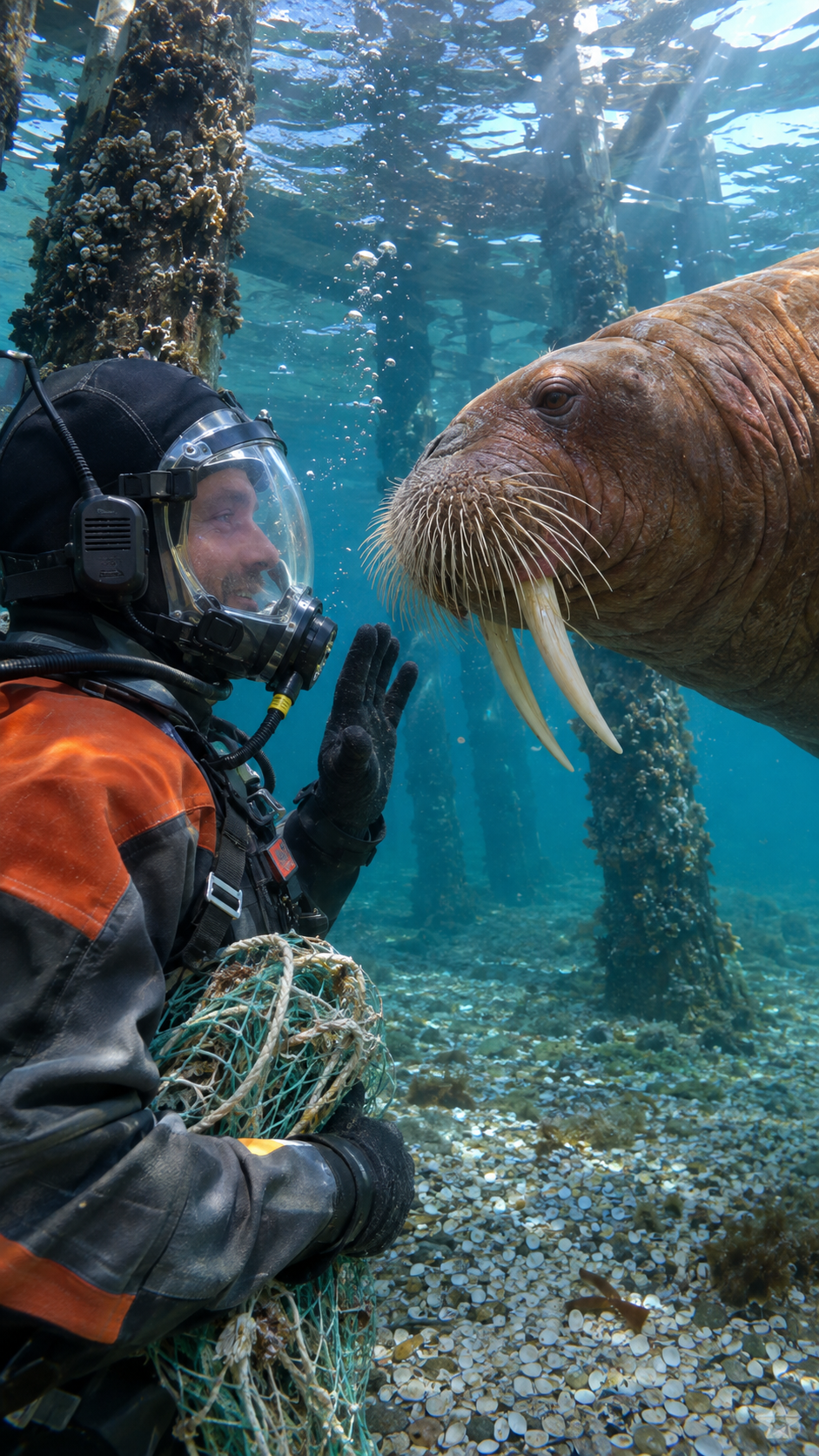
However, instead of immediately disappearing into the surrounding water, the walrus slowly turned toward Ben.
An Unexpected Face-to-Face Encounter
The freed walrus began gliding toward the diver.
Its long ivory tusks and thick cream-colored whiskers became increasingly prominent as the distance between them narrowed.
Ben remained underwater, holding the bundled fishing net beneath his left arm.
The animal continued approaching until its whiskers were only a short distance from his clear full-face mask.
A narrow strip of blue water remained visible between their faces.
Ben leaned backward slightly.
The scene captured the extraordinary difference in size between the human diver and the enormous marine mammal.
The walrus’s cinnamon-brown skin moved naturally as it hovered in the water. Its whiskers extended toward the diver’s mask, while the filtered daylight illuminated both faces.
There was no spoken exchange during this moment.
Instead, the sound of Ben’s breathing, the movement of the surrounding water, and the quiet underwater atmosphere allowed the encounter to speak for itself.
The walrus had been freed from the fishing net, yet it remained near the diver.
For viewers, the moment might resemble an expression of curiosity or appreciation.
However, the actual intentions of a wild animal cannot be determined simply from its proximity to a human.
The encounter is an imaginative cinematic depiction, not documented evidence that walruses understand human rescue efforts or deliberately express gratitude afterward.
Its emotional strength comes from the contrast between the earlier struggle and the animal’s now unrestricted movements.
The tight fishing net was gone.
The walrus could move freely again.
And for one memorable moment beneath the fishing pier, the enormous marine mammal and the diver remained face-to-face.
The Hidden Danger of Discarded Fishing Equipment
The fictional rescue highlights a genuine environmental problem affecting marine wildlife.
Fishing nets, ropes, lines, and other equipment can become lost or abandoned in oceans and coastal waters.
These materials may continue drifting through marine habitats or become caught around underwater structures.
Animals that encounter them can become entangled.
For marine mammals, entanglement can restrict swimming, interfere with feeding, increase exhaustion, and potentially cause serious injuries.
Depending on the circumstances, an animal may also struggle to reach the surface to breathe.
The olive-colored fishing net in this story illustrates how even a relatively small section of material can interfere with the movement of a much larger animal.
The walrus possesses powerful foreflippers capable of moving its substantial body through the water.
Nevertheless, the tight loop prevents one flipper from completing its natural stroke.
The contrast emphasizes that physical strength alone does not necessarily allow an animal to escape discarded fishing equipment.
Preventing fishing gear from entering marine environments unnecessarily, recovering lost equipment when it can be done safely, and supporting responsible waste management are important ways to reduce these hazards.
Professional marine wildlife organizations also play an important role in responding to reported entanglements.
The fictional rescue offers a dramatic illustration of why keeping underwater habitats free from abandoned fishing materials matters.
Understanding the Remarkable Walrus
Walruses are among the most distinctive marine mammals.
Their long tusks, thick skin, broad bodies, and sensitive whiskers make them immediately recognizable.
Their whiskers serve an important sensory function, helping them detect food along the seabed. Walruses commonly feed on bottom-dwelling marine organisms, including various shellfish.
Their tusks serve several purposes, including social interactions and helping them haul themselves onto ice or other surfaces.
Despite their impressive size and strength, walruses depend heavily on suitable marine habitats.
Environmental changes, human disturbances, and entanglement hazards can affect their well-being.
The underwater setting of this story provides an opportunity to appreciate the animal’s remarkable physical characteristics.
Its broad foreflipper, enormous tusks, cream-colored whiskers, and powerful swimming movements become central visual elements throughout the rescue.
However, walruses are powerful wild animals and can be extremely dangerous when approached, particularly when frightened, injured, or entangled.
Their appearance should never encourage people to attempt close encounters independently.
The fictional diver’s proximity to the animal is a cinematic storytelling choice rather than an example of safe wildlife interaction.
Real marine mammal rescues require specialized expertise, appropriate authorization, professional equipment, and careful assessment of the risks involved.
Why Responsible Wildlife Rescue Matters
Seeing an animal struggling can naturally create a desire to help.
However, assisting large marine mammals is considerably more complicated than removing an ordinary piece of litter from the water.
An entangled animal may react unpredictably because of stress, exhaustion, pain, or fear.
Its movements can create serious risks for both the animal and anyone attempting to approach it.
Underwater environments introduce additional hazards, including limited visibility, currents, submerged structures, and the possibility of rescuers becoming entangled themselves.
The presence of old timber pilings and discarded fishing net in this fictional story illustrates some of those challenges.
Ben’s communication with June also emphasizes that the rescue is not presented as an entirely isolated underwater encounter.
His surface partner remains connected through the dive radio, receiving updates as the fictional sequence progresses.
Nevertheless, communication equipment alone does not make such an intervention safe.
Anyone discovering an entangled marine mammal should maintain an appropriate distance and contact qualified wildlife rescue professionals or relevant authorities.
Providing accurate information about the animal’s location and condition can be valuable without creating additional danger.
The most responsible response is one that protects both the animal and the people involved.
A Powerful Reminder of Our Connection With the Ocean
The story begins with a single movement that cannot be completed.
A walrus attempts to sweep its foreflipper forward, but discarded fishing material stops it halfway.
That moment establishes the central problem without requiring a lengthy explanation.
The animal’s struggle is directly connected to an object that does not naturally belong in its underwater habitat.
As the fictional rescue progresses, the diver identifies the entanglement, the flipper becomes unrestricted, and the remaining fishing net is removed.
Each development brings the animal closer to regaining its natural freedom of movement.
The final face-to-face encounter adds an emotional dimension to the environmental message.
Whether viewers interpret the moment as curiosity, peaceful coexistence, or simply a visually remarkable meeting, the central theme remains the same.
Marine animals deserve environments where they can move, feed, and survive without unnecessary hazards created by human activities.
Protecting those environments requires more than individual rescue efforts.
Responsible fishing practices, effective waste management, conservation programs, and public awareness all contribute to reducing the risks associated with marine debris.
The fictional walrus rescue provides a memorable way to communicate that broader message.
An Underwater Encounter Worth Remembering
Beneath the wooden fishing pier, sunlight continued filtering through the blue-green water.
The olive fishing net was no longer wrapped around the walrus.
Its left foreflipper could move naturally, and the remaining mesh had been gathered away from its broad back.
Ben remained nearby, holding the discarded material beneath his arm.
The walrus approached his mask, creating a striking final image of two very different beings sharing the same underwater environment.
There were no dramatic speeches or elaborate explanations.
Only the quiet sound of breathing, the gentle movement of water, and the enormous animal’s distinctive whiskers and ivory tusks.
The encounter’s emotional significance came from the journey leading up to that moment.
An animal that had been struggling against a restrictive fishing net was finally able to move freely.
The discarded material had been separated from its body, and the immediate fictional emergency had ended.
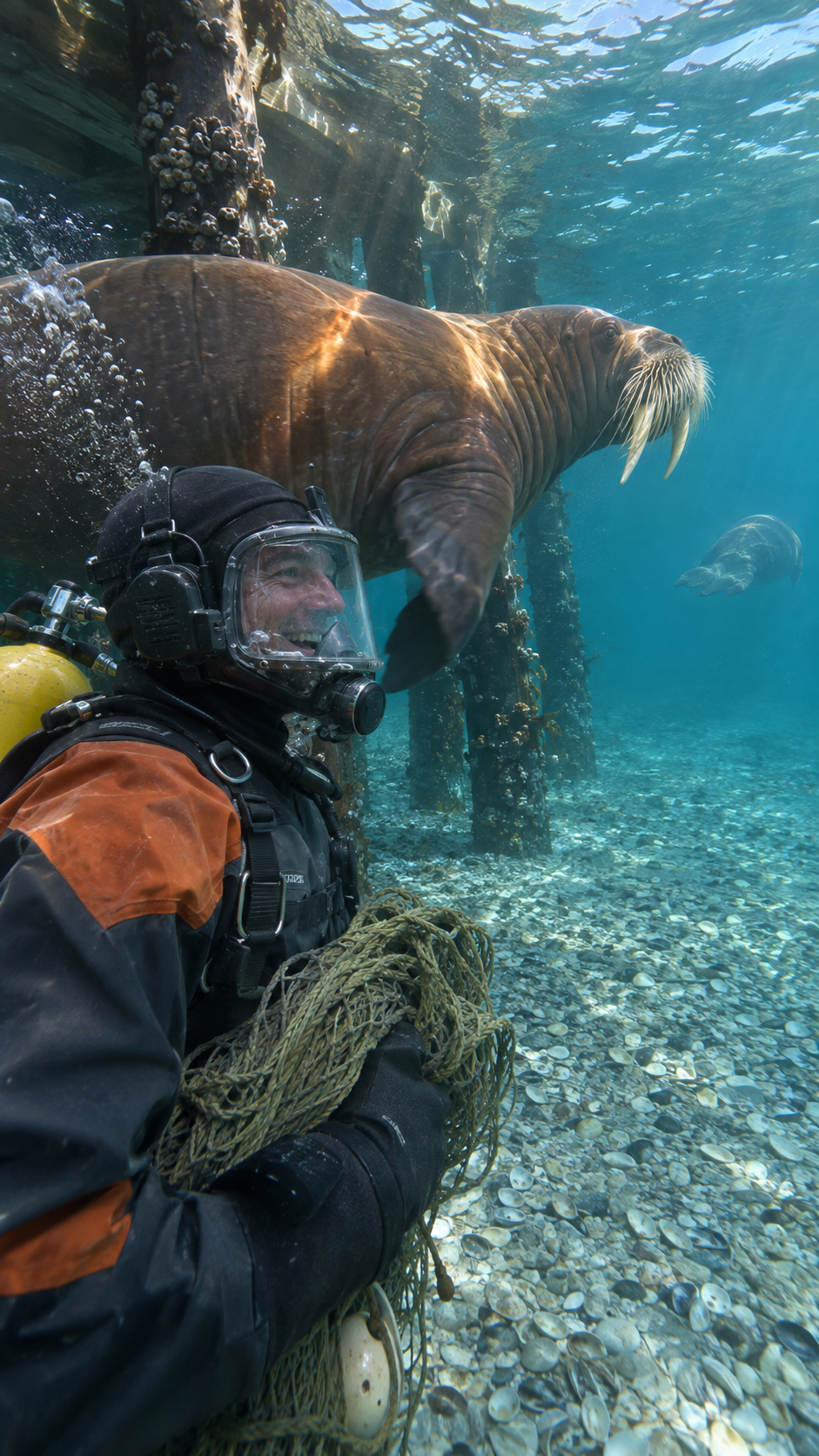
As sunlight illuminated the water beneath the fishing pier, the freed walrus remained briefly near Ben’s mask, its cream-colored whiskers and enormous ivory tusks creating an unforgettable underwater image. The fishing net that had restricted its movements was finally gone. Their fictional encounter offered a powerful reminder of the beauty of marine wildlife, the importance of protecting underwater habitats, and the responsibility humans share in keeping the oceans free from dangerous debris.