The Delivery That Went Terribly Wrong
For Eli, his faded-blue bicycle was more than a means of transportation. It was the equipment he depended on to deliver food, earn money, and cover his rent.
Every delivery mattered, and keeping his bicycle in working condition was essential to getting through another day.
That afternoon, Eli was carrying two pizza boxes on the front rack of his bicycle. He was approaching a garage where a man named Ray stood waiting, unaware that his delivery was about to end in disaster.
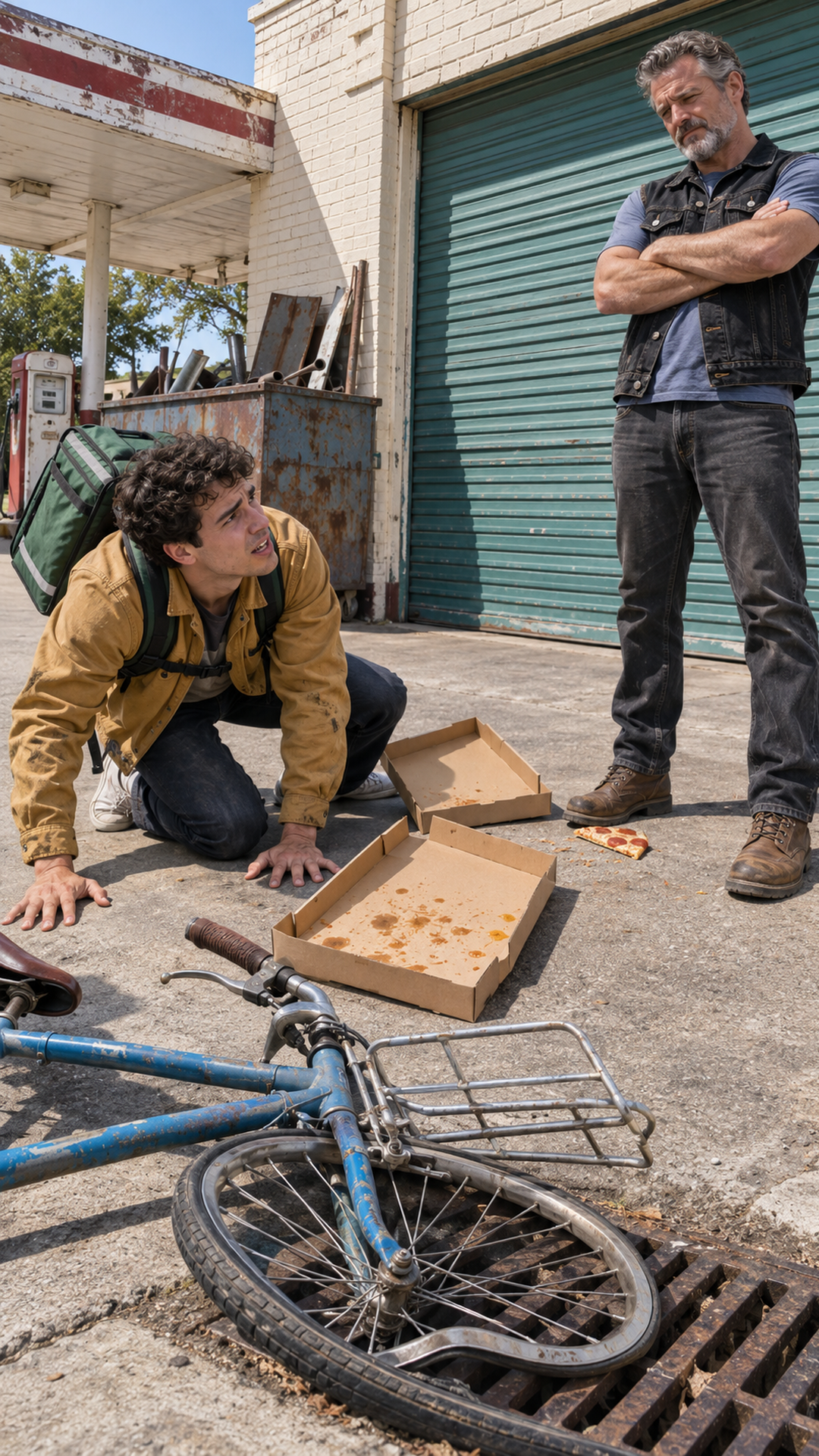
As Eli rode across the concrete, his front tire became wedged in a drain grate.
The bicycle stopped abruptly. Its front rim buckled sideways, throwing Eli off balance and sending him toward the ground.
He managed to catch himself with his hands and one knee, but the two pizza boxes were not as fortunate.
Both slid from the front rack and struck the concrete. Their cardboard lids flipped open, scattering pieces of pizza across the pavement.
A pepperoni slice slid directly toward Ray, stopping against his boot.
Ray stood with his arms folded, looking down at the unexpected scene.
Eli raised his head. Despite having just fallen from his bicycle, his immediate concern was the customer’s order.
“Oh, man. Your lunch.”
Behind him, the bicycle’s rear wheel continued turning slowly. The damaged front wheel rested at an unnatural angle against the concrete.
The delivery had gone wrong, and Eli was about to discover that the consequences extended far beyond two ruined pizzas.
He Was More Worried About the Customer
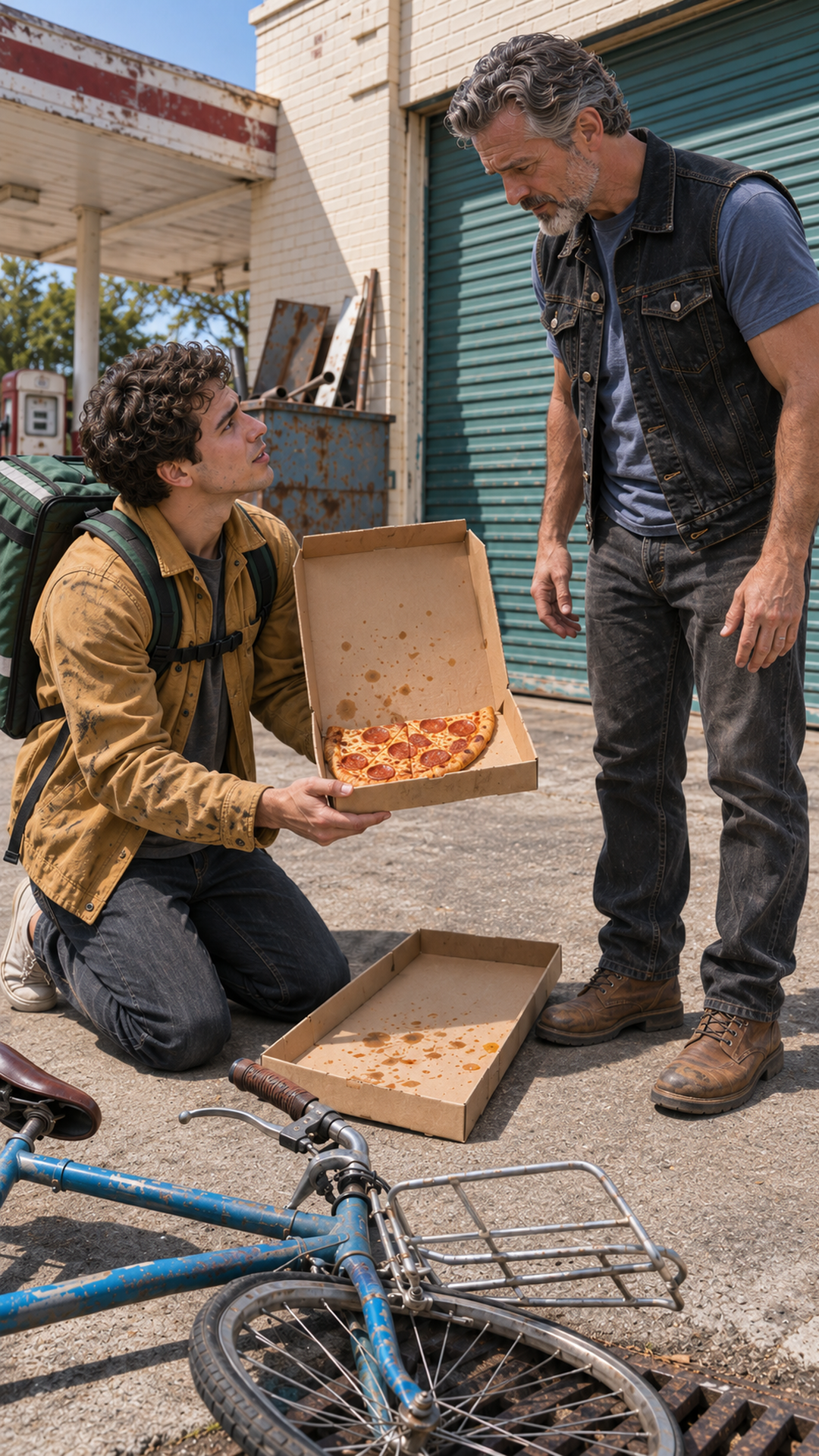
Still kneeling beside the fallen bicycle, Eli reached for one of the open pizza boxes.
He lifted it carefully by its corners. Approximately half the pizza remained inside, but the delivery was clearly no longer in acceptable condition.
Eli looked directly at Ray.
“I’ll bring you two fresh ones.”
His immediate response was to offer a solution. He did not complain about the drain grate or attempt to excuse the condition of the food. He understood that Ray had ordered two pizzas and that neither had arrived as expected.
Ray uncrossed his arms and stepped closer.
“You hurt?”
The question caught Eli’s attention.
He shook his head, indicating that he did not believe he was injured.
Ray looked down at the bicycle.
The front rim was badly buckled. The faded-blue frame lay against the pavement, and the damaged wheel no longer aligned properly with the rest of the bicycle.
Eli’s promise to replace the pizzas was understandable, but the condition of his transportation created an immediate problem.
Without a functioning bicycle, completing another delivery would be difficult.
Ray continued examining the damage.
The sound of cardboard moving in Eli’s hands mixed with the crunch of gravel beneath Ray’s boots.
For Eli, the situation was already stressful enough. He had dropped a customer’s lunch, damaged his bicycle, and potentially interrupted his ability to continue working.
He had no idea that Ray was about to make a decision that would leave him even more worried.
Ray Picks Up the Damaged Bicycle
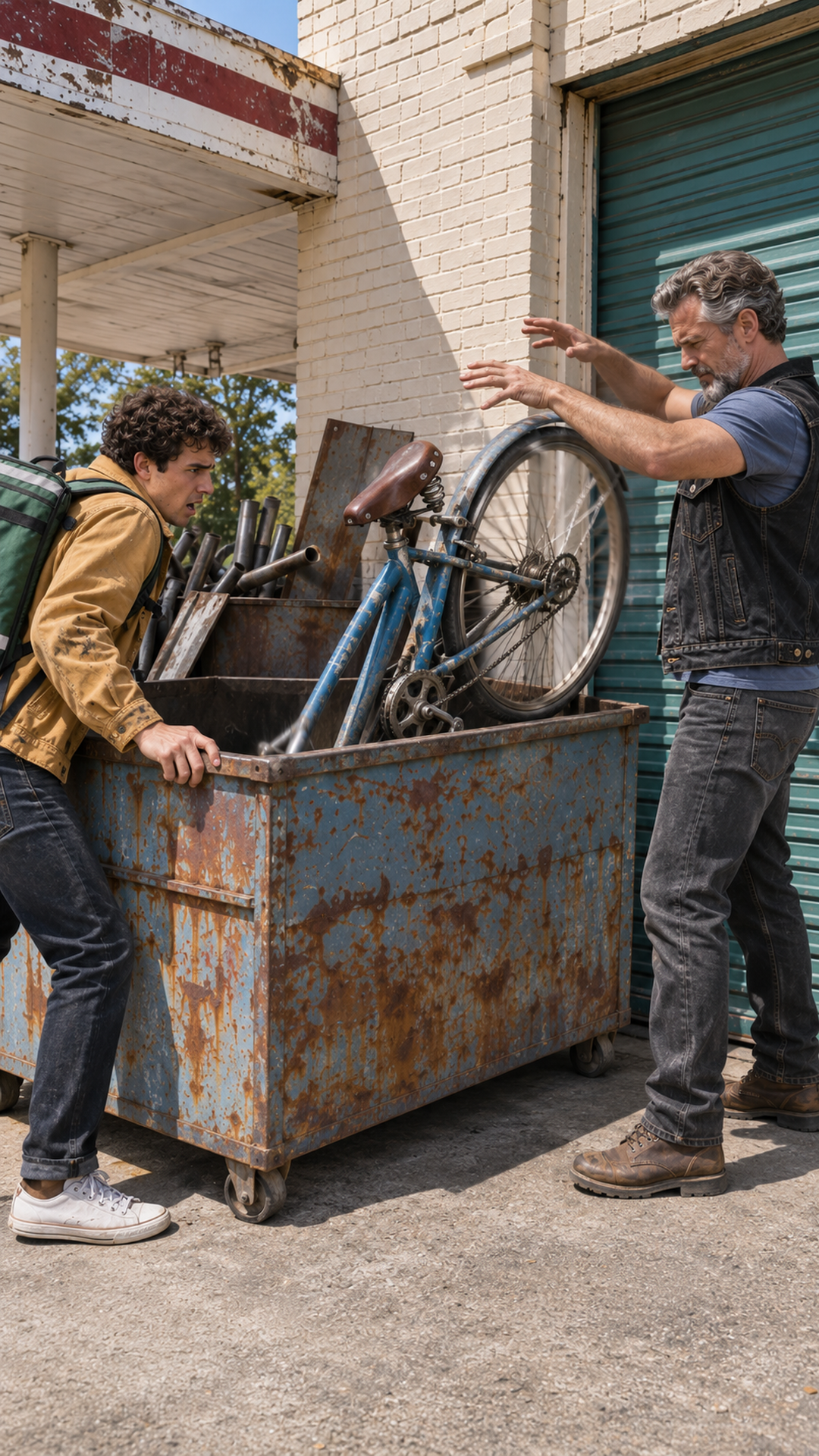
Ray stepped toward the faded-blue bicycle and reached down to lift it by its frame.
Eli watched as the man carried it toward a large steel scrap bin positioned beside the garage’s closed teal door.
At first, Eli appeared uncertain about what Ray intended to do.
Perhaps the man was moving the damaged bicycle away from the drain grate. Perhaps he wanted to examine it somewhere else.
But Ray continued directly toward the scrap bin.
He lifted the bicycle over its metal edge and lowered it nose-first into the container.
The bent front wheel disappeared inside.
The rear wheel remained visible above the rim, still turning slowly as the bicycle settled into the bin.
A hollow metallic clang echoed across the garage entrance.
Eli immediately scrambled to his feet.
“Hey! That’s my ride!”
He hurried toward the container and grabbed its metal lip.
The bicycle he depended on was now inside a scrap bin.
Ray stood nearby as the rear wheel gradually slowed. Its freewheel produced a faint ticking sound that became less frequent with every passing second.
For someone who did not depend on the bicycle for work, it might have looked like an old piece of damaged equipment.
For Eli, it represented his ability to earn a living.
Even in its damaged condition, he was not ready to give it up.
He had no replacement waiting for him, and nothing about Ray’s actions had yet suggested that another form of transportation was available.
The situation appeared to have gone from bad to worse.
Eli looked toward Ray, hoping the man would understand why the bicycle mattered so much.
The Bicycle That Paid His Rent
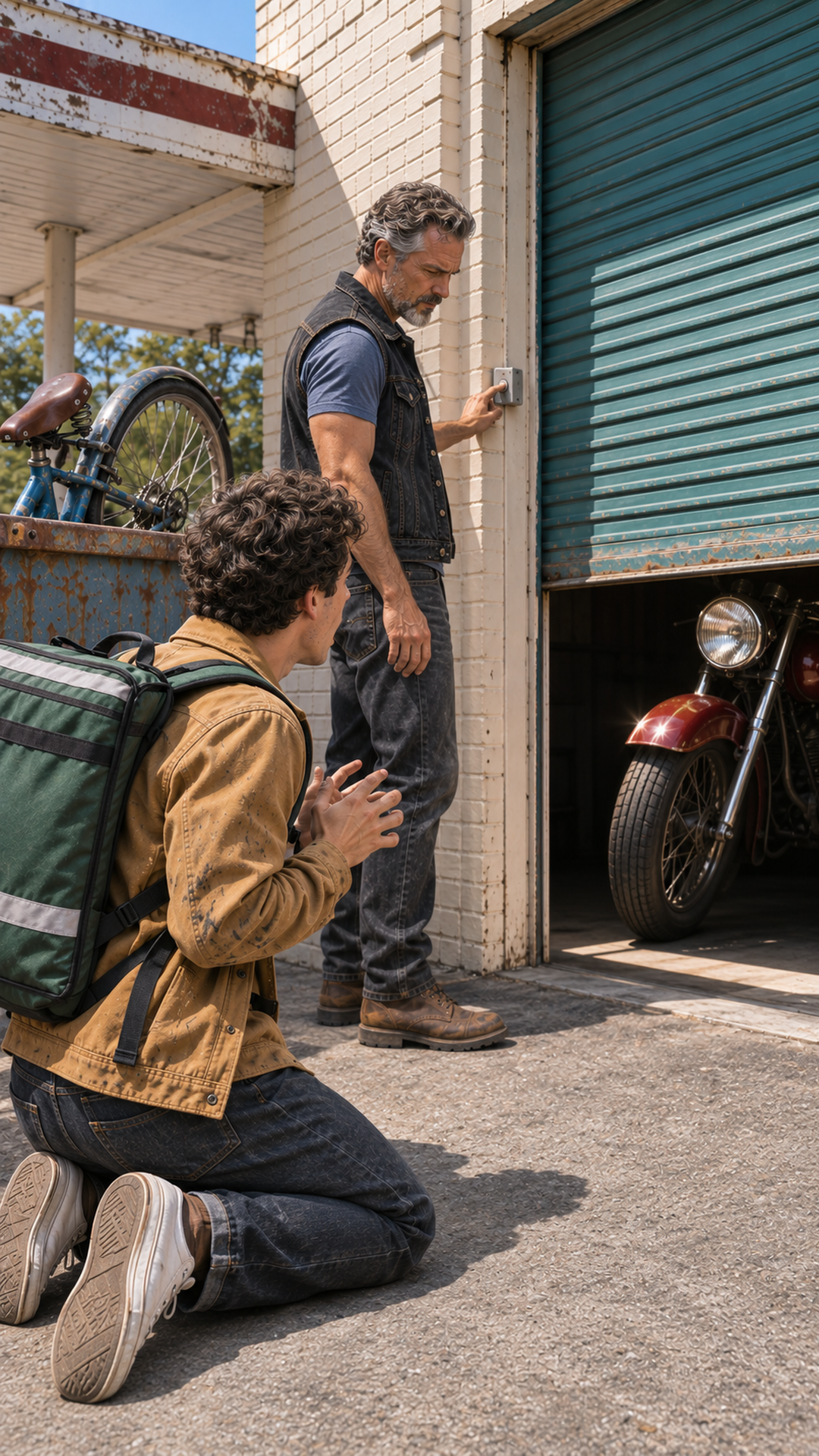
Eli dropped to his knees beside the steel scrap bin.
His hands came together as he looked up at Ray, visibly distressed by what had just happened.
“Please. That bike pays my rent.”
The statement explained everything.
The faded-blue bicycle was not simply something Eli used for occasional exercise or short trips. It was the transportation he relied on to complete deliveries and support himself financially.
Losing it meant facing uncertainty about his next shift, his next payment, and his ability to meet his everyday expenses.
The damaged front wheel had already created a serious problem, but seeing the bicycle disappear into a scrap bin made that problem feel even more permanent.
Ray listened without immediately responding.
Then he turned toward the wall beside the closed teal garage door.
He reached for a switch and pressed it.
A mechanical click broke the silence.
The garage door began rising, its rollers rattling as the heavy panel moved upward.
A narrow strip of daylight appeared beneath it and gradually widened.
Eli remained beside the scrap bin, watching the opening.
The sunlight first revealed a cherry-red motorcycle fender.
As the garage door continued moving, a round chrome headlight came into view.
Eli’s clasped hands slowly separated.
Something entirely unexpected was waiting inside the garage.
The man who had just placed his bicycle in a scrap bin was now revealing a motorcycle.
But Eli still did not understand what Ray intended to do with it.
The Cherry-Red Motorcycle Behind the Door
As the garage door finished opening, the motorcycle became fully visible.
It was a cherry-red cruiser with a black saddle, a round chrome headlight, and a polished fuel tank. The motorcycle rested on its kickstand just inside the garage.
Eli rose to his feet.
Only moments earlier, he had been kneeling beside the scrap bin, asking Ray not to take away the bicycle he depended on.
Now he was looking at a completely different form of transportation.
The contrast between the two vehicles was remarkable.
His faded-blue bicycle had a badly damaged front rim and was sitting inside a steel container. The cherry-red motorcycle stood upright inside the garage, ready for its next rider.
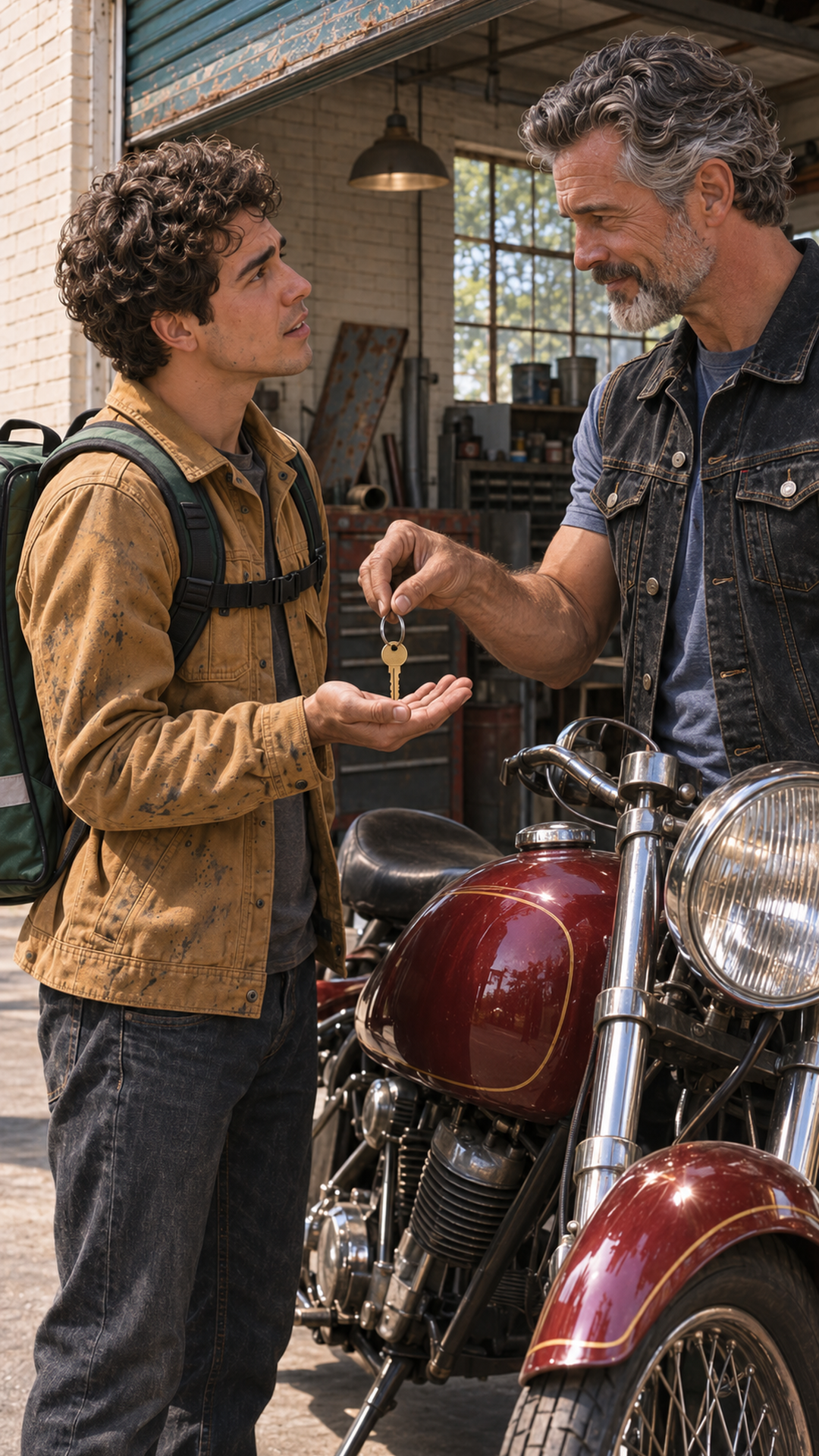
Ray stepped toward Eli and extended his hand.
A brass ignition key hung from a steel ring between his fingers.
Eli looked at the key, then opened his palm.
“Just for today?”
His question revealed how he understood the offer.
He appeared to believe that Ray was allowing him to borrow the motorcycle temporarily so he could finish his deliveries or get through the remainder of his working day.
Even that would have been an unexpected gesture of generosity.
Ray dropped the key into Eli’s open hand.
“For good. It’s yours.”
The small steel ring jingled as it landed against his palm.
Eli looked up.
The motorcycle was not being offered as a temporary replacement. Ray was telling him that he could keep it.
The entire encounter suddenly made sense in a different way.
What had appeared to be the loss of Eli’s only transportation had led to an extraordinary offer of help.
More Than a Replacement Vehicle
For Eli, the motorcycle represented something more significant than an upgrade from his damaged bicycle.
His ability to work depended on having transportation.
When the bicycle’s front wheel became trapped in the drain grate, the consequences extended beyond the immediate accident. The damaged rim threatened to interrupt the deliveries he relied on for income.
Ray’s gift offered a potential solution to that problem.
The motorcycle could provide Eli with another way to travel, assuming he had the necessary licensing, insurance, registration, training, and other requirements for operating it safely.
The fictional story does not establish those practical details, but its emotional focus is clear.
Ray recognized that the young man’s damaged bicycle was connected to his livelihood.
Rather than simply expressing sympathy, he offered something that could make a meaningful difference.
Eli had initially believed the motorcycle might be available only for the day. Ray’s response removed that uncertainty.
“For good. It’s yours.”
The words transformed the encounter from a temporary favor into a much larger act of generosity.
For someone who had just explained that his bicycle paid his rent, the offer carried particular significance.
It represented the possibility of continuing to work instead of facing an immediate interruption in his income.
The brass key resting in his hand became a symbol of that unexpected opportunity.
The Moment Ray Asked the Most Important Question
Looking back at the encounter, one of Ray’s earliest responses was particularly meaningful.
After Eli fell and dropped the pizzas, the delivery worker immediately apologized and promised to bring two fresh ones.
Ray could have focused entirely on the ruined food.
Instead, he asked whether Eli was hurt.
That simple question established a different priority.
The pizzas could be replaced. The condition of the person who had fallen mattered more.
Eli indicated that he was not injured, allowing their attention to shift toward the damaged bicycle.
The story uses this brief exchange to demonstrate how compassion can begin with something as ordinary as asking whether another person is all right.
Ray’s later decision to offer the motorcycle was far more dramatic, but the concern he showed immediately after the accident was meaningful in its own right.
Eli had arrived as a delivery worker responsible for bringing someone lunch.
Ray responded to him as a person whose well-being deserved attention.
That distinction becomes especially important when the bicycle’s role in Eli’s financial circumstances is revealed.
The ruined pizzas were an inconvenience. Losing his transportation could have created a much more serious difficulty.
Why the Scrap Bin Made the Surprise So Powerful
When Ray lowered the bicycle into the steel scrap bin, Eli believed he was watching his livelihood disappear.
The damaged front wheel vanished inside the container, leaving only the rear wheel visible above the metal edge.
Its slowly fading ticking sound emphasized the apparent finality of the moment.
Eli’s reaction was immediate.
He hurried toward the bin and explained that the bicycle was essential to his work.
At that point, he had no reason to expect a replacement motorcycle.
The closed garage door concealed everything that was waiting inside.
That uncertainty creates the central suspense of the fictional story.
Ray’s actions initially appear insensitive because he removes something Eli clearly values. Only after the garage door opens does the audience discover the unexpected direction of the encounter.
The cherry-red motorcycle provides a striking visual contrast with the faded-blue bicycle.
One vehicle represents the immediate problem. The other represents an unexpected opportunity.
The story does not suggest that disposing of someone else’s property without permission is generally appropriate. In an actual situation, the owner should be consulted before a damaged bicycle is discarded, particularly when it is essential to their livelihood.
Within the fictional narrative, the scrap bin serves as a dramatic storytelling device that makes the eventual gift more surprising.
The Value of Helping Someone Continue Working
Many people depend on particular tools or vehicles to earn their income.
For a delivery worker, reliable transportation can be just as important as the food being delivered.
A damaged bicycle, an unexpected repair, or the loss of essential equipment can interrupt work immediately.
That interruption may create additional difficulties when everyday expenses still need to be paid.
Eli expressed that reality in a single sentence.
“That bike pays my rent.”
He did not need to provide a detailed explanation of his financial situation. His words established why the damaged bicycle mattered so much.
Ray’s gift addressed the practical problem behind Eli’s distress.
Rather than simply offering reassurance, he provided another vehicle that could potentially help Eli continue earning money.
The fictional story does not reveal Ray’s financial circumstances or explain why the motorcycle was inside his garage.
It also does not establish whether the two men had met before that afternoon.
What it does show is a person recognizing another individual’s difficulty and responding with an unusually generous offer.
That is the central message of the encounter.
Meaningful assistance can involve understanding what someone needs to regain stability rather than focusing only on the immediate inconvenience.
For Eli, that need was transportation.
The Hug That Said More Than Words
With the brass key still in his hand, Eli stepped toward Ray.
The delivery worker who had been apologizing for two ruined pizzas was now trying to express gratitude for something he had never expected to receive.
He pulled Ray into a quick hug beside the cherry-red cruiser.
“You just saved my job.”
His words reflected what the gift meant to him.
The motorcycle was not simply an exciting possession. It represented the possibility of continuing the work he depended on.
Ray accepted the embrace.
Behind them, the garage door remained open, allowing sunlight to fall across the motorcycle’s polished surfaces.
The steel scrap bin was still nearby, containing the damaged faded-blue bicycle.
The two objects remained part of the same scene, illustrating how dramatically Eli’s circumstances had changed during their encounter.
Only a short time earlier, he had been kneeling beside the container, pleading for his bicycle.
Now he was standing beside a motorcycle that Ray had offered him permanently.
The fictional narrative does not show the formal transfer of ownership or the arrangements required before the motorcycle could legally be used on public roads.
Instead, it focuses on Eli’s immediate emotional response to Ray’s generosity.
The Sound of a New Beginning
A little later, Eli was sitting on the parked cherry-red motorcycle.
He wore a matte-black open-face helmet with its strap buckled. His green backpack was secured on his back, and both white sneakers rested firmly on the concrete.
Ray stood nearby in his black vest.
Eli looked down at the motorcycle’s controls and pressed the starter.
The engine caught.
Its low idle filled the garage entrance, replacing the earlier sounds of scraping pedals, falling cardboard, and the damaged bicycle’s slowly ticking rear wheel.
Eli remained seated on the stationary motorcycle.
He turned toward Ray, and the two exchanged a grin.
The story did not need to show him riding away to communicate the significance of the moment.
The sound of the engine and the smile on his face were enough to suggest a hopeful new beginning.
What had started as an unsuccessful pizza delivery had become an unexpected encounter with generosity.
Eli had arrived worried about completing his work. He had experienced a fall, lost two pizzas, and watched his damaged bicycle disappear into a scrap bin.
Now he held the key to a motorcycle that had been offered to him without any stated expectation of repayment.
The final moment captured the emotional difference between losing something essential and receiving an opportunity to move forward.
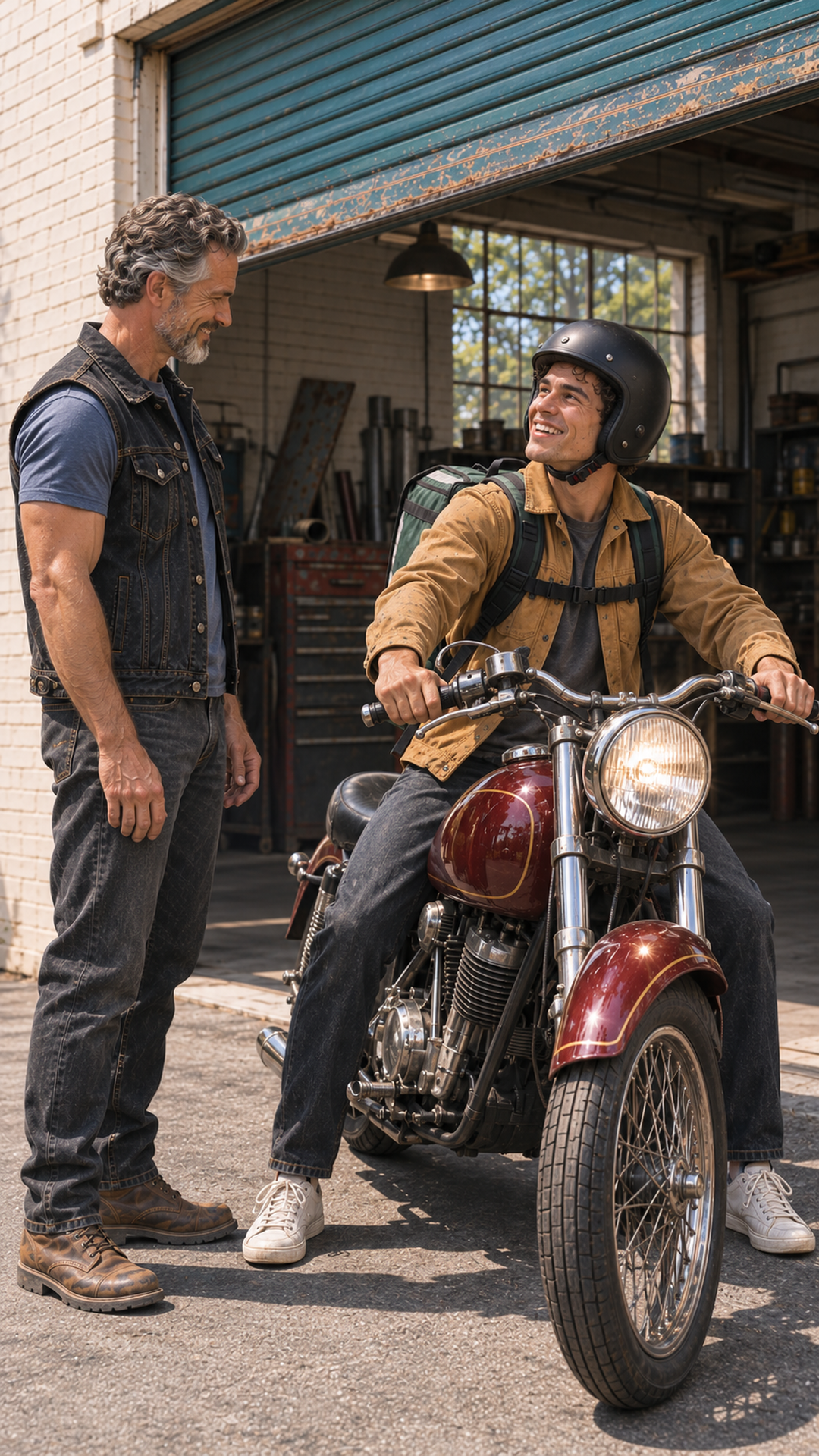
Eli sat on the cherry-red motorcycle with his helmet buckled, his green backpack secured, and both feet resting on the concrete. As the engine settled into a steady idle, he turned toward Ray and smiled. The delivery that had begun with a damaged bicycle and two ruined pizzas ended with an extraordinary gift, reminding us that one person’s generosity can offer someone else a completely unexpected new beginning.