An Afternoon That Changed Without Warning
The harbor was peaceful that afternoon. Water moved gently beneath the wooden pilings, and the distant sound of a passenger train echoed across the waterfront. Visitors could walk along the boardwalk, enjoy the fresh air, and watch the trains approaching the nearby depot.
For a 34-year-old woman named Nora, however, an ordinary afternoon had taken an unexpected and dangerous turn.
She lay unconscious between the railway tracks, dressed in a pale blue denim shirt, black jeans, and white sneakers. Her dark braid rested against the wooden crossing, and an overturned canvas grocery bag lay beside her.
A lemon had escaped from the bag and rolled across the planks until it gently touched her open hand.
It stopped there.

Nora’s eyes remained closed. Her chest rose gently with each breath, but she showed no indication that she was aware of her surroundings.
Farther down the railway line, a maroon-and-cream passenger train was slowly approaching the depot.
Along a nearby footpath, Eli, a 46-year-old man with short, graying curls, was enjoying a walk with his German shepherd.
He wore a red windbreaker over a charcoal T-shirt, tan work pants, and brown boots. His dog, Gus, had black-and-tan fur and wore a distinctive teal harness attached to a black leash.
“This way, Gus,” Eli called.
He expected the dog to continue beside him as usual.
Instead, Gus noticed something near the railway crossing that immediately captured his attention.
The German Shepherd Refuses to Follow the Path
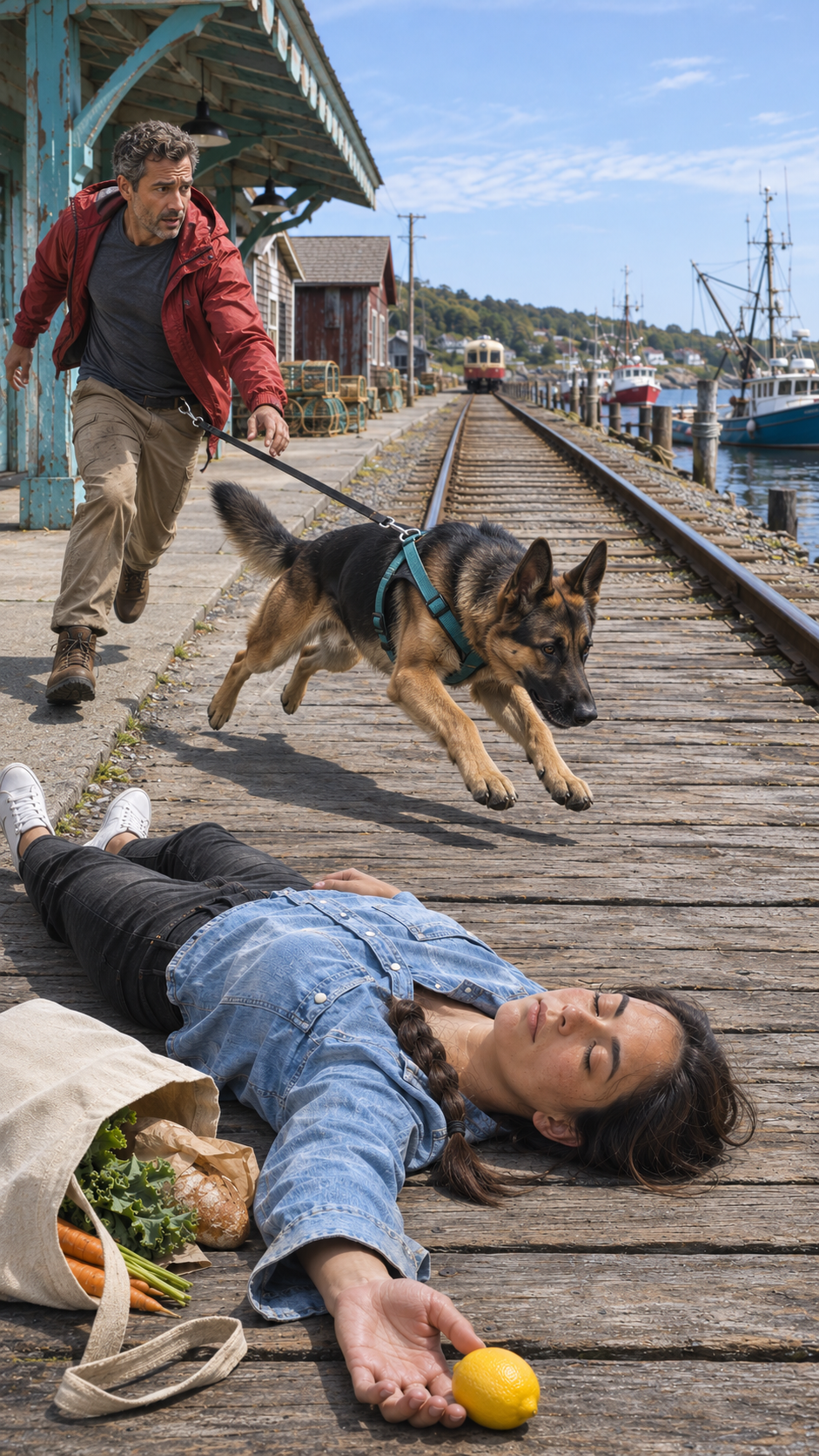
Gus suddenly changed direction, pulling the black leash tight against Eli’s left hip.
The movement was unexpected enough to interrupt Eli’s walk. He looked toward his dog, wondering what had attracted his attention.
Gus continued pulling toward the railway crossing.
His ears were raised, and his gaze remained fixed on something between the rails. Rather than following Eli along the footpath, he appeared determined to investigate.
“Easy, Gus,” Eli said.
Then he followed the dog’s gaze.
“Oh, I see her.”
From his new position, Eli could finally see Nora lying across the wooden crossing. Her pale blue shirt was visible between the dark rails, and her grocery bag rested nearby.
Something was clearly wrong.
She was not sitting beside the railway or taking a moment to rest. Her body remained motionless, and her eyes were closed.
Eli’s attention immediately shifted from his dog’s unusual behavior to the woman who appeared to need assistance.
The distant train made the discovery particularly alarming.
Gus had noticed Nora before his owner did. His sudden refusal to continue along their usual path had brought the situation to Eli’s attention.
The German shepherd moved toward the woman while Eli followed.
The leash clip made a small clicking sound, and Eli’s boots scuffed against the wooden planks.
Only moments earlier, the two had been enjoying a peaceful walk. Now they had encountered an emergency that neither could have anticipated.
Gus Tries to Get Her Attention
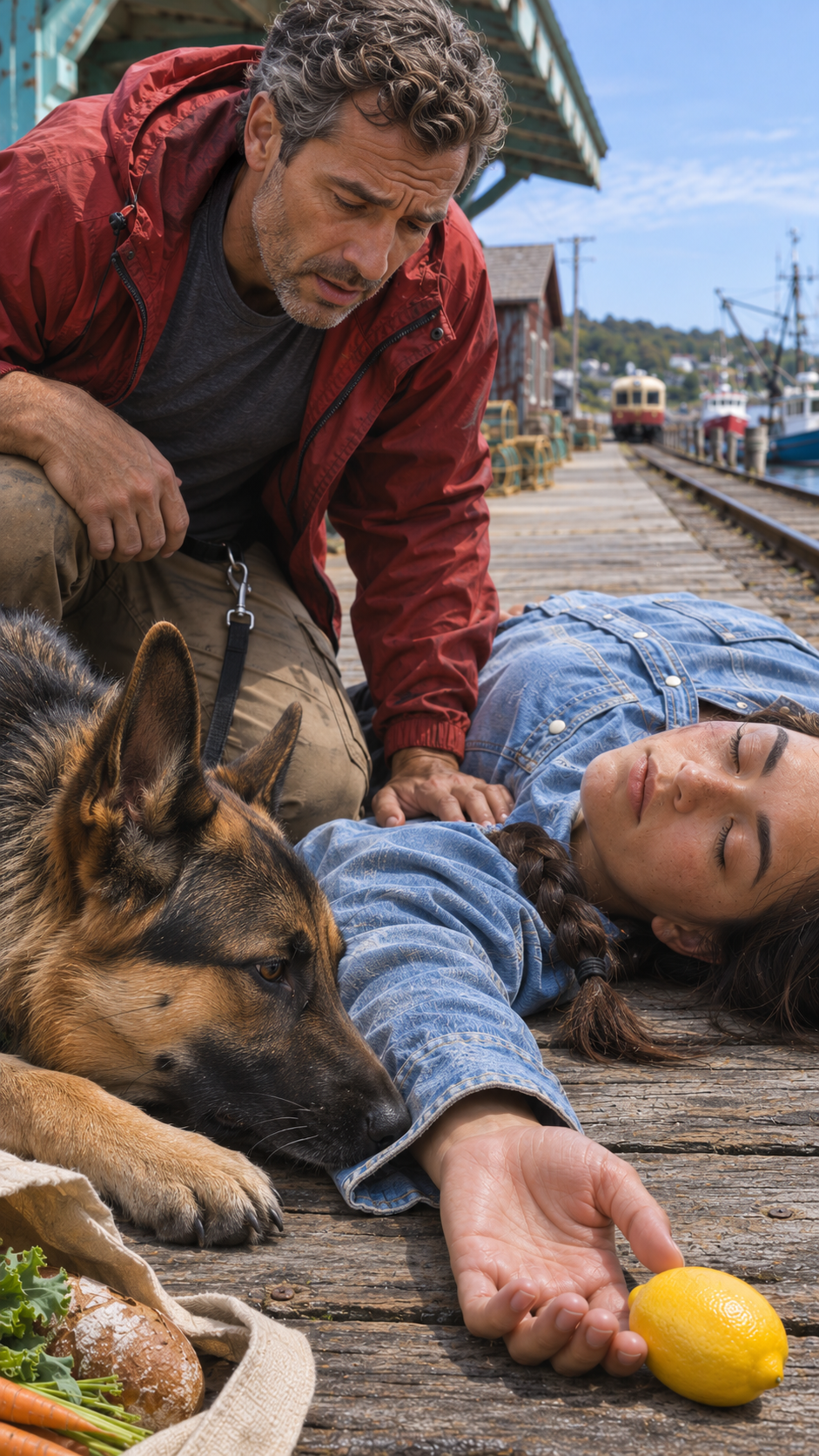
As Gus approached Nora, he lowered his head toward her open hand.
He gently slipped his nose beneath the cuff of her denim shirt. Her thumb brushed against his whiskers, but she did not open her eyes.
The German shepherd remained beside her.
Eli knelt nearby and attempted to speak to the unconscious woman.
“Ma’am, can you hear me?”
There was no response.
Her chest continued rising gently, but she remained unaware of the people and animal beside her.
The lemon still rested near her hand. Her grocery bag had tipped onto its side, suggesting that she had been carrying ordinary shopping before losing consciousness.
Eli did not know what had caused her to faint. He had no information about her medical history or how long she had been lying there.
What he did know was that she needed assistance.
Gus released a soft whine before turning his head toward the railway line.
His ears moved as the sound of the approaching passenger train became more noticeable.
Then he barked twice.
Eli looked toward the maroon-and-cream train in the distance. Although it was traveling slowly toward the depot, it was still moving along the railway where Nora had fallen.
The situation had become increasingly urgent.
Gus’s gentle attempt to get Nora’s attention had not awakened her. His barking now drew Eli’s attention toward the approaching danger.
The peaceful harbor surroundings suddenly seemed very different.
Eli needed to respond to the emergency, and the train needed to stop before reaching the crossing.
The Red Windbreaker Becomes a Warning
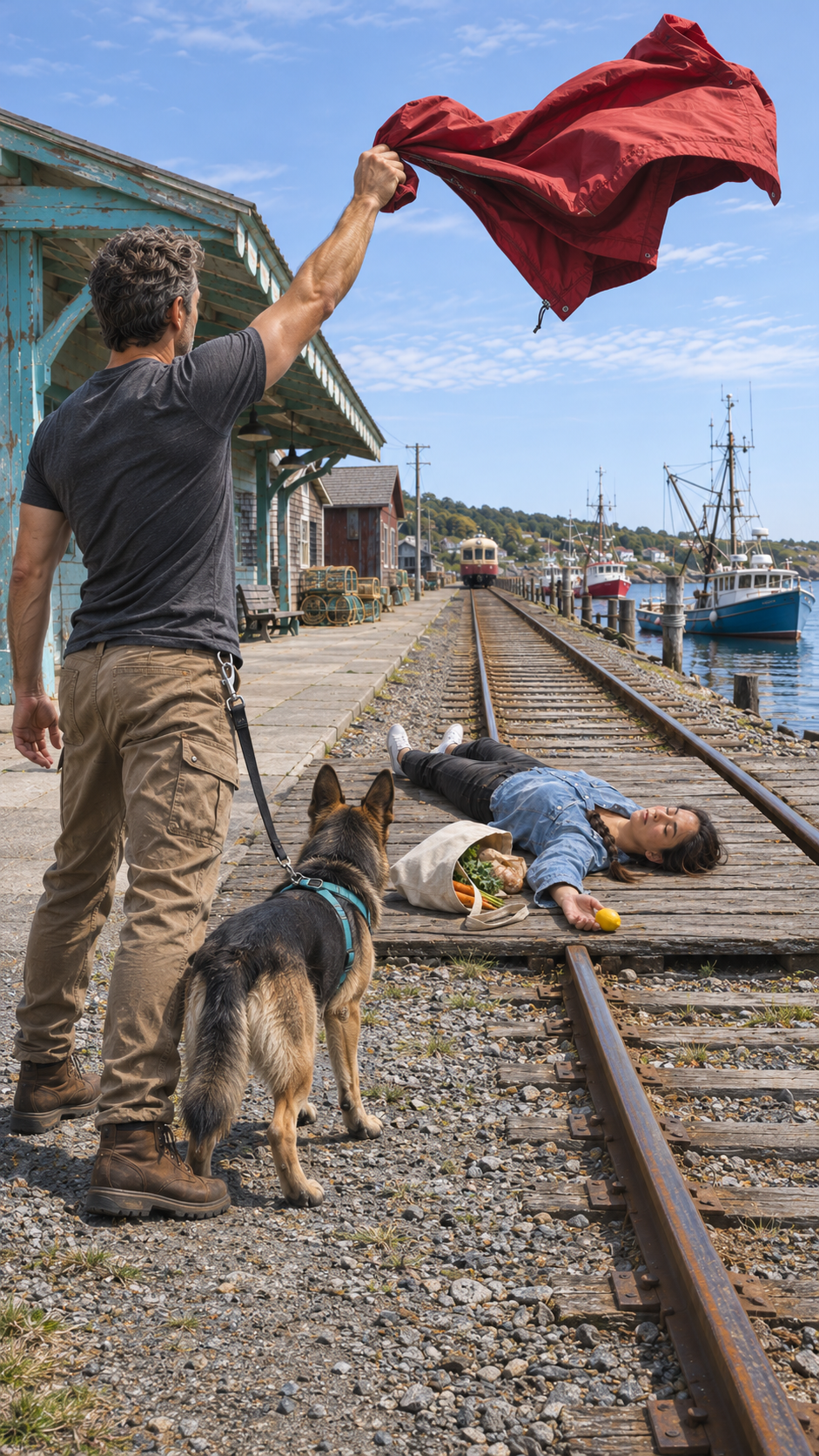
Eli stepped away from the rails and onto the gravel shoulder. Gus followed closely at his left heel.
The bright red windbreaker that Eli had worn throughout his afternoon walk became an important part of the fictional rescue.
He removed it and raised it overhead, attempting to attract attention from the approaching train.
“Stop! Someone’s down!” he shouted.
The maroon-and-cream passenger train remained visible farther along the railway line.
Then came the sound of air brakes.
The train gradually slowed until it came to a complete stop well before reaching Nora’s position.
A long stretch of empty railway track remained between the stationary train and the wooden crossing.
Eli lowered his arms, allowing the red windbreaker to fall beside his boots.
Gus remained close to him.
The immediate threat depicted in the story had been interrupted, but the emergency was not over. Nora was still unconscious and needed to be moved away from the railway corridor by people able to assist her.
The stopped train created an opportunity for additional help to arrive.
A rail worker named Walt soon joined Eli.
Walt wore navy coveralls beneath an orange reflective vest. His gray mustache and calm expression stood out as he approached the scene.
Together, the two men prepared to help Nora reach the adjoining boardwalk.
Gus watched from beside his owner.
The dog that had initially noticed the woman’s hand was still present as the rescue moved into its next stage.
Working Together to Bring Nora to Safety
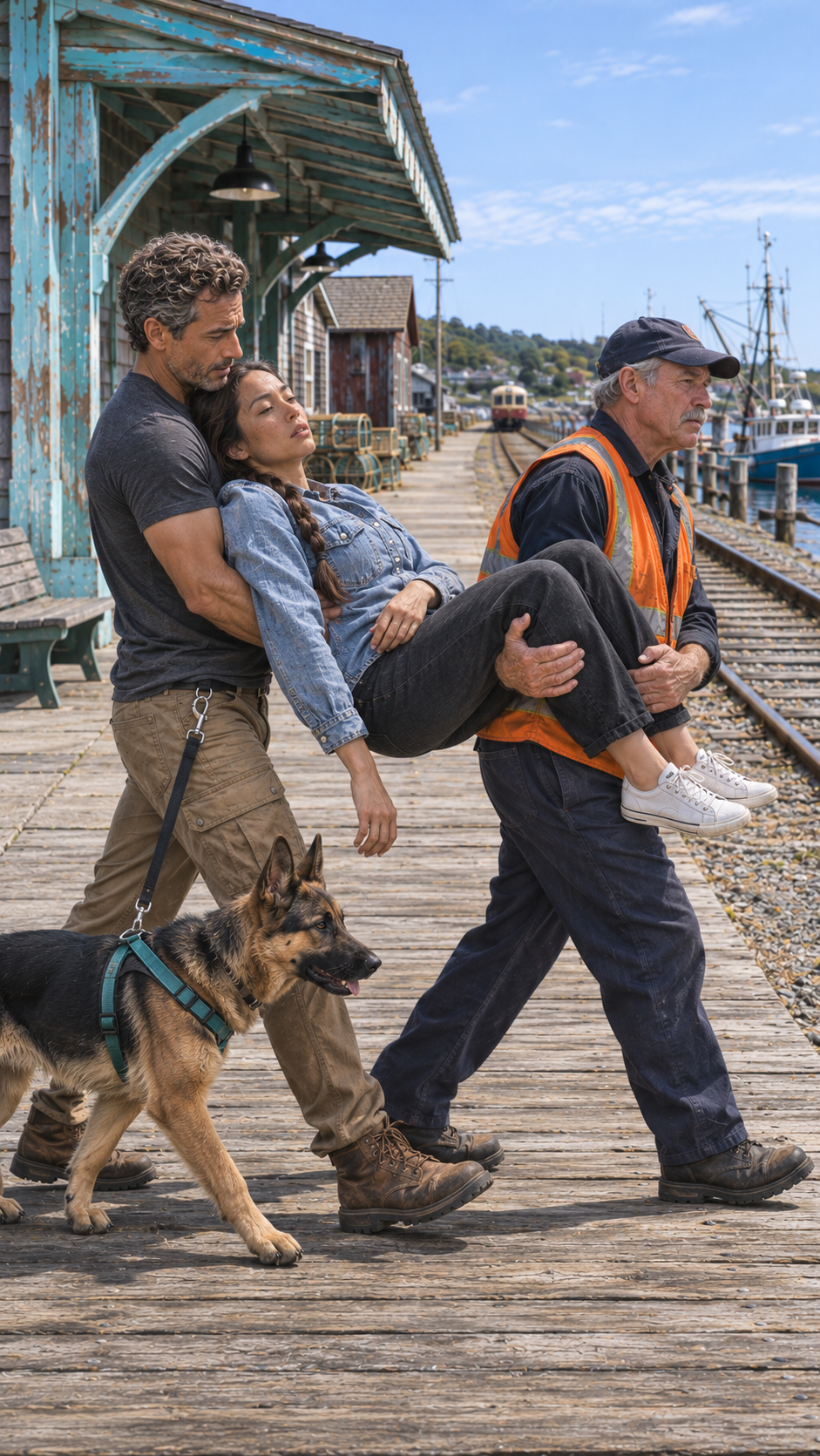
With the passenger train stopped in the distance, Walt and Eli helped carry Nora away from the railway tracks.
Walt supported her beneath her knees, while Eli supported her upper back.
Eli was now wearing only his charcoal T-shirt and tan work pants. His red windbreaker remained behind on the gravel shoulder.
Gus followed beside him, walking on the slack black leash.
The men’s boots made heavy sounds against the wooden boardwalk as they moved Nora away from the crossing.
Once they reached the adjoining area, they carefully lowered her.
Then something changed.
Nora opened her eyes.
Walt looked toward her and spoke softly.
“Hey, there you are.”
After the uncertainty of the previous moments, seeing her regain consciousness brought a sense of relief.
Nora was no longer lying between the rails. The passenger train remained stopped in the distance, and both men were beside her.
Gus stayed nearby.
His collar tag jingled as he moved closer to Eli.
For Nora, the experience must have been confusing. The last ordinary details associated with her afternoon were her grocery bag and the railway crossing. Now she was surrounded by two men and a German shepherd who had helped bring attention to her situation.
The fictional narrative does not establish what caused her loss of consciousness. It also does not show a medical examination or confirm that she had fully recovered.
Nevertheless, her opening eyes marked an important turning point in the story.
The immediate railway danger was behind her, and she was able to begin responding to the people around her.
The First One to Notice Her
Among the people involved in Nora’s fictional rescue, Gus occupied a particularly meaningful role.
He was the first to notice her.
Eli had been walking along the adjoining footpath without realizing that someone was lying between the railway tracks. It was the dog’s sudden change of direction that caused him to investigate.
Gus did not need to perform a complicated rescue himself. His most important contribution was drawing attention to something his owner had not yet seen.
The gentle nudge beneath Nora’s denim cuff added another emotional detail to the encounter.
Although she remained unconscious, her thumb briefly brushed against the dog’s whiskers.
Gus stayed beside her until his attention shifted toward the approaching train.
The story does not establish whether he understood the full danger of the situation. His behavior may be understood within the fictional narrative as a response to unusual circumstances, sounds, and the presence of an unresponsive person.
Dogs are often highly attentive to their surroundings. Their hearing, sense of smell, and ability to notice changes in familiar environments can make them remarkably observant companions.
However, their behavior should never be treated as a dependable emergency detection system.
What makes Gus’s role memorable is the simple fact that Eli paid attention when his dog behaved unexpectedly.
That moment of awareness began a sequence of events that ultimately brought Nora away from the railway crossing.
Two Strangers Who Chose to Help
Eli and Walt had different reasons for being near the railway that afternoon.
Eli was walking his dog along the waterfront. Walt was a rail worker carrying out his professional responsibilities.
Neither had expected their afternoon to involve Nora.
Yet their paths crossed when Gus drew attention to the emergency.
Eli’s initial concern led him to investigate the woman’s condition. Walt later joined him as they helped bring her onto the boardwalk.
Their cooperation became an essential part of the fictional rescue.
The encounter illustrates how unexpected situations can require people to communicate and work together.
There was no elaborate conversation between the men. Their attention remained focused on the woman who needed assistance.
Once Nora opened her eyes, Walt’s reassuring words helped create a calmer atmosphere.
Gus remained close throughout the encounter, connecting the discovery of the emergency with its emotional conclusion.
The story’s message is not that every person should attempt a dangerous rescue independently. Real railway emergencies require professional intervention and careful attention to safety.
Instead, the narrative celebrates the willingness to recognize another person’s distress and seek appropriate assistance.
The Lemon That Tells Its Own Story
The lemon beside Nora’s hand is one of the smallest details in the entire encounter, yet it gives the opening scene a particularly human quality.
It suggests that Nora had been carrying groceries before her unexpected collapse.
There was nothing extraordinary about the bag or its contents. They belonged to the ordinary routines of everyday life.
That contrast makes the emergency more striking.
One moment, a person may be completing a familiar task. The next, an unexpected medical problem can leave them unable to respond to their surroundings.
The lemon rolling across the wooden crossing emphasizes how suddenly Nora’s afternoon had changed.
It came to rest beside a hand that could no longer reach for it.
Later, Gus approached that same hand and gently nudged beneath her sleeve.
The story connects these small details without needing a lengthy explanation.
The lemon represents the ordinary afternoon that was interrupted. Gus’s touch represents the beginning of the assistance that followed.
By the final scene, Nora is able to respond to that familiar touch herself.
A Reunion Beneath the Turquoise Canopy
A little later, Nora knelt beneath the turquoise canopy near the waterfront.
Her dark braid rested over the shoulder of her pale blue denim shirt. She was conscious and able to interact with the people around her.
Eli stood nearby in his charcoal T-shirt, watching as Gus approached.
The German shepherd moved toward Nora and lowered his head.
Once again, he slipped his nose beneath the cuff of her denim shirt.
This time, everything was different.
Nora turned her palm upward.
She gently cupped the dog’s cheek and looked into his face.
Then she wrapped both arms around him.
Gus relaxed against her shoulder, his ears settling as she held him close.
The harbor water continued moving beneath the wooden pilings, creating the same peaceful sounds that had been present at the beginning of the afternoon.
But the circumstances had changed completely.
The woman who had been unable to respond when Gus first approached her was now embracing him.
Eli smiled behind them.
He had witnessed the dog’s unusual behavior, followed him toward the crossing, and participated in the rescue that followed.
Now he was watching Nora acknowledge the companion who had first drawn his attention to her.
Why the Final Gesture Matters
The reunion is especially touching because Gus repeats the same gentle action he performed when Nora was unconscious.
Earlier, his nose slipped beneath her denim cuff, and her thumb brushed against his whiskers.
Later, he approaches her in exactly the same way.
The familiar gesture provides a connection between the frightening discovery and the peaceful ending.
Nora’s response is no longer an uncertain movement of her hand. She deliberately turns her palm upward, touches Gus’s face, and embraces him.
Her words express gratitude in a personal and memorable way.
“I know that nose. Thank you, Gus.”
The fictional story does not confirm exactly what Nora remembers from the period when she was unconscious.
Instead, the repeated touch serves as an emotional storytelling device, linking the dog’s first attempt to get her attention with her eventual recognition of him.
There is no award ceremony or public celebration.
The conclusion is simply a woman embracing a dog while his owner watches nearby.
That quiet moment gives the story its warmth.
Important Lessons About Railway and Medical Emergencies
Although this fictional rescue has a hopeful conclusion, real railway emergencies are extremely dangerous.
Trains require considerable stopping distances, and their operators may not be able to respond immediately to unexpected obstacles.
Anyone who discovers an unconscious person near railway tracks should contact emergency services and railway authorities from a safe location. Entering an active railway corridor or attempting to stop a train independently can place additional lives at risk.
Similarly, unexplained fainting or loss of consciousness requires appropriate medical assessment.
Regaining consciousness does not necessarily mean that the underlying problem has been resolved.
The fictional narrative is intended to celebrate compassion, awareness, and the relationship between humans and animals rather than demonstrate emergency rescue procedures.
Its most meaningful lesson is the importance of noticing when something is wrong and ensuring that the appropriate assistance is sought.
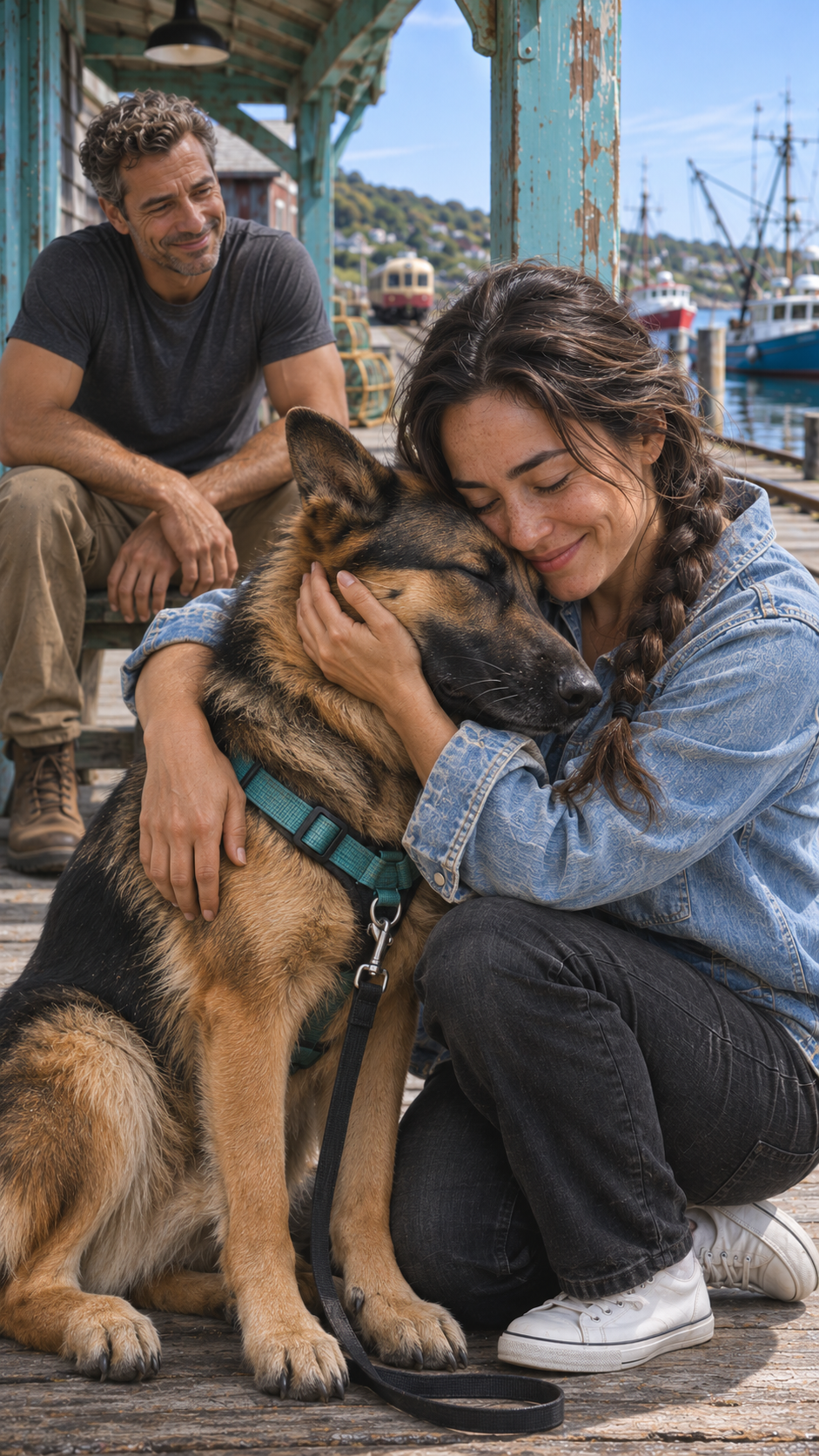
Beneath the turquoise canopy, Nora wrapped her arms around Gus as the German shepherd relaxed against her shoulder. Eli smiled nearby, and the gentle sounds of the harbor replaced the earlier noise of the approaching train. “I know that nose. Thank you, Gus,” she whispered. What began with an ordinary walk ended with an unforgettable embrace, celebrating the extraordinary connection between a loyal dog and the stranger whose distress he refused to ignore.