The Stranger With Only One Quarter
The afternoon was peaceful at a small waterfront food stand. The smell of grilled burgers drifted beneath a striped canvas awning, while the gentle movement of water could be heard beneath the wooden deck. A nearby ferry idled as customers enjoyed their meals at painted picnic tables overlooking the water.
Among the people visiting the stand was a man named Eli. He wore a faded olive coat pulled tightly around his body, worn boots, and a shaggy gray wig. His crooked nose and silver-streaked beard gave him a distinctive appearance, but there was little about his clothing that suggested he was anyone particularly important.
Sitting at one of the picnic tables, Eli opened his hand to reveal a single quarter.
June, an employee at the food stand, approached him carrying a red plastic basket containing a burger and fries. She placed it near him, noticing the coin resting in his palm.
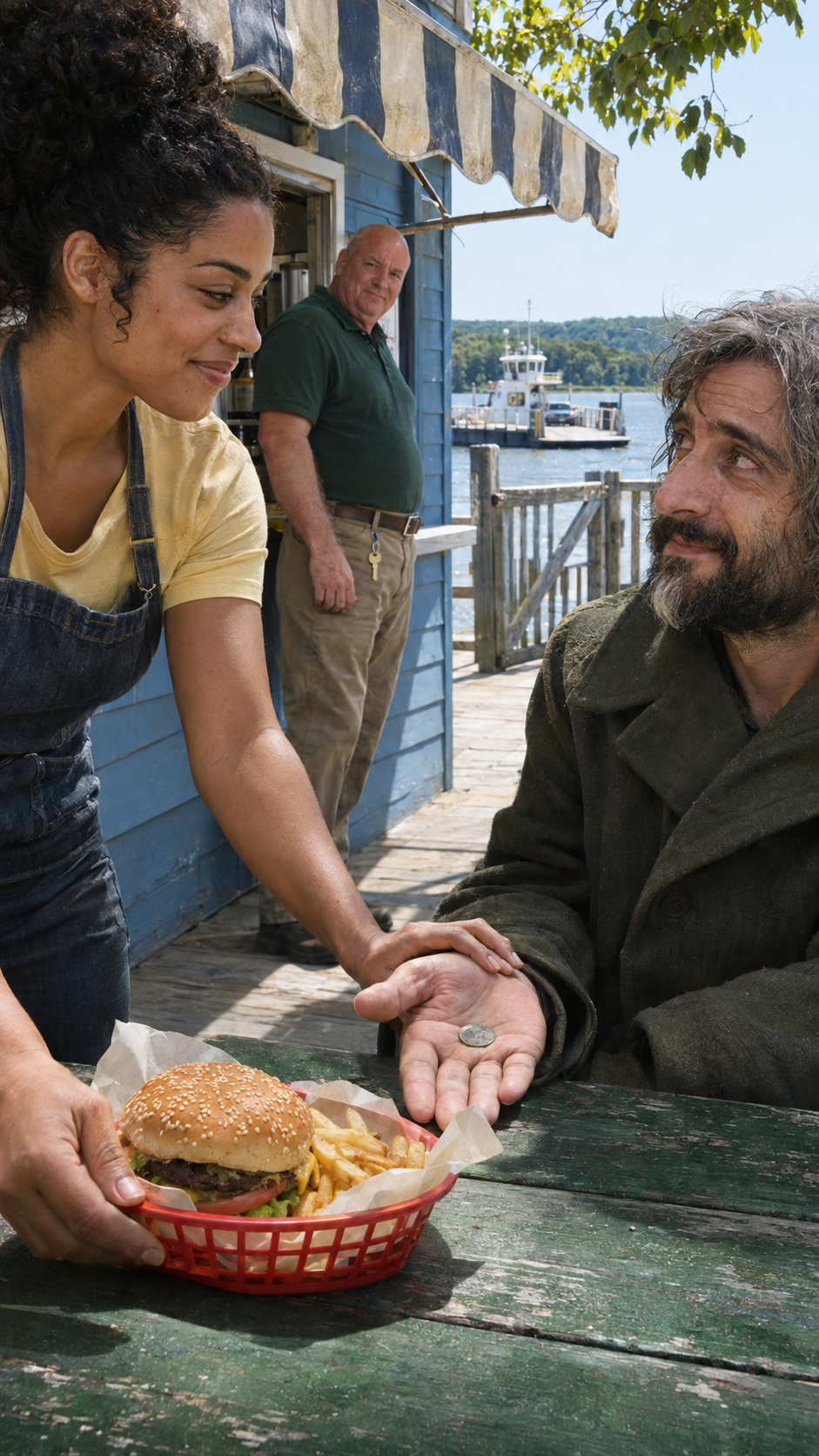
“That’s all I’ve got,” Eli told her.
June looked at the quarter and then back at the man. She could have taken the coin or explained that it was not enough to purchase anything on the menu. Instead, she gently closed his fingers around it.
“Keep it. Lunch is on me.”
She slid the basket across the painted wooden table until it was within his reach. The burger rested neatly on its wrapper, surrounded by freshly prepared fries.
Eli looked toward the meal. June’s gesture was simple, but she had made it clear that he did not need to surrender his last coin to enjoy lunch.
Before he could take his first bite, however, a shadow fell across the basket.
Frank, the manager of the food stand, had arrived.
The Meal Never Reached His Mouth
Frank stood beside the picnic table, looking down at the food June had given Eli. His expression made it immediately apparent that he was unhappy with what he had discovered.
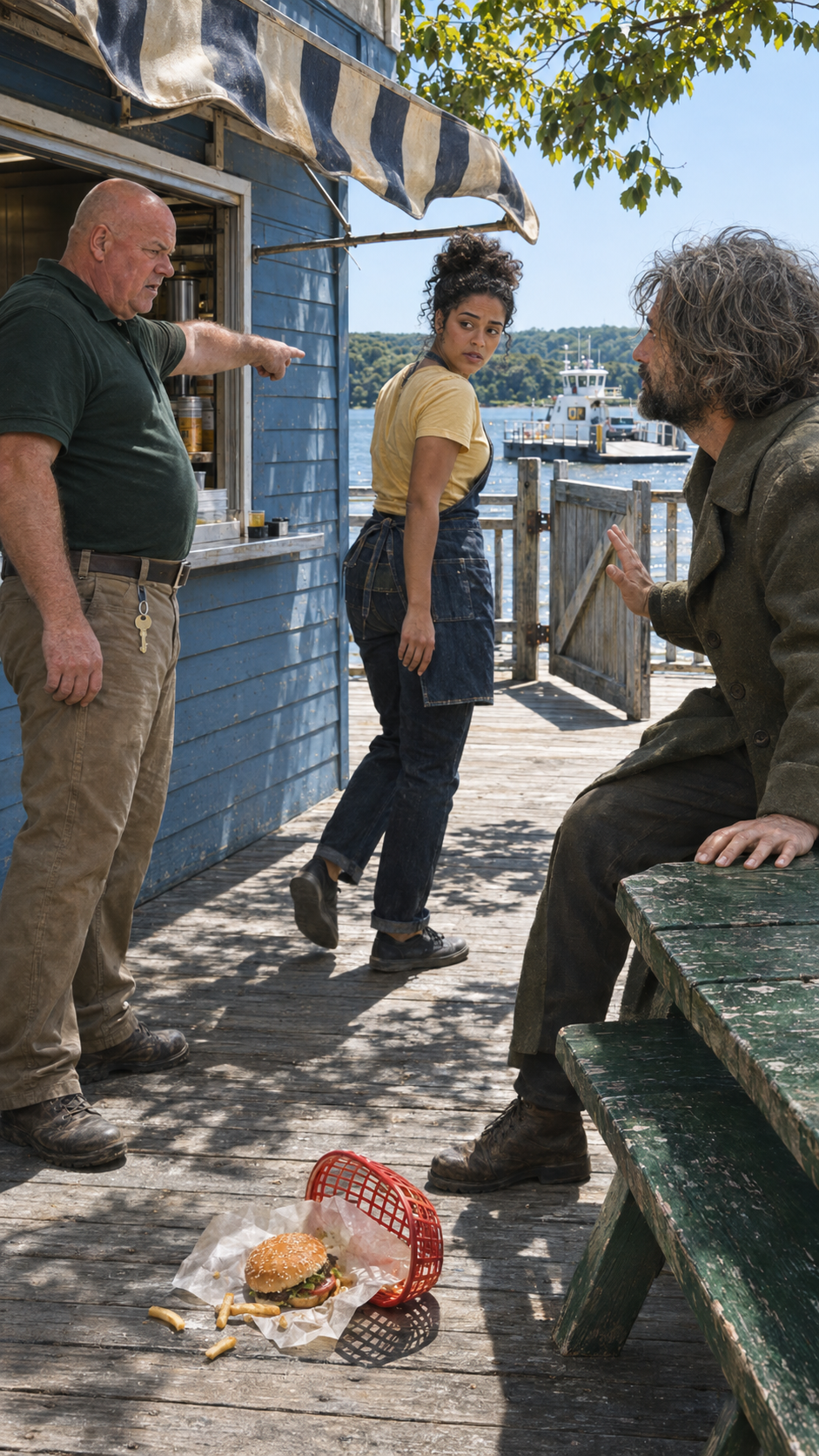
June had offered to cover the cost of the meal herself, but Frank did not stop to discuss the arrangement. Instead, he reached across the table and swept the red basket toward the edge.
The entire meal fell onto the wooden deck.
The burger landed on its wrapper, while the fries scattered across the boards. The empty red basket struck the deck with a hollow slap before coming to rest upside down beside the table leg.
“Nobody eats for free,” Frank declared.
Eli remained seated, his olive coat still pulled shut. The quarter was still in his hand, and the lunch June had offered him was now scattered across the floor.
June straightened and looked directly at Frank.
“Then put it on my tab.”
She did not raise her voice or respond with an insult. She simply repeated her willingness to pay for the food.
Her answer addressed the very concern Frank had expressed. If the stand needed payment for the meal, June was prepared to provide it.
But Frank’s reaction suggested that the disagreement had become about something more than the price of a burger.
The sound of the grill continued behind them. The ferry engine maintained its steady hum, and the striped awning moved in the breeze.
What should have been an ordinary lunch had turned into an uncomfortable confrontation.
June had tried to help someone who appeared unable to afford a meal. Now she was being challenged for that decision, even though she had offered to cover the expense herself.
Eli watched the exchange quietly.
Frank had no idea that the man sitting in front of him was paying close attention to everything he said.

Frank Orders Both of Them to Leave
Frank extended his arm toward the open service gate at the edge of the deck.
“Both of you. Off my deck.”
The instruction was unmistakable. He wanted Eli to leave, and he was ordering June away as well.
June took a step toward the gate. Her attempt to provide a stranger with lunch had unexpectedly placed her in conflict with the person managing the stand.
She had not asked the business to absorb the cost of the meal. She had volunteered to pay for it herself.
Nevertheless, Frank appeared unwilling to reconsider his decision.
The spilled fries remained scattered near the picnic table. The overturned red basket lay beside its leg, a visible reminder of how quickly the situation had escalated.
Then Eli spoke.
“Look at me first, Frank.”
June stopped walking.
There was something unexpected about the way Eli addressed the manager. He did not sound like a customer pleading to be allowed to remain. His voice was steady, and he spoke Frank’s name with familiarity.
Eli rose from the picnic bench. His boots settled firmly against the wooden boards as he stood opposite the manager.
The shaggy gray wig was still in place. His faded olive coat remained closed, concealing the clothing underneath.
For the first time during their confrontation, Frank was looking directly into the stranger’s face at eye level.
Eli did not argue about the spilled meal. He did not demand another burger or ask Frank to apologize.
Instead, he prepared to reveal something that would completely change the balance of authority between them.
June remained near the service gate, watching closely.
The man she had helped was about to show them who he really was.
The Gray Wig Comes Off
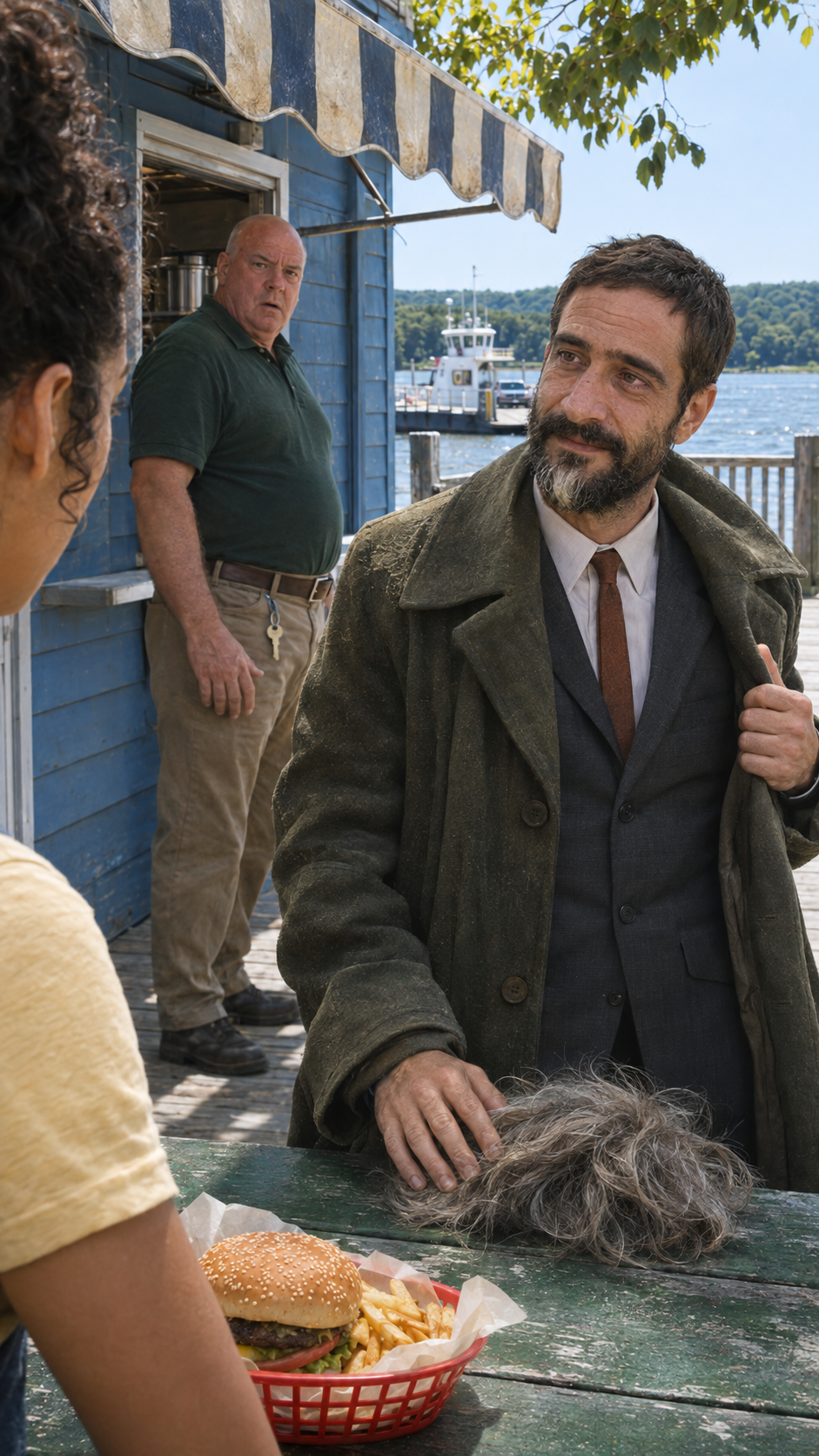
Eli raised his hands toward his head and carefully lifted away the shaggy gray wig.
Beneath it was his own short, dark hair.
He placed the wig on the empty end of the picnic bench, where it remained visible beside him.
Frank watched without speaking.
Eli then parted his faded olive coat. The worn outer garment opened to reveal a charcoal suit and a rust-colored tie.
His appearance changed dramatically, although his crooked nose and silver-streaked beard remained exactly the same.
The man who had been sitting at the picnic table moments earlier was not who Frank had assumed him to be.
Eli looked directly at the manager.
“I own this stand, Frank.”
For a moment, the only noticeable sounds were the movement of Eli’s coat and a gull calling somewhere across the water.
Frank’s pointing hand slowly dropped.
The authority with which he had ordered both Eli and June off the deck suddenly disappeared.
He had just thrown away a meal offered to the owner of the very business he managed. He had also ordered that owner to leave the premises.
More importantly, Eli had witnessed how Frank treated someone he believed could not afford to eat.
The disguise had concealed Eli’s position, but it had not changed his identity. He was the same person before and after removing the wig.
June’s expression reflected the unexpected nature of the revelation. She had offered him food when she believed he was simply a stranger with very little money.
She had not known that he owned the stand. She had not expected her decision to influence her position at work.
Her kindness had come before the truth was revealed.
That was what made the difference between her actions and Frank’s so striking.
The Owner Makes His Decision
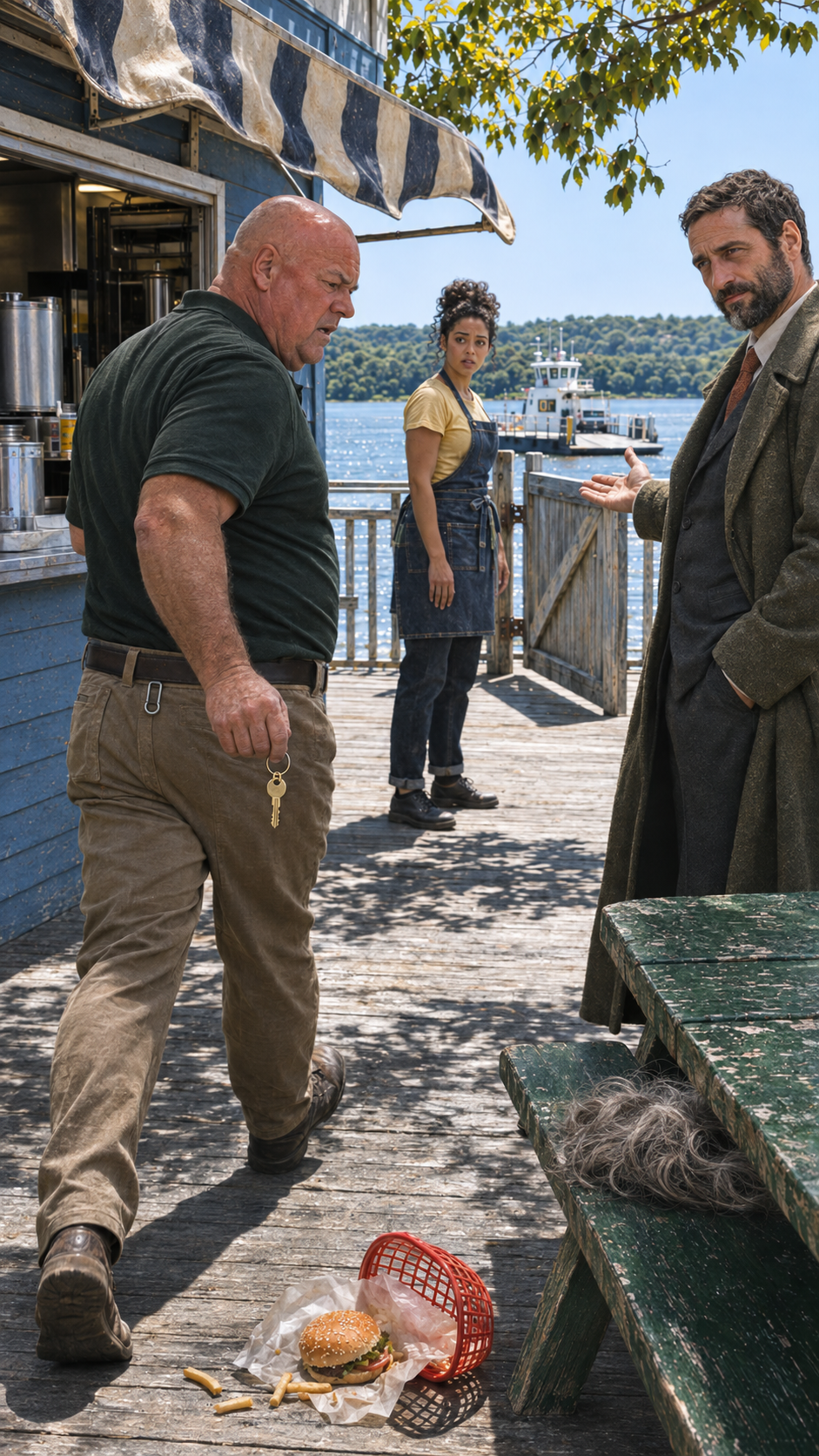
Eli stepped clear of the aisle, leaving enough room for Frank to move toward the service gate.
June remained nearby, watching the two men.
The owner looked directly at Frank and spoke with the same calm authority he had shown when revealing his identity.
“Hand June the key. She runs the stand now.”
Frank opened his mouth as though he wanted to respond. Then his eyes moved toward the overturned basket and the food scattered across the wooden deck.
He closed his mouth again.
The instruction was clear. Eli had decided that June would take responsibility for running the food stand.
Frank reached toward his belt, where a single brass key was attached to a metal clip.
He unclipped it.
The small sound of the clip snapping shut was almost lost beneath the ordinary waterfront noises, but the key represented an important change.
Until that moment, Frank had been the person exercising authority over the stand and its employees. He had decided who could remain on the deck and had attempted to dismiss both June and Eli.
Now the owner had instructed him to transfer that responsibility to the employee whose judgment he had challenged.
Frank turned toward June.
His footsteps echoed across the hollow wooden boards as he approached the service gate, holding the brass key in his hand.
Eli remained beside the picnic table, his olive coat open over the charcoal suit.
The gray wig still rested on the bench.
Nothing about the physical surroundings had changed. The same grill continued cooking food, the same ferry engine could be heard nearby, and the same awning moved above the deck.
But the roles of the people standing there had changed completely.
What June Had Demonstrated Without Realizing It
June’s original decision had been remarkably straightforward. She had seen a man holding a quarter and understood that it was not enough to purchase the meal she was offering.
Rather than embarrassing him or asking him to explain his circumstances, she had told him to keep the coin.
She was willing to cover the cost of lunch.
When Frank challenged her decision, she maintained that position. Even after he threw the food onto the deck, she offered to have the meal added to her own tab.
Her response demonstrated both compassion and personal responsibility.
She did not demand that the business provide something for nothing. She volunteered to pay for the food because she believed helping the stranger was worthwhile.
Eli’s eventual decision to put her in charge reflected what he had observed during their encounter.
June had shown how she treated someone when there was no obvious personal advantage in doing so.
She had no reason to believe the stranger could reward her. His appearance suggested that he had little money available, and his only visible coin was a quarter.
Yet she had treated him respectfully.
That quality became particularly significant once his identity was revealed.
The fictional story does not establish how long June had worked at the stand or whether she had previously held management responsibilities. It focuses on the owner’s immediate decision after witnessing the confrontation.
Within that moment, her conduct demonstrated the kind of values Eli wanted represented in his business.
Why Frank’s Reaction Mattered
Running a food stand involves practical responsibilities. Ingredients cost money, employees need to be paid, and businesses must manage their resources carefully.
A manager may have legitimate reasons to enforce payment policies or limit complimentary meals.
However, those responsibilities do not require humiliating customers or wasting food.
Frank could have spoken privately with June. He could have asked whether the meal had been paid for or explained the stand’s policy regarding complimentary orders.
June’s willingness to cover the expense offered an immediate solution.
Instead, he swept the basket onto the deck and ordered both people to leave.
His actions turned a manageable disagreement into a confrontation.
The fictional story uses that response to explore the difference between exercising authority and demonstrating good judgment.
Frank had the authority to manage the stand, but Eli’s decision showed that the owner expected more than strict enforcement of rules.
He also expected respectful treatment of customers and employees.
The revelation was especially uncomfortable for Frank because his behavior had occurred before he knew Eli’s position.
He could not change the way he had treated the stranger simply by discovering that the stranger was his employer.
The incident had already revealed how he responded to someone he believed lacked money and influence.
The Importance of Treating Everyone With Dignity
The most meaningful lesson in the story is not that people should be kind because a seemingly poor stranger might secretly own a business.
That interpretation would miss the point entirely.
Eli deserved respectful treatment even if his quarter had genuinely been the only money he possessed. His clothing, appearance, and ability to purchase lunch did not determine his value as a person.
June understood this without needing to know anything about his background.
She offered him food because she was willing to help.
Her decision remained meaningful regardless of the owner’s later revelation.
Had Eli been an ordinary customer with no connection to the business, her gesture would still have demonstrated compassion.
Likewise, Frank could have declined to provide a complimentary meal while maintaining a respectful attitude.
The difference was not simply whether someone received free food. It was how each person responded to another human being in an uncomfortable situation.
June protected Eli’s dignity. Frank dismissed him.
The owner’s eventual decision brought those contrasting approaches into focus.
The Brass Key Changes Hands
Frank reached the service gate where June was waiting.
He extended his hand and placed the brass key into her left palm.
June looked down at it briefly.
The key represented the responsibility Eli had just given her. Moments earlier, Frank had ordered her to leave the deck. Now she was being placed in charge of the stand.
Frank then offered his right hand.
“I was wrong, June.”
She looked him directly in the eyes.
Instead of mocking him or responding with anger, she accepted his handshake.
Their hands met briefly before separating.
The apology did not erase the spilled food or the uncomfortable confrontation, but it acknowledged that Frank’s behavior had been wrong.
June’s response also revealed something about her character. She did not use her new position as an opportunity to humiliate him in return.
The story does not establish whether Frank remained employed at the stand or what happened to him afterward. Its focus remains on the transfer of responsibility and his acknowledgment of the mistake.
For June, the moment represented an unexpected change in her afternoon.
She had begun by offering someone lunch.
Now she held the key to the business.
There Was Still One Unfinished Matter
Despite everything that had happened, Eli had never received the meal June originally offered him.
The burger remained on its wrapper on the wooden deck. The fries were scattered nearby, and the red basket was still overturned beside the picnic table.
Eli stood with his olive coat open, revealing his charcoal suit and rust-colored tie. The shaggy gray wig remained on the bench where he had placed it.
June turned toward him.
After the revelation, the management decision, and Frank’s apology, she returned to the simple question that had started the entire encounter.
“Still want that burger?”
Eli smiled.
Her words brought the story back to its original purpose. Before anyone knew who owned the stand, June had wanted to make sure a stranger received lunch.
Her new responsibility had not changed that intention.
The grill continued sizzling, and the water lapped gently beneath the deck.
What began with a single quarter had become a memorable lesson about leadership, respect, and the importance of treating people well before knowing what they might be able to offer in return.
June held the brass key in her left hand as Eli smiled beside the picnic table. She had offered him a meal when she believed he had nothing, defended her decision when challenged, and accepted Frank’s apology without humiliating him. Now, even after being placed in charge of the stand, her first concern was whether Eli still wanted his burger. Her kindness had remained unchanged, reminding everyone that genuine character is revealed through how we treat people when we expect nothing in return.