The Woman Waiting Beside the Shuttle
It was a pleasant afternoon at a busy fairground. Visitors walked beneath canvas awnings, conversations drifted through the open space, and a shuttle waited near the grandstand with its engine quietly running.
Passengers were climbing aboard, stepping through the open doorway and finding places to sit. For most of them, boarding the vehicle was an ordinary part of their afternoon.
But for a woman named Leah, the single metal step presented a significant obstacle.
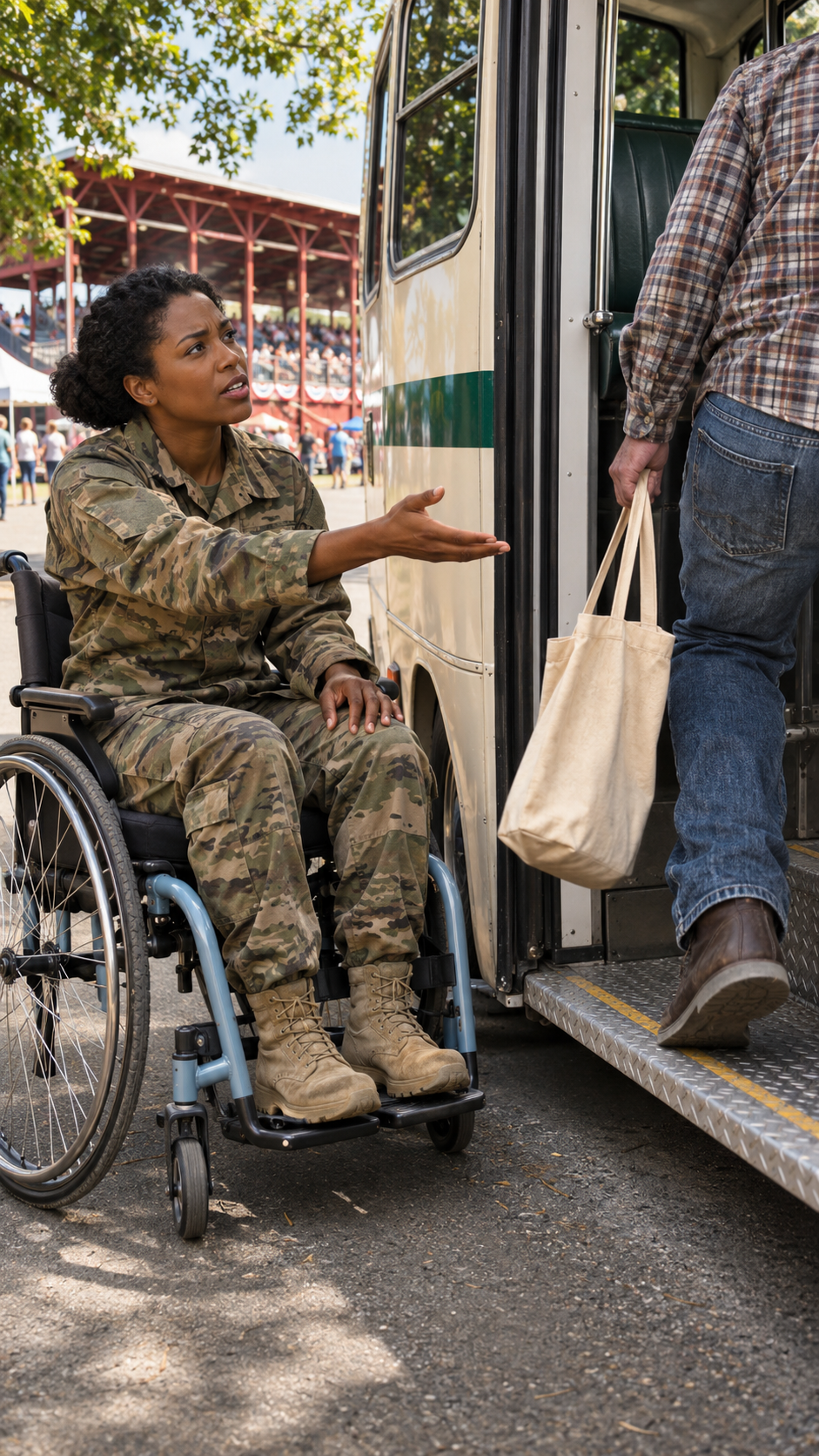
Leah sat in a blue wheelchair with silver push rims. Her small front wheels rested just outside the shuttle entrance, unable to cross the step without assistance.
As another passenger approached, Leah extended her right hand.
“Excuse me! Could you give me a hand?”
The passenger carried a canvas tote that swung close to her fingertips. For a moment, it appeared that someone might finally notice her request.
Instead, the passenger continued through the doorway without turning around.
Leah watched as the remaining riders disappeared inside the shuttle. Their shoes struck the hollow metal step, creating a series of sharp sounds above the low hum of the engine.
Her hand remained raised.
The doorway was open. The shuttle was still waiting. There was even a bench near the front where she could sit.
Yet Leah remained outside, unable to reach it.
She was not asking for anything extraordinary. She simply needed assistance getting aboard the same vehicle everyone else had entered without difficulty.
As the final passenger moved inside, the space around her became noticeably quieter.
One Last Attempt to Be Heard
Leah slowly lowered her outstretched hand toward the silver push rim of her wheelchair.
She looked at the metal step again.
The distance between her and the shuttle’s interior was small, but without an accessible entrance or someone willing to assist her, it might as well have been much farther.
She had already asked for help. The passengers had continued walking, and nobody had stopped to speak with her.
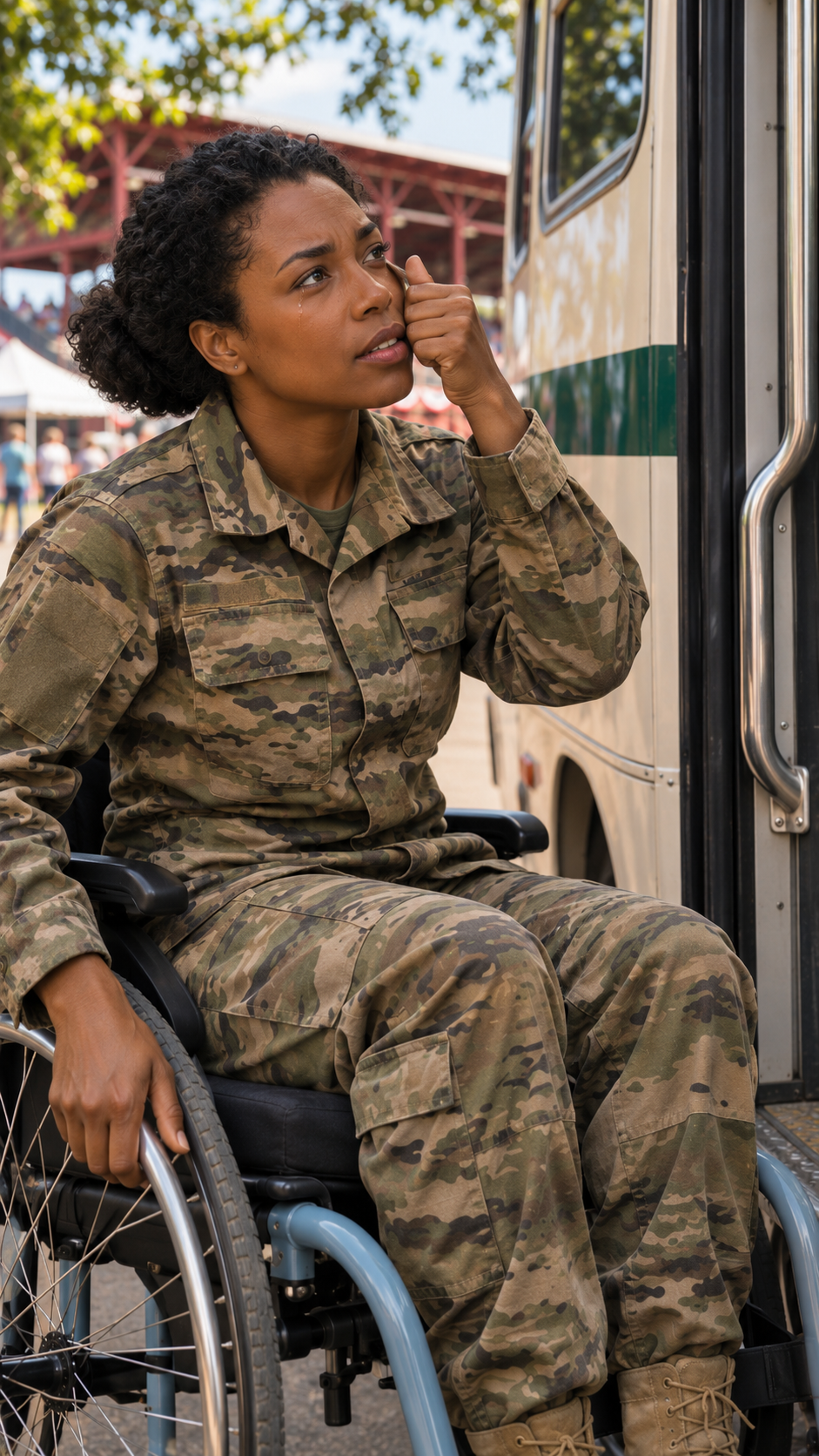
A tear appeared on her cheek.
Leah lifted her left hand and wiped it away with her thumb, trying to compose herself as she looked toward the doorway.
“Wait,” she said quietly.
Her voice was softer than before.
The footsteps inside the shuttle gradually faded as the passengers settled into their seats. Somewhere beneath the grandstand, a sparrow chirped.
Leah took a shaky breath.
She did not know whether the driver had seen her. From where she sat, it was difficult to tell what was happening inside the vehicle.
She could only hope that the shuttle would remain parked long enough for someone to notice that she was still waiting.
The difficult part was not simply the physical obstacle in front of her. It was the experience of asking for assistance while people continued moving around her as though she were not there.
Leah had made her request clearly. She had extended her hand and tried to catch someone’s attention.
Now she sat quietly beside the open door, uncertain whether she would be able to continue her journey.
The Driver Notices Something in His Mirror
Inside the shuttle, a driver named Cal sat behind the steering wheel.
The engine continued idling as the passengers settled into the vehicle. The front door remained open, allowing the sounds of the fairground to drift inside.
Cal glanced toward his curbside mirror.
In its reflection, he noticed a woman sitting beside the shuttle.
The sunlight caught the silver rim of her wheelchair. As he watched, Leah lowered her hand from her cheek.
Something about the scene immediately caught his attention.
She was positioned near the entrance, but she had not boarded. Her wheelchair remained beside the metal step, and her expression suggested that she was upset.
Cal looked more closely.
He realized that the woman was waiting for assistance.
Rather than preparing to leave, he turned toward the passengers seated behind him.
“Hang on, folks. One more rider.”
His words were calm and matter-of-fact.
There was no announcement about how much time the passengers might lose. He did not describe Leah as a problem or suggest that helping her would be an inconvenience.
To Cal, she was another passenger who needed to get aboard.
The driver’s seat creaked as he stood.
Leaving the engine idling and the front door open, he moved toward the entrance.
Outside, Leah was still looking at the step when Cal appeared.
For the first time since she had reached the shuttle, someone was coming directly toward her.
He Asked Before Offering Assistance
Cal stepped onto the pavement and approached Leah’s wheelchair.
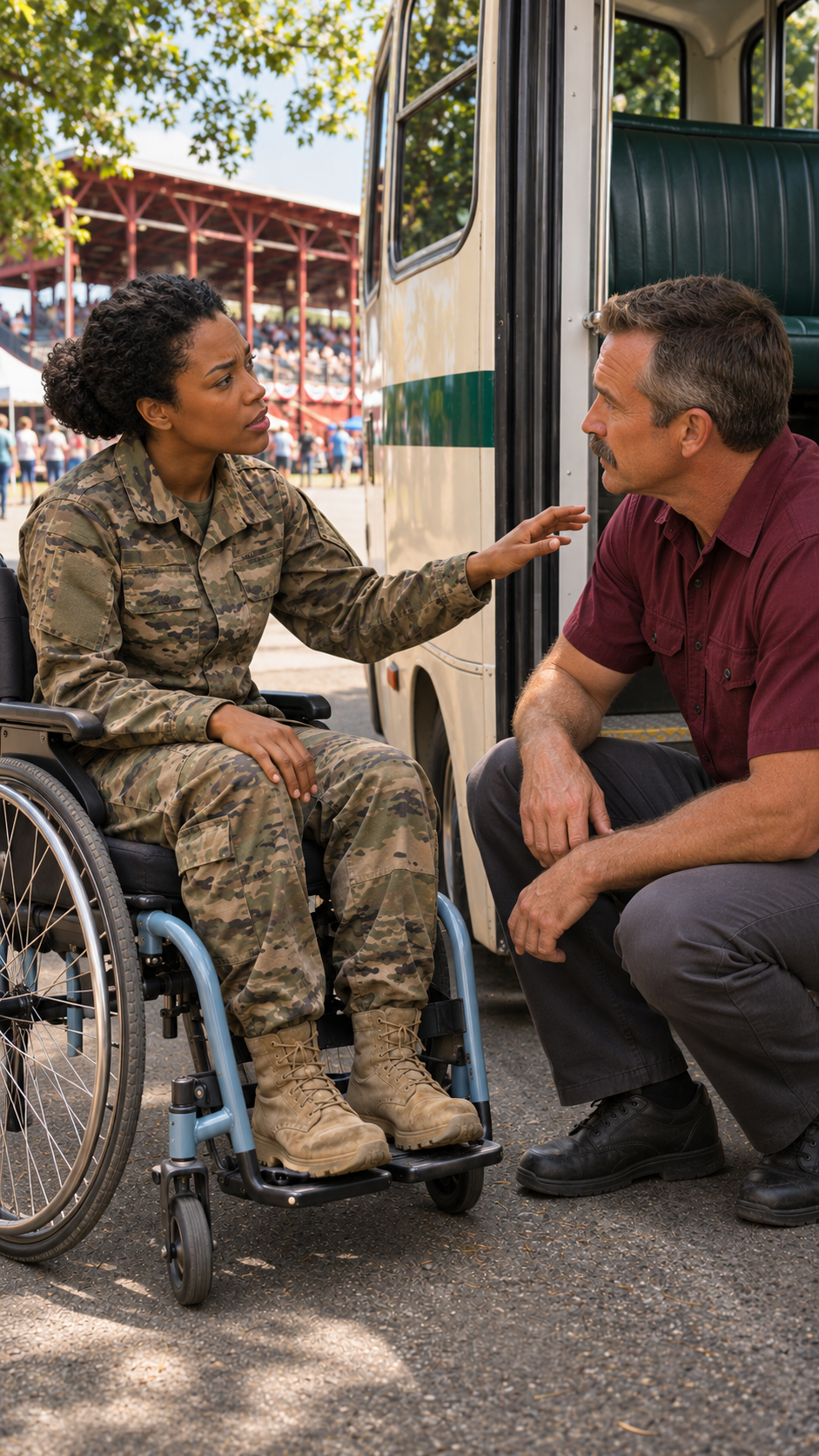
Instead of standing above her and speaking from a distance, he crouched beside her so they could look at each other at eye level.
The open shuttle doorway remained visible behind him. Through it, Leah could see the green vinyl bench near the front.
Cal did not immediately reach for her wheelchair or attempt to move her without permission.
He asked a simple question.
“How can I help?”
Leah looked directly at him.
After several unsuccessful attempts to get someone’s attention, she finally had the opportunity to explain what she needed.
“Could you lift me in?”
Cal nodded.
The exchange was brief, but it was an important part of their interaction. He had allowed Leah to communicate her own preference rather than assuming he knew what was best for her.
She reached toward his shoulder as they prepared for the transfer.
The canvas awning nearby flapped gently in the breeze. Cal adjusted his position beside the wheelchair while Leah prepared to move from her seat.
There was no need for an elaborate conversation.
Leah knew where she wanted to sit, and Cal was willing to assist her.
The same doorway that had seemed impossible to cross moments earlier was now within reach.
For Leah, the driver’s willingness to listen made an immediate difference. She no longer needed to keep asking passing strangers for help.
Someone had finally stopped, acknowledged her request, and given her the opportunity to decide how she wanted to proceed.
The Importance of a Simple Question
Cal’s question was particularly meaningful because assistance should begin with communication.
People who use wheelchairs have different abilities, preferences, and support needs. Some may require assistance in particular situations, while others may not want or need physical help at all.
There is no single approach that works for everyone.
By asking Leah how he could help, Cal respected her ability to explain what she needed.
He did not treat her wheelchair as an object he could move without permission. He did not assume that she was incapable of making decisions for herself.
Within the fictional story, Leah specifically requested assistance transferring into the shuttle.
Her answer guided what happened next.
That distinction matters because kindness is not only about being willing to help. It is also about respecting the person receiving that assistance.
Cal’s approach allowed Leah to remain an active participant in the situation.
She was not simply someone being moved from one place to another. She was a passenger communicating her needs and choosing where she wanted to sit.
Finally Crossing the Metal Step
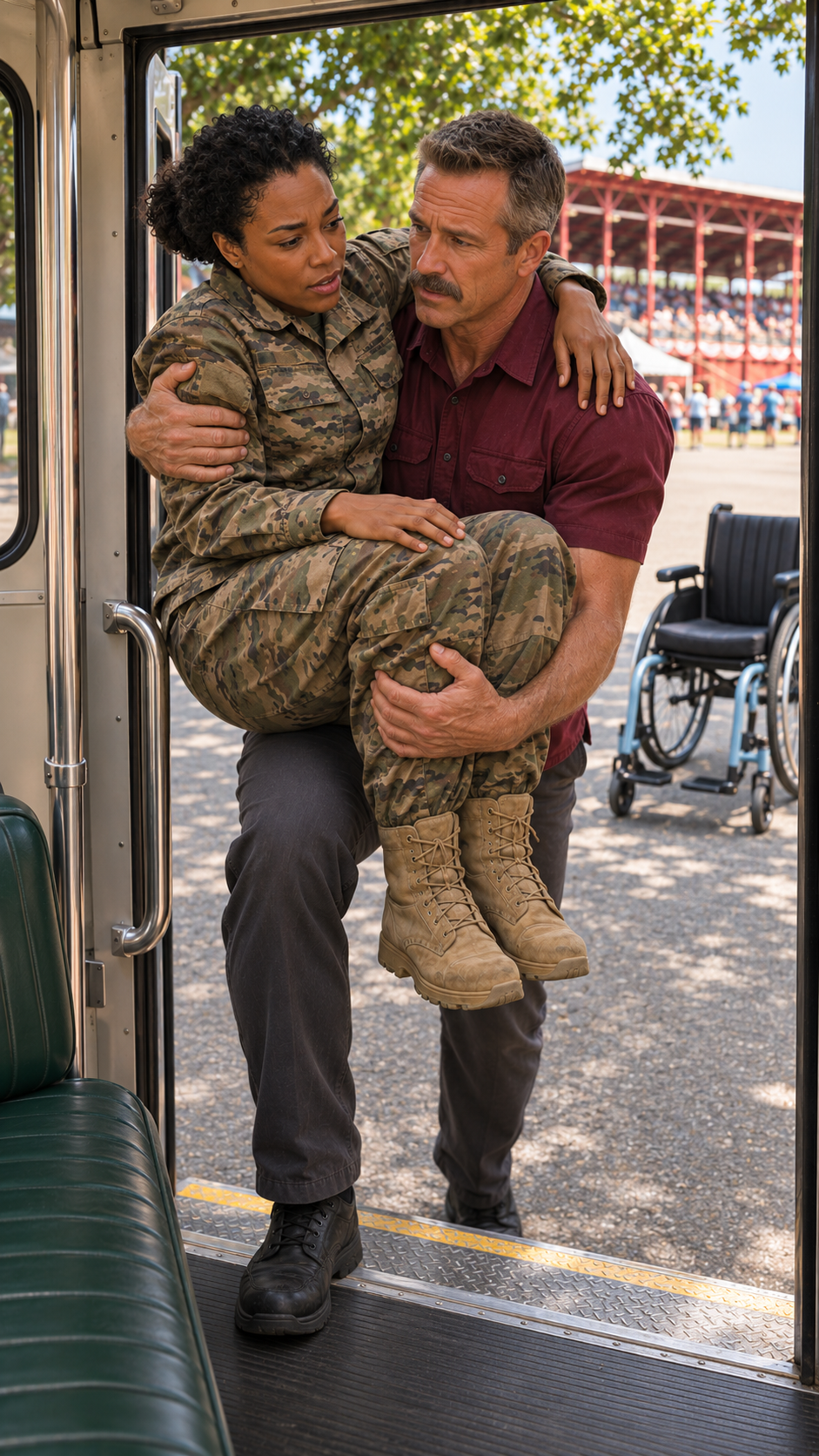
Leah placed an arm around Cal’s shoulder as he supported her back and knees.
Her boots lifted clear of the wheelchair’s footplates.
Cal carefully moved toward the open shuttle doorway.
The metal step that had prevented Leah from boarding was now directly in front of them.
His shoes made a hollow sound as he stepped inside.
Leah looked toward the front bench, noticing the available space near its end.
“Right here’s good.”
Cal followed her direction and moved toward the seat.
He lowered her onto the green vinyl, which creaked softly as she settled into position.
Leah was finally inside the shuttle.
Through the open doorway, her empty blue wheelchair remained visible on the pavement. Its silver push rims reflected the afternoon sunlight.
The transfer had addressed the immediate problem of getting Leah aboard, but Cal understood that something important remained outside.
Her wheelchair needed to accompany her.
Leaving it behind would mean that she could not continue independently when she reached her destination.
Cal turned back toward the doorway.
The other passengers remained inside while he prepared to retrieve the chair.
For Leah, the experience was already very different from the moments before he noticed her. Instead of sitting outside wondering whether the shuttle would leave, she was now seated near the front.
But the driver’s assistance was not yet complete.
He wanted to make sure she had everything she needed for the rest of her journey.
More Than Simply Getting Aboard
Leah’s wheelchair was an essential part of her mobility.
It allowed her to move through the fairground, reach different areas, and continue her activities.
Bringing her aboard without bringing her chair would have created another obstacle at the end of the journey.
Cal recognized this practical detail.
His assistance was not limited to helping her cross the metal step. It also involved making sure her wheelchair could travel with her.
The empty chair remained outside while Leah waited on the green bench.
Cal returned to retrieve it.
Within the fictional encounter, this additional action demonstrated that he was paying attention to her needs beyond the immediate moment.
He was not rushing to return to his driver’s seat as soon as she entered the vehicle.
He was making sure the boarding process was complete.
Sometimes, meaningful assistance involves noticing the next practical requirement rather than stopping after the most visible part of a task has been accomplished.
For Leah, having her wheelchair nearby was just as important as having a seat on the shuttle.
The Wheelchair Comes Aboard
Cal brought Leah’s folded blue wheelchair through the open doorway.
The silver push rim passed close to the handrail as he moved toward the storage area beside her bench.
Leah watched from her seat.
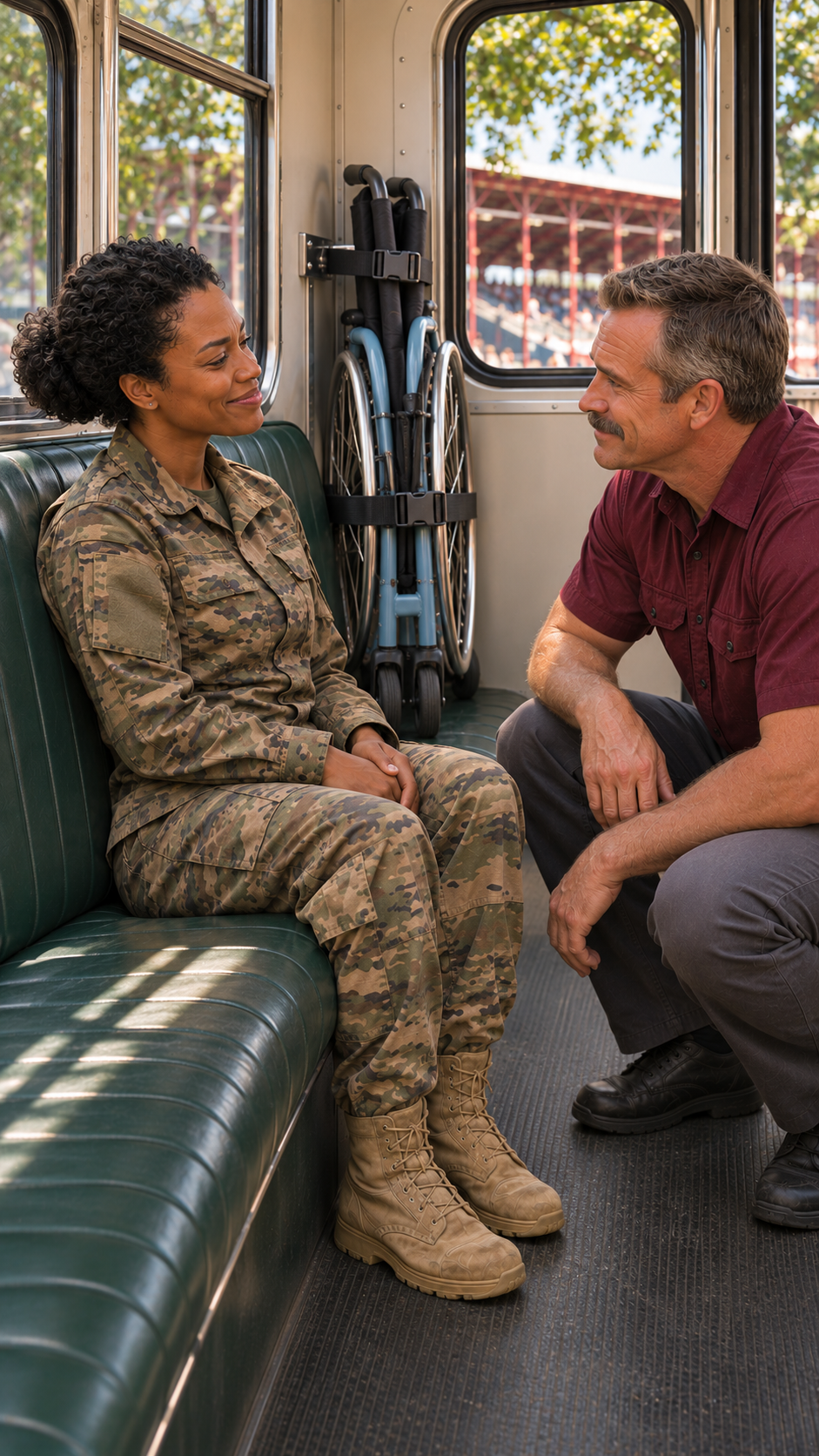
Cal positioned the folded chair beside the storage bracket and secured it with a strap.
A small click confirmed that the strap had closed.
Her wheelchair was now aboard the shuttle, stored within the designated area shown in the fictional scene.
Cal turned toward Leah and crouched beside her once more.
Her shoulders relaxed.
The uncertainty that had marked her earlier experience was beginning to disappear.
She no longer needed to worry about being left outside or separated from her wheelchair.
“Thanks for waiting,” she said.
Cal smiled.
“We’ve got time.”
His response was simple, but it carried a powerful message.
Leah’s presence was not an inconvenience. Helping her board was not something that required an apology.
She was entitled to participate in the journey alongside the other passengers.
Cal had recognized that and acted accordingly.
The distant chatter of fairground visitors continued outside, while the engine maintained its quiet hum.
Nothing dramatic was needed to complete the moment.
A passenger had asked for assistance, and a driver had taken the time to listen.
Why Accessibility Matters
The metal step at the shuttle entrance illustrates a broader issue faced by many people with mobility disabilities.
An entrance that seems ordinary to one passenger may present a substantial barrier to another.
Steps, narrow doorways, uneven pavement, and inaccessible transportation can prevent people from participating in everyday activities.
These barriers can affect someone’s ability to attend events, travel independently, visit friends, or simply move through public spaces.
Leah’s fictional experience demonstrates how quickly an ordinary journey can become difficult when accessibility has not been adequately considered.
Cal’s compassion helps resolve the immediate situation within the story, but individual kindness should not replace accessible transportation.
Properly designed ramps, lifts, wheelchair spaces, and trained personnel can allow passengers with disabilities to board safely and with greater independence.
People should not have to depend on the willingness of passing strangers whenever they encounter a physical obstacle.
The most inclusive environments are those designed to accommodate different mobility needs from the beginning.
Cal’s response is meaningful because he recognizes Leah as a passenger whose journey matters. The broader lesson is that accessible services should consistently reflect that same principle.
The Difference Between Looking and Noticing
Several passengers passed close to Leah while boarding the shuttle.
The story does not establish why they failed to respond. Some may have been distracted, while others may not have understood the situation.
What is clear is that Leah asked for assistance and remained outside.
Cal noticed her from a different position.
He was sitting behind the steering wheel when her reflection appeared in his curbside mirror.
Rather than dismissing what he saw, he took a moment to understand it.
He noticed the wheelchair beside the entrance. He noticed that Leah was still waiting. He recognized that she needed someone to speak with her.
Then he acted.
The difference between the earlier passengers and Cal was not necessarily the amount of time available to them.
It was his decision to stop and acknowledge the person in front of him.
His actions did not require a grand public gesture or an extraordinary financial sacrifice.
They required attention, communication, and a willingness to make sure another passenger was included.
That is what gives the fictional encounter its emotional strength.
Everyone Deserves to Be Included
Leah’s request was straightforward from the beginning.
She wanted to board the shuttle.
She was not asking to be treated as more important than the other passengers. She wanted the opportunity to travel alongside them.
Cal’s response recognized that ordinary expectation.
When he told the passengers there was one more rider, he included Leah in the group without hesitation.
When he asked how he could help, he respected her choices.
When she indicated where she wanted to sit, he listened.
And when he brought her wheelchair aboard, he made sure her mobility equipment accompanied her.
Each action contributed to a more respectful experience.
The story is ultimately about dignity rather than pity. Leah is a person with her own preferences, decisions, and destination.
Her wheelchair does not define her entire identity, and needing assistance with an inaccessible step does not diminish her independence or worth.
Cal’s kindness matters because he treats her accordingly.
Three Words That Changed the Afternoon
“We’ve got time.”
Cal’s final words stand in contrast to the hurried atmosphere at the beginning of the story.
Initially, passengers were moving quickly through the doorway. Their footsteps echoed against the metal step, and Leah’s request went unanswered.
By the end, the driver had deliberately slowed the boarding process to make sure she could join them.
His reassurance removed the pressure Leah might have felt about delaying the other passengers.
She had thanked him for waiting, but Cal did not make her feel responsible for the extra time.
He simply reminded her that there was enough of it.
In a world where people often hurry from one activity to the next, that willingness to stop can be especially meaningful.
Sometimes, inclusion begins with making room in a schedule, listening to a request, or recognizing an obstacle that someone else cannot easily overcome.
For Leah, those small decisions transformed an upsetting experience into a moment of reassurance.
Leah sat comfortably on the green bench with her folded blue wheelchair secured beside her. Cal crouched nearby, smiling as he reassured her that there was plenty of time. The same woman who had been left waiting beside the open doorway was finally ready to continue her journey. His simple act of consideration offered a lasting reminder that nobody should be left behind simply because the world around them was not designed with their needs in mind.