Separated by Just a Few Inches
The afternoon was peaceful along a quiet stretch of road surrounded by grassy banks and open meadows.
Several pickup trucks stood nearby, their engines idling softly as three workers attended to a roadside barrier.
Eli, Marcus, and Walt had encountered an unexpected situation involving a group of deer.
On one side of a blue barrier stood an adult buck with velvet-covered antlers. On the other side, four small spotted fawns were huddled together against a grassy bank.
The smallest fawn repeatedly tried to reach the adult deer.
It raised its front legs and tapped its tiny hooves against the blue panel.
Two hollow knocks echoed across the gravel.
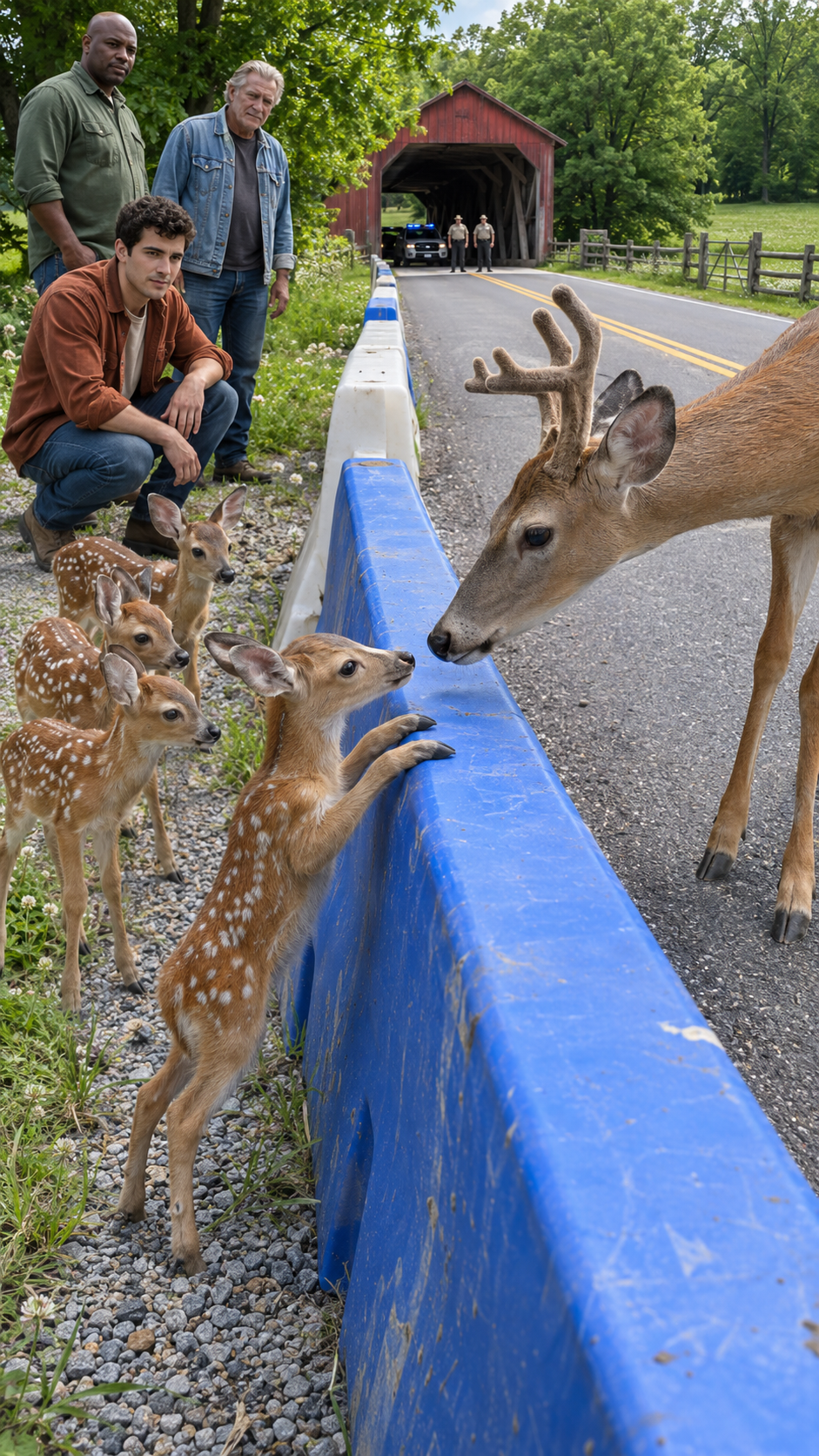
The buck leaned forward from the asphalt, lowering his muzzle toward the young animal.
Their noses came within an inch of touching.
But the barrier stood between them.
The little fawn dropped back onto the gravel beside the other three.
Eli crouched nearby, carefully observing the group.
He could see four spotted backs pressed close together.
He turned toward his colleague.
“Walt! Four on this side!”
A thin bleat rose above the distant sound of the pickup trucks.
The men realized that the barrier was preventing the young deer from reaching the open roadway and the meadow beyond.
They would need to find a way to help all four.
Three Workers Face an Unexpected Challenge
Eli remained near the grassy bank while Marcus and Walt examined the blue barrier.
The four fawns appeared uncertain about their surroundings.
They stayed close together, occasionally lifting their heads toward the adult deer waiting nearby.
The workers understood that moving too quickly could frighten the animals.
The roadside barrier was not something the little fawns could easily overcome on their own.
Its solid surface separated the gravel area from the asphalt.
The adult deer could reach over it, but the young animals remained on the opposite side.
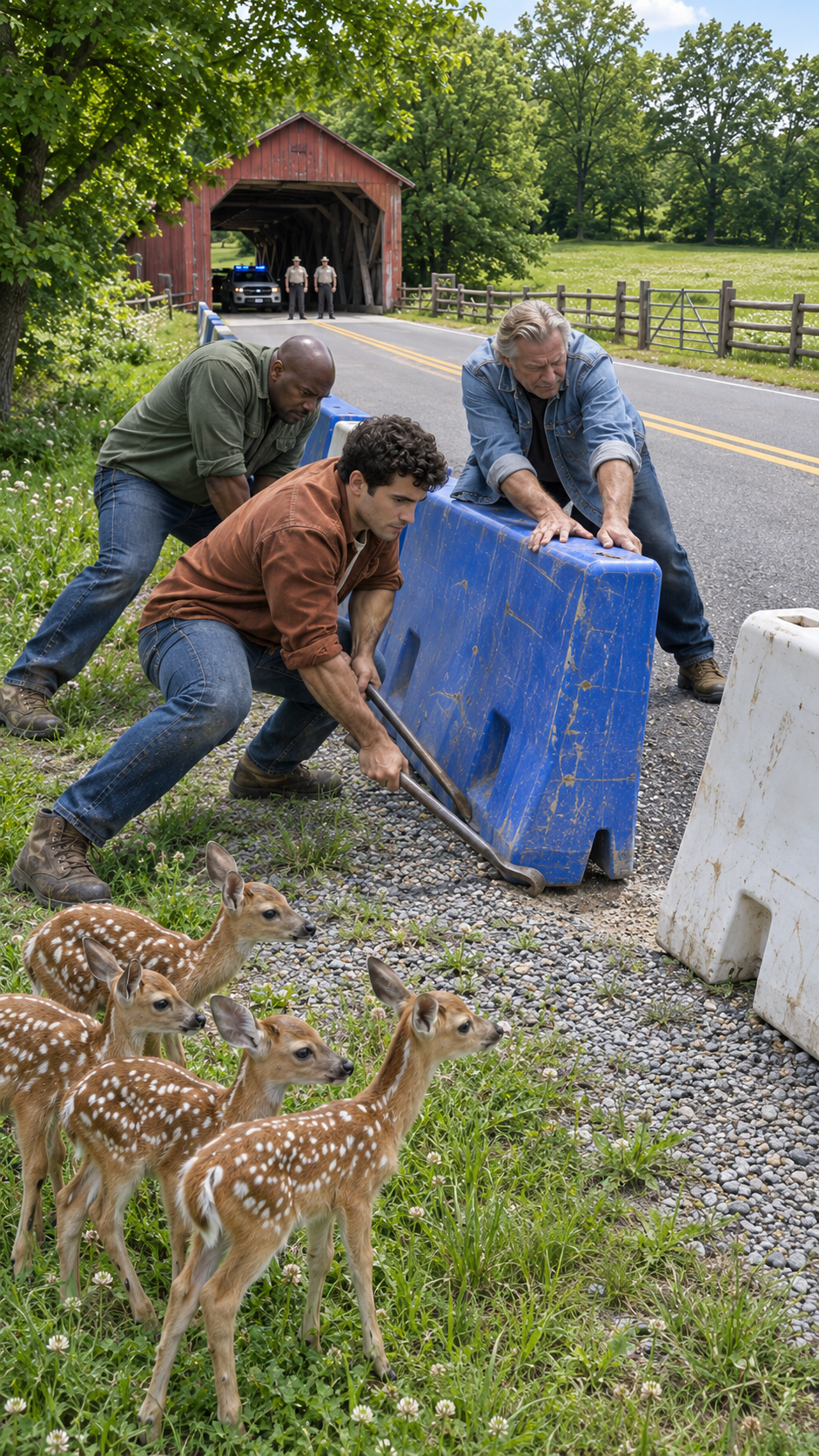
One section of the barrier appeared loose enough to move.
The three men positioned themselves beside it.
Using long steel bars, they began easing the section sideways.
Their work boots shifted against the gravel as they carefully applied pressure.
The blue corner scraped across the stones.
Slowly, a narrow opening appeared.
Marcus watched the position of the panel.
He wanted enough space for the fawns to pass through without allowing the barrier to shift unexpectedly.
“Right there. Hold it.”
Walt steadied the section.
A steel bar clinked against a stone.
Behind them, the grass rustled as the four young deer remained huddled together.
The opening was ready.
Now came the delicate part of the rescue.
Creating a Passage to the Other Side
The gap between the barrier sections offered a possible route toward the empty lane.
However, the fawns did not immediately move through it.
They remained close to the grassy bank.
Their spotted coats blended naturally with the surrounding vegetation, and their small bodies stayed low to the ground.
Eli crouched beside the nearest fawn.
Marcus and Walt maintained their positions around the opening.
The men needed to coordinate their movements carefully.
The barrier had been moved just enough to create a passage, but the animals still needed to reach the opposite side.
Walt positioned himself where he could receive the first fawn.
Eli looked toward the opening.
Then he turned back to the young deer.
The first transfer was about to begin.
The First Fawn Is Lifted
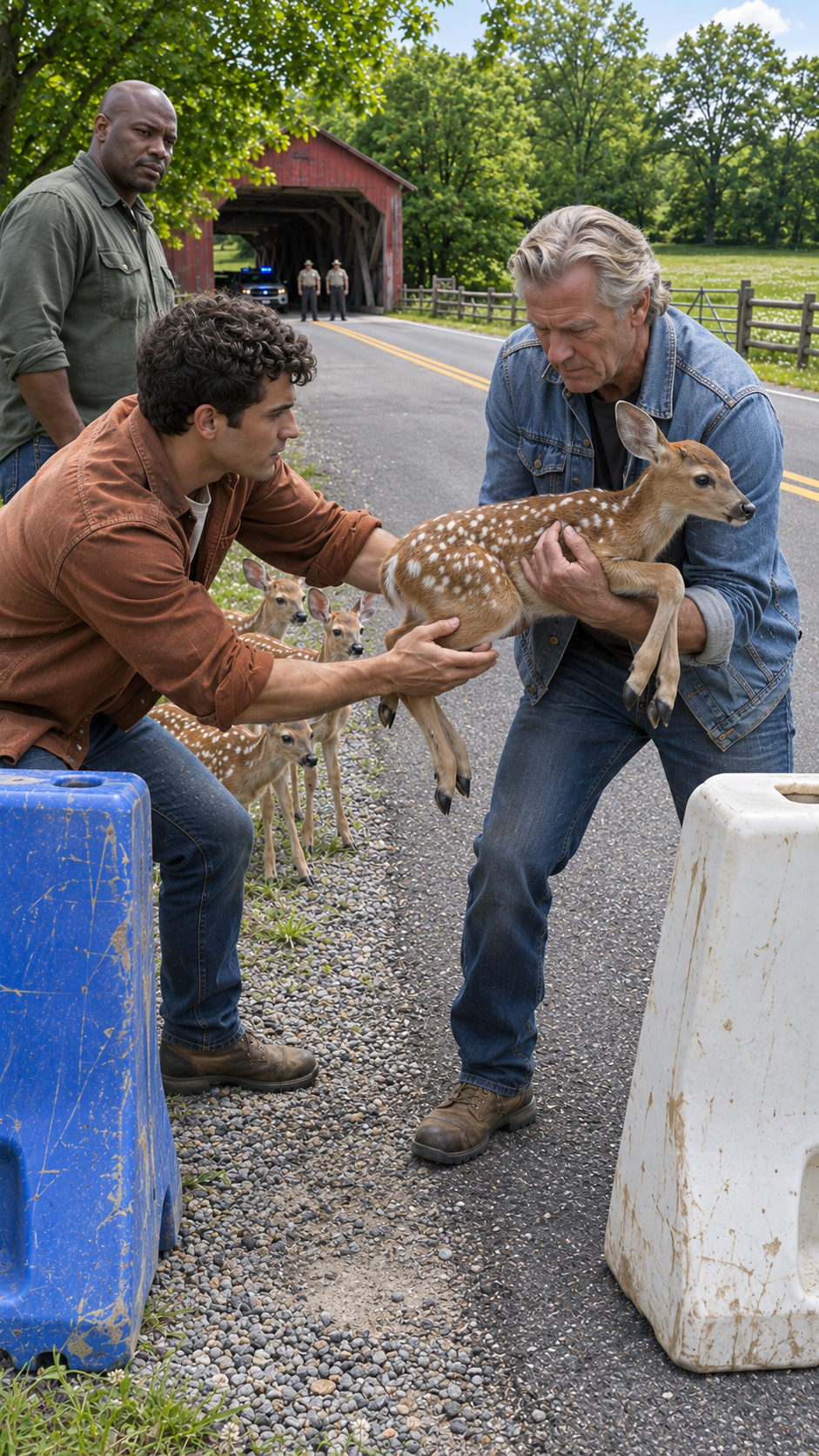
Eli gently lifted the first fawn against his rust-colored overshirt.
He supported its chest and hindquarters, keeping its small body close as he rose.
The fawn’s delicate legs remained visible beneath his arms.
Its spotted coat stood out against the warm color of his shirt.
Eli moved toward the opening in the blue barrier.
On the opposite side, Walt waited in his denim jacket.
The other three fawns remained together behind Eli.
As he reached the gap, Eli carefully extended the young animal toward his colleague.
“You got her?”
Walt reached forward and accepted the fawn’s weight.
“I do.”
The transfer was complete.
One of the fawn’s tiny hooves brushed against Walt’s denim jacket.
He turned toward the empty lane, carrying the animal away from the barrier.
His boot crunched against the gravel at the edge of the asphalt.
Eli looked back toward the remaining three fawns.
The first had made it through.
But the workers still had more to do.
Working Together for the Remaining Fawns
The rescue depended on cooperation between the three men.
Eli was positioned near the young animals.
Walt waited on the opposite side of the opening.
Marcus helped manage the barrier and assist with the remaining transfers.
Each worker had a role.
The young deer needed to be moved without unnecessary noise or sudden movements.
The adult bucks remained nearby.
The men continued their efforts until three of the four fawns had reached the pavement.
The little animals settled together near the double yellow lines.
Their spotted backs formed a small group against the dark asphalt.
The roadway was temporarily empty of moving traffic, allowing the workers to focus on the animals.
Only one fawn remained to be brought through.
Marcus prepared to complete the final transfer.
The Fourth Fawn Reaches the Pavement
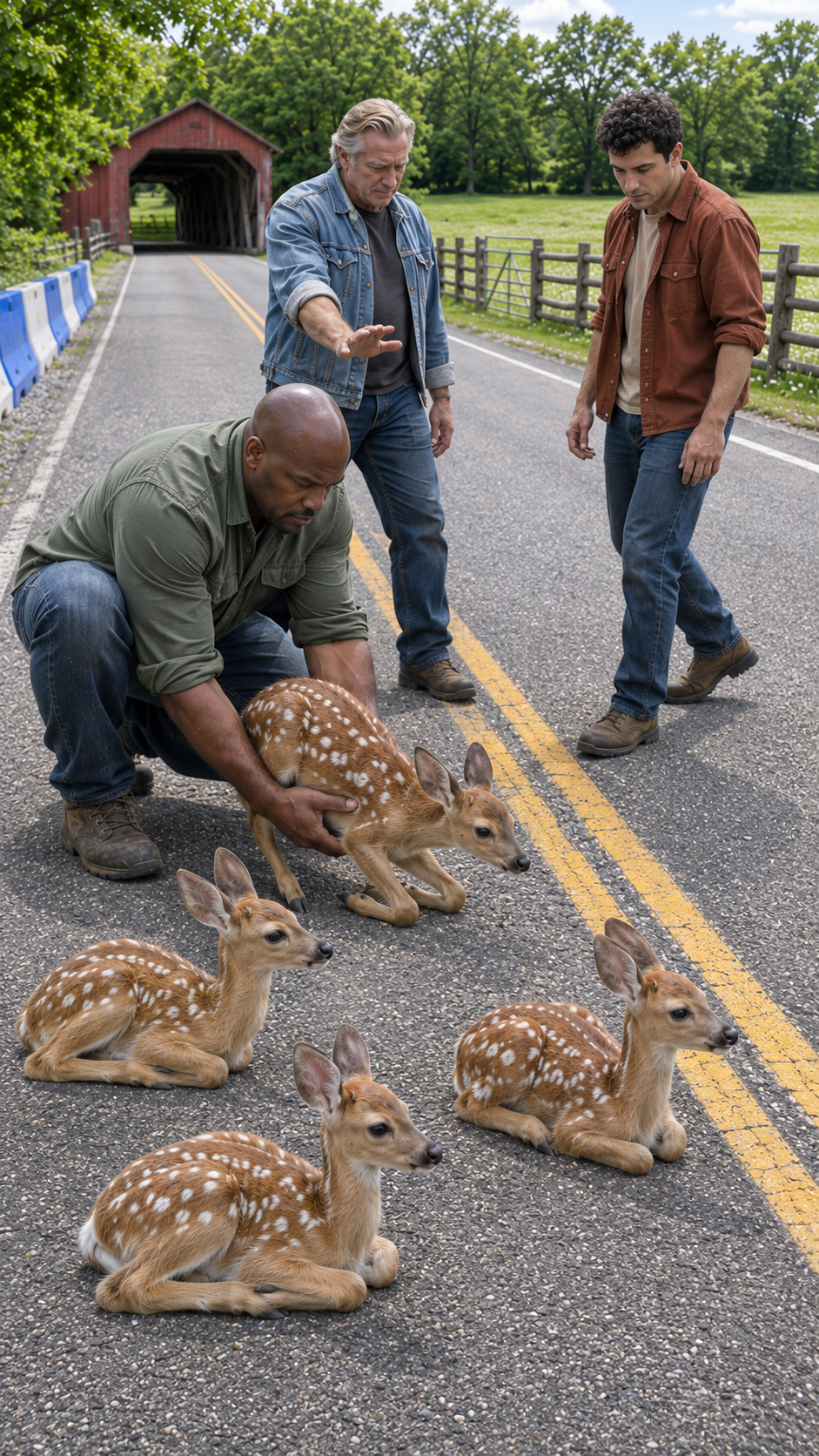
Marcus approached the other three fawns with the final young deer supported in his arms.
His green sleeves surrounded its small body as he carefully lowered it toward the pavement.
The fawn’s hooves touched the road.
For a moment, it remained upright.
Then it folded its legs beneath itself and settled beside the others.
All four were now together.
The blue barrier was behind them.
The men had successfully moved the entire group to the same side as the waiting adult deer.
Walt looked toward Marcus and Eli.
He gestured for both men to step backward.
“Let’s give ’em some room.”
The workers moved away.
A boot heel scuffed against the asphalt.
Then the area became noticeably quieter.
Grasshoppers chirped near the fence.
The four fawns remained close together beside the double yellow lines.
The men had completed the physical part of the rescue.
Now they needed to allow the animals to respond naturally.
Giving the Deer Space
Walt understood that the workers’ presence could make the adult deer hesitant to approach.
The three men had already helped the fawns reach the open roadway.
There was no reason to remain directly beside them.
They stepped back and watched quietly.
The fawns rested together.
Their small ears occasionally moved in response to nearby sounds.
Beyond them stood three velvet-antlered bucks.
The adult deer appeared attentive to the young animals.
Without the blue barrier separating them, they could finally approach.
Marcus stood beside Walt.
Eli remained nearby.
Nobody rushed toward the herd.
The workers waited to see what would happen.
Then the adult deer began moving forward.
The Three Bucks Approach
The bucks walked slowly toward the center of the road.
Their velvet-covered antlers were visible in the afternoon light.
The four young deer remained together near the yellow lines.
One of the fawns released a soft bleat.
Marcus turned toward Walt.
“Hear that?”
The sound was quiet but distinct.
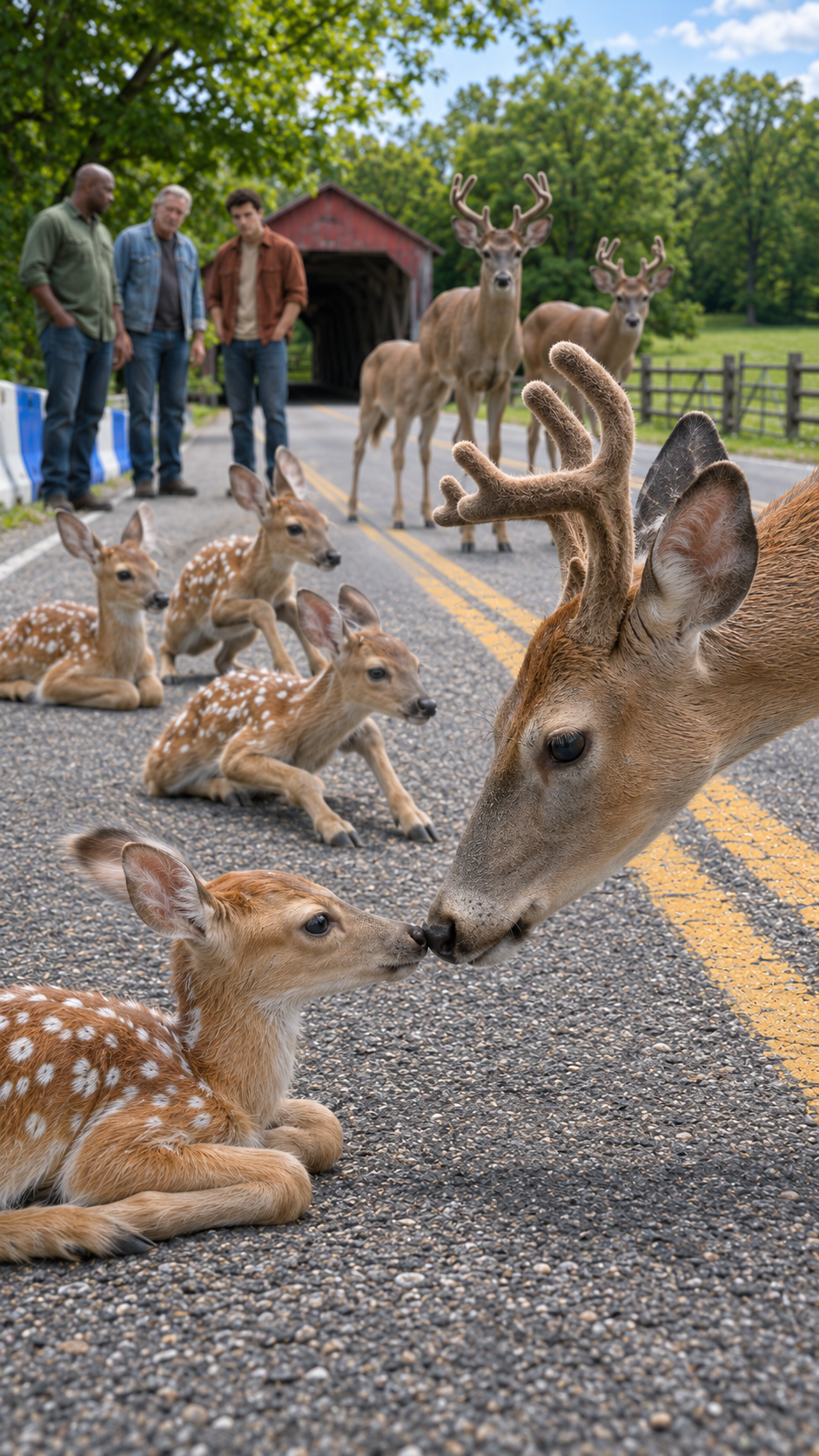
The nearest buck lowered his head as he approached the smallest fawn.
The little animal raised its muzzle.
Earlier, the two deer had been separated by the blue barrier.
Their noses had nearly touched, but the panel prevented them from getting close enough.
This time, there was nothing between them.
The buck leaned forward.
The smallest fawn remained still.
Then their noses touched.
It was a brief, gentle moment.
The little fawn flicked one ear.
Nearby, two of the other fawns began unfolding their front legs.
The workers watched without interrupting.
After the noise of moving steel bars and scraping gravel, the quiet contact between the animals felt especially meaningful.
The reunion was finally taking place.
The Moment That Made the Rescue Worthwhile
The smallest fawn had been the first animal to attract attention.
Its tiny hooves had knocked against the blue barrier as it tried to reach the buck.
That opening moment revealed how close the animals were and how completely the obstruction separated them.
Now the same fawn was resting on the pavement with the adult deer directly in front of it.
Their noses touched without anything standing in the way.
The visual contrast was striking.
What had previously been impossible was now happening naturally.
The other young deer began responding to the presence of the bucks.
Two unfolded their legs.
Another shifted its position.
The workers remained at a distance, allowing the herd to gather.
The story does not establish the precise biological relationship between the three bucks and the four fawns.
But within the fictional encounter, the adult deer are portrayed as familiar companions waiting for the young animals to join them.
The group was together again.
And soon they would be ready to leave the road.
Waiting for the Smallest Fawn
The three bucks began moving toward the far side of the roadway.
Several fawns rose and prepared to follow.
Walt watched carefully.
He wanted to make sure that all four young animals were moving with the group.
The smallest fawn remained on the pavement for a brief moment after the others had stood.
Its little legs were still folded beneath its body.
Marcus looked toward the herd.
Walt continued watching the smallest animal.
Then the fawn began to rise.
It straightened its front legs and pushed itself upright.
“There’s number four,” Walt said softly.
The final fawn had joined the others.
The workers could now see all seven deer moving together.
Three velvet-antlered bucks.
Four spotted fawns.
Nobody had been left behind.
The herd turned toward an open meadow gate beyond the far lane.
Leaving the Road Behind
The adult deer crossed the remaining section of asphalt.
The four fawns trotted after them.
Their small hooves made light sounds against the pavement.
The open meadow gate stood ahead, offering access to a grassy field covered with clover.
The workers remained where they were.
They did not attempt to follow closely or touch the animals again.
Their role was finished.
The smallest fawn stayed slightly behind the others but continued moving toward the gate.
Walt and Marcus watched its progress.
Eli looked across the road toward the open field.
One by one, the deer passed through the gate.
The three bucks entered the meadow.
The first three fawns followed.
Then the smallest reached the opening.
Its white tail disappeared beyond the gate.
All four had made it through.
The sound of hooves against asphalt gave way to the soft movement of grass and clover.
The herd was finally away from the roadway.
Why Every Fawn Mattered
Throughout the rescue, the workers paid attention to the number of young deer.
Eli had counted four when he first crouched beside the grassy bank.
He called that number to Walt.
During the transfer, the first fawn was passed through the opening.
The others followed until Marcus lowered the fourth onto the pavement.
When the herd began leaving, Walt counted them again.
His final words confirmed that the smallest had risen and joined the group.
“There’s number four.”
The repeated attention to the number of animals gives the story its emotional structure.
Helping one fawn would not have been enough.
Helping three would still have left another behind.
The rescue was complete only when every young deer had reached the meadow.
That final count brought relief to the workers and closure to the encounter.
An Obstacle in an Otherwise Peaceful Landscape
The blue roadside barrier was the central obstacle in the story.
It was an ordinary piece of infrastructure, but its position created an unexpected problem for the young deer.
The adult bucks could approach it from the asphalt.
The fawns remained on the gravel side.
The smallest repeatedly tried to reach across the panel.
The workers responded by creating an opening.
Once the animals had been transferred, the barrier no longer separated the two groups.
The fictional encounter illustrates how human-made structures can sometimes interfere with wildlife movement.
Roadside fencing, construction barriers, and other obstacles may affect the routes animals use to reach feeding areas, shelter, or open land.
Such situations require careful assessment, particularly when they occur near roads.
Moving barriers or handling wildlife without authorization can create additional risks.
In real circumstances, trained wildlife responders and appropriate road authorities should be contacted when animals are trapped or unable to move safely.
The Quiet Strength of Teamwork
None of the three workers completed the rescue alone.
Eli identified the four fawns and helped with the first transfer.
Marcus coordinated the movement of the barrier and carried the fourth fawn.
Walt received the first animal, helped maintain the opening, and encouraged the others to step back once the group was together.
Their cooperation allowed the fictional rescue to progress from one stage to the next.
They communicated using short, practical instructions.
“Right there. Hold it.”
“You got her?”
“I do.”
“Let’s give ’em some room.”
There were no long speeches.
The men focused on the immediate situation.
Their actions demonstrated the importance of communication, patience, and coordination when responding to an unexpected challenge.
From Uncertainty to Freedom
The afternoon began with four young deer unable to reach the other side of a barrier.
The smallest fawn knocked its hooves against the blue panel.
An adult buck leaned toward it, but their noses could not touch.
The workers noticed the problem and created a passage.
One by one, the young deer reached the open roadway.
Then the men stepped away.
The bucks approached.
The smallest fawn finally touched noses with the nearest adult deer.
Moments later, the entire herd began moving toward the meadow.
The story’s emotional progression comes from these connected events.
Separation becomes reunion.
Uncertainty becomes relief.
The hard surface of the roadway gives way to soft grass.
And the final image is not of the workers carrying the animals, but of the deer moving freely together.
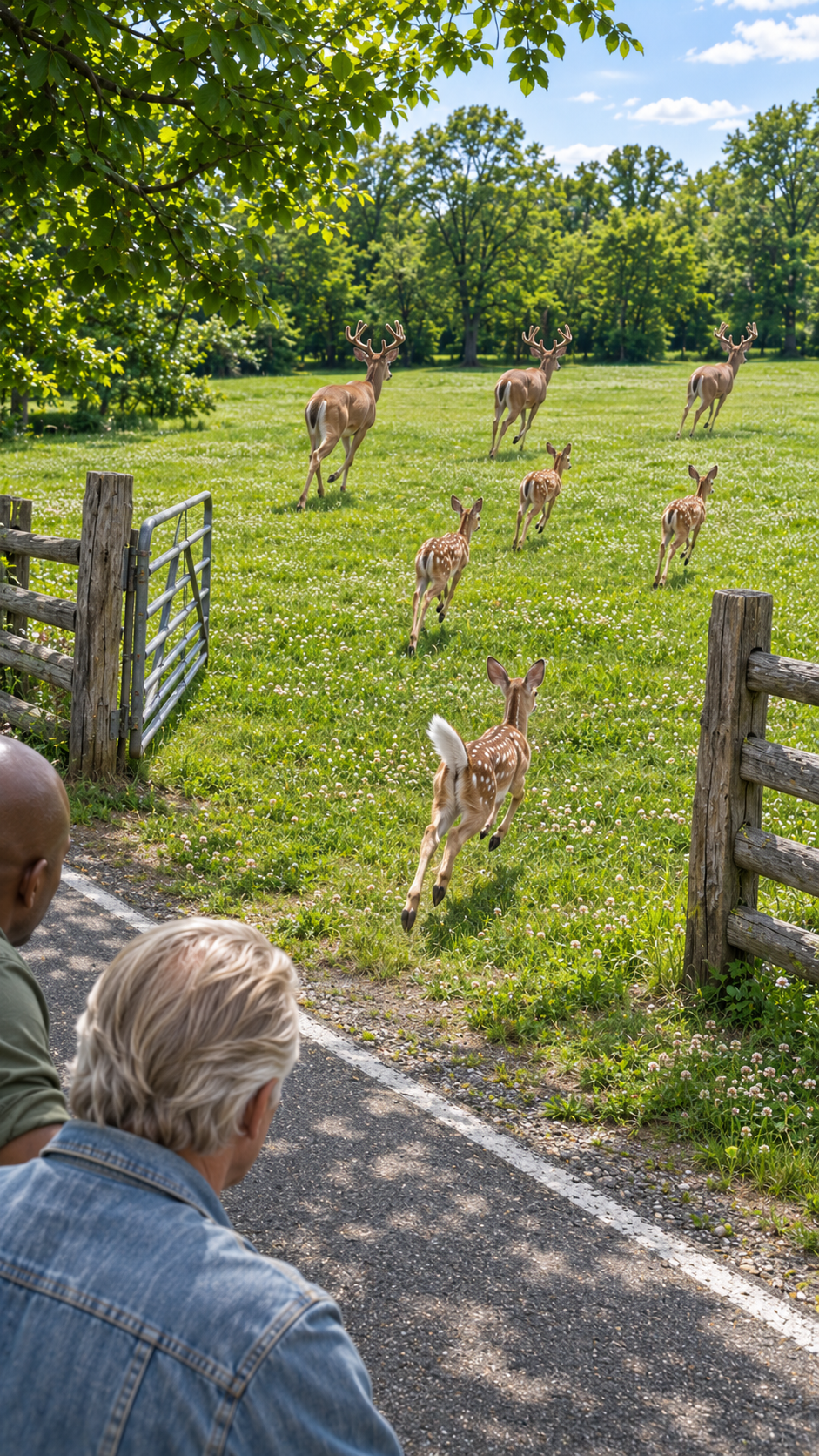
Walt watched as the smallest fawn trotted through the open meadow gate behind the other three young deer and the three velvet-antlered bucks. Its little white tail disappeared into the clover, confirming that every animal had reached the field. Eli, Marcus, and Walt remained beside the quiet roadway, their work complete. What began with two noses separated by a blue barrier ended with seven deer moving freely together, offering a touching reminder of the importance of protecting wildlife and respecting the natural world.