An Empty Pocket at the Flea Market
The afternoon was busy at an old drive-in flea market. Vendors had arranged their merchandise beneath canvas awnings, while customers wandered along gravel pathways between colorful food trailers and small market stalls.
The smell of freshly prepared food drifted through the air. Near one corner of the market stood a turquoise doughnut trailer, where a stocky vendor named Wade was arranging glazed doughnuts on a metal tray.
Wade wore a navy cap and a denim apron over a cream-colored shirt. His dark mustache gave him a distinctive appearance as he worked behind the serving counter.
Approaching the trailer was a 27-year-old man named Eli.
With dark curly hair, a faded rust-colored T-shirt, charcoal jeans, and scuffed tan sneakers, Eli looked like an ordinary young man visiting the market.
There was nothing about his appearance that suggested wealth or influence.
As he approached the counter, he turned one of his pockets inside out.
It was empty.
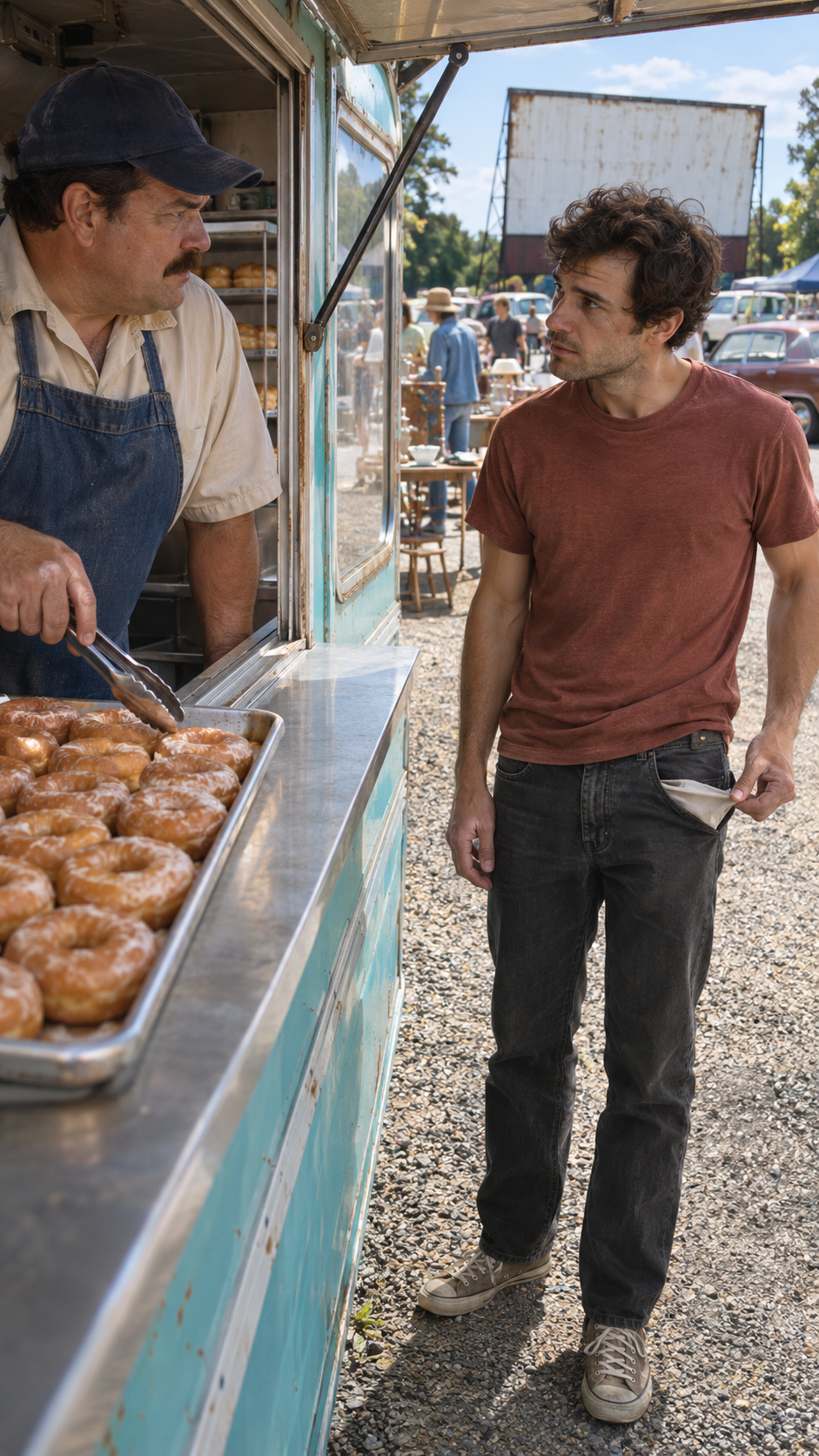
Wade had just placed a tray of glazed doughnuts on the counter when Eli looked up at him.
“Got a day-old you could spare?”
He was not asking for a large order or anything freshly prepared. He simply wondered whether the vendor had an older doughnut that he could spare.
Wade’s metal tongs paused above the tray.
For a brief moment, Eli waited for an answer.
He had no idea that this simple request would lead to an encounter that would change the atmosphere of the entire market.
The Vendor’s Cold Response
Wade looked toward Eli and his empty pocket.
Instead of checking whether he had any leftover doughnuts, he pulled the metal tray closer to himself.
The glazed doughnuts moved away from the edge of the counter.
Eli remained standing in front of the turquoise trailer.
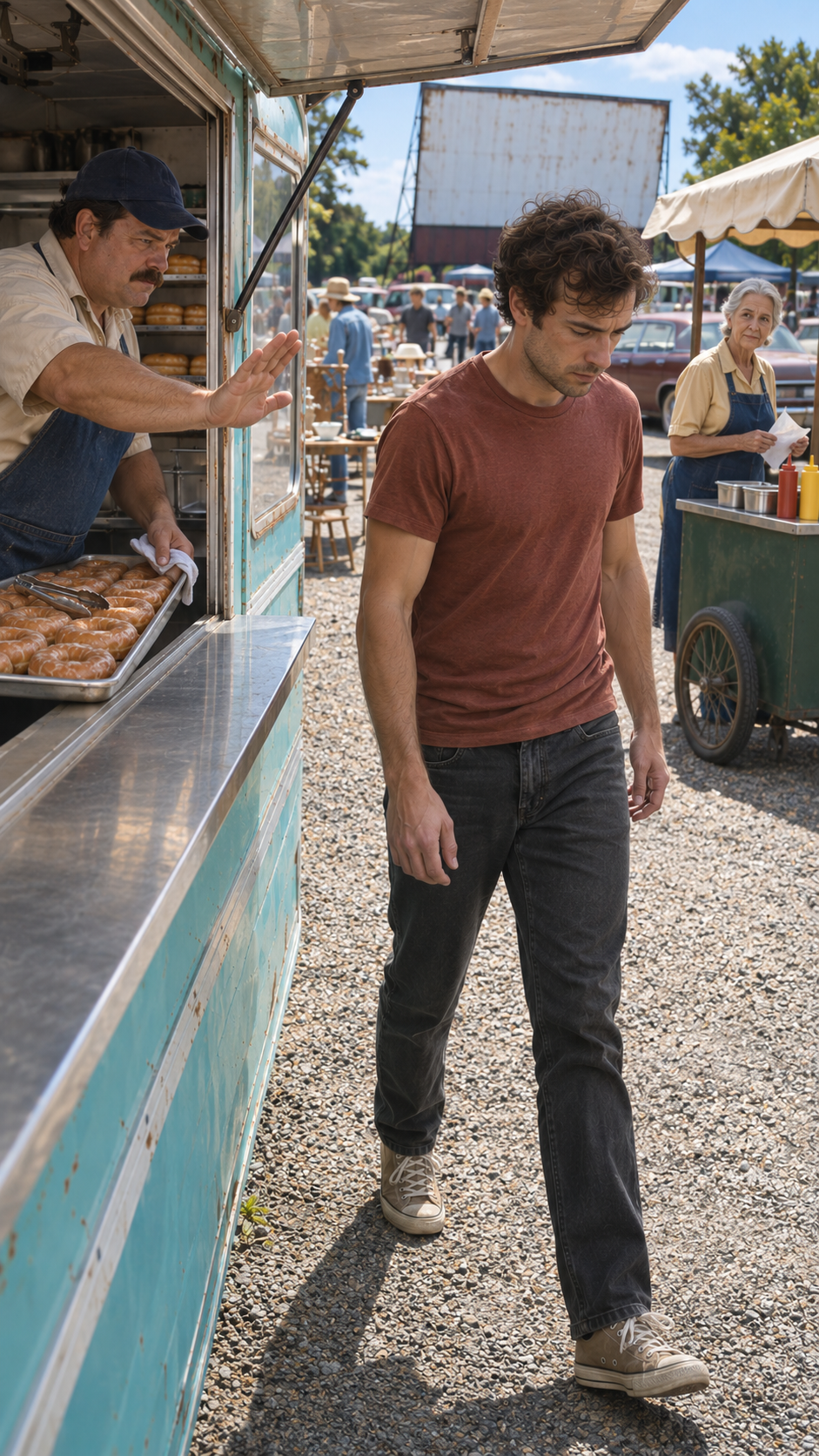
Wade raised his free hand and waved him aside.
“If you can’t pay, keep moving.”
His response was direct and dismissive.
Eli did not argue.
He did not ask again or attempt to persuade the vendor.
He simply lowered his gaze and walked away.
His scuffed tan sneakers scraped against the gravel as he moved toward the next stall.
Behind him, Wade continued working.
The doughnuts remained on the tray, and the serving window stayed open for paying customers.
For Eli, the interaction appeared to be over.
But someone nearby had noticed what happened.
At the neighboring stall, an elderly woman stopped folding a piece of wax paper.
Her name was Mae.
She operated a forest-green hot dog cart beneath a cream-colored awning.
And unlike Wade, she was not about to let Eli walk past without saying anything.
The Woman at the Green Cart
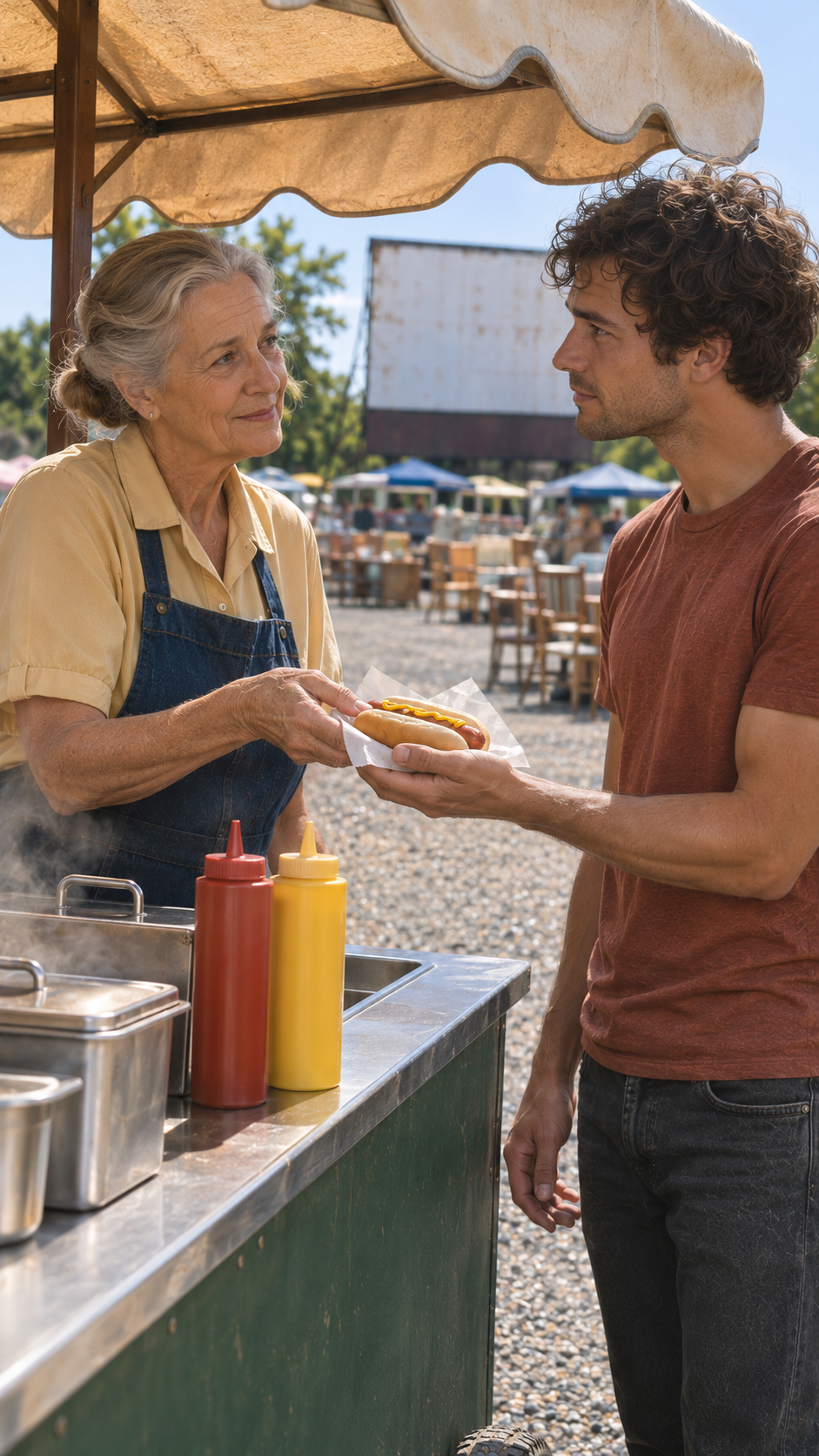
Mae was 70 years old, with silver hair gathered neatly into a bun.
She wore a butter-yellow blouse beneath an indigo apron.
Her small food cart was simple but carefully arranged. Fresh buns rested near the serving area, and steam rose gently from the heated compartment where she kept the food warm.
Mae watched Eli approach.
She had seen him walk away from the doughnut trailer with his head lowered.
She caught his eye.
There was no need for a lengthy conversation.
Instead, she turned toward her food supplies and began preparing something.
She placed a hot dog inside a soft bun and added a single stripe of mustard.
Then she settled it into a folded piece of white wax paper.
Eli stopped beside her cart.
Mae extended her hand, offering him the freshly prepared food.
The young man looked surprised.
He hesitated before reaching for it.
“I don’t have cash.”
Mae kept her hand extended.
She looked directly into his eyes.
“I didn’t ask, honey.”
Her answer was gentle and immediate.
There was no judgment in her voice.
There was no request for an explanation.
She simply wanted him to have something to eat.
Kindness Without Conditions
Eli slowly accepted the hot dog with his left hand.
The white wax paper crackled softly between their fingers.
Steam continued rising from the cart, while the cream awning moved gently in the afternoon breeze.
Mae returned his uncertain expression with a reassuring look.
She had offered him food without asking who he was, where he came from, or why he had no money available.
She did not know his occupation.
She did not know anything about his financial circumstances.
She had simply seen someone asking for food and decided to help.
For Eli, the difference between the two encounters was unmistakable.
At the first trailer, he had asked whether there was an older doughnut the vendor could spare.
He had been told to leave.
At the second stall, he had not even needed to ask.
Mae had prepared a fresh hot dog and offered it to him.
When he explained that he had no cash, she made it clear that payment was not expected.
Her kindness came without conditions.
And that was precisely what made the moment meaningful.
A Quiet Moment on the Parking Curb
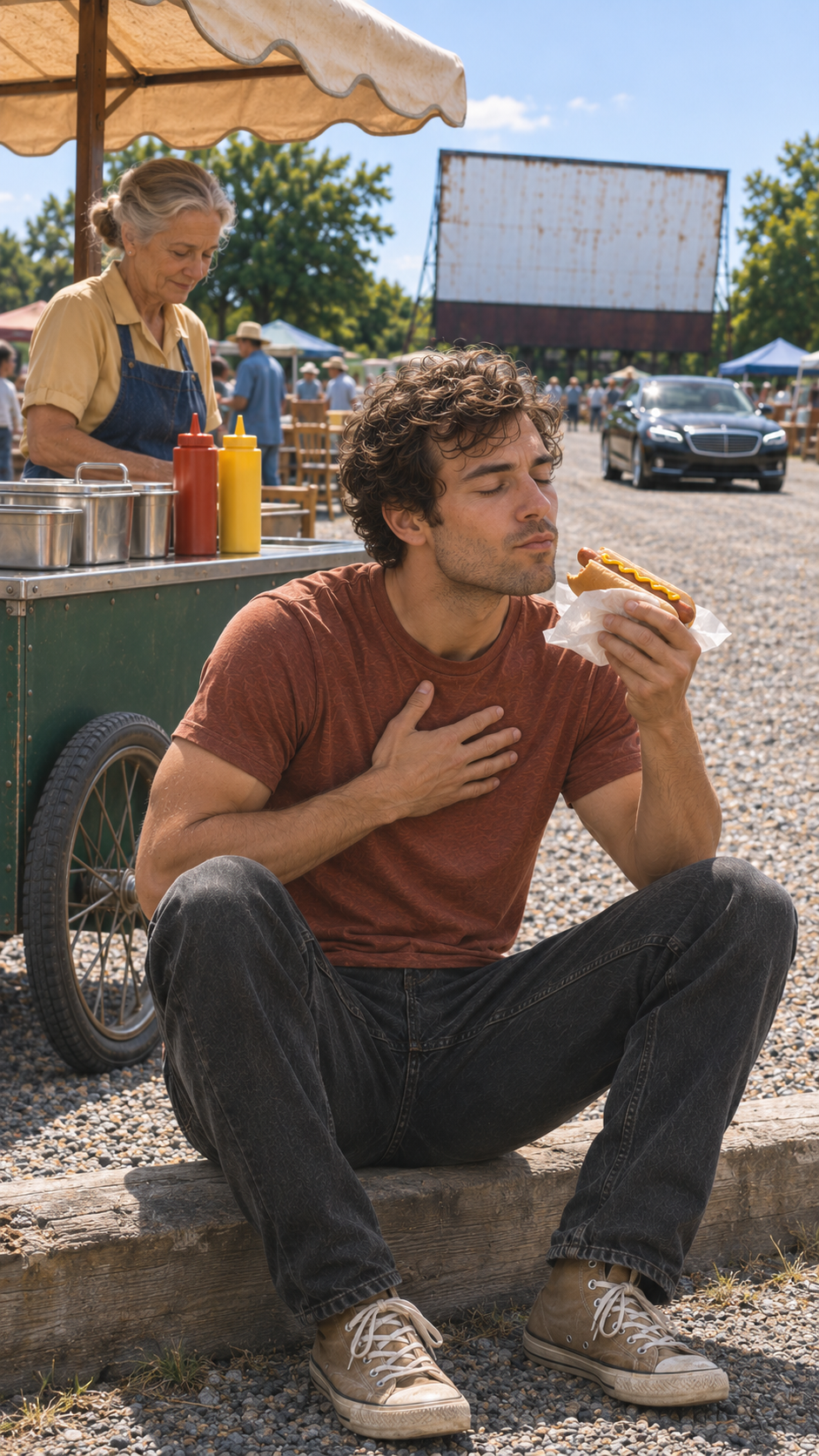
Eli moved toward a timber parking curb beside Mae’s green cart.
He sat down carefully, still holding the hot dog in his left hand.
Before taking his first bite, he looked back toward the elderly woman.
“Thank you, ma’am.”
Mae remained beneath the cream awning.
Eli raised the hot dog and took a bite.
He closed his eyes briefly, savoring the food.
His right hand rested against his chest.
For a moment, the busy flea market seemed to fade into the background.
The young man was simply enjoying the meal someone had offered him.
The wax paper rustled softly.
People continued walking between the stalls.
Wade remained at his turquoise doughnut trailer.
Everything appeared ordinary.
Then the sound of tires moving across gravel interrupted the peaceful moment.
A glossy black luxury sedan was approaching.
It moved slowly through the market lane before stopping near Mae’s cart.
Eli was still enjoying his food when the vehicle’s front wheel came into view.
The arrival of the expensive car seemed strangely out of place beside the modest food stalls.
But what happened next would make its presence perfectly understandable.
FOTO 3
The Unexpected Arrival
The black sedan stood beside the gravel lane with its engine quietly idling.
Its polished exterior reflected the surrounding market stalls.
The driver’s door opened.
A clean-shaven man wearing a black suit and white shirt stepped outside.
His professional appearance contrasted sharply with Eli’s faded T-shirt, charcoal jeans, and worn sneakers.
The driver carried a navy blazer.
He walked directly toward Mae’s green hot dog cart.
Eli had returned to his feet.
His partially eaten hot dog rested on its white wrapper on the cart’s ledge.
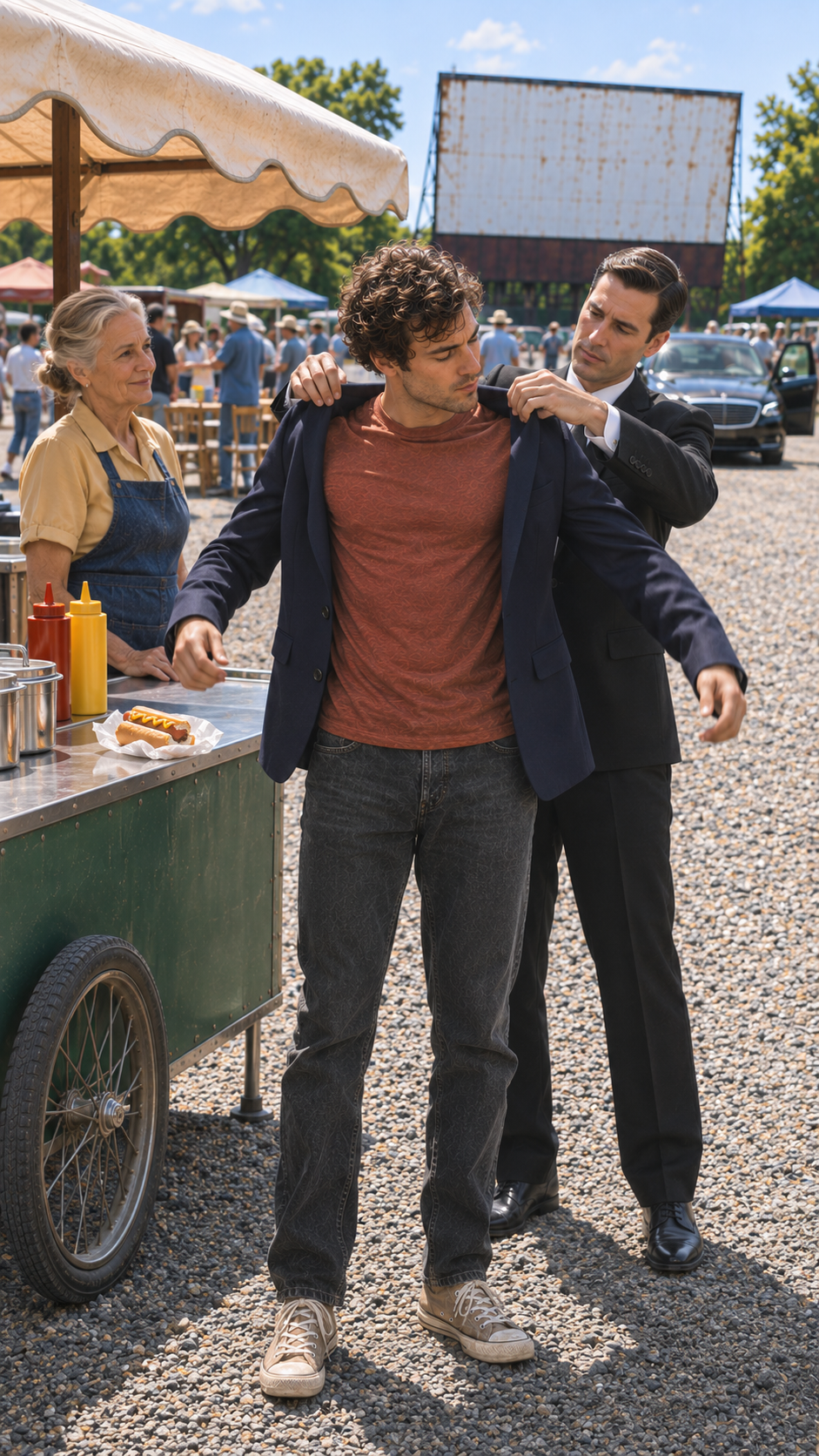
The driver approached him from behind and held the blazer open.
Then he spoke.
“Your jacket, Mr. Hayes.”
Mae looked toward the two men.
Eli calmly slipped his arms into the sleeves.
The navy blazer settled over his faded rust-colored T-shirt.
His charcoal jeans and scuffed tan sneakers remained unchanged.
But the arrival of the driver revealed something that his appearance had not suggested.
Eli was apparently someone with access to a private driver and a luxury vehicle.
The man who had just asked for a leftover doughnut was being addressed formally as Mr. Hayes.
Mae watched in surprise.
She had offered him food without knowing any of this.
More Than His Appearance Suggested
Until the driver arrived, there had been little reason for anyone at the market to assume that Eli was wealthy.
His clothing was ordinary.
His sneakers were worn.
He had shown Wade an empty pocket and told Mae that he had no cash.
Yet the black luxury sedan and professionally dressed driver suggested that his circumstances were more complicated than they first appeared.
The fictional story does not explain Eli’s profession or establish exactly how much money he possesses.
It does not reveal whether he owns a business or holds an important position.
What it does establish is that he has access to resources that were not immediately apparent.
That revelation changes the meaning of his earlier encounters.
Wade had judged the situation based on Eli’s inability to pay at the counter.
Mae had responded to his immediate need without considering whether helping him might benefit her.
Neither vendor knew that a driver would arrive moments later.
Their decisions had already been made.
And now Eli was preparing to make a decision of his own.
Eli Turns Back Toward Mae
With the navy blazer resting over his shoulders, Eli turned away from the black sedan.
He looked toward Mae and her forest-green cart.
The elderly woman remained beneath the cream awning, watching the unexpected scene unfold.
The buns were still arranged near the serving area.
The steam compartment continued hissing softly.
Eli glanced at the remaining food.
Mae had given him one hot dog without expecting payment.
Now he wanted to return that kindness in a way that could benefit more than just the two of them.
He looked directly at her.
“I’ll buy the rest. Feed anybody who asks.”
Mae froze.
For a moment, she appeared unable to respond.
Then she raised both hands toward her mouth.
The offer was much larger than the meal she had given away.
Eli was not merely paying for his own hot dog.
He was offering to purchase her remaining food so that other people could receive a meal without needing money.
The woman who had helped one stranger was now being given the opportunity to help many more.
One Hot Dog Becomes Something Bigger
Mae’s original gesture had been modest.
She had taken one bun, prepared one hot dog, added mustard, and wrapped it in white wax paper.
She had offered it to a young man who said he had no cash.
There had been no agreement that he would repay her.
She had not asked for his name.
She had not expected a luxury sedan to arrive.
Yet her small act of generosity had inspired Eli to offer something much larger.
His promise to purchase the remaining food meant that Mae could serve additional customers without asking them to pay.
The exact number of meals is not established in the story.
But the purpose of his offer is clear.
He wanted the kindness he received to continue beyond his own experience.
Rather than making an elaborate display of wealth, Eli directed his resources toward something practical.
Food for anyone who asked.
It was a simple response to the generosity Mae had shown him.
The Vendor Who Watched From Across the Lane
Not far from Mae’s cart stood the turquoise doughnut trailer.
Wade was still behind its serving window.
His navy cap and denim apron were unchanged.
The metal tongs remained in his hand.
From his position, he could see the black sedan, the professionally dressed driver, and Eli wearing the navy blazer.
He could also see Mae’s emotional reaction.
Only moments earlier, Wade had told the same young man to keep moving because he could not pay.
Now that young man was offering to purchase the remaining food from the neighboring vendor.
Wade’s mouth opened beneath his dark mustache.
His tongs remained suspended above a glazed doughnut.
For a moment, he appeared too surprised to continue working.
Then the tongs clicked shut over empty air.
The fictional scene ends without Wade saying another word.
His expression provides the final contrast between the two vendors.
One had dismissed Eli.
The other had offered him food.
Neither knew what would happen afterward.
But their different responses had led to very different outcomes.
The Danger of Judging Someone by Their Clothing
Eli’s appearance played an important role in the story.
He wore a faded T-shirt, charcoal jeans, and scuffed sneakers.
His pocket was empty.
He asked for a leftover doughnut rather than placing a conventional order.
Those details could easily lead someone to make assumptions about his circumstances.
But clothing and immediate access to cash do not necessarily reveal a person’s financial situation, character, or background.
The arrival of the driver demonstrates how incomplete those assumptions can be.
However, the deeper message is not that people deserve kindness because they might secretly be wealthy.
Eli deserved respectful treatment before the sedan arrived.
He deserved it when he was wearing only his faded T-shirt.
He deserved it when he showed his empty pocket.
And he deserved it regardless of whether he would ever be able to repay anyone.
Mae understood that principle through her actions.
She helped him before she knew anything about his resources.
That is what makes her generosity meaningful.
Why Mae’s Words Matter
“I didn’t ask, honey.”
Mae’s response was only four words.
But it captured the heart of the entire story.
Eli had explained that he could not pay.
Mae did not demand an explanation.
She did not make him justify accepting the food.
She had already decided that she wanted to offer him a meal.
Her words removed the uncertainty from the interaction.
Eli no longer needed to wonder whether he could accept the hot dog without money.
He could simply take it and enjoy it.
That small moment demonstrated the difference between giving something reluctantly and offering it freely.
Mae’s generosity was not presented as a business strategy.
It was not an attempt to impress the people around her.
It was an ordinary act of compassion that happened to have an extraordinary consequence within the fictional narrative.
The Difference Between Business and Compassion
Food vendors operate businesses.
They have expenses, responsibilities, and supplies that cost money.
They are not automatically obligated to provide free food to every person who asks.
The story does not suggest otherwise.
The important distinction lies in how people are treated.
Wade could have declined Eli’s request politely.
He could have explained that he did not have any leftover doughnuts available.
Instead, he dismissed him abruptly.
Mae made a different choice.
She decided that she could spare one hot dog.
She offered it without making Eli feel uncomfortable about accepting it.
Her decision was voluntary.
And Eli’s eventual offer to purchase her remaining food was voluntary as well.
The story illustrates how generosity and ordinary business responsibilities can coexist.
It also reminds audiences that declining a request does not require treating someone disrespectfully
 .
An Unexpected Way to Give Back
When Eli offered to buy Mae’s remaining food, he could have simply paid her for the hot dog he had eaten.
That would have been a straightforward way to return her kindness.
Instead, he extended his offer to future customers.
“Feed anybody who asks.”
Those words transformed the situation.
Mae’s original act had helped one person.
Eli’s response created the possibility of helping others.
The fictional story does not show those additional customers arriving or establish how the arrangement would be carried out.
It ends with the offer itself.
But the intention is unmistakable.
Eli wanted other people to experience the same generosity he had received.
His response demonstrates how a small act of kindness can inspire a larger one.
The Real Value of the Afternoon
The luxury sedan provides the unexpected reveal.
The navy blazer changes Eli’s appearance.
The driver’s formal greeting introduces an element of mystery about his background.
But none of those details is as important as what happened before the car arrived.
Mae saw someone who appeared to need food.
She prepared a hot dog.
She handed it to him.
She expected nothing in return.
That moment would still have mattered even if Eli had walked away afterward and never returned.
The value of her kindness did not depend on the reward.
The later offer simply gave the story an uplifting conclusion.
It allowed Mae’s generosity to reach beyond the original encounter.
And it showed how compassion can influence the decisions of others.
The Final Moments at the Flea Market
The glossy black sedan remained parked beside the gravel lane.
Eli stood near the forest-green hot dog cart, wearing his navy blazer over the same faded rust-colored T-shirt.
Mae stood beneath her cream awning.
Her silver hair remained neatly gathered in a bun, and her indigo apron covered her butter-yellow blouse.
Eli looked toward the remaining buns and repeated his intention to purchase the food.
Mae brought both hands to her mouth in surprise.
Across the lane, Wade watched from his turquoise doughnut trailer.
His metal tongs hovered above the tray of glazed doughnuts.
He stared at the young man he had dismissed only moments earlier.
Then the tongs clicked shut.
The market continued around them, but the meaning of the afternoon had changed completely.
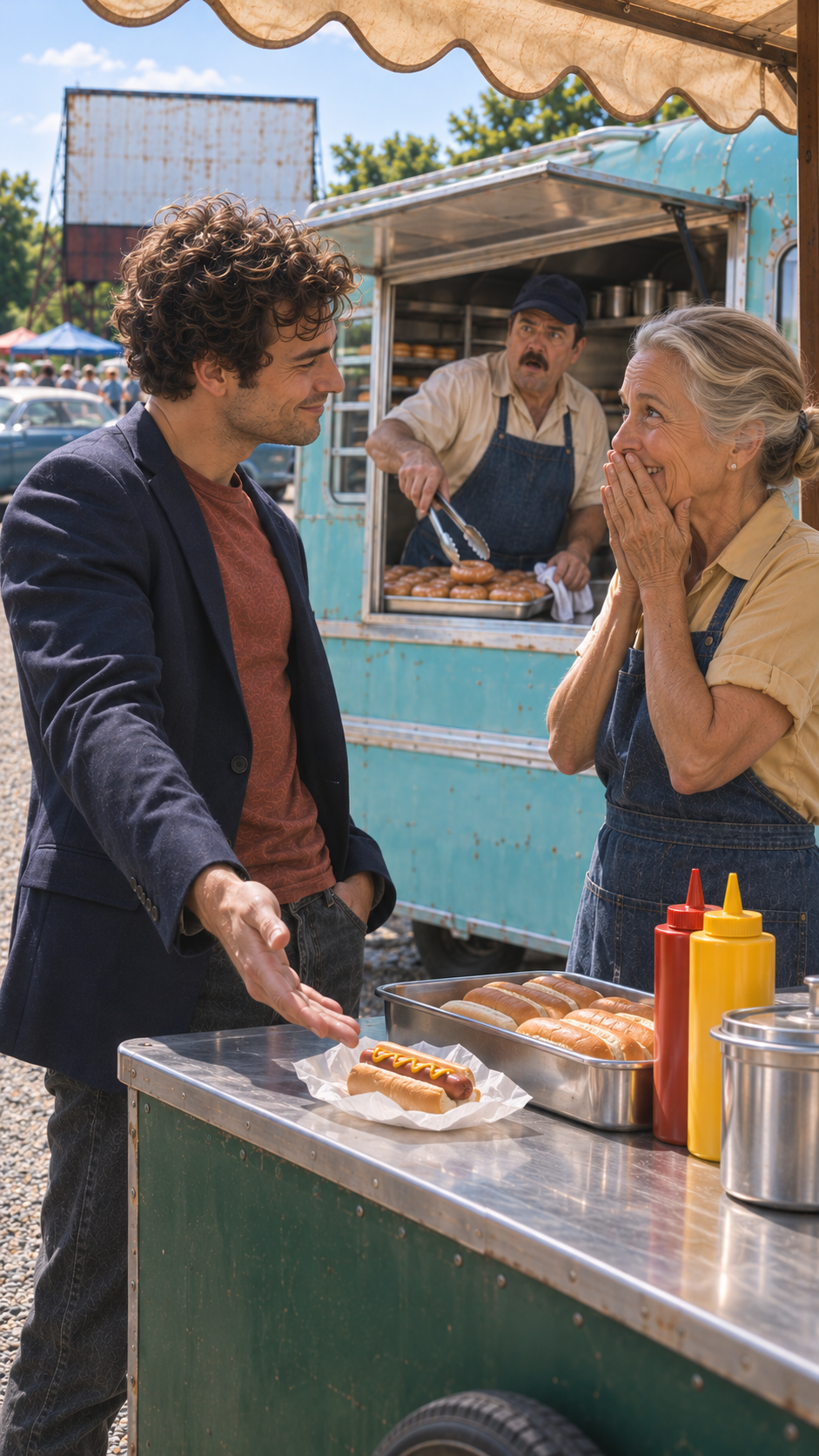
Mae stood beside her green hot dog cart, visibly moved by Eli’s offer to purchase the remaining food and feed anyone who asked. Behind him waited the glossy black sedan, while Wade watched silently from his doughnut trailer. The woman who had offered a stranger one hot dog without expecting anything in return had inspired a much larger act of generosity. What began with an empty pocket ended with a powerful reminder that kindness should never depend on someone’s appearance, wealth, or ability to repay it.