One Small Bread Roll
The afternoon sun warmed the pavement outside a modest bakery trailer parked beside an old outdoor shopping area.
A canvas awning stretched above the serving hatch, offering a little shade to customers waiting near the steel counter.
Beyond the trailer stood a wooden bench, several weathered speaker posts, and faded yellow parking stripes.
The steady hum of a ventilation fan came from inside the trailer.
At the counter stood an elderly man named Walt.
His shoulders were slightly bent, and his hands moved carefully as he examined the few coins he had collected.
He was not ordering a large meal.
He was not asking for anything expensive.
He wanted one small bread roll.
The baker held the roll in a pair of metal tongs.
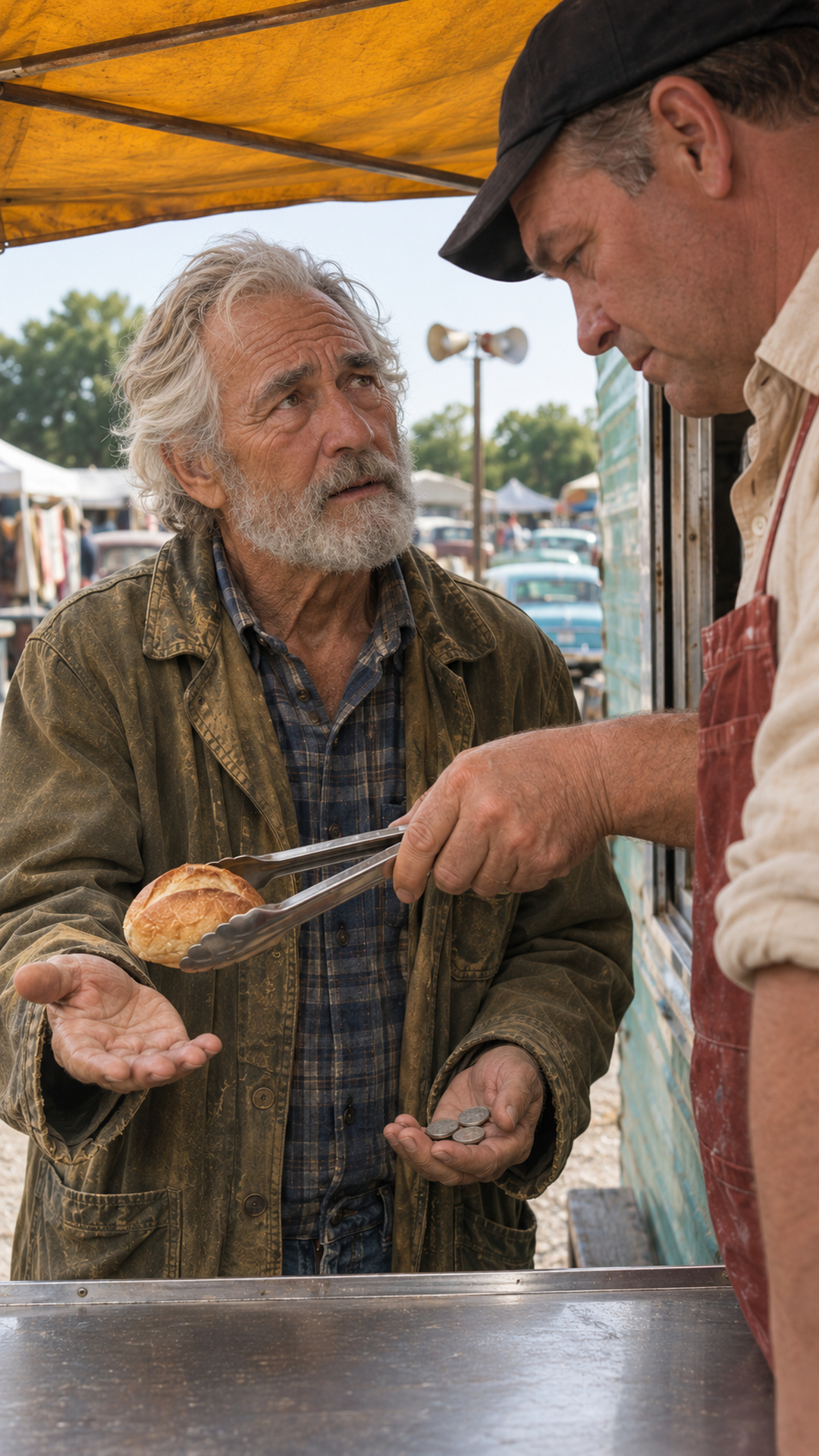
For a moment, it hovered just an inch above Walt’s open right hand.
Walt looked at the bread.
Then he glanced down at the coins resting in his left palm.
He moved them slightly, trying to determine whether he had enough.
“Would this cover that little one?”
The baker looked down at the change.
The tongs squeaked softly.
Two coins clicked together in Walt’s hand.
The elderly man waited.
He was hoping the money would be enough.
But the baker’s response would turn a simple purchase into an embarrassing moment.
The Baker Pulls the Bread Away
The small bread roll remained suspended between the metal tongs.
Walt held out his right hand.
His left palm contained the coins he was counting.
The baker examined the change.
Then he pulled the roll away.
The bread returned to its tray behind the counter.
Walt looked down again.
He was still trying to count.
Perhaps he had missed a coin.
Perhaps the amount was closer than it appeared.
But the baker was already moving on.
“You’re short. Next, please.”
The words were abrupt.
Walt had not finished counting.
The baker waved him aside.
For a moment, the elderly man remained at the counter, looking at the coins.
Then one slipped from his left hand.
It was a quarter.
Walt tried to catch it.
But as he moved, the remaining coins spilled too.
The change scattered across the metal step and pavement.
Sharp metallic pings interrupted the steady fan.
Walt looked down in alarm.
The little money he had been counting was now spread across the ground.
Coins Across the Pavement
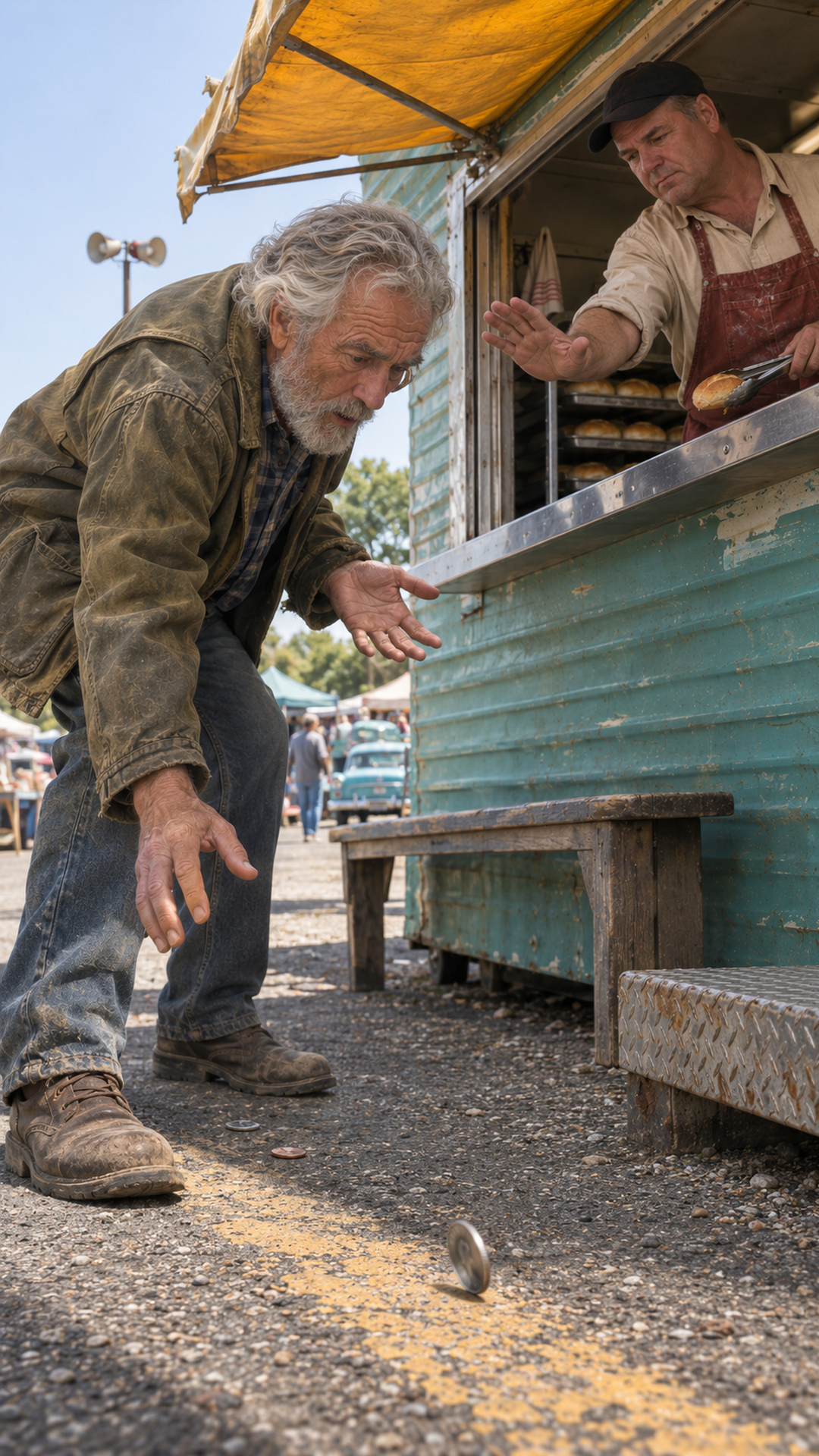
The quarter rolled away from Walt.
It crossed the asphalt and followed a faded yellow parking stripe.
Other coins bounced near the trailer step.
Walt lowered himself toward the pavement.
He reached for the scattered change.
The baker remained behind the serving hatch.
The small bread roll was back on its tray.
The transaction had ended without a sale.
Walt was now on one knee, gathering the money that had slipped from his hand.
He collected the nearest coins.
But the quarter continued rolling.
It wobbled along the yellow line.
Then it came to a stop against a black shoe.
Someone else had noticed what happened.
The shoe belonged to Officer Reed.
The Officer Notices
Officer Reed looked down at the quarter.
Then he looked toward Walt.
The elderly man was still kneeling on the pavement, carefully collecting his coins.
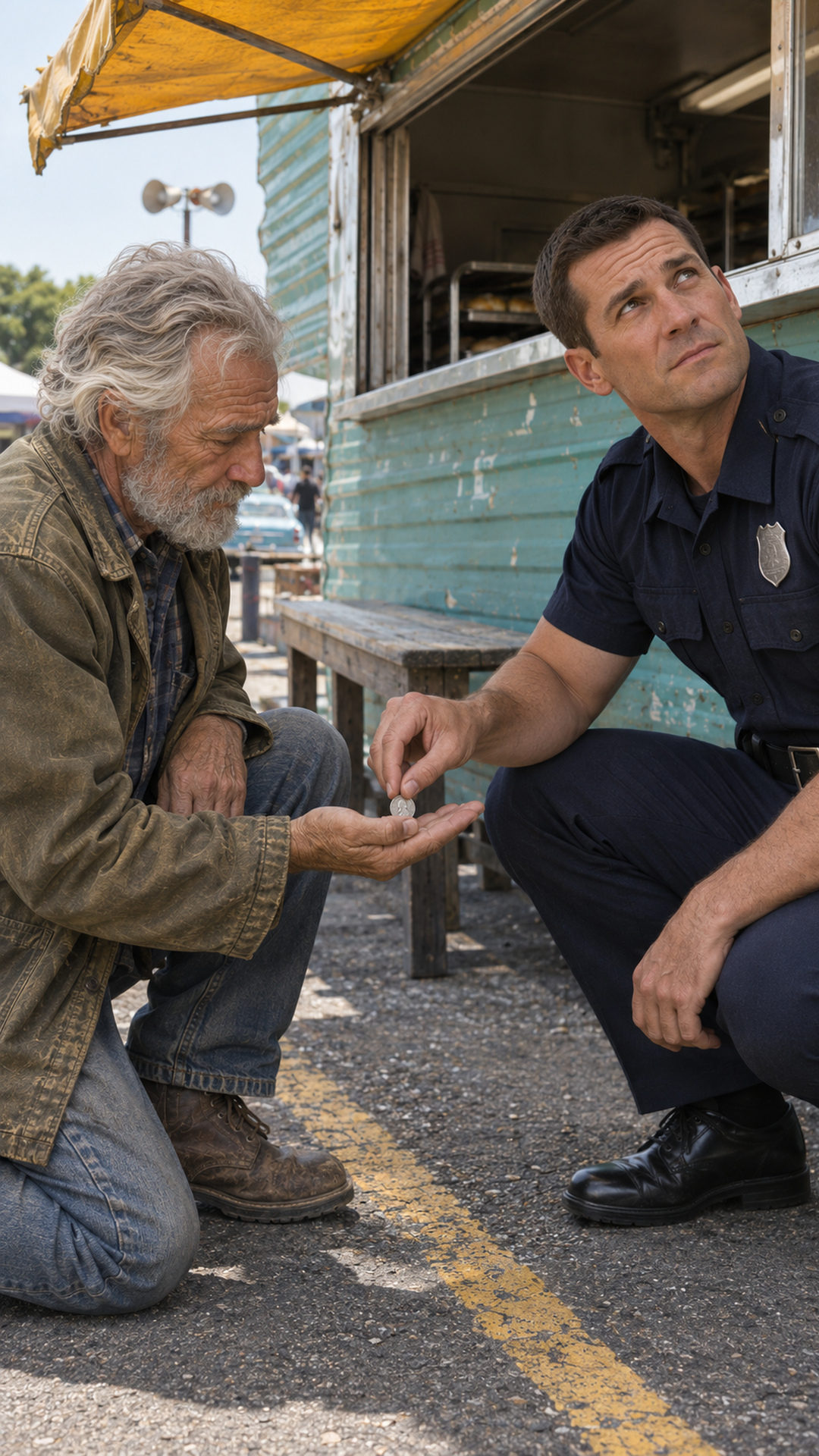
Reed crouched beside him.
He picked up the quarter.
Then he placed it in Walt’s palm.
“Here’s the last one, sir.”
Walt closed his fingers around the coin.
The officer remained beside him for a moment.
A shopping cart rattled somewhere in the distance.
The sound of traffic and the trailer’s ventilation fan continued around them.
Reed glanced toward the serving hatch.
He had seen enough to understand that Walt had been trying to buy something.
The elderly man had not been demanding special treatment.
He had been counting the money he possessed.
And when the coins fell, he had tried to recover them himself.
Reed looked toward the bakery counter.
His next decision would change the afternoon.
A Small Gesture of Respect
The quarter was only one coin.
Its monetary value was limited.
But the way Reed returned it mattered.
He did not throw it toward Walt.
He did not leave it on the ground.
He crouched beside the elderly man and placed it directly into his palm.
He also addressed him respectfully.
“Here’s the last one, sir.”
That brief exchange contrasted with the way Walt had been dismissed at the counter.
The baker had hurried him along.
The officer gave him time.
The baker had focused on the missing money.
The officer noticed the person trying to gather it.
The fictional scene shows how dignity can be communicated through small actions.
Reed did not make a speech.
He simply returned the quarter and acknowledged Walt.
Then he stood.
And turned toward the bakery.
Something Larger Than a Bread Roll
Inside the trailer, the baker remained behind the steel counter.
Officer Reed approached the serving hatch.
The small bread roll Walt had wanted was still available.
But Reed looked toward something else.
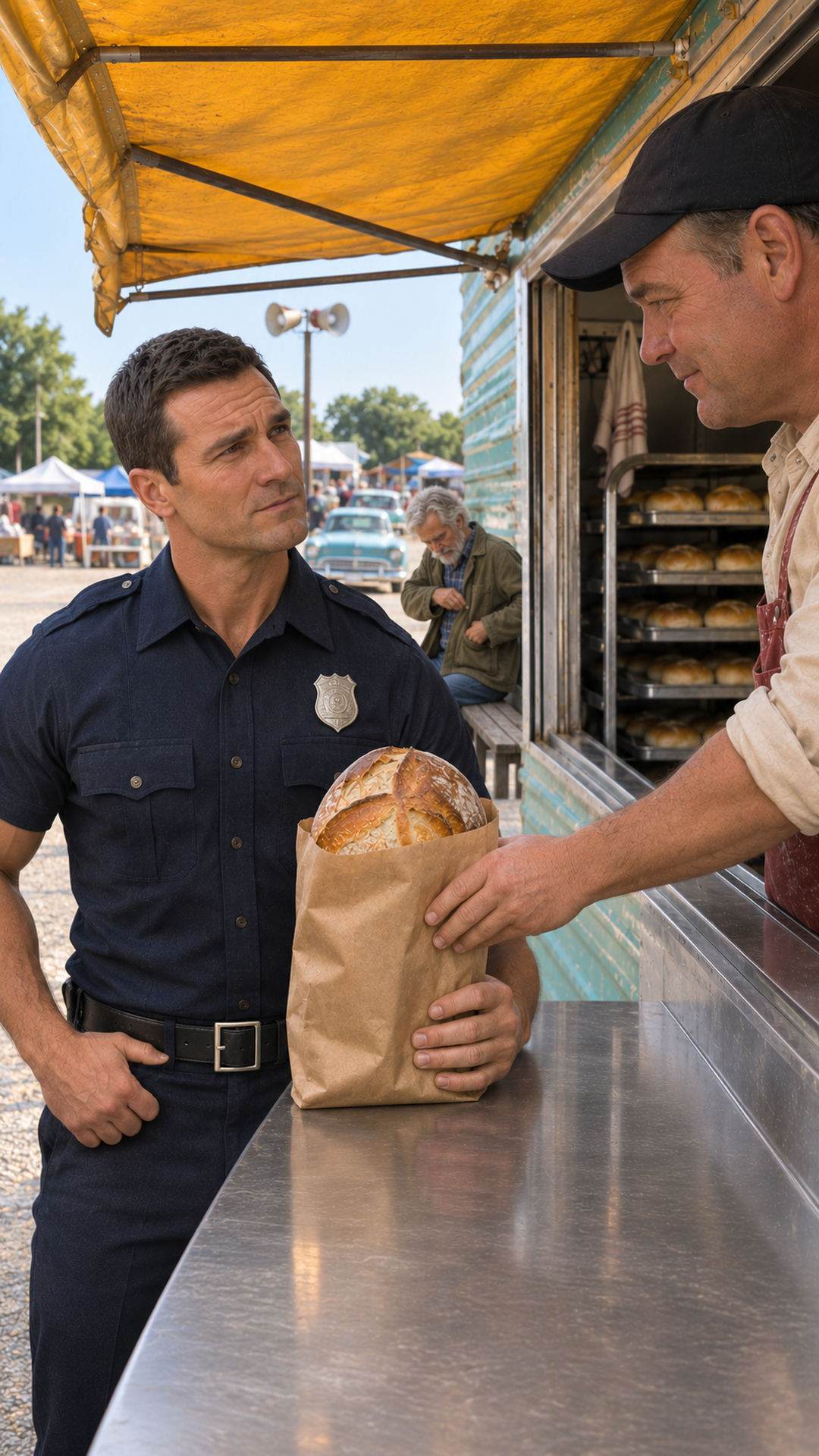
A large round loaf rested in an open brown paper bag.
Its golden crust was visible above the paper.
Reed pointed toward it.
“I’ll take the whole loaf.”
The baker reached for the bag.
He slid it across the steel counter.
Reed accepted it in his left hand.
The stiff brown paper crackled as he took its weight.
Behind him, Walt had finished collecting his change.
The elderly man placed the coins into his pocket.
Then he moved toward the nearby wooden bench and sat down.
He was no longer standing at the counter.
And he still had not received the small roll he originally wanted.
But Officer Reed was holding an entire loaf of bread.
The Difference Between One Roll and a Whole Loaf
The contrast was immediate.
Walt had asked for the smallest bread roll.
He had held out a few coins.
The baker refused the sale because the money was insufficient.
Now Reed was purchasing a whole loaf.
The bread was large and round, with a golden crust.
It sat inside an open brown paper bag.
The loaf was considerably more than Walt had originally requested.
But the story was not simply about the quantity of bread.
Reed had watched an elderly man struggle to complete a modest purchase.
He had seen the coins fall.
He had helped recover the last quarter.
And he had decided to do something about the situation.
The larger loaf represented an opportunity to offer Walt something more substantial than the roll he could not afford.
Still, Reed had one more thing to address before leaving the counter.
Two Folded Bills
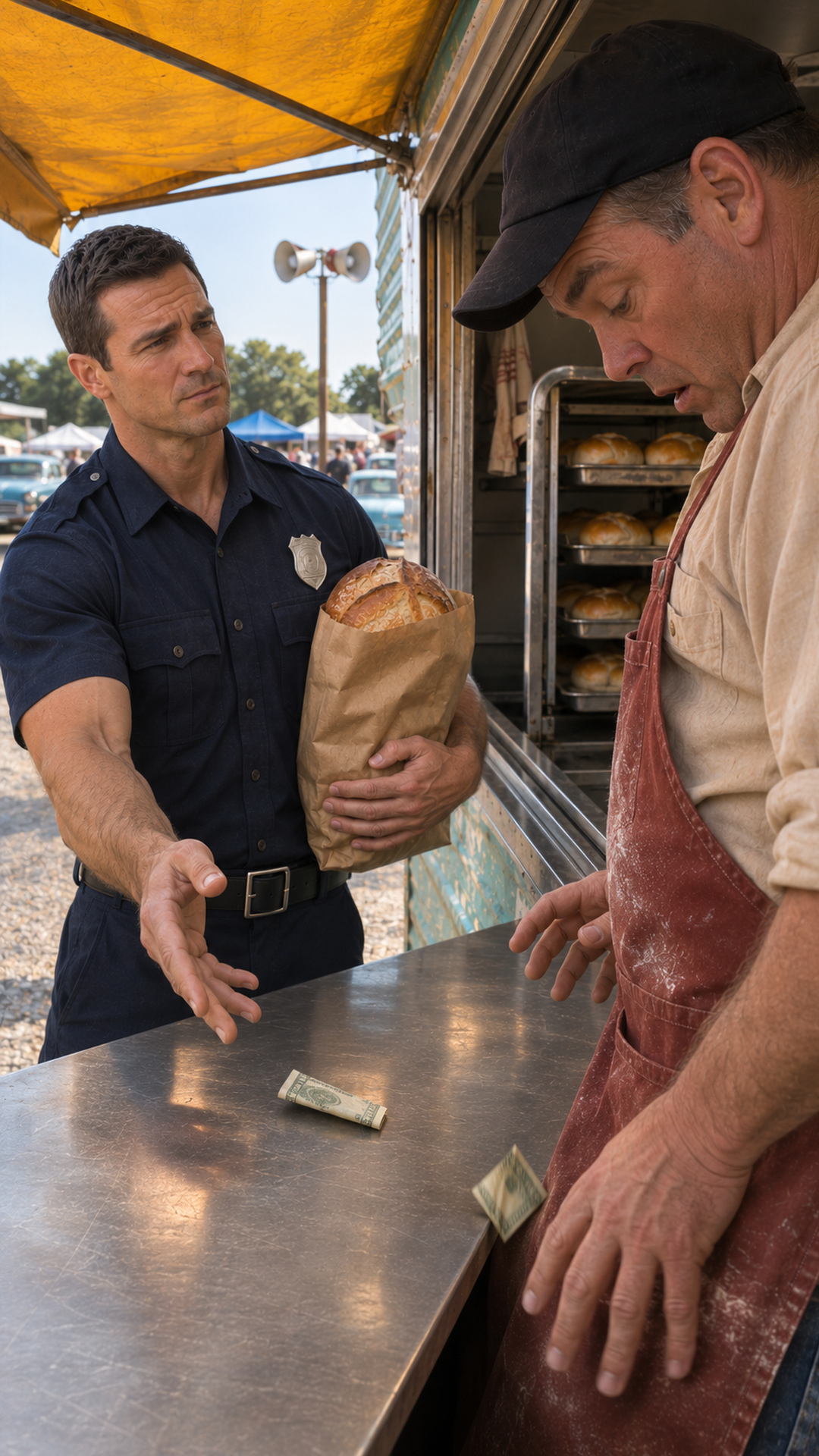
Officer Reed stood at the serving hatch.
The loaf rested securely in his left hand.
The baker was visible behind the steel counter, wearing a rust-red apron.
Reed reached with his right hand.
He took out two folded bills.
Then he tossed them across the counter.
The paper moved quickly over the metal surface.
One bill brushed the baker’s apron before falling beside the other.
The baker looked startled.
Reed remained composed.
He did not raise his voice.
He did not threaten the baker.
Instead, he spoke evenly.
“Next time, let him finish counting.”
The baker looked at him.
Then his eyes lowered.
For a moment, neither man spoke.
The canvas awning flapped in the breeze.
The steady fan continued humming inside the trailer.
The message had been delivered.
The Officer’s Words
“Next time, let him finish counting.”
The sentence was short.
But it addressed the most important part of what had happened.
The baker was entitled to charge for his products.
A customer having insufficient money did not automatically mean the baker was required to give away food.
But Walt had been interrupted while counting.
He had been dismissed abruptly.
And the rushed interaction had ended with his coins scattered across the pavement.
Reed’s words focused on patience.
He was not asking the baker to abandon his business.
He was asking him to treat the next person with greater consideration.
The distinction matters.
Respect does not require every transaction to end in a sale.
It requires recognizing the dignity of the person standing at the counter.
The baker lowered his eyes.
The fictional story does not reveal his private thoughts.
But his reaction suggests that the officer’s words had affected him.
The Baker’s Reaction
The baker stood behind the steel counter.
The two folded bills rested on the surface.
One had brushed his rust-red apron before falling.
He looked down.
The moment had changed.
Earlier, he had waved Walt aside.
“You’re short. Next, please.”
Now Officer Reed had completed a purchase and confronted the way the elderly man had been treated.
The baker did not respond with another dismissive remark.
He did not argue.
He simply lowered his gaze.
The scene leaves his feelings open to interpretation.
Perhaps he recognized that he had been impatient.
Perhaps he was embarrassed.
The story does not need to explain exactly what he was thinking.
His silence provides the contrast.
The elderly customer had been hurried away.
The officer had stopped long enough to make the baker reconsider the interaction.
And now Reed was ready to deliver the bread.
Walt Waits on the Bench
A short distance from the bakery trailer, Walt sat on a wooden bench.
The coins were safely in his pocket.
The small bread roll remained behind the counter.
He had not purchased anything.
The surrounding area looked ordinary.
The old speaker posts stood nearby.
Faded yellow parking stripes marked the asphalt.
A canvas awning moved above the bakery window.
Customers and shopping carts could still be heard in the distance.
Walt sat quietly.
He did not know what Officer Reed was about to do.
He had received help recovering the quarter.
But the officer had continued toward the bakery.
Now Reed approached the bench.
In his left hand was the large round loaf inside the brown paper bag.
He stopped beside Walt.
Then he bent toward him.
An Unexpected Gift
Reed held out the bag.
Walt looked up.
The elderly man’s hands moved toward the paper.
He accepted the loaf.
Its weight settled into his hands.
The bag crinkled softly.
Then Walt noticed something.
The bread was still warm.
He could feel the heat through the brown paper.
“Still warm. Thank you.”
The words were quiet.
Walt drew the loaf against his chest.
He held it carefully.
The officer did not remain to receive more praise.
He turned and began walking away.
His footsteps carried him between the weathered speaker posts.
Walt stayed seated on the bench.
He watched Reed leave.
Then he looked down at the bread.
The loaf rested against his chest.
Only minutes earlier, he had been unable to purchase a small roll.
Now he was holding an entire warm loaf.
Why the Warm Bread Matters
The final scene uses a small physical detail to communicate emotion.
The bread is warm.
Walt feels that warmth through the paper bag.
It is not merely an object being handed to him.
It is fresh food that he can hold against his chest.
The sensation makes the moment more personal.
At the beginning, Walt’s right hand was open beneath a bread roll he could not afford.
At the end, both hands hold an entire loaf.
That visual contrast connects the first and final scenes.
The same elderly man who had been dismissed at the counter now receives something freely offered.
The officer’s gesture does not solve every possible difficulty in Walt’s life.
The story does not claim that it does.
But it changes that particular afternoon.
Walt is no longer leaving the bakery empty-handed.
The Importance of the Scattered Coins
The coins are another central detail.
At first, they represent Walt’s limited purchasing power.
He holds them in his left palm and tries to count.
Then the baker interrupts him.
A quarter slips.
Walt tries to catch it.
The rest scatter.
The quarter rolls along the faded yellow stripe.
That movement creates the opportunity for Reed to enter the story.
The officer notices the coin and returns it.
The simple act of recovering the quarter becomes the beginning of a much larger gesture.
The coins also establish the difference between the two interactions.
The baker sees insufficient payment.
Reed sees an elderly man who needs a little patience.
Both observe the same situation.
But they respond differently.
Kindness Without a Long Speech
Officer Reed does not deliver a dramatic lecture.
He does not gather a crowd.
He does not make a public announcement.
His actions are direct.
He returns the quarter.
He buys the loaf.
He asks the baker to allow customers time to finish counting.
Then he gives Walt the bread.
Each action has a purpose.
The first restores something Walt lost.
The second provides the food Walt wanted.
The third addresses the treatment Walt received.
And the fourth completes the gesture.
The fictional story emphasizes that kindness does not always need elaborate words.
Sometimes it appears through practical help and respectful behavior.
Why Walt’s Request Is So Moving
Walt’s opening question is modest.
“Would this cover that little one?”
He is not asking for an entire loaf.
He is not requesting the largest item in the bakery.
He is pointing toward a small bread roll.
His right hand is open beneath it.
His left palm contains a few coins.
The question reveals that he is uncertain whether he has enough money.
That uncertainty creates vulnerability.
The baker’s refusal is therefore especially uncomfortable to watch.
But the emotional impact comes from the way the refusal happens.
Walt is hurried along before he finishes counting.
The coins fall.
He must kneel to retrieve them.
The audience sees not only a failed purchase but also a moment of embarrassment.
The Officer’s Choice
Reed could have returned the quarter and walked away.
That alone would have been a considerate action.
But he chooses to do more.
He purchases the whole loaf.
Then he addresses the baker.
His intervention combines generosity with a reminder about respectful treatment.
The gift is practical.
The words are measured.
He does not suggest that Walt should feel ashamed for lacking enough money.
He does not make the elderly man explain his circumstances.
He simply offers help.
Within the fictional narrative, that approach allows Walt to receive the bread without being subjected to another humiliating exchange.
A Story About Human Dignity
The emotional center of this story is dignity.
Walt’s money is limited.
But that does not make his time or feelings less important.
He deserves the same basic courtesy as any other customer.
The baker’s impatience makes the interaction painful.
Reed’s behavior offers a contrast.
He speaks respectfully.
He returns the lost quarter.
He purchases bread.
And he gives it to Walt without demanding anything in return.
The story does not establish why Walt has so little money.
It does not invent a history of unemployment, homelessness, or family hardship.
Those details are not necessary.
The audience only needs to understand what happens at the counter.
An elderly man asks whether he can afford a small roll.
He is dismissed.
His coins scatter.
Then another person notices and helps.
Six Scenes, One Clear Message
The thirty-second video follows six connected moments.
The first scene shows Walt asking whether his coins will cover a small bread roll.
The second shows the baker pulling the roll away, dismissing Walt, and the coins scattering across the pavement.
The third introduces Officer Reed, who retrieves the last quarter and returns it to Walt.
The fourth shows Reed purchasing an entire round loaf.
The fifth shows him placing two folded bills on the counter and telling the baker to let customers finish counting.
The sixth ends with Reed handing the warm bread to Walt on the wooden bench.
The story moves from uncertainty to rejection.
Then comes embarrassment.
A stranger notices.
He intervenes.
And the ending provides a quiet moment of gratitude.
The sequence is simple enough to understand without narration.
Each scene adds a new detail that leads naturally to the final gift.
The Contrast Between the Opening and Ending
The opening focuses on Walt’s empty right hand.
The bread roll is only an inch away.
But he cannot take it.
The baker still holds it in the tongs.
Walt is waiting for an answer.
The ending shows Walt holding a whole loaf against his chest.
There is no uncertainty about whether he can afford it.
The bread has already been given to him.
The contrast is visual and emotional.
In the opening, Walt is asking.
In the ending, he is thanking.
In the opening, the bread is withdrawn.
In the ending, the bread is offered.
The same basic need remains.
But the response he receives has changed.
The Value of Patience
One of the story’s strongest messages is that patience matters.
The baker could have allowed Walt a few more seconds to count.
He could have explained the price without dismissing him.
Even if Walt still lacked sufficient money, the exchange could have ended respectfully.
Instead, the hurried response contributed to the embarrassing moment.
Reed’s words address that exact problem.
“Next time, let him finish counting.”
The sentence is memorable because it does not demand anything extraordinary.
It asks for a basic courtesy.
A few additional seconds can make a meaningful difference when someone is struggling.
And that courtesy costs nothing.
A Quiet Ending
Walt does not celebrate loudly when he receives the bread.
He does not make a speech.
He simply feels the warmth through the bag.
“Still warm. Thank you.”
Then he holds the loaf against his chest.
Reed walks away.
The story ends with the elderly man’s face in the foreground.
The officer’s footsteps fade between the old speaker posts.
The brown paper crinkles softly.
The ending is deliberately restrained.
There is no need for a crowd applauding.
No need for an exaggerated reaction.
The gift and the words are enough.
The quietness makes the moment feel personal.
What the Story Leaves Behind
The fictional scene does not show what Walt does after the officer leaves.
It does not reveal whether the baker changes his behavior permanently.
It does not establish what happens later that afternoon.
The story ends at the bench.
Walt is holding the warm loaf.
Reed is walking away.
That limited ending is meaningful because it focuses on a single completed act of kindness.
The officer saw someone struggling.
He helped recover the lost money.
He bought food.
He addressed the disrespectful interaction.
Then he continued on his way.
The moment does not need to become something larger to matter.
The Final Moments at the Bench
The old wooden bench stood a short distance from the bakery trailer.
Walt sat quietly, his recovered coins tucked into his pocket.
Officer Reed approached with the round loaf in its brown paper bag.
The officer bent slightly and offered it to him.
Walt reached forward.
He accepted the weight of the bread with both hands.
The paper crinkled.
He felt the warmth through the bag.
“Still warm. Thank you.”
Walt drew the loaf against his chest.
Reed straightened and turned away.
His footsteps moved between the old speaker posts.
The afternoon sounds continued around them.
Walt remained seated, holding the bread.
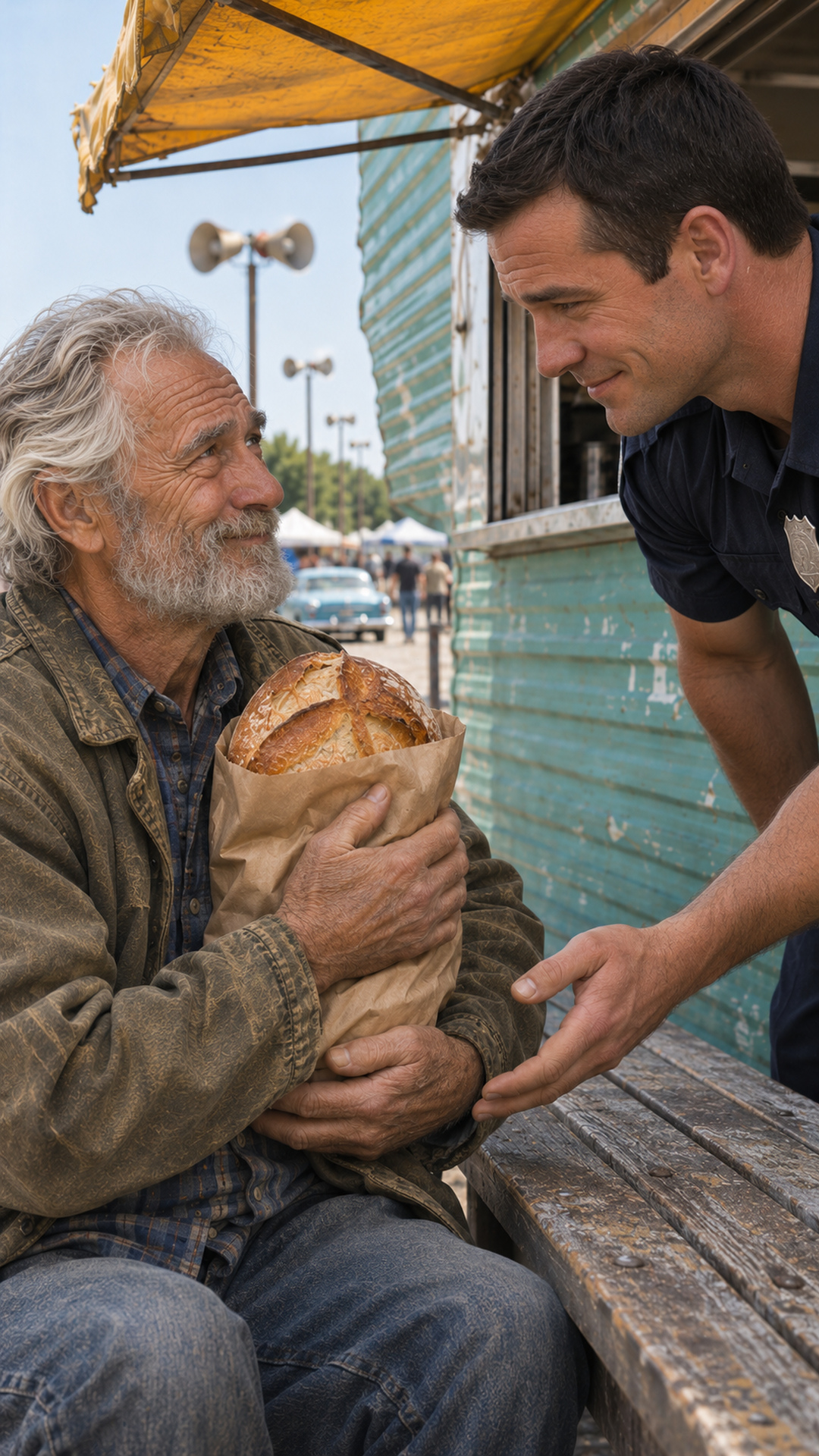
Walt sat on the wooden bench with the warm loaf resting against his chest. The large round bread was wrapped in an open brown paper bag, its golden crust visible above the folded edges. Officer Reed had just handed it to him. Walt felt the warmth through the paper and looked up with quiet gratitude. “Still warm. Thank you,” he said. He drew the loaf closer as Reed turned and walked away between the weathered speaker posts. The bag crinkled softly in Walt’s hands, and the officer’s footsteps gradually faded across the pavement.
The fictional story began with an elderly man trying to purchase one small bread roll using the few coins in his palm. Before he could finish counting, the baker pulled the roll away and told him he was short. Walt accidentally dropped his money, and a quarter rolled along a faded yellow parking stripe. Officer Reed noticed, crouched beside him, and returned the coin. He then purchased an entire warm loaf and reminded the baker to treat customers with patience. The most touching moment came when Reed handed Walt the bread and the elderly man quietly said, “Still warm. Thank you.” The officer walked away without asking for recognition, leaving Walt seated on the bench with the loaf held close to his chest. What began as an embarrassing moment at a bakery counter ended as a fictional reminder that generosity, patience, and respect can make an ordinary afternoon meaningful.