An Ordinary Morning at the Market
The morning market was already busy.
Shoppers moved between colorful stalls, carrying paper bags filled with fresh food and stopping to examine the goods displayed beneath canvas awnings.
The sounds of conversation, footsteps, and vendors serving customers filled the open-air marketplace.
Near one of the stalls stood an elderly woman named Della.
Her silver curls framed her face, and she wore a mustard-colored shirt beneath her work apron.
In front of her was a dented silver doughnut cart.
The cart had four small red wheels, a metal lid, and enough room for Della to display and serve the freshly prepared doughnuts she was selling that morning.
She worked carefully, using metal tongs to pick up each doughnut.
A customer stood in front of her.
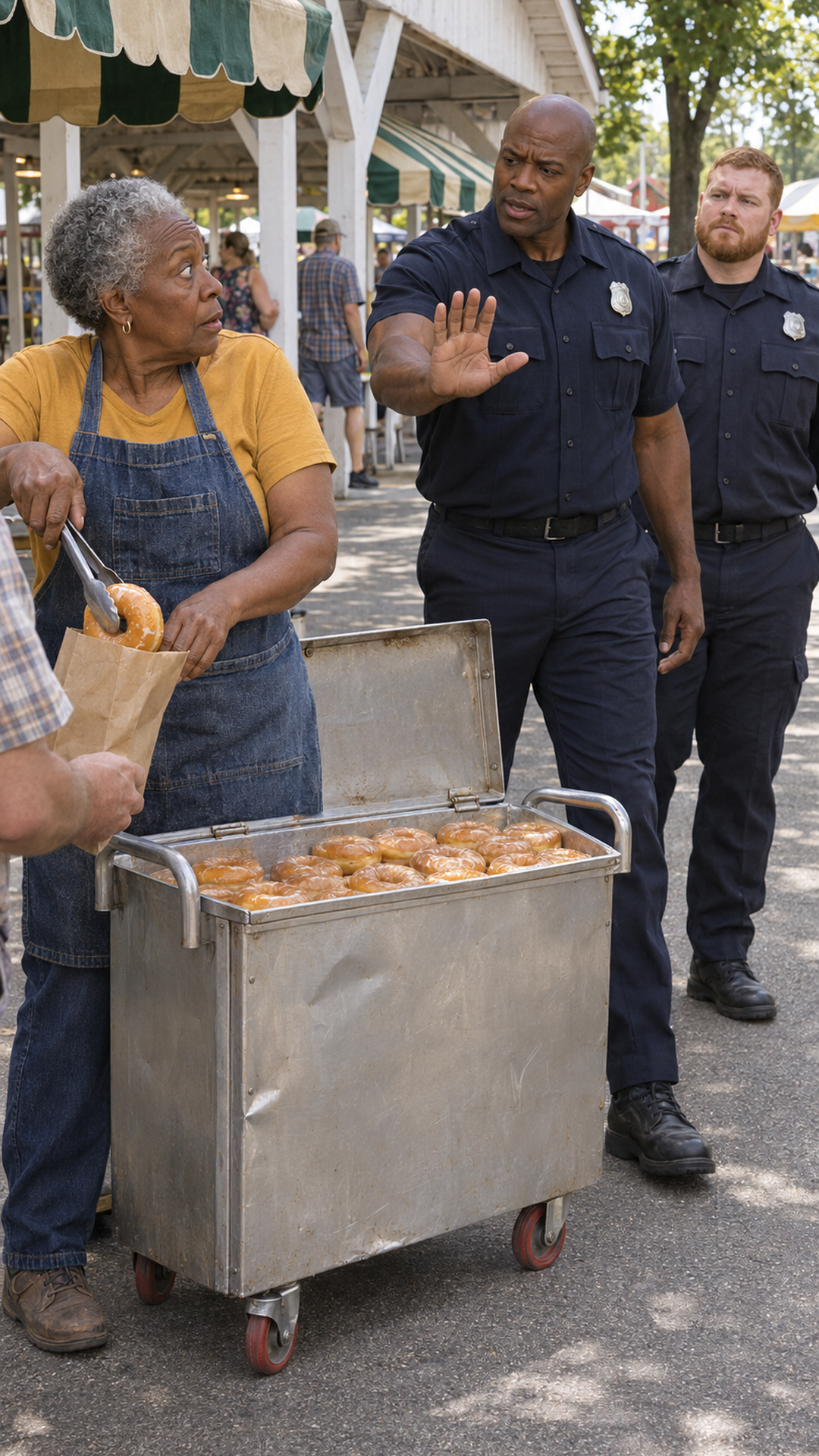
Della selected a glazed doughnut and slipped it into his paper bag.
The bag crackled softly.
It was an ordinary transaction.
Then a voice interrupted her.
“Ma’am, hold up a second.”
Della looked up.
Two uniformed officers were approaching.
Their names were Ellis and Reed.
Officer Ellis had one hand raised, signaling for her to stop.
The customer stepped aside with his doughnut.
Della’s tongs remained suspended above the next pastry.
She looked from one officer to the other.
Something unexpected was happening.
And neither officer had explained why.
The Officers Approach Her Cart
Officer Ellis stood near the front of the stall.
Officer Reed moved toward the other side.
Della watched them carefully.
Her silver cart was positioned on the pavement between the surrounding market stalls.
She had been serving customers only moments earlier.
Now the two officers were standing beside her equipment.
Della lowered her tongs.
The metal touched the cart with a small sound.
Reed reached toward the lid.
He closed it.
Then the officers moved to opposite handles.
Della watched as they prepared to lift the cart.
There was no extended conversation.
No detailed explanation.
And no indication that the morning’s sales were about to continue normally.
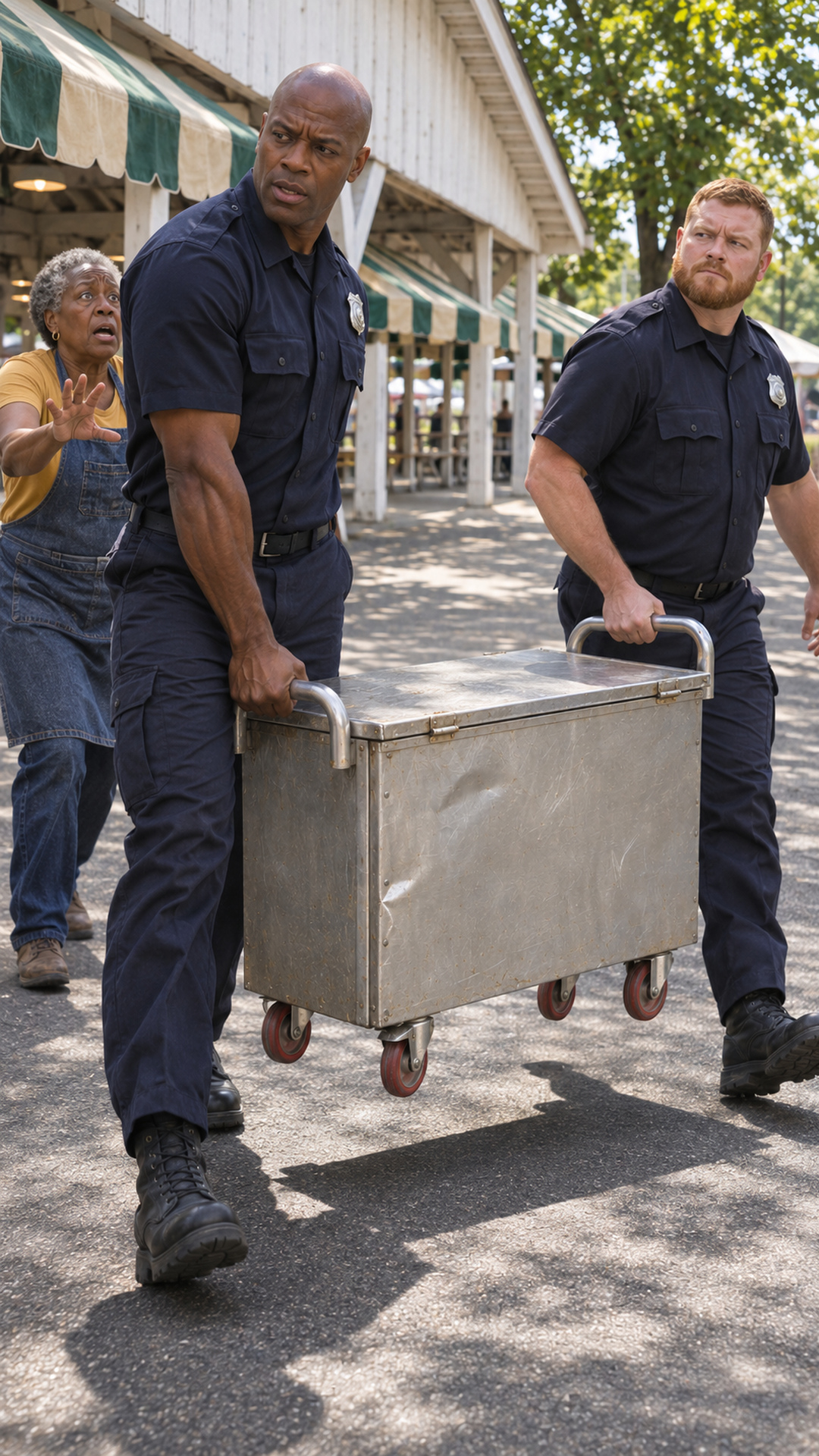
The two officers lifted together.
All four red wheels rose off the pavement.
The cart was now completely suspended between them.
Della took a step forward.
“Hey! Where’s my cart going?”
The officers continued carrying it.
The loose metal lid rattled as they walked.
Della followed for a moment, clearly confused.
The cart was the equipment she had been using to sell her doughnuts.
And now it was being carried away.
Four Red Wheels in the Air
The sight was difficult to misunderstand.
The dented silver cart was no longer resting on the ground.
Its four red wheels hung above the pavement.
Their shadows moved beneath them as Ellis and Reed carried the cart toward a service lane.
The officers held opposite handles.
They walked steadily, keeping the cart between them.
Della stood a short distance behind.
She watched the equipment move farther away.
A few moments earlier, she had been placing a glazed doughnut into a customer’s paper bag.
Now her entire selling station was being removed.
The sudden change left her uncertain about what would happen next.
The officers continued toward the service area.
The rattling metal lid grew quieter.
Their footsteps faded.
And Della was left standing in the space where her cart had been.
An Empty Space Between the Stalls
Della looked down at the pavement.
The cart was gone.
Only the open space remained.
Around her, the market continued operating.
Canvas awnings moved in the breeze.
Shoppers walked between the stalls.
Vendors continued serving customers.
But Della could no longer sell from her usual cart.
She turned toward the service lane.
The officers were moving farther away with it.
She called after them.
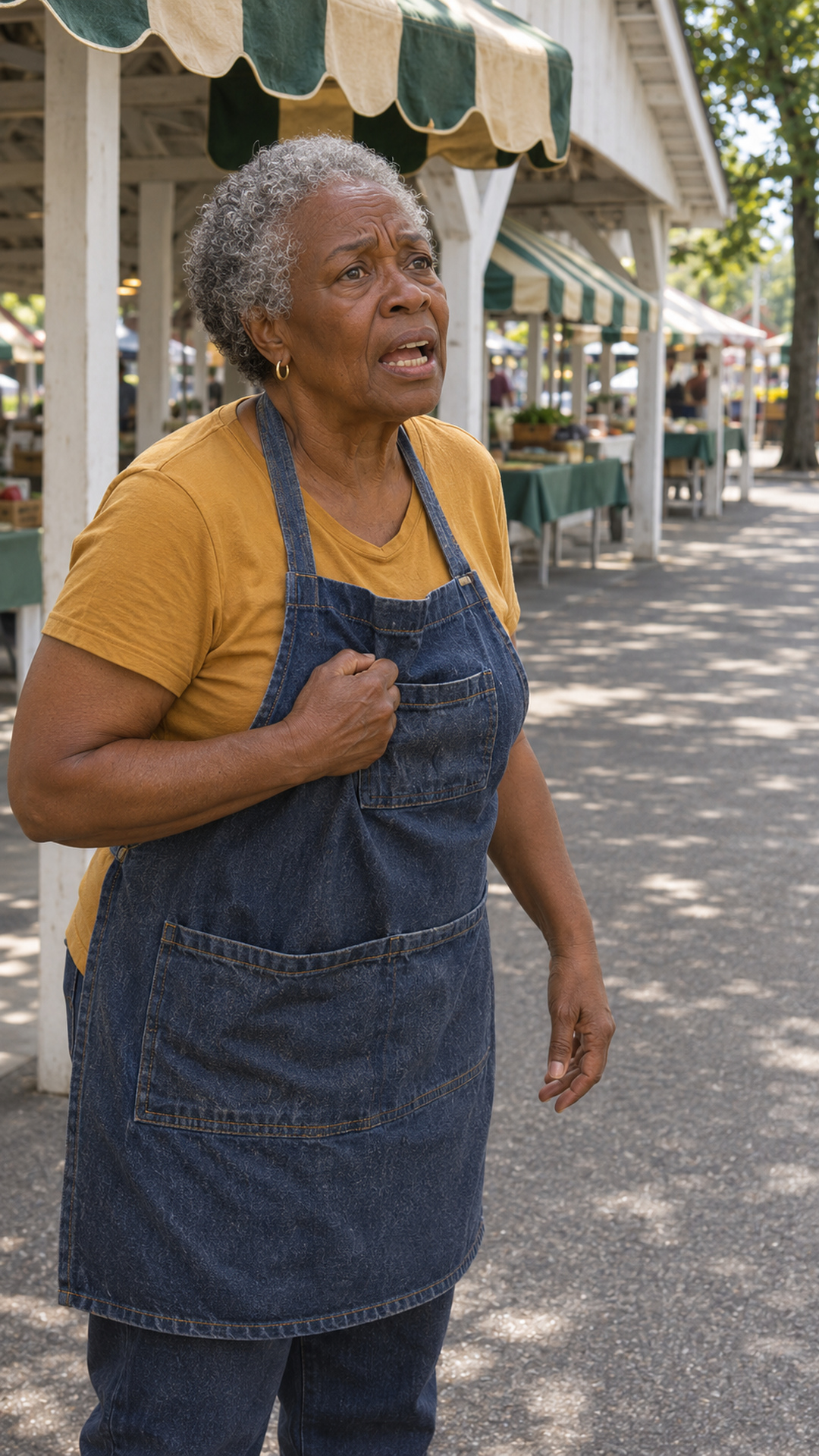
“I’ve got six dozen to sell by noon!”
Her voice carried across the market.
She had seventy-two doughnuts to sell.
The morning was important to her.
Every interruption meant lost selling time.
Della gripped her apron.
Her fingers tightened around the fabric.
She looked again at the empty pavement.
The market around her was busy.
But her stall had suddenly stopped functioning.
And she still had no explanation.
Why the Missing Cart Matters
Della’s silver cart was not an expensive-looking piece of equipment.
It was dented.
Its metal lid rattled.
Its four red wheels were small.
But the cart served an important purpose.
It allowed her to display doughnuts, reach customers, and complete sales.
Without it, she had no working stall in the space where she had been serving.
That made the officers’ actions especially confusing.
Della had been in the middle of a sale.
She had not finished her morning.
And she had a specific goal: sell six dozen doughnuts by noon.
The fictional story does not explain how long Della had owned the cart or how much income she earned.
It does not establish her financial circumstances.
But it makes one thing clear.
The cart was part of her daily work.
Taking it away without an explanation interrupted that work.
And Della wanted to know why.
Something Is Happening in the Service Lane
The officers continued toward the service lane.
A gray utility flatbed was waiting there.
The truck had a short lifting boom.
Della approached the area, still trying to understand what was happening.
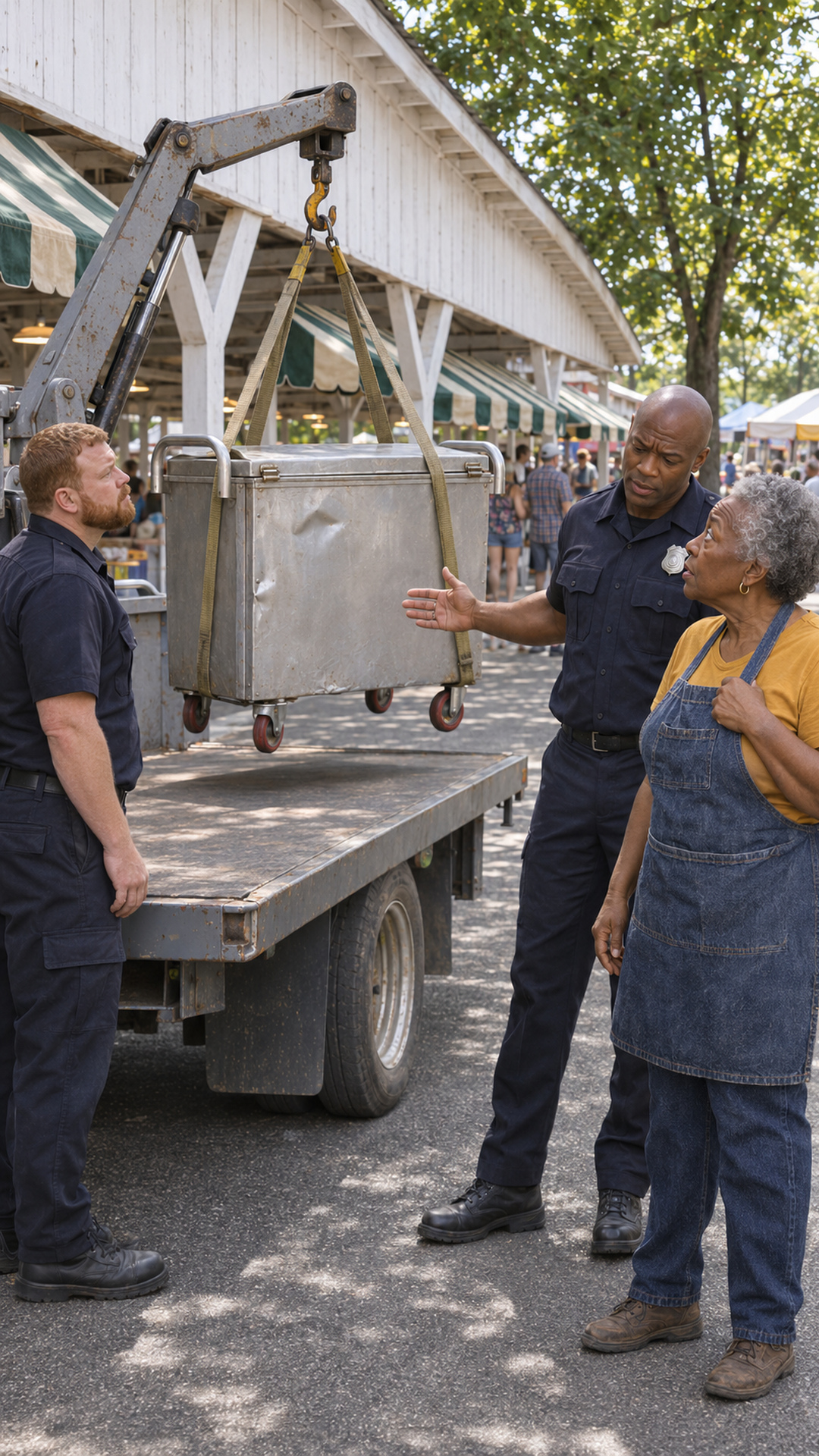
The dented silver cart was now attached to the lifting equipment.
Its four red wheels hung above the truck bed.
The boom supported the cart as it was moved into position.
The winch made a mechanical sound.
The wheels rose above the flatbed.
Della stood several paces away.
Officer Reed remained near the truck.
Officer Ellis stood closer to her.
She looked directly at him.
“At least tell me why.”
It was a reasonable request.
Her cart had been removed from her stall.
It was now being loaded onto a utility truck.
And she still did not know the reason.
Ellis did not immediately explain.
Instead, he made a gentle gesture over her shoulder.
“Turn around, Miss Della.”
Della hesitated.
Then she began to turn.
The Moment Everything Changes
Della’s fingers slowly loosened their grip on her apron.
She turned away from the flatbed.
At first, part of the view was blocked by a pavilion post.
Then the space beyond it came into sight.
A large vehicle stood nearby.
It was a cream-and-teal doughnut truck.
Its serving hatch was open.
The truck looked completely different from Della’s dented silver cart.
It had a larger serving area and a distinctive two-tone exterior.
But something on the side of the vehicle caught Della’s attention immediately.
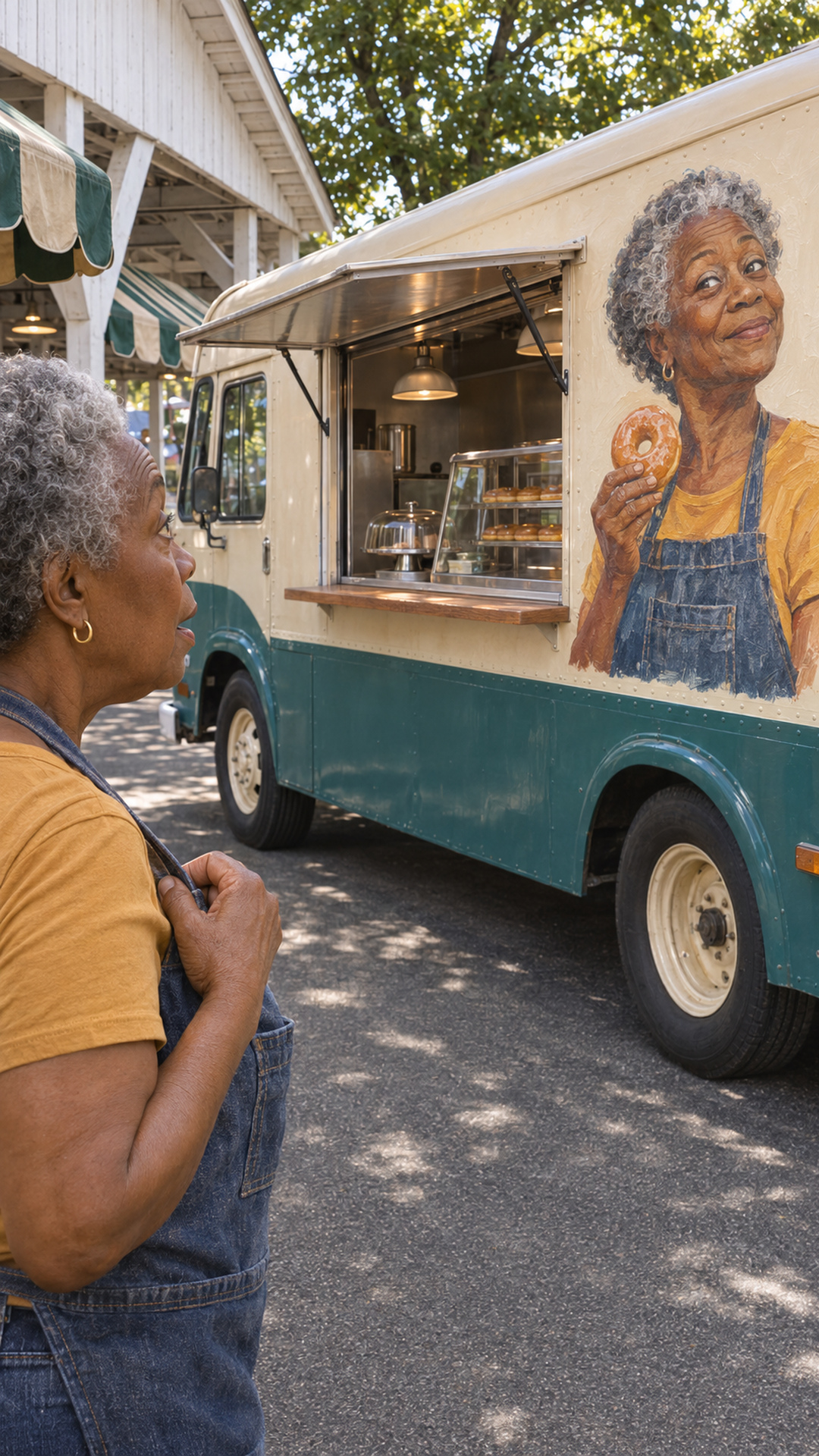
Beside the serving hatch was a painted portrait.
It showed a woman holding a glazed doughnut.
The woman had silver curls.
She wore a mustard-colored shirt.
Della stared at the painting.
Then she looked down at her own clothing.
The resemblance was unmistakable.
The portrait was of her.
“That’s my face.”
She spoke almost to herself.
A small metal catch tapped against the open serving hatch in the breeze.
Della remained still.
The strange morning was beginning to make sense.
A Portrait She Never Expected to See
The cream-and-teal truck stood beneath the pavilion.
Its serving hatch was open.
The painted portrait beside it was clearly visible.
The artist had captured Della’s silver curls.
The mustard-colored shirt matched the one she was wearing.
And the woman in the painting held a glazed doughnut.
The same kind of pastry Della had been selling from her cart.
The details connected the truck directly to her.
This was not an ordinary commercial vehicle parked at the market.
It had been personalized.
Someone had taken the time to make its appearance reflect Della herself.
For a moment, she could only stare.
She had been worried about her missing cart.
Now she was looking at a much larger doughnut truck with her own face painted on the side.
But one question remained.
Who did it belong to?
The Keys in Her Hand
Officer Reed approached Della.
He held a set of keys.
The elderly woman looked toward him.
Then she looked again at the cream-and-teal truck.
Reed reached for her hand.
He placed the keys in her palm.
They jingled softly.
“It’s yours, Miss Della.”
Della stared at the keys.
Then she looked toward the truck.
The meaning of the surprise finally became clear.
The vehicle was not simply being shown to her.
It was being given to her.
The officers had removed her old cart as part of a planned surprise.
And now they were presenting her with a new doughnut truck.
Della closed her fingers around the keys.
Her expression changed.
The confusion and concern of the previous moments gave way to astonishment.
She looked toward Ellis.
Then toward Reed.
Neither man needed to explain much more.
The keys were in her hand.
And her portrait was painted on the truck.
A Surprise Bigger Than Her Old Stall
Della’s old silver cart had four red wheels.
It had a dented metal body.
Its loose lid rattled when moved.
It had served as a compact selling station.
The new truck was dramatically different.
It had a cream-and-teal exterior.
A serving hatch was already open.
And the painted portrait made it unmistakably personal.
The story does not show the interior equipment or establish the vehicle’s operating capacity.
It also does not explain the arrangements behind the gift.
But the emotional meaning is clear.
Della had been working from a small cart.
Now she was being presented with a dedicated doughnut truck.
The surprise had been planned around her.
The portrait demonstrated that the gift was not generic.
It was intended for the woman standing in front of it.
Della’s Response
Della held the keys tightly.
Then she reached toward the officers.
Ellis and Reed moved closer.
She drew them into an embrace.
The three stood together beneath the painted portrait.
Della laughed softly.
The tension from the earlier scenes had disappeared.
Only moments before, she had been calling after the officers as they carried her cart away.
Now she was hugging them.
She looked toward the two men and spoke.
“First dozen’s on me.”
The offer was simple.
It was also perfectly suited to the moment.
Della sold doughnuts.
The officers had given her a doughnut truck.
And she was offering them the first dozen.
The three shared a quiet laugh.
The new truck stood behind them.
Its painted portrait watched over the scene.
Why the Opening Creates Immediate Suspense
The story begins during an ordinary sale.
Della places a glazed doughnut into a customer’s paper bag.
Then Officer Ellis raises his hand.
“Ma’am, hold up a second.”
The interruption is sudden.
The audience sees two officers approaching a small business.
The situation immediately creates questions.
Has Della done something wrong?
Is there a problem with the stall?
Are the officers going to shut down her business?
The uncertainty increases when they lift the cart.
All four wheels leave the pavement.
Della asks where it is going.
But the officers continue carrying it away.
The scene deliberately withholds the explanation.
That makes the audience want to discover what is really happening.
The Importance of the Red Wheels
The cart’s four red wheels are a distinctive visual detail.
They appear while Della is serving customers.
Then they rise off the pavement when the officers lift the cart.
Their shadows move beneath them.
Later, the same wheels hang above the bed of the gray utility flatbed.
This continuity helps the audience follow the cart’s movement.
The equipment does not suddenly change appearance.
It remains the same dented silver cart.
The four red wheels also make the removal visually dramatic.
A cart is normally pushed or rolled.
Seeing all four wheels suspended in the air emphasizes that it is being taken away rather than moved a short distance.
The unusual action builds suspense.
The Empty Stall Makes the Situation Personal
The third scene focuses on Della after the officers leave.
The camera reveals the empty space where her cart had stood.
That visual choice matters.
Instead of following only the officers, the story returns to the person affected.
Della is standing between the market stalls.
She looks down at the bare pavement.
Then she calls out about the six dozen doughnuts she needs to sell.
The line makes her concern specific.
She has a morning sales target.
She is not simply upset because her cart has moved.
She is worried about losing the opportunity to work.
The empty space communicates that concern without requiring a long explanation.
Ellis and Reed’s Roles
Officer Ellis and Officer Reed work together throughout the sequence.
Ellis initially asks Della to stop.
Reed closes the cart lid.
The two officers lift the cart from opposite handles.
They carry it toward the service lane.
Later, Reed remains near the utility flatbed while Ellis speaks with Della.
When she asks for an explanation, Ellis directs her attention toward the surprise.
“Turn around, Miss Della.”
Finally, Reed places the keys in her hand.
“It’s yours, Miss Della.”
The two officers have distinct roles.
Ellis guides the reveal.
Reed delivers the final confirmation.
Both are present when Della embraces them.
Their coordinated actions connect the opening mystery to the final gift.
The Emotional Power of “Turn Around”
The fourth scene contains one of the most important lines.
“Turn around, Miss Della.”
Until that moment, Della believes something is happening to her cart.
She has watched it being lifted.
She has seen it carried away.
She has followed the officers toward the service lane.
She has asked for an explanation.
Then Ellis tells her to turn around.
The line changes the direction of the story.
The audience’s attention shifts from the old cart to something behind Della.
The reveal is delayed just long enough to create anticipation.
Then the pavilion post moves out of view.
The cream-and-teal truck appears.
And Della recognizes her own face on the side.
The suspense is resolved through a visual discovery.
Why the Painted Portrait Matters
The portrait is the emotional centerpiece of the reveal.
Without it, Della might simply see a new doughnut truck.
She might wonder who owned it.
But the painted image changes everything.
The woman in the portrait has her silver curls.
She wears her mustard shirt.
She holds a glazed doughnut.
The likeness tells Della that the truck was created with her in mind.
Her whispered response captures the moment.
“That’s my face.”
She does not immediately deliver a long speech.
She simply recognizes herself.
That small reaction makes the surprise feel personal.
The gift is not only about a larger selling space.
It is also about recognizing Della and the work she does.
A Gift That Represents Recognition
Della’s work is ordinary in the best sense.
She serves doughnuts.
She fills paper bags.
She speaks with customers.
She works toward a daily sales goal.
The fictional story presents her as someone whose efforts deserve recognition.
The new truck symbolizes that recognition.
Its painted portrait puts her at the center.
The officers’ gift suggests that her work matters.
It is not presented as a reward for a dramatic achievement.
It is a gesture toward someone carrying out a familiar daily routine.
That is why the reveal feels emotional.
Della expected an explanation about her missing cart.
Instead, she discovered that someone had prepared a gift specifically for her.
Why the Surprise Is Not a Real-World Procedure
The story uses an unexpected removal of the cart to create suspense.
But taking someone’s business equipment without permission or explanation would be inappropriate in a real situation.
It could cause distress, interrupt income, or create safety and legal problems.
The fictional officers’ actions are part of a scripted reveal.
They should not be interpreted as recommended police conduct.
A genuine gift or business upgrade should be arranged transparently and with the recipient’s consent.
The story’s emotional message comes from generosity and recognition.
It does not depend on endorsing the way the surprise was staged.
The ending is designed to be heartwarming, but the initial confusion is an intentional storytelling device.
Six Scenes That Build Toward One Surprise
The thirty-second video follows six connected moments.
The first scene shows Della serving a customer when Officer Ellis interrupts the sale.
The second shows Ellis and Reed lifting her dented silver cart, with all four red wheels suspended above the pavement.
The third reveals Della standing alone in the empty stall, worried about the six dozen doughnuts she still needs to sell.
The fourth shows the cart hanging from a gray utility flatbed while Ellis tells Della to turn around.
The fifth reveals the cream-and-teal doughnut truck, with Della’s portrait painted beside the open serving hatch.
The sixth ends with Reed placing the keys in her hand and Della embracing both officers.
The structure begins with confusion.
It develops into concern.
Then comes the mysterious instruction to turn around.
The reveal transforms the meaning of the officers’ actions.
And the final hug provides the emotional resolution.
From Worry to Relief
Della experiences several emotions in a very short period.
At first, she is focused on her work.
Then she becomes confused when the officers approach.
Her confusion grows when they lift her cart.
She becomes worried as it is carried away.
Standing in the empty stall, she calls out about her unfinished sales.
At the utility flatbed, she demands an explanation.
Then she turns around.
She sees the truck.
She recognizes her portrait.
And finally, Reed places the keys in her hand.
The shift is immediate.
Her concern turns into surprise.
The surprise becomes joy.
And her response is an embrace.
The story’s emotional progression depends on the contrast between what Della initially fears and what she ultimately receives.
The First Dozen
Della’s final words are particularly fitting.
“First dozen’s on me.”
She doesn’t ask the officers what they want in return.
She doesn’t deliver a long speech.
She offers them the product she knows best.
Doughnuts.
The line also connects the ending to the beginning.
At the start, Della is selling a glazed doughnut to a customer.
At the end, she is offering a dozen doughnuts to the people who surprised her.
Her work remains central to her identity.
The gift has not changed who she is.
It has given her a new place from which to continue doing what she already does.
The Market Around Them
The market remains a consistent setting throughout the story.
There are canvas awnings.
Produce stalls.
Customers carrying paper bags.
A pavilion.
A service lane.
And the sounds of an active morning marketplace.
The silver cart begins between the stalls.
It is carried toward the service lane.
The gray flatbed waits nearby.
The cream-and-teal doughnut truck is revealed beyond the pavilion post.
The geography of the scene stays connected.
That continuity helps make the surprise feel like one uninterrupted event rather than a collection of unrelated moments.
The audience follows Della from her stall to the place where the new truck is waiting.
A New Beginning for Della
The story ends before Della serves a customer from the new truck.
It does not show the first sale.
It does not show a grand opening.
And it does not establish what happens to the old cart afterward.
Instead, the final moment focuses on the gift itself.
Della has the keys.
The serving hatch is open.
Her portrait is painted on the side.
Ellis and Reed stand beside her.
She pulls them into a hug.
The scene suggests a new opportunity without inventing the details of her future business.
What matters is the moment of recognition.
Della was worried about losing the cart she depended on.
Now she has been given a new doughnut truck.
The Final Moments Beneath the Portrait
The cream-and-teal truck stood beside the pavilion.
Its serving hatch remained open.
The painted woman holding a glazed doughnut looked remarkably like Della, with the same silver curls and mustard-colored shirt.
Officer Reed stood beside her.
He placed the truck keys into her palm.
“It’s yours, Miss Della.”
The keys jingled.
Della closed her hand around them.
She looked at Ellis.
Then at Reed.
Her expression filled with emotion.
She reached for both officers.
They leaned closer.
Della pulled them into a hug.
“First dozen’s on me.”
Their laughter rose above the quiet guitar music.
The portrait remained visible behind them.
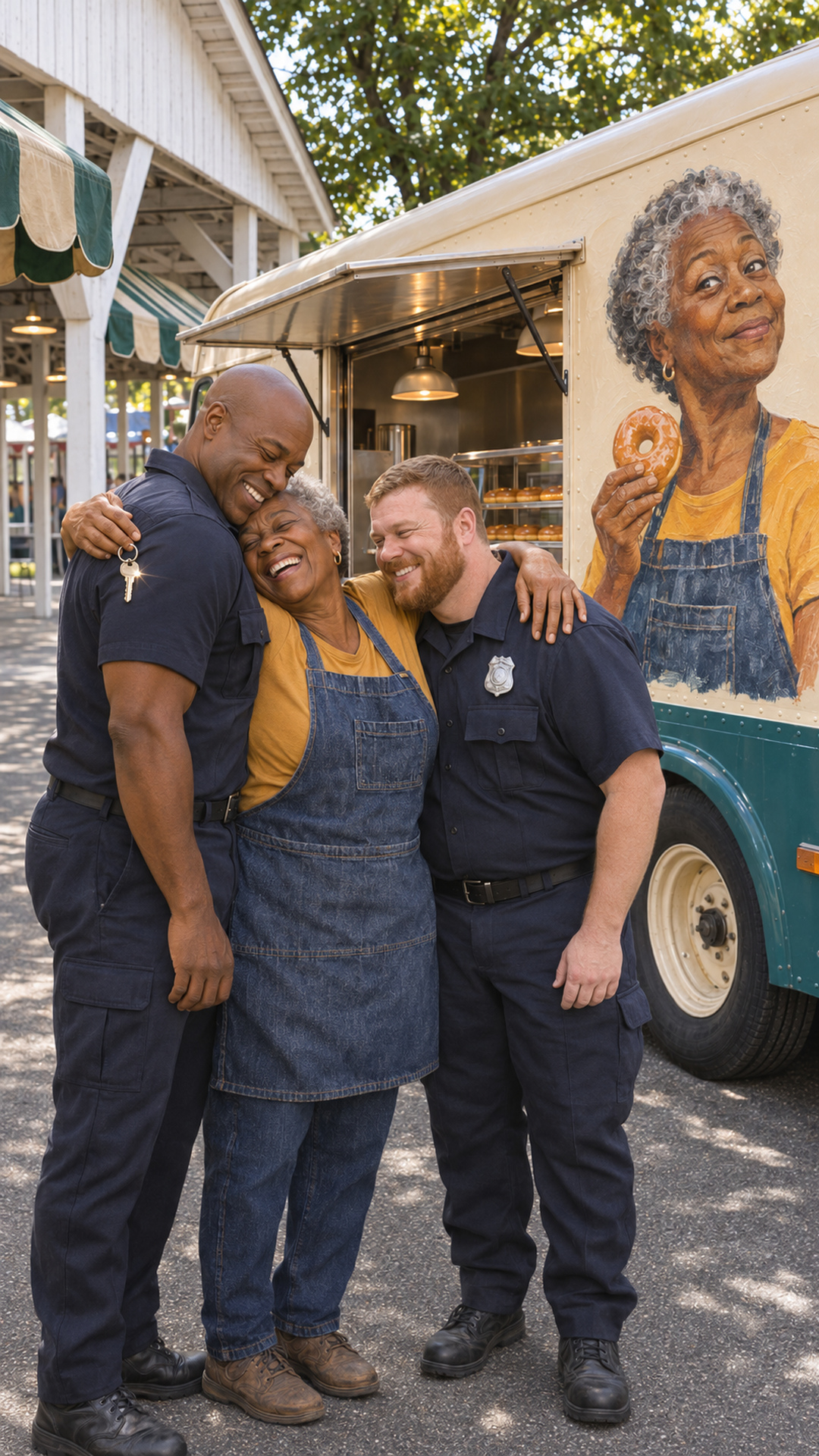
Della stood beneath the painted portrait on the side of the cream-and-teal doughnut truck. Her silver curls and mustard-colored shirt matched the image beside the open serving hatch. Officer Reed had just placed the keys in her palm. “It’s yours, Miss Della,” he said. She closed her fingers around them and looked from Reed to Ellis. Then she reached toward both men and pulled them into a warm embrace. Against Ellis’s shoulder, she laughed. “First dozen’s on me.” The officers smiled as the three remained together beneath her portrait, with the quiet sounds of the market continuing around them.
The fictional story began when two officers interrupted Della while she was selling glazed doughnuts from her dented silver cart. Without immediately explaining their actions, Ellis and Reed lifted the cart off the pavement and carried it toward a service lane. Della was confused and worried, especially because she still had six dozen doughnuts to sell before noon. When she followed the officers, she saw her cart suspended above a gray utility flatbed. She demanded an explanation, but Ellis simply told her to turn around. The emotional turning point came when Della discovered a cream-and-teal doughnut truck with her own portrait painted beside the serving hatch. Reed then placed the keys in her hand, confirming that the truck was hers. What began as a frightening interruption ended as a fictional story of unexpected generosity, recognition, and a gift that left an elderly doughnut seller embracing the two men who had surprised her.